Your new post is loading...

|
Scooped by
Mel Riddile
October 11, 2013 9:43 AM
|
The Council of Chief State School Officers (CCSSO) recently issued a set of principles for the new Common Core–aligned tests.
The Department (of Education) plans to use a peer-review process to ensure that the tests are high quality and aligned to tough standards.
"Done poorly, this peer-review process could have disastrous consequences, namely giving lots of state leaders reason to ask, “The feds have to approve our tests? Tell me again how this isn’t nationalization of K–12 schooling at work?”"
|
|
Scooped by
Mel Riddile
October 10, 2013 8:42 AM
|
The overall academic performance of U.S. students will never equal that of our toughest international competitors if we continue to focus on high-stakes tests alone, write Marc Tucker, Linda Darling-Hammond, and John Jackson.
"The countries that outperform the United States on international exams spend more than we do to measure and encourage these skills with essay tests and teacher-scored projects. And they can afford to do this because they test much less frequently than we do, typically only two or three times during a student's entire school career."
|
|
Scooped by
Mel Riddile
October 8, 2013 3:50 PM
|
Nearly every teacher in the U.S. now knows about the Common Core State Standards, and 73 percent of math, English, science, and social studies teachers in states that have adopted them say they are enthusiastic about their implementation,...
|
|
Scooped by
Mel Riddile
October 8, 2013 9:54 AM
|
Tech-Ready? SBAC Bandwidth Requirements
|
|
Scooped by
Mel Riddile
October 7, 2013 10:11 AM
|
"Ultimately, writing is a skill for adult life, growing steadily more important in an information age.
The Common Core writing Standards calls for writing to become a reliable, flexible habit for all students by the time they complete high school, so that they are ready for college and career success."
|
|
Scooped by
Mel Riddile
October 6, 2013 4:43 PM
|
"First things first: Writers must read. Any instruction in writing must follow opportunities to read, read, read. No shortcuts." - Amy Benjamin
|
|
Scooped by
Mel Riddile
October 6, 2013 9:47 AM
|
Close reading is the idea that students will re-read certain texts in order Close reading is purposefully reading a text while paying attention to the author’s word choice, sentence structure, and devices used to embed layers of meaning within. It involves reading the same text multiple times, each time studying a different aspect to encourage the reader to analyze what and why the author did what he did to communicate the point.
|
|
Scooped by
Mel Riddile
October 4, 2013 11:48 AM
|
Teachers support new Common Core learning standards, survey says A poll of more than 20,000 teachers, out today from the children's publisher Scholastic Inc., finds that about three-fourths of teachers think the standards known as Common Core will improve students' abilities to reason and think critically. Only 8% say Common Core will have a negative impact on the classroom as schools retool to comply with the new standards.
|
|
Scooped by
Mel Riddile
October 3, 2013 4:44 PM
|
We need a model for responding to the expectations while adhering to the research and best practices in teaching and learning. The balanced literacy model for promoting reading and writing competence in learners from preschool to high school does just that.
The balanced literacy model offers gradual release of teacher responsibility. As such, it supports all learners, even those who have trouble engaging with demanding and sophisticated texts.
|
|
Scooped by
Mel Riddile
October 3, 2013 10:09 AM
|
Practices that are helping to create an environment conducive to a successful transition to the new standards. What all three approaches have in common, according to the report, is an emphasis on making the teacher the center of the transformation by: - First ensuring that the significance of the changeover to Common Core State Standards is understood by teachers in terms of the need for dramatic changes to teaching styles, from drill to exploration;
- Ensuring that "teachers are at the front of the movement and working together to lead their own improvement toward shared, ambitious goals"; and
- Making certain teachers are provided with adequate "structures, time, and resources required to sustain the many years and many cycles of inquiry and improvement necessary to achieve the new bar for student learning" with the understanding that the process of improvement will take place over many years, not overnight.
|
|
Scooped by
Mel Riddile
October 2, 2013 4:25 PM
|
Though more breakdowns likely are inevitable given online testing's relatively new place in schools, the ability to protect the validity, integrity, and security of the process is increasingly crucial.
|
|
Scooped by
Mel Riddile
October 2, 2013 9:42 AM
|
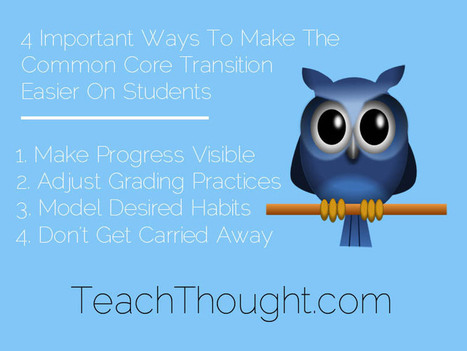
4 Important Ways To Make The Common Core Transition Easier On Students
"Those students who were previously high achievers are showing fight/flight/freeze stress responses when tested with single-response questions. For these students, who had obediently and very powerfully memorized all the information they were given, the loss of predictable test questions linked to their matched answers is unfair. They had been highly successful at compliance, process, and memorization, but have not developed the conceptual understanding or cognitive flexibility needed to respond to unpredictable questions. self-directed assignments, and the kind of open-ended thinking so much of modern learning seems to suggest. In some cases, teachers describe profound emotional reactions including anger, hostility, retribution (such as false accusations of teacher misconduct) and more subtle but equally disturbing behavioral changes of withdrawal of participation and effort, depression, and even increased absences from sick days."
|
|
Scooped by
Mel Riddile
October 1, 2013 1:36 PM
|
Results from the second year of common-core aligned tests in Kentucky showed a variety of results across school levels and student groups.
|
|
|
Scooped by
Mel Riddile
October 10, 2013 12:26 PM
|
"teachers need substantially more professional development around the common core, not just in understanding what the new standards include and how they differ from states' old standards, but also to fill the gaps in instructional strategies that will be needed for students to write well."
|
|
Scooped by
Mel Riddile
October 9, 2013 6:20 PM
|
|
|
Scooped by
Mel Riddile
October 8, 2013 12:16 PM
|
"The Pioneer Institute just released yet another paper claiming that Common Core sets a low bar in math. The paper’s authors, Sandra Stotsky and James Milgram, passionately believe that every American student should have to pass pre-calculus at least to graduate from high school and be ready for admission to a “selective” 4-year college. Legions of Common Core critics whose grasp on mathematics is, shall we say, looser than Migram's or Stotsky's are using their arguments to claim that Common Core is dumbing down math in this country."
|
|
Scooped by
Mel Riddile
October 8, 2013 9:47 AM
|
Forty-six states, the District of Columbia, and the Virgin Islands have adopted the Common Core standards, and tests based on these standards are set to go into effect in 2015. Here are some resources to help you understand what to expect.
|
|
Scooped by
Mel Riddile
October 6, 2013 5:51 PM
|
No parent wants his or her child underestimated or shortchanged. No matter their income-level, race or political ideology, parents want their children held to high standards.
The Alabama PTA strongly supports the College and Career Ready Standards based on the Common Core State Standards because parents know children are capable of great things when they are challenged, encouraged and supported.
|
|
Scooped by
Mel Riddile
October 6, 2013 4:40 PM
|
|
|
Scooped by
Mel Riddile
October 6, 2013 9:43 AM
|
With the state’s (MA) history of high standards and steadily rising test scores after the Education Reform Act of 1993 kicked in, questions here centered more on whether it was a good idea to change what we were already doing well. Massachusetts students excel on the National Assessment of Educational Progress, given to fourth-, eighth-, and sometimes 12th-graders in both private and public schools across the country. And the state ranked sixth in the world in math on the 2011 Trends in International Mathematics and Science Study (it comes out every four years). Public and private school students and schools in Massachusetts, measured with 63 countries and nine American states, scored in the company of Japan, Singapore, and South Korea.
|
|
Scooped by
Mel Riddile
October 3, 2013 4:48 PM
|
|
|
Scooped by
Mel Riddile
October 3, 2013 4:41 PM
|
Here’s a look at 10 things parents should know as the California public school system embarks on a brave new world of teaching and learning.
|
|
Scooped by
Mel Riddile
October 3, 2013 10:04 AM
|
A growing research consensus finds that teacher quality matters more for student achievement than any other school-based factor (such as class size). Economist Eric Hanushek has calculated that replacing the bottom 7%-12% of U.S. teachers with average teachers would rocket the U.S. to the academic company of the world's highest-performing countries.
|
|
Scooped by
Mel Riddile
October 2, 2013 9:44 AM
|
The critical thinking and close reading required in the new Common Core State Standards can take twice as long for students with dyslexia, reading disabilities, speech and language issues and attention deficit hyperactivity disorder (ADHD)....
|
|
Scooped by
Mel Riddile
October 1, 2013 1:39 PM
|
Texas, which has shunned Race to the Top and the common core, becomes the 43rd recipient of a No Child Left Behind Act waiver.
|