


A survey of 1,000 principals in 14 states shows that school leaders are heavily focused on the new standards, but don't necessarily feel prepared to manage the huge shift.

 Your new post is loading...
 Scoop.it! A survey of 1,000 principals in 14 states shows that school leaders are heavily focused on the new standards, but don't necessarily feel prepared to manage the huge shift. 
Scoop.it!

Visuals and Reading by Kathleen Stern Over the last few years in my seventh grade reading class, I’ve asked students to do more visual analysis and creation. This has nothing to do with the fact th...
Scoop.it!
The surveys, which reflect the views of 1,000 principals in 14 states that have adopted CCSS, reveal that principals overwhelmingly support the CCSS initiative and have a strong willingness to continue to engage deeply in instructional leadership activities as states move forward with the new standards.
Scoop.it!

SaraKLMS's curator insight,
December 15, 2013 9:15 AM
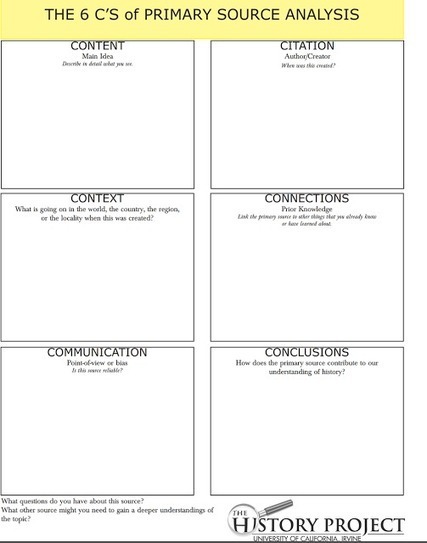
graphic organizer developed by UC Irvine History Project helps students evaluate primary sources 
Connie Wise's curator insight,
December 16, 2013 9:00 AM
Helpful tool to assist students in using primary sources.
Scoop.it!

December 10, 2013 Long before the Common Core State Standards were on anyone’s radar, the “reading wars” raged furiously.

Les Howard's curator insight,
December 12, 2013 7:29 AM
Worth reading as article looks at close reading, knowledge first, skills and strategies and just right texts.
Scoop.it!

School districts need to make multimillion-dollar investments to prep for online testing.
Mel Riddile's insight:
"72 percent of U.S. public schools lack the broadband connection needed to sustain digital learning."
Scoop.it!

By Dan Willngham "A New York Times editorial on December 6 called for improved math instruction, calling the current system “broken.” Although I agree we could be doing a better job of teaching math, the...
Mel Riddile's insight:
"Most American teachers—like most American adults, including me--don’t have a deep conceptual understanding of math. They are a product of the system we are trying to change. You cannot teach what you don’t know."
Scoop.it!

Patrick Riccards, Darren Burris, Governor Bob Wise, Jeff Nichols, Doug Sovde
Scoop.it!
|

|
Scooped by
Mel Riddile
December 7, 2013 7:36 PM
|
Scoop.it!
“Fewer, clearer, higher”: These were the words that guided the crafting of the Common Core State Standards.
|
|
Scooped by
Mel Riddile
December 7, 2013 7:22 PM
|
Scoop.it!

How to make real progress in student achievement.
What should students, teachers, parents, and policy-makers look for in the emerging reform of high school mathematics? From our perspective—as mathematicians, teachers, statisticians, teacher educators, and curriculum developers with extensive experience in school mathematics innovation—there are at least four key elements of the Common Core program that provide a basis for productive change in U. S. high school mathematics:
|
|
Scooped by
Mel Riddile
December 5, 2013 6:18 PM
|
Scoop.it!

School districts in Brecksville-Broadview Heights, North Royalton and Strongsville have embraced Common Core, which emphasizes deep learning and real-life applications.
No more spiraling the curriculum. Students are taught to mastery.
|
|
Scooped by
Mel Riddile
December 5, 2013 2:48 PM
|
Scoop.it!

"Here's how Oklahoma Governor Fallin describes what she's doing through her executive order: "The executive order I signed today makes it clear that neither the Obama Administration nor any subsequent administration will have a hand in developing the Oklahoma Academic Standards. No data will be collected that jeopardizes the privacy of our children. Finally, these standards will not jeopardize the right of every parent to home school their children and educate them as they see fit."
|
|
Scooped by
Mel Riddile
December 17, 2013 5:10 AM
|
Scoop.it!

The fundamental question that has been presented to all of us through the Common Core process is this one: Who decides what is taught in our schools?
|
|
Scooped by
Mel Riddile
December 15, 2013 12:28 PM
|
Scoop.it!

The Common Core, however, will necessarily generate thousands of examples of high quality student work.
Teachers shift the focus of class time to critical thinking and reasoning skills, something many have wanted to do for years.
|
|
Scooped by
Mel Riddile
December 15, 2013 12:12 PM
|
Scoop.it!

By Valerie Strauss
The Common Core State Standards, which spell out what K-12 students should learn in school, are at the center of a heated debate: Who should control public education? What do students really need to know? Let’s separate fact from fiction to figure out what’s at stake.
|
|
Scooped by
Mel Riddile
December 13, 2013 7:44 AM
|
Scoop.it!

When I taught sixth grade, I used to have to teach 127 unique math standards or topics. Now I’d be able to focus on 27 standards, giving me the time needed to make sure all of my students understood the underlying concepts.
|
|
Scooped by
Mel Riddile
December 12, 2013 6:15 AM
|
Scoop.it!

By Tim Shanahan
Does research show that adding more informational text will improve student achievement?
No, not directly. No one has done a study to examine the learning results when students read different proportions of different kinds of text. The idea that students should get more experience reading informational text is based on the following commonsense notions:
|
|
Scooped by
Mel Riddile
December 11, 2013 5:55 AM
|
Scoop.it!

by | Burkins & Yaris
"...many readers’ histories can be charted according to the series they passed through. And these readers share an important commonality. While some series may may linger longer than others, they are all eventually overshadowed by other series and titles. The series that students move on to generally tend to become more sophisticated."
|
|
Scooped by
Mel Riddile
December 11, 2013 5:14 AM
|
Scoop.it!

Teachers should draw on historical texts to give life to the literacy objectives of the common-core standards, Stanford University's Sam Wineburg writes.
|
|
Scooped by
Mel Riddile
December 10, 2013 5:06 PM
|
Scoop.it!
1) Explicitly teaching the standards
2) Employing best instructional practices
3) Establishing and maintaining positive relationships with students

I chose this topic because, as a current practitioner, I am always interested in improving student achievement. Explicitly teaching the standards is something that I fundamentally believe. After all, high-stakes testing evaluates the knowledge students possess that relate to these standards. So a curriculum must be well organized and focused. Obviously, high-quality instruction is needed. Building relationships with students is important as they engage in learning within the classroom. Because, the knowledge they gain is what they must be able to access when they take a mandated test.
|
|
Scooped by
Mel Riddile
December 7, 2013 7:38 PM
|
Scoop.it!

The Common Core standards, which 45 states and Washington, D.C., have adopted, could be the cure to United States’ mediocre math scores on PISA.
At least that’s a conclusion in an assessment of the latest American scores on the international testof 15-year-olds in 65 nations, whose results were released this week. The 10-page analysis was prepared by the Organisation of Economic Co-operation and Development; its education administrator, Andreas Schleicher is a big fan of the Common Core.
|
|
Scooped by
Mel Riddile
December 7, 2013 7:24 PM
|
Scoop.it!

Then there’s David Conley. His life’s work has been to research college readiness and related policy issues. For decades he's asked, "What does it take to make students succeed in college?" A renowned policy analyst and researcher, David is Professorof educational policy and leadership at the University of Oregon and the CEO and CSO of the educational policy group, Educational Policy Improvement Center.
Conley's latest book, Getting Ready for College, Careers, and the Common Core (2013) describes how he believes we can help students acquire the research skills they will need to navigate an increasingly crowded, complicated, and confusing web of information so they will succeed in college and in their careers.
|
|
Scooped by
Mel Riddile
December 6, 2013 1:22 PM
|
Scoop.it!

Mel Riddile of the National Association of Secondary School Principals, details five essential school wide conditions for the Common Core State Standards that will fundamentally shift the way principals lead schools.
|
|
Scooped by
Mel Riddile
December 5, 2013 6:08 PM
|
Scoop.it!

ReadWorks is a completely free resource—all you have to do is register!

Readworks.org offers access to a variety of passages and question sets when you register.






There is more to implementation than priortizing. The entire professional body of educators need to know what the standards say and what those words mean. And...schools must have an standards based assessment plan that not only measures their efforts but that measures the effect of new practice and heighted expectations on student achievement. These new standards are more than words on paper: the implications of the Common Core Standards is truly a shift in the culture of education and that kind of shift needs societal and legistlative support.