State Superintendent Larry Shumway received a prompt reply to a letter he sent U.S. Education Secretary Arne Duncan this week.
“His letter to me said that he was writing ‘to confirm our full and unqualified agreement with your letter.’ I think that’s a pretty clear statement,” he tells KCPW. ” Now, we’re going to have to continue to be vigilant, but my personal view is that it makes the resolution that’s proceeding through the bodies here, SCR 13, unnecessary.”
I’ve spent some time – as I’m sure many others have – analyzing and evaluating the Common Core Standards. I've focused on 8th grade mathematics. Forty-four states will adopt these standards...
Achieve and the U.S. Education Delivery Institute have developed a practical Common Core Implementation Workbook for all states in the Partnership for Assessment of Readiness for College and Careers (PARCC).
Teach technology and media literacy while providing students more opportunities to develop their reading, writing, communication, critical thinking and problem solving skills. More effectively prepare your students for life beyond high school!
Common Core creates high-quality, low-cost CCSS-based curriculum tools. We are a non-profit founded in 2007 to keep all of the liberal arts and sciences in the classroom.
Oakland Schools, the largest ISD in Michigan, serves 28 districts. These writing units for grades 6-8 are aligned with the Common Core State Standards.
A new Pew survey considers the intellectual future of the millennial generation.
The survey found, overall, what many others already have:
that neuroplasticity is, indeed, a thing; that multitasking is, indeed, the new norm;
that hyperconnectivity may be leading to a lack of patience and concentration;
that an "always on" ethos may be encouraging a culture of expectation and instant gratification.
The Have's and Have Not's
The rich will get even richer!
"There is a palpable concern among these experts," Rainie puts it, "that new social and economic divisions will emerge as those who are motivated and well-schooled reap rewards that are not matched by those who fail to master new media and tech literacies." As a result: "Many of the experts called for reinvention of public education to teach those skills and help learners avoid some of the obvious pitfalls of a hyper-connected lifestyle."
Skills Most Desireable
public problem-solving through cooperative work
crowdsourcing and the like
the ability to search effectively for information online
the ability to distinguish the quality and veracity of online discoveries
the ability to synthesize, or combine facts and details from different sources into coherent narratives
the ability to concentrate
the ability to distinguish between the signal and the noise as the information we're exposed to gets bigger, and broader, and more plentiful.
All these skills can be taught. The question is whether kids will learn them in school, or outside of it.
"Precollegiate and postsecondary education have been like toddlers, playing side by side in the sandbox but not together, and they've got to start playing together if students are going to be well prepared for college and good jobs."
That was the message that Gene Wilhoit, the executive director of the Council of Chief State School Officers, carried to a national forum of K-12 and higher education officials here. The event is aimed at defining how two sectors that haven't historically worked closely together can collaborate in the interest of turning the new common standards into better teaching and learning. (The CCSSO and the National Governors Association co-led the initiative that resulted in the standards, which have now been adopted by all but four states.)
Much higher. In the work I’m involved in with the Smarter Balanced Assessment Consortium, we’re actually using a cognitive rigor matrix that was developed in 2009. It uses Bloom’s taxonomy and Norman Webb’s depth of knowledge to define what students need to be able to demonstrate to show that they’ve achieved proficiency.
Ask 10 fifth-grade teachers how they teach fractions, and you’ll probably get 10 different answers. That’s the beauty of teaching: part art, part science, all creativity.
Will the Common Core State Standards change that? Will we suddenly have a nation of automatons at the front of our classrooms, delivering identical lessons?
As a teacher, I think not. To me, the Common Core represents an empowering opportunity for teachers to collaborate, exchange best practices and share differing curricula—because a common set of standards is not the same thing as a common curriculum.
Mere adoption of the Common Core State Standards will be insufficient.
Success in each state will hinge on implementation:
the strategies used to improve instruction in every classroom,
the tiered supports provided to all students
policy changes to promote coherence and alignment and a commitment to building and maintaining widespread understanding of and support for the new standards.
To assist states in gauging the strength of their implementation plans and to illustrate how to improve them, Education First and Achieve have partnered on the development of a new “Common Core State Standards Implementation Rubric and Self-Assessment Tool.” This is no easy task, and will require states to assume a far stronger leadership role than most have in the past. This tool sets a high quality standard for a strong state role, provides some concrete details and examples to help state leaders get there and profiles some promising state approaches. Recognizing differences in state tradition, restrictions and authority for education as well as the central role of districts and other partners in implementation, the rubric identifies a strong state role that attends to three essential outcomes:
Accountability for results
Quality of services and products
Alignment of services and products with the expectations articulated in the CCSS.
Flawed? First, a few earnest critics are convinced that the standards are substantively flawed, that the algebra sequence (or grade level) is wrong, the English standards don’t contain enough literature, the emphasis on “math facts” isn’t as strong as it should be, etc. This sort of thing has accompanied every past set of standards of every sort, and it’s perfectly legitimate. Insofar as such criticisms are warranted, the Common Core can be revised, states can add standards of their own, and jurisdictions that find the common version truly unsatisfactory can change their minds about using it at all.
Expensive? Second, the Common Core will be difficult and expensive to implement. Many organizations are working hard to help states surmount these genuine challenges. Many philanthropists are kicking money into the effort. And some groups (Fordham included) are trying to cost it all out. Nobody denies that doing this right will be hard and costly (though some of those costs are already embedded in state and district budgets.) Of course, those who think the country is doing OK today have every reason to shirk that challenge and stick with what they’re used to.
Won't Raise Achievement? Third, the Common Core won’t make any difference in student achievement—but may cause a politically-unacceptable level of student failure. As noted above, standards per se do not boost achievement. (Of course, standards per se don’t carry costs or failure rates, either. They don’t, by themselves, do much of anything!) And failure rates will worsen only if (a) the new assessments are truly rigorous and (b) schools neglect preparing their pupils to pass them.
Some states will regress? Fourth, states have done as well, or better, on their own, and switching over to the Common Core will just mess them up. This criticism mostly emanates from Massachusetts, which has done a commendable job on its own and where the decision to adopt the Common Core was truly conflicted. Other states that prefer to go it alone, mostly notably Texas and Virginia, have simply declined to adopt the Common Core. Others are free to exit from it (though doing so would, for some, violate commitments they made in their Race to the Top proposals.)
National is scary? Fifth, “national” is not the right way to do anything in American education. We retain a deep (if, in my view, unwarranted) affection for “local control” in this realm and constitutional responsibility for education is undeniably vested in the states. Some folks dread the prospect of a “national curriculum.” (Some simply mistrust the Gates Foundation, which has bankrolled much of this work.) Others are incapable (perhaps willfully so) of seeing any distinction between “national” and “federal”, though we seem to have no difficulty making that distinction elsewhere in education. (E.g. National Governors Association, S.A.T., A.P., ACT.)
The CCSS reveal the integrated nature of real reading comprehension among the domains: key ideas, text structure, integration of knowledge& ideas, and text complexity.
K-W-L
The idea is that before reading, good readers question themselves to access prior knowledge and establish a foundation on which they can build knowledge about the subject or topic at hand.
The “K” stands for “what we know” and metacognitvely allows for access of background knowledge.
The “W” stands for “what we want to find out” to establish reading purpose for the “during” reading process.
Finally, the “L” or “what I learned” is the “after” reading step that promotes reading reflection. Good readers, the theory goes, consider what they knew before reading, recognize gaps in knowledge and finally, consider what was read or learned in relation to what they already knew or hoped to learn.
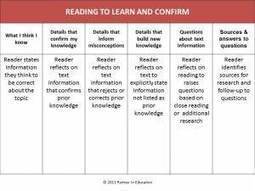
Reading to Learn and Confirm
The expectations of the CCSS demand that readers be able to identify what they learned and support that learning with clear citations from the text.
This implies that learners or readers may find that some of their assumptions were wrong or that some of their positions have been swayed by the arguments of the text.
Moreover, the CCSS demand that readers look beyond the superficial or literal implications of a text and explore what questions or implications are nuanced by the text.
I like Anita Archers definition of engagement: Students are actively interacting with their teacher or other students in relation to the topic or content of the lesson.
Blogger Ben Johnson defines student engagement and describes what it looks like in the classroom.
Michael Schmoker shares in his book, Results Now, a study that found of 1,500 classrooms visited, 85 percent of them had engaged less than 50 percent of the students. In other words, only 15 percent of the classrooms had more than half of the class at least paying attention to the lesson.
Teacher-Directed Learning You will see students...
Paying attention (alert, tracking with their eyes)
Taking notes (particularly Cornell)
Listening (as opposed to chatting, or sleeping)
Asking questions (content related, or in a game, like 21 questions or I-Spy)
Responding to questions (whole group, small group, four corners, Socratic Seminar)
Following requests (participating, Total Physical Response (TPR), storytelling, Simon Says)
Reacting (laughing, crying, shouting, etc.)
Student-Directed Learning You see students individually or in small groups...
Reading critically (with pen in hand)
Writing to learn, creating, planning, problem solving, discussing, debating, and asking questions)
Performing/presenting, inquiring, exploring, explaining, evaluating, and experimenting)
Interacting with other students, gesturing and moving
I disagree with this statement...
"I believe that the majority of teachers pick up on the audience cues as they direct-teach and can tell if a student is not interested or not engaged."
Teachers can tell if students are engaged when observing other people's classes, but when they are in the moment they have tough time doing so.
Assuming that teachers do know when students are engaged, they don't know what to do to get them engaged.
However, they can learn and it is relatively painless.
"A lecture is still a lecture." (agree)
Want to engage students?
Make them work while you watch. They don't learn much listening to you anyway. Students learn by doing something--actively interacting.
Stop calling only on students who raise their hands. Stop answering your own questions. Give the students a chance to think and respond.
The Pioneer Institute—no friends of the Common Core to begin with—released a report this week claiming that it will cost the nation $16 billion to implement the new standards. (If you read the full text, the authors frequently note that this is, in their opinion, a wild underestimate.)
The astronomical estimate is not entirely surprising. If you want to scare cash-strapped states away from moving forward with their Common Core plans, it’s not hard to attach a frighteningly large price tag to implementation. After all, the purpose of standards is to create the foundation upon which the entire education system is built. So, obviously, changing standards must mean knocking down the house, re-pouring the foundation, and starting again.
LOUISVILLE, Ky. (AP) - Kentucky's first-in the-nation acceptance of common core standards in education ranks as a "defining step" in its efforts to develop world-class schools, Gov. Steve Beshear told a conference on Tuesday.
Those standards are benchmarks designed to ensure a uniform public K-12 education from state to state. Coursework using the new standards began to be implemented this year in Kentucky's public schools.
Kentucky was the first state to adopt the standards. In doing so, the state will "move us closer toward positioning our children for success" in college and in their careers, the Democratic governor said. "It was a defining step in our ongoing effort ... to build a world-class education system for our people."
To get content containing either thought or leadership enter:
To get content containing both thought and leadership enter:
To get content containing the expression thought leadership enter:
You can enter several keywords and you can refine them whenever you want. Our suggestion engine uses more signals but entering a few keywords here will rapidly give you great content to curate.


 Your new post is loading...