Your new post is loading...

|
Scooped by
Mel Riddile
March 18, 2012 10:56 AM
|
State leaders say it’s time to face the truth:
Graduating from high school in Ohio doesn’t necessarily mean you’re ready for college or a career.
That won’t do anymore, Gov. John Kasich
“The current system is letting kids down,” state Superintendent Stan Heffner said. - 44 percent of Ohio school districts were rated “excellent” or better on state report cards in 2009, but more than 40 percent of Ohio high-school grads who went to state public universities that year needed remedial math or English courses.
Where students currently learn some concepts piecemeal across several grades, under the Common Core, they’ll be more likely to learn them in-depth in one grade and build upon the concept in the next.
“The emphasis and focus has changed” to deeper understanding and critical thinking.
All New Tests
That means all-new (computer-based) tests are coming. - The state has joined a consortium of other states to create the tests. They’re not finished yet, but this much is known: They will be computer-based. The exams will be given at the end of the year and will include a way to measure writing and show work.
- “Because these are computer-based, results will be delivered in a week or two, instead of taking a test in the spring, the results being delivered over the summer and then shared the next year — sometimes by another teacher,” said Chad Colby, spokesman for the Partnership for Assessment of Readiness for College and Careers, or PARCC.
|
|
Scooped by
Mel Riddile
March 17, 2012 11:34 AM
|
by Bobson Wong | Celebration of Teaching & Learning March 16, 2012
The Common Core alone won’t reform American education. However, encouraging students to think more critically and make connections across disciplines is a significant step in the right direction. If classroom teachers give significant input to help implement the new standards, the Common Core may be successful enough to win over even my most skeptical colleagues.
- Teachers can fill out PARCC’s online survey to give input for sample instructional units in ELA and math. By the spring of 2012, PARCC plans to pilot sample assessment tasks, so people who want to get involved should act quickly.
- Teachers can get involved with their school districts and schools to help redesign curricula to align with the Common Core. School districts will have to do most of the work necessary to shape how the new standards will look in classrooms.
- At the classroom level, teachers in all subjects should become more familiar with the Common Core’s ELA and math requirements for students.
- To make students ready for college and careers, the standards emphasize preparing students to read, write, and interpret across the curriculum.
- Teachers in all subjects can benefit by challenging students to understand concepts and make connections between topics in different subject areas.
- By aiming to prepare students for the real world, the Common Core presents a particular challenge for math teachers. The standards emphasize teaching students how to use mathematical modeling – something that many students currently have little experience with.
|
|
Scooped by
Mel Riddile
March 16, 2012 4:51 PM
|
|
|
Scooped by
Mel Riddile
March 16, 2012 4:27 PM
|
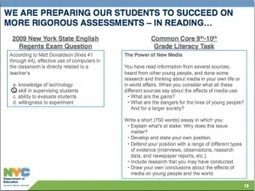
New York City and New York state officials have promised that new curriculum standards, known as the Common Core, would de-emphasize rote learning in favor of critical thinking.
ELA Comparison
Regents - The high school English Regents exam currently asks students to answer a series of multiple-choice questions that require them to locate pieces of information in texts.
CCSS - On a Common Core-aligned test, they would have to read several different passages and write an essay analyzing their arguments, bringing in information from other sources to bolster the analysis.
Math Comparison
CCSS - A sample fifth-grade question asks students to read a paragraph and draw out the relevant information to adjudicate a dispute about three friends’ pizza consumption.
State Assessment - In contrast, a current exam question simply asks students to add fractions that represent the sizes of two people’s meals.
Regents exams are supposed to start reflecting the Common Core’s focus on real-world situations, problem-solving, and informational texts in the 2013-2014 school year.
|
|
Scooped by
Mel Riddile
March 15, 2012 3:37 PM
|
Over the Next Few Posts We’ll Outline Some of the Common Core Standards Messages That Your State Or District Could Use to Garner Enthusiasm for CCSS, and Make Implementation Much Easier.
|
|
Scooped by
Mel Riddile
March 15, 2012 3:20 PM
|
In this article, we will be looking at the historical background and context of a novel, play, or poem as an approach to the Informational Text Standards for ELA.
|
|
Scooped by
Mel Riddile
March 15, 2012 3:05 PM
|
Because of its emphasis in the common-core standards, millions of teachers are faced with increasing their use of nonfiction.
The common standards' emphasis on informational text arose in part from research suggesting that employers and college instructors found students weak at comprehending technical manuals, scientific and historical journals, and other texts pivotal to their work in those arenas.
Influencing the standards, also, were the frameworks for the National Assessment of Educational Progress in reading, which reflect an increasing emphasis on informational texts as students get older.
They draw equally from informational and literary passages at the 4th grade level. But by 8th grade, the tilt toward informational reading reaches 55 percent, and by 12th grade, it's 70 percent.
The common core's vision of informational text includes:
- literary nonfiction
- historical documents
- scientific journals
- technical manuals
- biographies and autobiographies
- essays
- speeches
- information displayed in charts, graphs, or maps, digitally or in print.
Helping students tackle complex examples of such genres across the disciplines—from English to engineering—bolsters them for work and higher education by building foundational knowledge, vocabulary, and literacy strategies, common-core advocates contend.
Teachers are rebalancing their fiction-and-nonfiction scales because the Common Core State Standards in English/language arts demand it.
"Often, our nod to nonfiction is the autobiography or true-story version of something," said Ms. Wessling, who was the 2010 National Teacher of the Year. "But there's a real gap in other kinds of nonfiction. Students absolutely understand how to read a piece of fiction with a beginning, middle, and end. But that's not how you read things like Nickel and Dimed. It's a much slower process.
Maintain a balance - As states and districts press more deeply into informational text, however, some experts are cautioning them to maintain a proper balance with fiction.
|
|
Scooped by
Mel Riddile
March 15, 2012 10:44 AM
|
The common standards aim to increase rigor, critical thinking, and communication skills in America's classrooms.
Many believe the standards offer unprecedented opportunities for teachers to collaborate on refining instruction.
But states and districts are struggling with the tension between imminent plans for Common Core implementation and awareness that teachers need professional development and resources to adjust instruction.
|
|
Scooped by
Mel Riddile
March 14, 2012 10:00 AM
|
Elizabeth Birr Moje is Associate Dean for Research and an Arthur F. Thurnau Professor in the School of Education at the University of Michigan, Ann Arbor, Michigan.
Research on the Role of Disciplinary Literacy Instruction: Delivering and Expanding onthe Common Core State Standards will be the topic of Elizabeth Birr Moje’s 2012 Research Address presentation at the IRA Annual Convention in Chicago.
Based on her research work in disciplinary literacy teaching, Moje will help us to think about how current research provide a framework for disciplinary teaching including critical components of the Common Core State Standards.
Moje will review research on disciplinary literacy teaching to help teachers at all grade levels to deliver the promises of the Common Core State Standards.
The review will draw on existing studies that exemplify how teachers can think about disciplinary literacy instruction.
Moje will also share studies to illustrate key practices for teaching children, youth, and novice teachers how to navigate the demands of reading and writing challenging subject-area texts.
In closing, she will lay out the challenges to integrating such instruction into elementary and secondary classrooms and offer suggestions for navigating those challenges.
|
|
Scooped by
Mel Riddile
March 14, 2012 9:42 AM
|
Achieve and Education First Release Common Core State Standards Tool to Assist States in Implementing the CCSS
Tool defines critical outcomes for Common Core via Education Daily March 14, 2012
The new rubric and self-assessment tool specifies three criti-cal outcomes in which officials hope state leaders will focus on as they transition to the Common Core State Standards in English/language arts and mathematics. They include:
1. Accountability for results. States must have a
monitoring system with “feedback loops” that regularly collects data to address concerns, and then they must be empowered to act to identify and solve problems with their partners if results fall short.
2. Quality of services and products. States must
clearly and consistently define and communicate what quality looks like, and ensure that schools, districts, and regional service providers have a way of accessing high quality materials and resources -- whether these are required to be used or voluntary.
3. Alignment of services and products with the
expectations articulated in Common Core. States
will need to communicate consistently with schools
and school districts and show how implementation of Common Core is different from past standards and past expectations. And they will need to ensure that all materials, resources, tools, and training are aligned to the new benchmarks.
|
|
Scooped by
Mel Riddile
March 14, 2012 9:19 AM
|
Performance Assessments engage students in authentic, high-level work that is aligned to curricular standards so that we can more carefully plan for instruction that meets students where they are and truly moves them forward.
The performance assessments you will find here were designed to align to particular Common Core State Standards in reading and writing, and to anchor specific units of study in data collection and close observation of student work.
We recommend viewing these as both pre- and post-assessments: - you may (and we suggest doing so) conduct the assessment in whole or in part before teaching the relevant units, as a measure of what students are capable of prior to your instruction;
- you will then use the data from this assessment to tailor your units to students’ specific strengths and needs, and then conduct the same assessment again at the end of the unit, to determine the growth of the students and provide an opportunity to reflect on your instruction.
|
|
Scooped by
Mel Riddile
March 13, 2012 12:50 PM
|
Video provides an overview of the Common Core State Standards in Arkansas
|
|
Scooped by
Mel Riddile
March 12, 2012 5:27 PM
|
Change in school and system accountability means new look at student performance - PUTNAM COUNTY --
Common Core standards
Tennessee's implementation of Common Core standards will play a role in the effectiveness of the waiver, Kolbe said.
Common Core standards were developed by a group of teachers, school administrators and education experts in attempt to create a framework of curriculum to ensure that students from across the country are ready for college and the workforce upon graduation. The idea is to close gaps between states by using a unified set of learning standards. Putnam County schools began implementing Common Core this school year in kindergarten through second grade.
Read more: Herald Citizen - Change in school and system accountability means new look at student performance
|
|
|
Scooped by
Mel Riddile
March 18, 2012 10:45 AM
|
A study commissioned by the foundation, the Houston Endowment, found that only about 1 in 5 eighth-graders earns such a credential.
Completion Gap
"White students' rates of earning a college credential are two to two and a half times higher than those of Hispanics and blacks," the report said. "Given the state's growing Hispanic population, this means that it will be impossible for Texas to contribute its share in reaching national attainment goals without improving Hispanic college-going and graduation rates."
There is "leakage throughout the education pipeline."
Credential-earning rates in Texas
Disparities by gender: - 23.9% female students
- 16.1% male students
- 7.7% black male students
- 46.5% Asian American female students
|
|
Scooped by
Mel Riddile
March 16, 2012 4:54 PM
|
To truly meet the demands of the Common Core State Standards it is not sufficient to simply revise the list of mathematical content covered in the curriculum. The Standards' emphasis on Mathematical Practices require students to be able to think mathematically, and apply the techniques they have learned to rich problems in diverse contexts. Achieving this requires changes in the way mathematics is taught and assessed in most schools.
The Mathematics Assessment Project has developed the Classroom Challenges to exemplify the types of activities needed to supplement traditional classroom practice and support the Standards. The Professional Development Modules are designed to help teachers with the practical and pedagogical challenges presented by these lessons.
|
|
Scooped by
Mel Riddile
March 16, 2012 4:36 PM
|
by Bill McCallum
Here is a suggested arrangement of the high school standards into courses, developed with funding from the Bill and Melinda Gates Foundation and the Pearson Foundation, by a group of people including Patrick Callahan and Brad Findell.
|
|
Scooped by
Mel Riddile
March 16, 2012 11:58 AM
|
The Progress of Education Reform considers potential ways states might define “college readiness,” identifying for each approach: potential benefits, potential drawbacks and key components to consider. (Jennifer Dounay Zinth, ECS, March 2012)
|
|
Scooped by
Mel Riddile
March 15, 2012 3:34 PM
|
Webinar conducted on March 1, 2012
Bob Wise, Alliance for Excellent Education Laura Slover (PARCC) Sue Gendron (SmarterBalanced) Pascal D. Forgione, PhD (ETS)
|
|
Scooped by
Mel Riddile
March 15, 2012 3:14 PM
|
North Carolina State Superintendent Dr. June Atkinson said the criteria used to measure how well schools and students are performing under the new Common Core/Essential Standards curriculum are going to change next year, a change that will reflect the rigor of the new standards.
A New Way of Learning
The new Common Core curriculum is an effort to refocus the state’s education system toward critical thinking and problem-solving skills that Atkinson said are critical in the Information Age.
A New Way of Teaching
“Common Core requires a different way of teaching, a different accountability system and a different way for students to engage in learning,” she said.
A New Way of Assessing
Under the old curriculum, students were tested via multiple choice tests, a model the state superintendent said did little to measure “the breadth and depth of what students actually know.”
“With the implementation of Common Core, there will often be more than one acceptable answer when it comes to solving problems, so teachers will have to focus more on problem-solving skills, since there will be situations having more than one answer,” she said.
The result, Atkinson said, will be more in-depth projects that require students to dig deeper rather than focus simply on content.
|
|
Scooped by
Mel Riddile
March 15, 2012 2:58 PM
|
Teacher collaboration—when it's good, it's very, very good, but when it's bad, it's horrid.
Many educators believe that implementation of the Common Core Standards offers an unprecedented opportunity for collaboration among teachers. What do educators already know about the benefits and pitfalls of collaboration?
Marsha, a science teacher from Kansas, posed this question to colleagues on the Center for Teaching Quality's Teacher Leaders Network discussion board. Drawing on their own successful (and miserable) experiences, teachers identified key attributes of effective collaboration:
|
|
Scooped by
Mel Riddile
March 8, 2012 8:37 AM
|
English teachers are appalled at the thought of forsaking fiction for a seemingly “unbalanced” emphasis on non-fiction. By nature, we love our literature—especially a great novel!
It is imperative that ELA teachers realize that it is NOT the English Language Arts teachers’ sole responsibility to address this aspect of the Common Core Standards. According to the Common Core State Standards Initiative’s Myths versus Facts section:
|
|
Scooped by
Mel Riddile
March 14, 2012 9:56 AM
|
Math being taught in kindergarten classrooms today includes geometry as children learn about different geometric shapes.
This is due to the establishment of the Common Core Standards for Education, which was developed by the Common Core State Standards Initiative, a state-led effort coordinated by the National Governors Association Center for Best Practices (NGA Center) and the Council of Chief State School Officers (CCSSO).
These standards affect both English and math curricula. The Common Core Standards are specific, purposeful instruction to promote student understanding and achievement in grades kindergarten through 12.
Simply put, the Standards are the way to ensure that American students will have access to a quality, equitable education.
|
|
Scooped by
Mel Riddile
March 14, 2012 9:35 AM
|
This research examines what makes a prepared high school graduate, and how we know if the current high school curriculum produces such graduates.
The Center for Public Education offers the
following recommendations for school boards
seeking to ensure rigorous high school curricu-
lum delivery:
• Expand access to Algebra II, especially in
large schools and high-minority schools.
• Ensure equitable access to rigorous
courses, especially in light of research showing
“that exposure to higher-level courses can trans-
late into long-term gains for underrepresented
students.”
• Be aware of federal and state funding
sources that can help expand course offerings.
• Keep abreast of efforts promoting rigorous
high school curricula and consider advocating
for the issue.
• Assess graduates’ performance in their first
year of college and evaluate their high school
preparation using data from the National Student
Clearinghouse or state feedback systems.
• Support ongoing data collection, reporting,
and analysis to develop a body of research on
rigorous high school curricula.
|
|
Scooped by
Mel Riddile
March 13, 2012 7:23 PM
|
WebQuests work hand in hand with the Common Core to increase students’ inquiry and critical thinking skills and develop their ability to research and use evidence!
The Common Core, however, gives us a terrific opportunity to re-examine and re-prioritize WebQuests as an important methodological tool.
Importantly, the Common Core State Standards establishes the following expectations: - By high school, 70% of students’ reading (including reading in science, math, and social studies) should center on informational text. (See page 5 of the CCSS for English Language Arts and Literacy in History / Social Studies, Science, and Technical Subjects.)
- By high school, 80% of students’ writing tasks should require them to persuade or explain.
- Students need to make and support assertions using specific text evidence.
- Students need to integrate and evaluate content presented in diverse formats and media. (See the CCSS ELA Anchor Standards)
- Literacy development should be a shared responsibility, with reading, questioning and writing expected beyond the English classroom.
- Research, technology, and media skills should be integrated throughout the curriculum.
How Do WebQuests Align with Common Core Expectations?
As defined by Bernie Dodge, a Webquest is “an inquiry-oriented activity in which some or all of the information that learners interact with comes from resources on the internet.”
A true, high-quality WebQuest is not simply a series of web-based experiences or an internet scavenger hunt. By contrast, a real WebQuest will make good use of internet-based resources, allowing teachers to present content in diverse formats and media and requiring students to engage in a learning activity modeled on a real-world task that requires them to research and use technology skills, then synthesize and analyze the information they have gathered. In the culminating project or writing assignment of a WebQuest, students are generally asked to persuade an audience or explain their point of view based on the specific evidence they have gathered through internet-based inquiry.
In short, a well-designed WebQuest can fulfill many of the Common Core expectations for teaching and learning. Moreover, a WebQuest is a relevant tool across the curriculum, helping teachers in content-driven courses share the responsibility for students’ literacy development. WebQuests work hand in hand with the Common Core to increase students’ inquiry and critical thinking skills and develop their ability to research and use evidence!
|
|
Scooped by
Mel Riddile
March 12, 2012 5:33 PM
|
According to a new study, children in New York City schools who learned to read using an experimental curriculum that emphasized nonfiction texts outperformed those at other schools.
“This data shows a promising option for principals to consider,” said Josh Thomases, the deputy chief academic officer for the city’s Education Department.
He said the new curriculum could be useful in helping achieve the new learning targets, known as the Common Core, that New York and most other states have adopted. “As we align curricula and materials with the new Common Core Standards, we look forward to working with this group and others toward a higher standard,” he said.
|