Your new post is loading...

|
Scooped by
Mel Riddile
April 16, 2012 2:40 PM
|
by Christina Hank
Key Points - Bad standards paired with improved instructional practices (assuming these were happening in the same state) could produce good testing results in the same way bad standards paired with local concentration on improving test preparation strategies can improve test scores.
- Good instruction can be independent of standards, but good curriculum cannot.
- Good standards do not ensure good curriculum.
Essential Question: Will these standards have an effect on student achievement? - But there are still tremendous things happening for our students right now.
- Think about the “buzz words” that have developed from CCSS implementation: text complexity, text-dependent questions, rigor.
- Are these new concepts? Not necessarily, but were these ideas prevalent in the early 1900′s? No.
- So, we are going somewhere with our educational system. We are moving in some direction.
|
|
Scooped by
Mel Riddile
April 16, 2012 12:07 PM
|
eSchool News April 15, 2012 by Laura Devaney
Webinar explores tips, advice as most states adopt the common standards
As states move toward implementing the Common Core State Standards, school principals must ensure they are fully equipped to help classroom teachers incorporate the standards as effectively as possible.
Not our old standards - “Average isn’t good enough,” said Mel Riddile, associate director for high school services with the National Association of Secondary School Principals and a former high school administrator. Opportunity brings challenges - “Those of us who have really worked to increase the number of college- and career-ready students, see this as the best opportunity we’ve had in a long time, and with that opportunity comes challenges.” Major Shift - The Common Core effort is causing a “major shift” in the education conversation, Riddile said, because it will force educators and administrators to measure something different and new. Second-Order Change - “This is about a second order change—we have to learn new skills, new habits, and new behaviors. We have to unlearn what bad habits we have,” he said. Standards, Classroom, School - School leaders must know what their school’s teachers know about the standards, and they must be knowledgeable about what needs to be done in the classroom as well as what must be done on a building level. Culture Change - “This is a big culture change for schools,” Riddile said. School principals will need vision, focus, and a positive mindset as the process continues. Implementation is the key - “The fidelity of implementation of these standards is going to be the ‘make it or break it’ issue,” Riddile said. Leaders Grow Leaders - “We’ll have to collaborate [and] share leadership throughout the school; leaders are going to have to grow more leaders … and build the collective capacity of our staff.”
|
|
Scooped by
Mel Riddile
April 15, 2012 4:56 PM
|
Essential Question: How well are teachers integrating quantitative measures with qualitative and individual reader/text variables when making decisions about grade level complex text?
Example: Patrick Henry’s Speech against the Constitution - In spite of its Lexile measure of 810 (Quantitative), which places this text quantitatively in a category appropriate for fourth and fifth graders,
- the qualitative factors of explicit vs. implicit meanings and word choice were readily apparent.
- This text raised issues in the reader and task department as well. Without the appropriate context (reader) this text was hard for Kim, a proficient, adult reader, implying that it would present even greater challenges to twelve-year-olds.
Misinterpretations - Administrators - We have encountered administrators asking teachers to report the Lexile numbers of the texts they are selecting and, if they don’t fall within the confines of the Lexile chart, they scold teachers for not challenging students.
- Teachers - We have also observed teachers who would see the 810 associated with Patrick Henry’s speech and say, “That is not hard enough for my seventh graders.” When we overgeneralize in this manner, potentially good ideas become bad ideas and instruction becomes “littered with the remains of educational trends lost in translation” (Croft and Burkins, 2010, p. xv).
Reminders: - Text complexity is more than just a quantitative measure.
- The theory behind text complexity is solid and by honoring the three criteria for measuring it, we are presented a promising method for raising reading proficiency.
|
|
Scooped by
Mel Riddile
April 15, 2012 4:34 PM
|
by Kim Yaris
In teaching children to read closely, we need to introduce them to the idea of bias. Identifying bias means prompting students to think as much about what isn’t written on the page as it requires looking at what is written on the page.
|
|
Scooped by
Mel Riddile
April 14, 2012 3:13 PM
|
Curriculum (not standards) can and does move student performance. (see chart above.)
Isn't the Common Core going to solve the nation's sloppy curricular choices? - Without a renewed focus by states on curriculum, Tom Loveless (and other detractors ) will unfortunately be proven right.
- Because states and districts have a long-standing tradition of choosing and implementing curricula that bear little real connection to their own standards, they are unlikely to behave any differently for having replaced their state standards with the Common Core.
The Bottom Line - States along with the rest of us need to confront the fact that the Common Core is not a curriculum.
- Without attention to good curricular choices, not only will teachers be less effective than they would be otherwise, student progress will continue to stall.
|
|
Scooped by
Mel Riddile
April 14, 2012 2:46 PM
|
Why U.S. Students Stumble on Complex Texts
- Research shows that texts students read in grades K–12 became easier after 1962.
- Instruction is heavily scaffolded compared to college.
- High school students are rarely held accountable for independent reading.
- College reading is mostly expository, but K–12 reading is mostly narrative, which is easier to comprehend.
Source: Liben, David. (2010). "Why text complexity matters" in Common core state standards for English language arts and literacy in history/social studies, science, and technical subjects. Appendix A: Research supporting key elements of the standards. National Governors Association Center for Best Practices, Council of Chief State School Officers: Washington, D.C.
http://www.ascd.org/publications/newsletters/education-update/apr12/vol54/num04/It's-Complicated.aspx
|
|
Scooped by
Mel Riddile
April 14, 2012 11:45 AM
|
How we visualize the standards makes all the difference. It is very tempting to look them in isolation and disregard the spirit behind them, which is communicated in conversations and documents on the periphery of the official lists of standards.
|
|
Scooped by
Mel Riddile
April 13, 2012 6:49 PM
|
A direct comparison between human graders and software designed to score student essays achieved virtually identical levels of accuracy, with the software in some cases proving to be more reliable, a groundbreaking study has found.
Automated scoring of essays holds the promise of lowering the cost and time of having students write so they can do it more often.
At a time when the U.S. Department of Education is funding states to design and develop new forms of high-stakes testing, the study introduces important data. Many states are limited to multiple-choice formats, because more sophisticated measures of academic performance cost too much to grade and take too long to process. Forty-five states are already actively overhauling testing standards, and many are considering the use of machine scoring systems.
|
|
Scooped by
Mel Riddile
April 12, 2012 6:08 PM
|
If you are teaching writing with the Common Core Standards in mind, no doubt you have visited the website: www.commoncorestandards.org
Are familiar with requirements for writing for your grade level–and perhaps others as well?
Maybe you’ve even taken time to peruse the Anchor Standards for College and Career Readiness. But–have you had a look at Appendix A? Right–the appendix.
Writing Only a few pages (22 to 25) are devoted to writing, but they are gems.
Definitions
First, you’ll find extended, helpful, readable definitions of the three text types emphasized in the Standards, namely: - Informational/explanatory writing
- Argument
- Narrative writing
|
|
Scooped by
Mel Riddile
April 11, 2012 7:36 PM
|
by Beth Mulvey
I see our work to implement standards-based grading – using Marzano’s proficiency scale model – as the onramp to a full-scale implementation of the CCSS in 2013. Traveling down the road to standards-based grading at the high school level has not been a road without bumps and road blocks to say the least. At times, I think we have all felt like making a quick U-turn back to Traditional Grading Avenue. But, I’m grateful we didn’t. I’m sure the journey towards common core will be a similar trip. My hunch is that we will be better prepared because of our experience with transitioning to standards-based grading.
|
|
Scooped by
Mel Riddile
April 11, 2012 7:28 PM
|
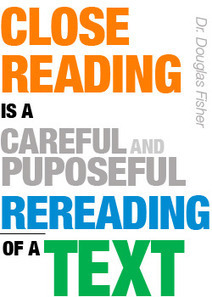
Dr. Douglas Fisher discusses close reading and how it relates to the Common Core State Standards for English/Language Arts.
|
|
Scooped by
Mel Riddile
April 11, 2012 11:24 AM
|
Previously I’ve written about my support for the Common Core Reading and Writing Standards for Literacy in History/Social Studies, as I urged my fellow history teachers to embrace the Common Core...
|
|
Scooped by
Mel Riddile
April 11, 2012 11:17 AM
|
Russ Whitehurst and Matthew Chingos provide policy recommendations for state and federal agencies, along with non-profit organizations, to take steps to identify the most effective curriculum and also provide a systematic way to collect which...
|
|
|
Scooped by
Mel Riddile
April 16, 2012 12:21 PM
|
eSchool News April 15, 2012 by Laura Devaney
Webinar explores tips, advice as most states adopt the common standards
As states move toward implementing the Common Core State Standards, school principals must ensure they are fully equipped to help classroom teachers incorporate the standards as effectively as possible.
Kentucky Commissioner of Education Terry Holiday recently observed that the state’s educators face a challenge in identifying high-quality, engaging instructional resources that support and reinforce the new Common Core State Standards—something that is true for all states, said Tracey Lamb, principal of Fulton County High School in Hickman, Ky.
Kentucky was the first state to adopt the common standards. The state has been working on aligning its instruction to the Common Core State Standards since June 2010, and all schools in the state participate in high school and college readiness tests in grades 8, 10, and 11.
Some efforts include revising curriculum maps and pacing guides, and making samples of instructional units available to help teachers.
10 Keys for School Leaders
Lamb said there are a handful of key ways a principal can lead his or her school’s change efforts when it comes to implementing the Common Core standards: - Become educated on the Common Core State Standards inside and out.
- Actively participate in all available trainings offered, and apply lessons learned.
- Use all tools available through your state and district.
- Build capacity within your school building.
- Make sure vertical alignment occurs between elementary, middle, and high schools.
- Use free apps, such as the Common Core Standards app.
- Provide professional learning opportunities and peer networking.
- Ensure time is built in for teachers to use and implement the Common Core standards for instruction and assessment.
- Monitor, monitor, monitor progress.
- Provide time for teachers to analyze data and make necessary revisions.
KY Leadership Cohorts Kentucky has created Leadership Network Cohort Trainings, which are modeled on the most current research-based data available on effective professional development. - There are eight cohorts in the state, and the program focuses on capacity-building.
- Teams from school districts attend training and obtain resources, and as a team they put together a plan regarding how they will deliver those materials and that knowledge to their own staff.
CIITS The state also recently implemented the Continuous Instructional Improvement Technology System—a program that lets teachers access Common Core standards, programs of study, deconstructed standards, student information, and more. - Principals can perform “learning checks” three or four times a year to ensure that teachers are on target and that students understand the material, Lamb said.
- Classroom walk-throughs with meaningful, immediate feedback to teachers, as well as honest evaluations of teachers, is key.
|
|
Scooped by
Mel Riddile
April 16, 2012 11:21 AM
|
Teachers and administrators have homework of their own, studying a net set of instructional guidelines and a fundamental shift of how they teach and test.
Proponents say the state standards, called Common Core, better match how students learn and better prepare them for college or work.
- Depth over Breadth - "With the old standards, kids are learning lots of little bits of information and then quickly forgetting them. Which means we didn't spend enough time learning them well."
- Problem-Solving - These new standards open "a new era in education." But while the bells and whistles will be strikingly new, the focus returns to getting students better at the basics and problem solving. "We've got to give them problems where there aren't easy answers."
- Close Reading - A focus on fine literature will shift to reading for information.
- Writing - Wording a cohesive argument will outweigh creative writing. "What we have now lacks great materials for writing, when we know that's the No. 1 predictor of student success,"
- Technology - All schools need enough computers and Internet bandwidth for classes to test online simultaneously. Paper tests "were appropriate for the times." But advances in artificial intelligence give far more options. "This is where technology is catching up with education."
- Districtwide retraining will be needed.
- Backward Design - "I think that process of beginning with the end in mind and working their way down is powerful,"
- College Professor - California State University, Stanislaus, math Professor Viji Sundar has studied the Common Core math guidelines and believes the changes will help more students be ready for her college courses. "I think it's wonderful, something that's very much needed," Sundar said. California now has dozens of math steps to be learned in every grade. "We need to focus more on certain things more deeply," she said. I really do believe that this has helped us step up our game. We need different skills for the 21st century."
Read more here: http://www.modbee.com/2012/04/15/2159429/new-standards-to-shift-learning.html#storylink=cpy
|
|
Scooped by
Mel Riddile
April 15, 2012 4:45 PM
|
The Common Core sets in motion many new trends, including a focus on text complexity. - This focus drives a shift toward raising proficiency by engaging students in interactions with “lots of complex texts” that “offer them new language, new knowledge, and new modes of thought.” (Appendix A, p. 4)
Measuring Text Complexity
Appendix A suggests that we measure text complexity by considering: PART 1: QUANTITATIVE VARIABLES PART 2: QUALITATIVE VARIABLES PART 3: INDIVIDUAL READER/ TASK VARIABLES
Takeaways - Text complexity is more than just a quantitative measure (Lexile).
- How well are we integrating quantitative measures with qualitative and individual reader variables to make informed decisions as we select text for instruction?
|
|
Scooped by
Mel Riddile
April 15, 2012 11:14 AM
|
I am not a Common Core guru. I am a mother, teacher, booklover, and believer in every child having access to research based lessons every single day no matter where they live. - We need positive! As a first grade teacher, I simply do not have time to deal with teacher, education, or standards bashing. I need to spend my valuable time preparing lessons to support the new standards in a way that is meaningful, differentiated, and of course fun!
- A national assessment has been in the works way before the Common Core Standards came to be. The CCS are not to blame. As the middle school student I mentor would say, “Don’t hate the player, hate the game.”
- It was time for a change! If the Common Core Standards can effectively be implemented, the students I receive from other states will on the same page as my class-or at least close. This is great news….not for me, but for the children who make this move!
- It’s broken, so let’s fix it! No one program (Fundations, Singapore Math, etc) will work for every child. Nor do all schools have access to all of these materials even IF (and again the don’t!) they did work for every child. What we do know is that we must find what works for the individual child. Having like standards opens the door for national collaboration about improving student learning.
And most importantly…
"Standards do not teach children. Teachers teach children. Common Core Standards are the WHAT, teachers, schools, and counties create the HOW. The Common Core Standards in no way dictate how we teacher our students."
--- Lyssa Sahadevan is mommy to an adorable preschooler. She is a first grade teacher in Georgia, wife to a terrific hubby, an education advocate, and Georgia’s 2011 Mom Congress Delegate. She loves all things books and tells all about it at My Mommy Reads.
|
|
Scooped by
Mel Riddile
April 14, 2012 3:03 PM
|
Proficiency rates are expected to drop in half!
"These projections are stark and show just how great the challenges are facing students, schools and districts as Ohio moves forward in fully implementing the Common Core and the greater academic expectations that go along with it."
- In Ohio, this year's district- and building-level report cards will include an “early warning system” alerting parents that higher standards and more rigorous assessments are just two school years away. Next to the school’s current percent of students proficient in reading and math is a projection of the percent of students who would be proficient in 2014-15 under the new system (the state uses the percent of students who are “accelerated” or “advanced” on the current tests as a proxy).
- In most cases (as State Superintendent Heffner said at our February Common Core event), proficient rates drop by half.
- For example, in Columbus (Ohio’s largest district):
- In third-grade reading, 61 percent of students are proficient under the current system; just 37 would be under the new one.
- By eighth grade, just 29 percent would be proficient under the new system, despite 69 percent being deemed proficient today.
The results are worse for certain subgroups: - Sixty percent of black students and sixty percent of economically disadvantaged students in Columbus are currently proficient in reading (across all tested grades); yet just 20 percent would be proficient come 2015.
Upgrading Expectations - Lawmakers, the state board of education, and the state superintendent are sure to take much flak from local education leaders and others about broadcasting such dismal information.
- But shining light on the reality of how well our students are doing is the first step to upgrading expectations for students, schools and the larger community, and ultimately developing the capacities needed to meet the challenge.
|
|
Scooped by
Mel Riddile
April 14, 2012 2:37 PM
|
Tennessee’s Education Commissioner, Kevin Huffman: - Once common core standards are put in place, problems with changing expectations will be addressed positively.
- Educators also expressed the hope that those responsible for training teachers in the common core program will be consistent in the information they provide.
- Commissioner Huffman responded that he was aware of problems with training in the past and his department was attempting to address those issues by hiring and training the personnel instead of relying on contract employees.
- He praised the Leadership Council for helping to create the standards and said more than 16,000 educators would be trained over the summer.
|
|
Scooped by
Mel Riddile
April 13, 2012 6:53 PM
|
A new study suggests there is little, if any, difference in the reliability and accuracy of the computer approach to scoring student essays.
And this may be good news for those who believe essays are an essential component of state testing systems, since the cost-savings may well encourage more states to embrace the use of such test items to balance out multiple-choice questions.
"The demonstration showed conclusively that automated essay-scoring systems are fast, accurate, and cost-effective," said Tom Vander Ark, the chief executive officer of Open Education Solutions, and a co-director of the study, in a press release. (Vander Ark is also a former top education official at the Bill & Melinda Gates Foundation.)
Essential to Common Core Assessments
The study comes as two state testing consortia are working to develop new assessment systems pegged to the Common Core State Standards in reading and mathematics. In fact, the two consortia are supporting the Hewlett effort, and three PARCC states and three SMARTER Balanced states supplied student essays for the current study.
Results
"The results demonstrated that overall, automated essay scoring was capable of producing scores similar to human scores for extended-response writing items with equal performance for both source-based and traditional writing genre," says the study, co-authored by Mark Shermis, the dean of the University of Akron's college of education, and Ben Hammer of Kaggle, a private firm that provides a platform for predictive modeling and analytics competitions.
|
|
Scooped by
Mel Riddile
April 12, 2012 6:18 PM
|
See Appendix A of the ELA Standards
Three text types emphasized in the Standards, namely - Informational/explanatory writing
- Argument
- Narrative writing
Appendix A makes it clear that each of these “text types” embraces many different sub-genres or forms of writing. For example, informational writing could include everything from an essay on humpback whales to a police report or newspaper article or script for a documentary film. The reason this matters so much is that we often do not think creatively when assigning writing in school. We need to think beyond the traditional research report because, as important as that form is, it’s not sufficient to help students bridge the gap between high school and college or the workplace.
The Wonderful World of Blended Genres
Appendix A also points out that much of our finest writing is a blend of genres. Indeed, any time a writer strings together more than a few paragraphs, it is nearly impossible not to combine genres in some way. My favorite example of this is Bill Bryson’s remarkable book In a Sunburned Country, based on the author’s research and travels to Australia. Bryson’s book seamlessly and deftly combines travel writing, geography, history, informational writing (on countless topics, including topography, wildlife, and cooking), and wildly humorous anecdotes. It’s a book that defies classification–which is precisely what makes it such a treasure.
The Special Place of Argument
A particularly important feature of Appendix A is a thoughtful explanation of just why argument is so important–and so strongly emphasized. Argument, the Standards writers claim, encourages deep thinking. And that in a nutshell is the whole point. Whether it’s oral argument or written, students must think carefully about an issue, give just and respectful consideration to both (or all) sides, weigh evidence, analyze projected outcomes, and guide readers to a good decision. The purpose of argument is not–as is often supposed–to simply get people on your side. This simplistic view often leads students to offer emotional responses or hasty replies that have little or nothing to do with facts or evidence: e.g., Year-round school is a terrible idea because students would hate it, College is not for everyone because we’re all individuals. Note also that the writers use the word “argument” in a special way. This may be splitting semantic hairs, but it’s worth paying attention to . . .
Argument vs. Persuasive Writing
Many of us have used (and continue to use) the term “persuasive writing” in referring to what is essentially the same as the Common Core definition of “argument.” But the Core writers draw a distinction. And that distinction hovers around one word: evidence. A piece may be highly persuasive, but appeal primarily to emotion or (when all else fails) the well-being of the reader. In other words, persuasive pieces are often about passion.
True argument, by contrast, relies on evidence and logical reasoning. This means that the writer needs to do his or her research and examine various perspectives meticulously. This is not to say that the writer won’t make a forceful or compelling case in the end, but underlying all that irresistible oratory will be the heart and soul of any strong argument: reason.
|
|
Scooped by
Mel Riddile
April 11, 2012 7:38 PM
|
This activity requires students to use higher level thinking skills as they interact with a primary source image. The thinking triangle also gives students practice in the visual equivalent of Common Core State Standards (CCSS) reading anchor standard 2.
Follow the directions below to record thoughts about the image using the thinking triangle.
- Row 1 (Who/What?): Think about who or what this image represents and describe it in one word (write the word on the top line in the triangle).
- Row 2 (When?): Think about the time period this image represent sand describe it in two words (wirte each word on one line in the second row).
- Row 3 (Where?): Think about the place shown in this image and describe it in three words (write each word on one line in the third row).
- Row 4 (How?): Think of a How question that this image answers and write the answer in four words, one word on each line in the fourth row.
- Row 5 (Why?): Think of a Why question that this image answers and write the answer in five words, one word on each line in the fifth row.
|
|
Scooped by
Mel Riddile
April 11, 2012 7:34 PM
|
Web Resources for Common Core Essential Standards...
|
|
Scooped by
Mel Riddile
April 11, 2012 7:27 PM
|
As we perused the PARCC materials, it became clear to all of us that we will need to be doing a lot around teaching critical research skills to our students. We know this is a weak area for us. And in talking to other teachers and working in other districts, this seems to be a common area of weakness.
With PARCC and the Common Core, research is clearly a big part of the learning, and students must use what they have found to create a powerful argument on a topic. If you look at the Assessment Chart, you can see that a large project is the main assessment of skills under PARCC. Research and argument is at the heart of the expectations, as far as I can tell.
|
|
Scooped by
Mel Riddile
April 11, 2012 11:21 AM
|
Much quiet focus by teachers and principals was spent during the past eight months in preparation for spring.
|