KROTOASA FOUNDATION's definition of Africa Indigeon refers to all African communities with deep historical ties to the lands, natural resourses and environment, who maintain unique cultures, traditional practices and self-governance, and those who lost theirs due to colonialism and slavery.
Africa Indigeon also refers to all people of African descent who are fundamentally indigenous to Africa as the continent is the origin of all humanity even though the term "Indigenous People" in modern political and legal contexts refers to specific marginalized communities. (The argument that all africans are indigenous was used by some governments to deny specific indigenous rights.)
Africa Indigeon also points to the rich diversity of Africa's original inhabitants, whose traditional lives and rights are central to understanding the continent's complex history and ongoing social dynamics. These are groups of people native to a specific region, people who lived here before colonist arrived.
A vast majority of Native African's can be considered to be "indigenous" in the sense that we originated from this continent and nowhere else (like all Homo sapiens), identity as an "indigenous people" isn't just about being the first inhabitants but about cultures distinct from the dominant society, under threat, dependent on land, and facing discrimination.
Groups like the San and Khoena in Southern Africa are recognised indigenous peoples, distinct from the broader African populations who lost their historic continuity of their culture, tribes, indigenous livestyles, territories and surrounding natural resources. Other groups ....
Political Participation: Indigenous People lack political representation and participation, economic marginlization and poverty, lack of access to social services and discrimination, protection of rights.
Africa's marginalization in global politics and economics stems from a mix of historical legacies of colonialism, global politics and global economic structures that favor commodity exports, leading to asymmetrical trade, capital flight, and limited industrialization. Key factors include dependence on external powers, poor infrastructure, illicit financial flows, and structural disadvantages within global trade rules, despite rich resources.
Africa's revolution of sweeping transformation, primarily the anti-colonial independence movements (Decolonisation of Africa 1950 -1970s), the anti-colonial restistance, the political revolution, the economic and social revolutions, the labour revolutions with key drivers and goals of self-determination by ending foreign control and achieving political independence and economic independence by moving from exporting raw materials to manufacturing in areas where extraction taking place.
When the United Nations was established in 1945, 750 million people - almost a third of the world's population - lived in Territories that were non-self-governing, dependent on colonial Powers. Today, fewer than 2 million people live in such Territories.
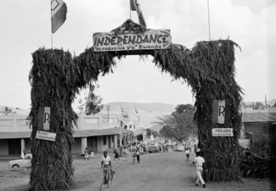
One of the specially decorated arches set up in Kigali, Rwanda to mark that nation's independence on 1 July 1962. (UN Photo)
The Charter of the United Nations established, in Chapter XI (Articles 73 and 74), the principles that continue to guide United Nations decolonization efforts, including respect for self-determination of all peoples.
The United Nations Charter also established the International Trusteeship System in Chapter XII (articles 75-85) and the Trusteeship Council in Chapter XIII (articles 86-91) to monitor certain Territories, known as "Trust" Territories. Those Territories, each subject to separate agreements with administering States, were formally administered under Mandates from the League of Nations, or were separated from countries defeated in the Second World War, or were voluntarily placed under the system by States responsible for their administration. Eleven Territories were placed under this system.
The Charter binds administering Powers to recognize that the interests of dependent Territories are paramount, to agree to promote social, economic, political and educational progress in the Territories, to assist in developing appropriate forms of self-government and to take into account the political aspirations and stages of development and advancement of each Territory.
Administering Powers are also obliged under the Charter to convey to the United Nations information on conditions in the Territories. The United Nations monitors progress towards self-determination in the Territories.
Hoping to speed the progress of decolonization, the General Assembly adopted, in 1960, the Declaration on the Granting of Independence to Colonial Countries and Peoples. Known as the Declaration on decolonization, it stated that all people have a right to self-determination and proclaimed that colonialism should be brought to a speedy and unconditional end.
In 1962 the General Assembly established the Special Committee on Decolonization to monitor implementation of the Declaration and to make recommendations on its application.
Fourth (Special Political Decolonization) Committee of the General Assembly
Decolonization is one of the main subjects that the Special Political and Decolonization Committee (Fourth Committee) of the General Assembly deals with.
Committee of 24 (Special Committee on Decolonization)
The Special Committee on the Situation with regard to the Implementation of the Declaration on the Granting of Independence to Colonial Countries and Peoples (also known as the Special Committee on decolonization or C-24), the United Nations entity exclusively devoted to the issue of decolonization, was established in 1961 by the General Assembly with the purpose of monitoring the implementation of the Declaration (General Assembly Resolution 1514 (XV) of 14 December 1960).
The Special Committee annually reviews the list of Territories to which the Declaration is applicable and makes recommendations as to its implementation. It also hears statements from NSGTs representatives, dispatches visiting missions, and organizes seminars on the political, social and economic situation in the Territories.
Further, the Special Committee annually makes recommendations concerning the dissemination of information to mobilize public opinion in support of the decolonization process, and observes the Week of Solidarity with the Peoples of Non-Self-Governing Territories.
I got into the Colonial Service in 1932 and was sent up to Cambridge by the Government on the Colonial Service course for a fourth year to study those subjects which it was considered would help us to run the Empire. I went out to Freetown by Elder Dempster ship in 1933 and was met in Freetown by my brother who had been seconded from his Regiment, the Inniskilling Fusiliers, to whom I had been attached in the Supplementary Reserve for the four years I had been up at Cambridge. He had been seconded to the West African Frontier Force and it was good to meet one of my own family on first setting foot on foreign soil. I was sent up country as an Asst. District Commissioner, on probation, to Makeni under the District Commissioner, Humpherson. He soon went out on trek and left me in charge of the Station H.Q. with an African Staff of three literate clerks to keep records and interpret if necessary and about 35 Court Messengers. These were all ex-soldiers of the R.W.A.F.F. of exemplary character with military ranks from Private to Sergeant Major, a very much respected force throughout the country who wore distinctive uniform and were the maid-of-all-work for the D.C.
A much decomposed body was brought into the District Office by a messenger from a Paramount Chief and I was required to ascertain the cause of death. I sent the body down to the Medical Officer who reported that he thought that the body had died as a result of being mauled by a leopard. I held an enquiry such as I was able and brought in a verdict that the body had died as a result of being mauled by a leopard. I was quite ignorant of African ways of thought but I sensed from murmurings amongst the Court Messengers that my verdict was incorrect, though of course they were too polite to make an open objection.
You see, from the African standpoint there were three ways in which that body could have met its end. One was being mauled by a leopard; the second was by murder, for there was a Leopard Society in which malefactors combined and took binding oaths of secrecy, covered their bodies with leopard skins and tied on to the hands and feet iron claws made by local blacksmith, then lay in wait for their chosen victim, pounced on him and clawed him to death. Then the Africans thought there was a third way, by which a man could put his spirit into that of a leopard which would then be conducted to attack his chosen victim, and thus though the leopard had actually killed the person, the guilty party was he who had put his spirit into the leopard. In African eyes this was murder. In this case I gathered that the Court Messengers thought that number three of the alternatives was the correct one which we know is impossible and thus I gained the first insight into the African mind, about which, as time went on I began to learn a little more.
Then during my first tour I was asked to play tennis for Sierra Leone against Nigeria. I am afraid that in those days no Africans played, so six of us Europeans sailed down to Lagos and we, a tiny country, beat mighty Nigeria which was very gratifying.
Western Green Mamba Later still in my first tour I was transferred to Port Loko as Asst. D.C. to the D.C. who was "Baby" Taylor. There was no proper house for the Asst. D.C. in the H.Q. station, so my permanent house was just a Rest House as it would be on trek. The government decided that there should be a permanent house for the Asst. D.C. and allotted 60 pounds for its construction. Even in those days of cheap labour and material, 60 pounds was very little. I chose the site and in the evenings I cut down the bush on this site to clear the area. As I was cutting down a tree with a great axe I felt a piercing stab in my head, and as I looked up a green snake fell from the tree on to my shoulder and on to the ground. I realised that this snake had bitten me, but I had no idea of the variety. I went to Baby Taylor and told him, but he was writing a report and I remember him saying, "Are you sure it wasn't a mosquito?" So I went back to my Rest House and told my boys. "Oh, Massa, that is a very bad snake, you must have some native medicine." I had been warned against native medicine but I recalled my tuition on the Colonial Service course up at Cambridge in Tropical Hygiene. We were taught that when bitten by a snake you should rub pot permanganate into the area after having cut open the part bitten. I did not feel very much like doing that on my head.
But the other instruction was to apply a tourniquet at a point nearer to the heart. This would mean putting a strangle hold round my neck, and I didn't think that was much good. The final remedy was to drink some spirits, so I asked my boy, or rather intimated to him, to bring me some whisky. I put this in my mouth, but I was quite unable to swallow. The liquid just came down my nose. I could not talk for I was unable to articulate. My eyes remained closed for there were no muscles able to lift my eye lids. I could not even get rid of my saliva. I was completely paralysed from the neck up. My head swelled right up and as I pressed my finger into it left a great hole, showing it to be oedemetous. Baby Taylor did come along finally and saw me in this poor shape and he sent off to the nearest doctor which was at Makeni, 80 miles away. He came the following evening, when the effects of the venom of the green mamba, as the snake turned out to be, had begun to wear off. He gave me an anti-venom injection, for what it was worth at that late hour, but he said that I really was lucky at being bitten on the ear, for the venom had to go through my thick hair, which must have absorbed some and then the blood vessels in the scalp are very small and so comparatively little of the venom got into my system at a time and the body defence mechanism was able to deal with it. He said that if I had been bitten in the arm or leg I would surely have been a goner!
Owing to the white corpuscles which are the body's mechanism for fighting infection having been excessively over-produced by the lymphatic gland I got quite sick and was sent home after a year instead of 18 months which was the normal tour. I also got a lot of malaria. However I got perfectly well on leave and came back for my second tour when I acted for a spell as A.D.C. to the Governor. I was then sent up country and in spite of being only an Asst. D.C. I acted asaD.C. thereafter and became a substantive D.C. after six years.
There were a number of things that happened to one, but I shall tell of two of them which occurred before the War. I was acting as D.C. to Nkolili District and was out on trek. I had fetched up at a Rest House and the Doctor from my H.Q., Bill Quin, happened to arrive at this same Rest House, he also being out on trek, a coincidence which never occurred again. After having supper together we went to bed and in the middle of the night I was awakened by a messesnger from a Paramount Chief to come to his town immediately as a European had killed one of his subjects. If a dead body was concerned I thought that this was right up the doctor's street, so I asked my boys to waken the doctor so that he could accompany me to the scene of the shooting. There was a man called Opey, an engineer from a Mining Company whom the Chief said had shot the African, so I asked him about it. He said that all he had been doing the previous evening was to shoot at tins which he had chucked in the river which was the Sewa, a very big river, and as the swift-flowing stream carried the tins down he shot at them to practise his accuracy. He had a .22 rifle.
The dead body of a young African was laid out on the verandah of a house, so I asked Bill Quin if he could find the bullet which had killed the boy and he set to work to carve the body up. I was fascinated with the meticulous manner in which he did this, and he could see where the bullet had gone through the heart. He then put his hand to the back of the African and just under the skin he could feel the bullet. The bullet matched the rifle which Opey had been using. Bill Quin was at that time working for his F.R.C.S. and I wondered whether he purposely did his dissection in the front to get some practice. The bullet matched Opey's .22 rifle, so it was clear how the African had met his end. He had, the evening before, been lying up on the steep bank, in thick bush which came right down to the river with a string tied on to his big toe, on the other end of which was a baited hook. The African would lie up there, invisible to anyone on the opposite bank and probably go to sleep until he felt a tug at his toe when he would wake up and play the fish. The chances were millions to one against, but somehow one of Opey's shots must have ricocheted off either a tin or the water itself and bored its way through the bush into the African's heart. I had to hold an enquiry and it was clear that there was no guilt on Opey's part, but a young African had been killed whose dependants must be compensated. I decided that Opey, or his Company, should pay to the African's family the sum of 20 pounds with which all agreed. That was in 1937.
Marampa Iron Ore Works Early in 1939 I was out on trek collecting tax and hearing complaints when I got an urgent message from an iron ore mining company. Sierra Leone Development Co., to come to their H.Q. at Lunsar near Marampa because 4,000 of their labourers had gone on strike and things were looking very bad. I left all the tax, several thousand pounds, for the clerk to get back to my H.Q., Port Loko, and with 4 Court Messengers set off to walk to the nearest motor road, 10 miles away, to get a lorry and then drive on the 40 miles to Lunsar. As I approached the mine I saw a large band of Africans, all armed with sticks and looking bellicose. I then noticed that they had felled the palm trees on the side of the road, thus preventing any vehicles getting up to the mine. The D.C. always wore a blue band round his topi, and the Africans knew that he was impartial and when I got out of the lorry and they saw this they became more friendly. I asked them to pull the palm trees off the road so that we could get up to the mine, and this they did. There were 40 Europeans up at the mine and the Manager said that the Company would not parley under duress and if they would go back to work they might consider the increase in pay the labourers were demanding. The Company wanted to give them more rice to improve their diet and thus get more work out of them, but the labourers wanted more money. Then I got a message from the Government in Freetown to the effect that I must get the labourers back to work, for the iron ore which the company produced was needed in England for armaments which were then being built up in preparation for the War. I asked the Government to let me have 30 more Court Messengers from other Districts, which they provided and each morning I used to hold a meeting on the football field and asked the labourers to go back to work and then the company would consider increasing their pay, with or without more rice. Each time they refused to go back to work.
I had to do something so I asked the Army to let me have a platoon of troops to be kept in reserve. Col. Woolner, the O.C. of the Battalion of R.W.A.F.F. came up and said to me, "You know, Pat, if you call us in a soldier shoots to kill".
Oh Gosh, I thought, this is reminiscent of my namesake. Sir Michael O'Dwyer, Governor of the Punjab and General Dyer before the First World War. I asked the Court messengers to get as many labourers as they could on to the football field the next morning and I would ask them finally to go back to work after which the company would talk. I made the plan that if they continued to refuse, then each of the 34 Court Messengers should grab the labourer standing next to him and frog-march him up the hill to the alluvial iron ore mine and set him to work. If this plan failed, and there was chaos, then the R.W.A.F.F. troops, hidden out of sight in the adjoining bush would be called in to keep order. Well, they would not go back to work, I gave the signal, the Court Messengers frog-marched the adjacent African up the hill, put a shovel in his hand which put the iron ore on to a conveyor belt, thence on to a railway which went down through the country to the shore at Pepel and on to a ship bound to England. All the other labourers seemed so stunned at seeing their colleagues going up the hill and starting to work that they followed and the strike was over.
Later on in that same year, of course, the Second World War broke out. I was on the Reserve of Officers and whilst out on trek again, collecting tax at the end of August, I got an urgent command from the R.W.A.F.F. to rejoin the Battalion in Freetown. Again I left the tax to the clerk and had to walk another 10 miles to get to the road and a lorry to take me down to Freetown. I was in the R.W.A.F.F. for 14 months when the Government commanded me to come out of the Army and take charge of a District. And so I was locked there for the rest of the War, but my time in the Colonial Service was abruptly terminated by an occurrance on October 21st 1945, the date of the Battle of Trafalgar, on which I reckon I met my Waterloo. I had been transferred to a District called Moyamba and a woman came into the District Officer there complaing that her daughter had been murdered by a Secret Society, the object of which was to kill a young girl, cut the heart out, and smear their bodies with the fat around the heart after which they would be impregnable to man. That was the legend.
Shenge Rest House I sent Court Messengers out to try and get some evidence, but none was forthcoming. On my next trek I would include this place where the woman lived, Shenge, and amongst other things look into this complaint. Now Shenge was a very pleasant spot, on the Coast with the Rest House high up on the cliff looking out into the Atlantic. I was very keen on fishing and the attraction of Shenge was the tarpon fishing which was to be had there. I remember arriving there by launch one Saturday evening, and usually on trek one went into the native court to hear cases much as on any other day of the week. But I thought I would spend this Sunday fishing so I sent for Captain Huff, the head fisherman who had a large dug out canoe, and asked him if he and two other fishermen would accompany me out to sea and I would fish for tarpon. In the past I had hooked many tarpon but never landed one. They take the bait very lightly and then jump high in the air and usually manage to spit the hook out but on this occasion when I hooked one and the fish jumped three times high in the air still the hook remained in its mouth. The top and bottom of their mouths are very hard and a hook will not penetrate but it is soft at the side and if the hook gets lodged there it will stick. The energy needed to hurl that great weight out of the water is terrific, so it will only jump three times, such a sight with its tough silvery scales shining in the bright sun! But then it will rush through the water with the reel screeching out.
From one moment to the next I felt quite suddenly very ill. I had this great fish on the end of the line but I could not hold the rod up with my left hand all I could do was to put the butt under my right armpit and feebly work the reel with my right hand. After half an hour the poor old fish was near to the canoe feeling dead as I was, and Captain Huff, after trying fruitlessly to gaff the fish through its impenetrable scale, finally got the gaff down its large mouth and pulled it into the canoe. Both the fish and I lay at the bottom of this canoe quite flat out. We finally got ashore when the Paramount Chief and the people came down to see that the D.C. had caught a tarpon, the natives in those days not having the tackle to do so.
I felt really desperately ill but custom required that I stand around whilst the fish was carved up and distributed to the chief. Court Messengers etc. The fish weighed 96 lbs. I finally got into the Rest House, the mud walls of which had been decorated by the people with country cloths, and I lay down on my camp bed, feeling dead to the world. It was a boiling hot sunny day but I felt desperately cold and I asked my boy to pull all those country cloths off the walls and on top of me and one of my Court Messengers went off to call the Doctor, two days march away in Molyamba. He, Harold Tweedy and his wife Dorothy finally got to Shenge, but not before the Sergeant of my patrol, Bindi Bekadu with four other Court Messengers behind him stood at the door of the Rest House and announced to me, lying prostrate on my camp bed, "Please Sir, We know what is the matter with you. The head of that Secret Society into which you are going to enquire about that child's death does not want you to 'talk' that case. He has therefore put a 'swear' on you to prevent you doing so and there are only two ways open to you. One is to give us enough money with which to bribe this man to 'pull' the 'swear' and you will then get better, or give us permission to cut his head off, for if he dies so will the 'swear' become ineffective.''
The doctor, Harold Tweedy then found that I had blackwater fever, sleeping sickness, from the bite of the tsetse fly, and malaria, all together. He felt he must get some help from Freetown so he sent a message to the D.M.S. there to send another Doctor, John Busby and a European sister who arrived by launch. They thought that I was going to die so for good measure John Busby gave me an injection of triparcimide. This was specific against the sleeping sickness which normally requires a prolonged course of treatment, but in a miraculous manner the blackwater fever seemed to evaporate and the fevers subsided. I was very weak and yet I felt remarkably better and in a week I was put in a hammock and taken down to the sea-shore and carried through the water to a launch. The Paramount Chief and his Tribal Authority stood in the water to bid me farewell and I remember leaning out of the hammock to shake the chiefs hand and say to him that I would be back to talk that alleged murder case and other things.
Hill Station There was a journey of about 40 miles across the sea to Freetown. I was taken from the landing up the hill to the European Nursing Home on Hill Station. It was evening and as the sun went down over the sea as one looked westward I noticed the phenomenon of the green flash, an optical illusion which one sometimes saw. In the morning I was feeling all right but an orderly brought me some tea. It was dark. He then came to shave me; it was still dark. I just thought they started early here. Then he brought me some breakfast; it was still dark. I asked him the time. It was 8 a.m. when the sun was well up and I could not see it. I had gone blind overnight. I was not allowed to go back to Moyamba to pack up even where all my belongings accumulated over 13 years were, but my boys went back to do so.
I got back to England in January 1946 and started a new life as a Blind man at the age of 36. I then trained as a Chartered Physiotherapist at the Physiotherapy School run by the National Institute for the Blind. Having qualified in 1950 my wife. Bay, and I came down to Eastbourne and started a private practice in physiotherapy. My eldest daughter then in 1981 took over the practice and though married with two children ran it under her maiden name, Mary O'Dwyer.
Whether my colonies realize it or not, I am the reason they still exist Europa Universalis IV is one of the best modern grand strategy games. Following from the ...
Belgium Colonization and the Ignition of the HIV Global Pandemic by Dr. Lawrence Brown In an article entitled “The Early Spread and Epidemic Ignition of HIV-1 in Human Populations,” in the magazine...
This article talks about the spread of HIV and how it started. HIV originated in the Democratic Republic of Congo in Kinshasa, and it later spread to other countries by the production of the railroad. But, one of the main problems with saying that Congo was the country that started the world pandemic is that Congo was colonialized by Belgium, so historians are wondering whether Belgium had something to do with it too.
This article was interesting to read because I didn't know that HIV started in the Congo area, and the whole problem started with colonialism, so it was interesting to where the world pandemic stemmed from.
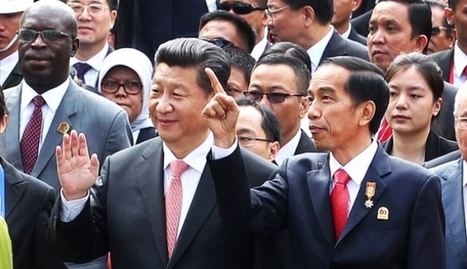
The Asian-African Conference, where leaders of developing nations have vowed to build a fairer international order, ended in Indonesia on Friday with leaders taking a symbolic walk to the venue of the first conference in 1955....
Encouraged by the success of this experiment, the Company extended free passage from 1685 to 1707 for Hollanders wishing to settle at the Cape. In 1688 it sponsored the immigration of 200 French Huguenot refugees forced into exile by the Edict of Fontainebleau.
The arrival of Portuguese explorer Vasco da Gama at Calicut in 1498 opened a gateway of free access to Asia from Western Europe around the Cape of Good Hope; however, it also necessitated the founding and safeguarding of trade stations in the East.[10] Very rapidly one European power followed another, all eager to trade along this route. The Portuguese landed in Mossel Bay in 1500, explored Table Bay two years later, and by 1510 had started raiding inland.[16] Shortly afterwards the Dutch Republic sent merchant vessels to India, and in 1602 founded the Vereenigde Oostindische Compagnie (Dutch East India Company; VOC).[17] As the volume of traffic rounding the Cape increased, the Company recognised its natural harbour as an ideal watering point for the long voyage around Africa to the Orient and established a victualling station there in 1652.[10] VOC officials did not favour the permanent settlement of Europeans in their trading empire, although during the 140 years of Dutch rule many VOC servants retired or were discharged and remained as private citizens.[17] Furthermore, the exigencies of supplying local garrisons and passing fleets compelled the administration to confer free status upon employees and oblige them to become independent farmers.[18]
Encouraged by the success of this experiment, the Company extended free passage from 1685 to 1707 for Hollanders wishing to settle at the Cape.[18] In 1688 it sponsored the immigration of 200 FrenchHuguenot refugees forced into exile by the Edict of Fontainebleau.[19] The terms under which the Huguenots agreed to immigrate were the same offered to other VOC subjects, including free passage and requisite farm equipment on credit. Prior attempts at cultivating vineyards or exploiting olive groves for fruit had been unsuccessful, and it was hoped that Huguenot colonists accustomed to Mediterranean agriculture could succeed where the Dutch had failed.[20] They were augmented by VOC soldiers returning from Asia, predominantly Germans channeled into Amsterdam by the Company's extensive recruitment network and from thence overseas.[21][22] Despite their diverse nationalities, the colonists used a common language and adopted similar attitudes towards politics.[23] The attributes they shared came to serve as a basis for the evolution of Afrikaner identity and consciousness.[24]
Afrikaner nationalism has taken the form of political parties and secret societies such as the Broederbond in the twentieth century. In 1914 the National Party was formed to promote Afrikaner economic interests and sever South Africa's ties to the United Kingdom. Rising to prominence by winning the 1948 general elections, it has also been noted for enforcing a harsh policy of racial separation (apartheid) while simultaneously declaring South Africa a republic and withdrawing from the British Commonwealth.[11]
The term "Afrikaner" presently denotes the politically, culturally, and socially dominant Germanic group[25] among white South Africans, or the Afrikaans-speaking populace of Netherlands Dutch origin - although their original progenitors also included Flemish, French Huguenot, and German immigrants.[10] Historically, the terms "burgher" and "Boer" have both been used to describe white Afrikaans speakers as a group; neither is particularly objectionable but Afrikaner has been considered a more appropriate term.[11] At one time, burghers merely denoted Cape Dutch, settlers who were influential in the administration, able to participate in urban affairs, and did so regularly. Boers often referred to the settled European farmers or nomadic cattle herders. During the Batavian Republic, "burgher" was popularised among Dutch communities both at home and abroad as a popular revolutionary form of address, or citizen.[11] In South Africa, it remained in use as late as the Second Boer War.[26]
The first recorded instance of a colonist identifying as an "Afrikaner" occurred in March 1707, during a disturbance in Stellenbosch.[27] When the magistrate, Johannes Starrenburg, ordered an unruly crowd to desist, a white teenager named Hendrik Biebouw retorted, "Ik ben een Afrikaander - al slaat de landdrost mij dood, of al zetten hij mij in de tronk, ik zal, nog wil niet zwijgen!" ("I am an African - even if the magistrate were to beat me to death, or put me in jail, I shall not be, nor will I stay, silent!").[28] Biebouw was flogged for his insolence and later banished to Jakarta.[29]:22 It is believed that "Afrikaner" in question initially indicated Cape Coloureds or other groups claiming mixed ancestry. Biebouw himself had numerous half-caste siblings and may have identified with Coloureds socially.[27] However, this defiant secession from Dutch law and sovereignty was a leap towards defining another consciousness for white South Africa, suggesting for the first time a group identification with the Cape Colony rather than any ancestral homeland in Europe.[30] In 1902, Sir Arthur Conan Doyle became the earliest English author to use "Africander" in reference to the Boers' eastward expansion from the Cape.[31]
Bantu peoples is used as a general label for the 300-600 ethnic groups in Africa who speak Bantu languages. They inhabit a geographical area stretching east and southward from Central Africa across the African Great Lakes region down to Southern Africa. Bantu is a major branch of the Niger-Congo language family spoken by most populations in Sub-Saharan Africa.
About 3000 years ago, speakers of the proto-Bantu language group began a millennia-long series of migrations eastward from their homeland between West Africa and Central Africa at the border of eastern Nigeria and Cameroon.[4] This Bantu expansion first introduced Bantu peoples to central, southern, and southeastern Africa, regions they had previously been absent from. The proto-Bantu migrants in the process assimilated and/or displaced a number of earlier inhabitants that they came across, including Khoisan populations in the south and Afro-Asiatic groups in the southeast.[5][6]
Individual Bantu groups today often include millions of people. Among these are the Luba of the Democratic Republic of Congo, with over 13.5 million people; the Zulu of South Africa, with over 10 million people; and the Kikuyu of Kenya, with over 6 million people. Although only around five million individuals speak the Bantu Swahili language as their mother tongue,[7] it is used as a lingua franca by over 140 million people throughout Southeast Africa.[8] Swahili also serves as one of the official languages of the African Union.
The word Bantu, and its variations, means "people" or "humans". Versions of this word occur in all Bantu languages: for example, as watu in Swahili; muntu in Kikongo; batu in Lingala; bato in Duala; abanto in Gusii; andũ in Kikuyu; abantu in Zulu, Runyakitara,[9] and Ganda; vanhu in Shona; batho in Sesotho; vandu in some Luhya dialects; and mbaityo in Tiv; and vhathu in Venda.
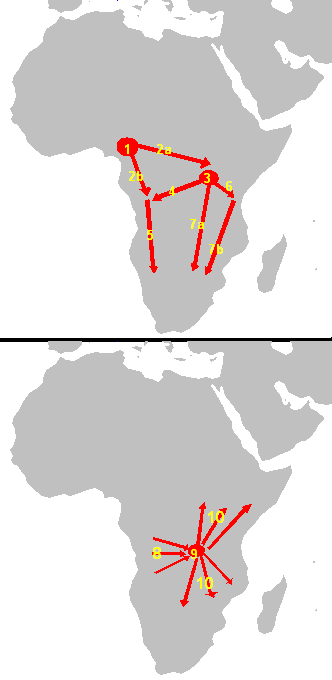
1 = 2000–1500 BC origin 2 = ca.1500 BC first migrations 2.a = Eastern Bantu,2.b = Western Bantu 3 = 1000–500 BC Urewe nucleus of Eastern Bantu 4–7 = southward advance 9 = 500 BC–0 Congo nucleus 10 = 0–1000 AD last phase[10][11][12]
Current scholarly understanding places the ancestral proto-Bantu homeland in West Africa near the present-day southwestern border of Nigeria and Cameroon c. 4,000 years ago (2000 B.C.), and regards the Bantu languages as a branch of the Niger–Congolanguage family.[13] This view represents a resolution of debates in the 1960s over competing theories advanced by Joseph Greenberg and Malcolm Guthrie, in favor of refinements of Greenberg's theory. Based on wide comparisons including non-Bantu languages, Greenberg argued that Proto-Bantu, the hypothetical ancestor of the Bantu languages, had strong ancestral affinities with a group of languages spoken in Southeastern Nigeria. He proposed that Bantu languages had spread east and south from there, to secondary centers of further dispersion, over hundreds of years.
Using a different comparative method focused more exclusively on relationships among Bantu languages, Guthrie argued for a single Central African dispersal point spreading at a roughly equal rate in all directions. Subsequent research on loanwords for adaptations in agriculture and animal husbandry and on the wider Niger–Congo language family rendered that thesis untenable. In the 1990s Jan Vansina proposed a modification of Greenberg's ideas, in which dispersions from secondary and tertiary centers resembled Guthrie's central node idea, but from a number of regional centers rather than just one, creating linguistic clusters.[14]
It is unclear exactly when the spread of Bantu-speakers began from their core area as hypothesized c. 5,000 years ago (3000 B.C.). By 3,500 years ago (1500 B.C.) in the west, Bantu-speaking communities had reached the great Central African rain forest, and by 2,500 years ago (500 B.C.) pioneering groups had emerged into the savannahs to the south, in what are now the Democratic Republic of Congo, Angola, and Zambia. Another stream of migration, moving east, by 3,000 years ago (1000 B.C.) was creating a major new population center near the Great Lakes of East Africa, where a rich environment supported a dense population. Movements by small groups to the southeast from the Great Lakes region were more rapid, with initial settlements widely dispersed near the coast and near rivers, due to comparatively harsh farming conditions in areas farther from water. Pioneering groups had reached modern KwaZulu-Natal in South Africa by A.D. 300 along the coast, and the modern Northern Province (encompassed within the former province of the Transvaal) by A.D. 500.[15]
Before the expansion of farming and herding peoples, including those speaking Bantu languages, Africa south of the equator was populated by neolithic hunting and foraging peoples. Some of them were ancestral to proto-Khoisan-speaking peoples, whose modern hunter-forager and linguistic descendants, the Khoekhoe and San, occupy the arid regions around the Kalahari desert. The Hadza and Sandawe populations in Tanzania comprise the other modern hunter-forager remnant in Africa of these proto-Khoisan-speaking peoples.
Over a period of many centuries, most hunting-foraging peoples were displaced and absorbed by incoming Bantu-speaking communities, as well as by Ubangian, Nilotic, and Sudanic language-speakers in North Central and Eastern Africa. The Bantu expansion was a long series of physical migrations, a diffusion of language and knowledge out into and in from neighboring populations, and a creation of new societal groups involving inter-marriage among communities and small groups moving to communities and small groups moving to new areas.
After their movements from their original homeland in West Africa, Bantus also encountered in East Africa peoples of Afro-Asiatic (mainly Cushitic) and Nilo-Saharan (mainly Nilotic and Sudanic) origin. As cattle terminology in use amongst the few modern Bantu pastoralist groups suggests, the Bantu migrants would acquire cattle from their new Cushitic neighbors. Linguistic evidence also indicates that Bantus likely borrowed the custom of milking cattle directly from Cushitic peoples in the area.[16] Later interactions between Bantu and Cushitic peoples resulted in Bantu groups with significant Cushitic ethnic admixture, such as the Tutsi of the African Great Lakes region; and culturo-linguistic influences, such as the Herero herdsmen of southern Africa.[17][18]
On the coastal section of East Africa, another mixed Bantu community developed through contact with MuslimArab and Persian traders. The Swahili culture that emerged from these exchanges evinces many Arab and Islamic influences not seen in traditional Bantu culture, as do the many Afro-Arab members of the Bantu Swahili people. With its original speech community centered on the coastal parts of Zanzibar, Kenya, and Tanzania – a seaboard referred to as the Swahili Coast – the Bantu Swahili language contains many Arabicloan-words as a result of these interactions.[19]
Between the 14th and 15th centuries, Bantu-speaking states began to emerge in the Great Lakes region in the savannah south of the Central African rainforest. On the Zambezi river, the Monomatapa kings built the famous Great Zimbabwe complex, a civilization whose origins and ethnic affiliations are uncertain. From the 16th century onward, the processes of state formation amongst Bantu peoples increased in frequency. This was probably due to denser population (which led to more specialized divisions of labor, including military power, while making emigration more difficult); to increased interaction amongst Bantu-speaking communities with Chinese, European, Indonesian, and Arab traders on the coasts; to technological developments in economic activity; and to new techniques in the political-spiritual ritualization of royalty as the source of national strength and health.[20]
Between the 14th and 15th centuries, Bantu states began to emerge in the Great Lakes region in the savanna south of the Central African rain-forest. In Southern Africa on the Zambezi river, the Monomatapa kings built the famous Great Zimbabwe complex, the largest of over 200 such sites in Southern Africa, such as Bumbusi in Zimbabwe and Manyikeni in Mozambique. From the 16th century onward, the processes of state formation among Bantu peoples increased in frequency. Some examples of such Bantu states include: in Central Africa, the Kingdom of Kongo,[21]Lunda Empire,[22] and Luba Empire[23] of Angola, the Republic of Congo, and the Democratic Republic of Congo; in the Great Lakes Region, the Buganda[24] and Karagwe[24] Kingdoms of Uganda and Tanzania; and in Southern Africa, the Mutapa Empire,[25]Rozwi Empire,[26] and the Danamombe, Khami, and Naletale Kingdoms of Zimbabwe and Mozambique.[25]
Toward the 18th and 19th centuries, the flow of Bantu slaves from Southeast Africa increased with the rise of the OmaniSultanate of Zanzibar, based in Zanzibar, Tanzania. With the arrival of European colonialists, the Zanzibar Sultanate came into direct trade conflict and competition with Portuguese and other Europeans along the Swahili coast, leading eventually to the fall of the Sultanate and the end of slave trading on the Swahili Coast in the mid-20th century.
In the 1920s, relatively liberal South Africans, missionaries, and the small black intelligentsia began to use the term "Bantu" in preference to "Native" and more derogatory terms (such as "Kaffir") to refer collectively to Bantu-speaking South Africans. After World War II, the racialist National Party governments adopted that usage officially, while the growing African nationalist movement and its liberal allies turned to the term "African" instead, so that "Bantu" became identified with the policies of apartheid. By the 1970s this so discredited "Bantu" as an ethno-racial designation that the apartheid government switched to the term "Black" in its official racial categorizations, restricting it to Bantu-speaking Africans, at about the same time that the Black Consciousness Movement led by Steve Biko and others were defining "Black" to mean all racially oppressed South Africans (Africans, Coloureds, and Indians).
Examples of South African usages of "Bantu" include:
One of South Africa's politicians of recent times, General Bantubonke Harrington Holomisa (Bantubonke is a compound noun meaning "all the people"), is known as Bantu Holomisa.
The South African apartheid governments originally gave the name "bantustans" to the eleven rural reserve areas intended for a spurious, ersatz independence to deny Africans South African citizenship. "Bantustan" originally reflected an analogy to the various ethnic "-stans" of Western and Central Asia. Again association with apartheid discredited the term, and the South African government shifted to the politically appealing but historically deceptive term "ethnic homelands". Meanwhile the anti-apartheid movement persisted in calling the areas bantustans, to drive home their political illegitimacy.
The abstract noun ubuntu, humanity or humaneness, is derived regularly from the Nguni noun stem -ntu in isiXhosa, isiZulu, and siNdebele. In siSwati the stem is -ntfu and the noun is buntfu.
In the Sotho–Tswana languages of southern Africa, batho is the cognate term to Nguni abantu, illustrating that such cognates need not actually look like the -ntu root exactly. The early African National Congress of South Africa had a newspaper called Abantu-Batho from 1912–1933, which carried columns in English, isiZulu, Sesotho, and isiXhosa.
See alsoWikimedia Commons has media related to Bantu peoples.
The Zulu were originally a major clan in what is today Northern KwaZulu-Natal, founded ca. 1709 by Zulu kaNtombela. In the Nguni languages, iZulu/iliZulu/liTulu means heaven, or sky.[3] At that time, the area was occupied by many large Nguni communities and clans (also called isizwe=nation, people or isibongo=clan). Nguni communities had migrated down Africa's east coast over centuries, as part of the Bantu migrations probably arriving in what is now South Africa in about the 9th century.[citation needed]
Shaka, king of the Zulu. After a sketch by Lt. James King, a Port Natal merchant
The Zulu formed a powerful state in 1818[4] under the leader Shaka. Shaka, as the Zulu King, gained a large amount of power over the tribe. As commander in the army of the powerful Mthethwa Empire, he became leader of his mentor Dingiswayo's paramouncy and united what was once a confederation of tribes into an imposing empire under Zulu hegemony.
On 11 December 1878, agents of the British delivered an ultimatum to 11 chiefs representing Cetshwayo. The terms forced upon Cetshwayo required him to disband his army and accept British authority. Cetshwayo refused, and war followed January 12, 1879. During the war, the Zulus defeated the British at the Battle of Isandlwana on 22 January. The British managed to get the upper hand after the battle at Rorke's Drift, and subsequently win the war with the Zulu being defeated at the Battle of Ulundi on 4 July.
After Cetshwayo's capture a month following his defeat, the British divided the Zulu Empire into 13 "kinglets". The sub-kingdoms fought amongst each other until 1883 when Cetshwayo was reinstated as king over Zululand. This still did not stop the fighting and the Zulu monarch was forced to flee his realm by Zibhebhu, one of the 13 kinglets, supported by Boer mercenaries. Cetshwayo died in February 1884, killed by Zibhebhu's regime, leaving his son, the 15 year-old Dinuzulu, to inherit the throne. In-fighting between the Zulu continued for years, until Zululand was absorbed fully into the British colony of Natal.
Under apartheid, the homeland of KwaZulu (Kwa meaning place of) was created for Zulu people. In 1970, the Bantu Homeland Citizenship Act provided that all Zulus would become citizens of KwaZulu, losing their South African citizenship. KwaZulu consisted of a large number of disconnected pieces of land, in what is now KwaZulu-Natal. Hundreds of thousands of Zulu people living on privately owned "black spots" outside of KwaZulu were dispossessed and forcibly moved to bantustans – worse land previously reserved for whites contiguous to existing areas of KwaZulu – in the name of "consolidation." By 1993, approximately 5.2 million Zulu people lived in KwaZulu, and approximately 2 million lived in the rest of South Africa. The Chief Minister of KwaZulu, from its creation in 1970 (as Zululand) was Chief Mangosuthu Buthelezi. In 1994, KwaZulu was joined with the province of Natal, to form modern KwaZulu-Natal.
Inkatha YeSizwe means "the crown of the nation". In 1975, Buthelezi revived the Inkatha YaKwaZulu, predecessor of the Inkatha Freedom Party. This organization was nominally a protest movement against apartheid, but held more conservative views than the ANC. For example, Inkatha was opposed to the armed struggle, and to sanctions against South Africa. Inkatha was initially on good terms with the ANC, but the two organizations came into increasing conflict beginning in 1976 in the aftermath of the Soweto Uprising.
Modern Zulu population
Zulu mother and child
The modern Zulu population is fairly evenly distributed in both urban and rural areas. Although KwaZulu-Natal is still their heartland, large numbers have been attracted to the relative economic prosperity of Gauteng province. Indeed, Zulu is the most widely spoken home language in the province, followed by Sotho.
Language
Map of South Africa showing the primary Zulu language speech area in green
The language of the Zulu people is "isiZulu", a Bantu language; more specifically, part of the Nguni subgroup. Zulu is the most widely spoken language in South Africa, where it is an official language. More than half of the South African population are able to understand it, with over 9 million first-language and over 15 million second-language speakers.[5] Many Zulu people also speak Afrikaans, English, Portuguese, Xitsonga, Sesotho and others from among South Africa's 11 official languages.
White South African is a term which refers to people from South Africa who are of European descent and who do not regard themselves, or are not regarded as, being part of another racial group, for example, as Coloured.
White South Africans differ significantly from other white African groups, because they have developed nationhood, as in the case of the Afrikaners, who established a distinct language, culture and faith in Africa.[4]
The history of the Afrikaner nation can be traced back to the first white settlement of Africa with the arrival of the Dutch under Jan van Riebeeck in 1652. Therefore, their presence in Africa long predates the arrival of other white groups on the continent although the Portuguese began trading African slaves in the 1550s. White South Africans are also considered to be the last major white population group on the African continent, since the number of white people in other African states has declined to negligible figures. Whites continue to play a role in the South African economy and across the political spectrum. Whites number approximately 4.5 to 5 million, or between 9% and 10% of South Africa's population. This represents a decline, both numerically and proportionately, since white rule ended. It is estimated[by whom?] that as many as 800,000 whites have emigrated since the end of apartheid in 1994, however some have since returned.
Under the 1950 Population Registration Act, each inhabitant of South Africa was classified into one of several different race groups, of which White was one. The Office for Race Classification defined a white person as one who "in appearance is obviously a white person who is generally not accepted as a coloured person; or is generally accepted as a white person and is not in appearance obviously not a white person." Many criteria, both physical (e.g. examination of head and body hair) and social (e.g. eating and drinking habits, knowledge of Afrikaans) were used when the board decided to classify someone as white or coloured.[2][5] The Act was repealed on 17 June 1991.
Post-apartheid era
The 1994 Employment Equity Act aimed at achieving equality in South African workplaces. In order to do this, the act required that it be possible to distinguish between black and white South Africans. It was necessary to know if someone was considered to be black or white when evaluating the racial composition of a company's workforce.[2]
In recent decades there has been a steady proportional (and possibly also numerical) decline in the white African population, due to higher birthrates among the non-white population of South Africa, as well as high emigration. In 1977, there were 4.3 million whites, constituting 16.4% of the population at the time. It is estimated that at least 800,000 white Africans have moved abroad since 1995.[6]
Like many other communities strongly affiliated with the West and Europe's colonial legacy in Africa, the white Africans are often economically better off than their black African neighbors and have only relatively recently surrendered political dominance to majority rule. There were also some white Africans in South Africa who lived in poverty—especially during the 1930s and increasingly since the end of minority rule. Current estimates of white poverty in South Africa run as high as 12%, though fact-checking website Africa Check described these figures as "grossly inflated", and suggested that a more accurate estimate was that "only a tiny fraction of the white population – as little as 7,754 households – are affected".[7]
The new phenomenon of white poverty is often blamed on the government's affirmative action employment legislation, which reserves 80% of new jobs for black people[8] and favours companies owned by black people (see Black Economic Empowerment). In 2010, Reuters stated that 450,000 whites live below the poverty line according to Solidarity and civil organisations,[9] with some research saying that up to 150,000 are struggling for survival.[10] A 2006 report claimed that there was anecdotal evidence to suggest that Afrikaner women are increasingly resorting to prostitution, though there appears to be no formal substantiation of this.[11]
A further concern has been crime. Some white South Africans living in affluent white suburbs, such as Sandton, have been affected by the 2008 13.5% rise in house robberies and associated crime.[12] In a study, senior researcher at the Institute for Security Studies (ISS), Dr. Johan Burger, said that criminals were specifically targeting wealthier suburbs. Burger revealed that several affluent suburbs are surrounded by poorer residential areas and that inhabitants in the latter often target inhabitants in the former. Burger also related to an entitlement complex that criminals have; "They feel they are entitled, for their own sakes, to take from those who have a lot". The report also found that residents in wealthy suburbs in Gauteng were not only at more risk of being targeted but also faced an inflated chance of being murdered during the robbery.[13]
The current global financial crisis has slowed down the high rates of white people emigrating overseas and has led to increasing numbers of white emigrants returning to live in South Africa. Charles Luyckx, CEO of Elliot International and a board member of the Professional Movers Association said that in the past six months leading to December (2008), emigration numbers had dropped by 10%. Meanwhile he revealed that "people imports" had increased by 50%.[14]
As of May 2014, Homecoming Revolution has estimated that around 340,000 white South Africans have returned in the last decade.[15]
Furthermore, immigration from Europe has also supplemented the white population. The 2011 census found that 63,479 white people living in South Africa were born in Europe; of these, 28,653 had moved to South Africa since 2001.[16]
Demographics
The Statistics South AfricaCensus 2011 showed that there were about 4,586,838 white people in South Africa, amounting to 8.9% of the country's population.[17] This is a 6.8% increase since the 2001 census. According to the Census 2011, English is the first language of 36% of the white population group and Afrikaans is the first language of 61% of the white population group.[3] The majority of white South Africans identify themselves as primarily South African, regardless of their first language or ancestry.[18][19]
Many white people have migrated to South Africa from other parts of Africa following the independence of those African nations or when those nations became hostile to them. Many Portuguese from Mozambique and Angola and white Zimbabweans emigrated to South Africa when their respective countries became independent.
Meanwhile, many white South Africans also emigrated to Western countries over the past two decades, mainly to English-speaking countries such as the United Kingdom, Ireland, Canada, Australia, New Zealand, and the United States, and with others settling in the Netherlands, Belgium, Spain, France, Argentina, Mexico, Israel and Brazil. However, the financial crisis has slowed down the rate of emigration and as of May 2014, Homecoming Revolution has estimated that around 340,000 white South Africans have returned in the last decade.[15]
White South Africans as a proportion of the total population.
0–20%
20–40%
40–60%
60–80%
80–100%
Density of the White South African population.
<1 /km²
1–3 /km²
3–10 /km²
10–30 /km²
30–100 /km²
100–300 /km²
300–1000 /km²
1000–3000 /km²
>3000 /km²
According to Statistics South Africa, white South Africans make up 8.9% (Census 2011) of the total population in South Africa. Their actual proportional share in municipalities is likely to be higher, given the undercount in the 2001 census.[21]
The following table shows the distribution of white people by province, according to the 2011 census:[22]
ProvinceWhite pop. (2011)White pop. (2001)% province (2011)% province (2001)% change 2001-2011% total whites (2011)Eastern Cape310,450305,8374.74.9-0.2 6.8Free State239,026238,7898.78.8-0.1 5.2Gauteng1,913,8841,768,04115.618.8-3.2 41.7KwaZulu-Natal428,842482,1154.25.0-0.8 9.3Limpopo139,359132,4202.62.7-0.1 3.0Mpumalanga303,595197,0797.55.9+1.6 6.6North West255,385233,9357.37.8-0.5 5.6Northern Cape81,246102,5197.110.3-3.2 1.8Western Cape915,053832,90215.718.4-2.7 19.9Total4,586,8384,293,6408.99.6-0.7 100.0Politics
White South Africans continue to participate in politics, having a presence across the whole political spectrum from left to right.
South African President Jacob Zuma commented in 2009 on Afrikaners being "the only white tribe in a black continent or outside of Europe which is truly African." and said that "of all the white groups that are in South Africa, it is only the Afrikaners that are truly South Africans in the true sense of the word."[23] These remarks have led to the Centre for Constitutional Rights (CCR) laying a complaint with the Human Rights Commission against Zuma.[24]
Former president Thabo Mbeki stated in one of his speeches to the nation that: "South Africa belongs to everyone who lives in it. Black and White."[25] The history of white people in South Africa dates back to the 17th century.
Prior to 1994, a white minority held complete political power under a system of racial segregation called apartheid. Many white people supported this policy, but some others opposed it. During apartheid, immigrants from Taiwan, South Korea, and Japan were considered honorary whites in the country, as the government had maintained diplomatic relations with these countries. These were granted the same privileges as white people, at least for purposes of residence.[26] Some African Americans such as Max Yergan were granted an 'honorary white' status as well.[27]
Statistics for the white population in South Africa vary greatly. Most sources show that the white population peaked in the period between 1989-1995 at around 5.2-5.6 million. Up to that point the white population largely increased due to high birth rates and immigration. Subsequently, between the mid 1990s and the mid-2000s the white population decreased overall. However, from 2006-2013 the population increased.
Colonialism is the establishment, exploitation, maintenance, acquisition, and expansion of colony in one territory by a political power from another territory. It is a set of unequal relationships between the colonial power and the colony and often between the colonists and the indigenous population.
A signatory page of the UN Charter, which passed unanimously, and was signed by representatives of UN Member States in 1945. (UN Photo/Rosenberg)
Delegates of 50 nations met at San Francisco between April 25 and June 26, 1945 and agreed upon the UN Charter, the founding document of the United Nations.
The decolonization efforts of the United Nations derive from the UN Charter's principleof “equal rights and self-determination of peoples” as well as from three specific chapters in the Charter devoted to the interests of dependent peoples:
Implementation of the Declaration on the Granting of Independence to Colonial Countries and Peoples by the specialized agencies and the International institutions associated with the United Nations
Report of Secretary-General on the environmental, ecological, health and other impacts as a consequence of the 30 year period of nuclear testing in the Territory (French Polynesia)
Caribbean Regional Seminar held in Quito, Ecuador, 28 - 30 May 2013
Regional Seminars
Since the 1990s the Special Committee has been organizing regional seminars, alternately in the Caribbean and the Pacific, to review the progress achieved in the implementation of the Plan of Action for the International Decade for the Eradication of Colonialism.
The seminars seek to enable the Special Committee to obtain the views of representatives of the Non-Self-Governing Territories, experts, members of civil society and other stakeholders in the process of decolonization that can assist the Special Committee in identifying policy approaches and practical ways that can be pursued in the United Nations decoloniza
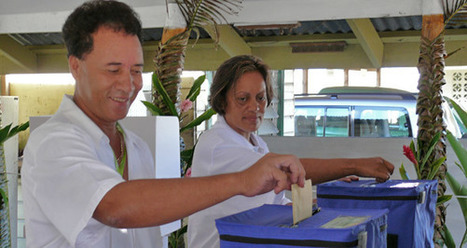
Election celebration in French Togoland (now Togo) in 1958. (UN Photo)
In a vast political reshaping of the world, more than 80 former colonies comprising some 750 million people have gained independence since the creation of the United Nations.
At present, 17 Non-Self-Governing Territories (NSGTs) across the globe remain to be decolonized, home to nearly 2 million people. Thus, the process of decolonization is not complete. Finishing the job will require a continuing dialogue among the administering Powers, the Special Committee on Decolonization, and the peoples of the territories, in accordance with the relevant UN resolutions on decolonization.
In 1990, the General Assembly proclaimed the first International Decade for the Eradication of Colonialism, including a specific plan of action. December 2010 marked the fiftieth anniversary of the Declaration, coinciding with the end of the Second International Decade and the proclamation of a Third one.
This clip shows how Kenya was settled by British citizens, transforming the native Kikuyu into wage laborers. The Kikuyu responded by organizing the Mau Mau ...
The following editorial was originally featured in the First Nations Strategic Bulletin (FNSB), June-October 2012. You can view/download this latest editio
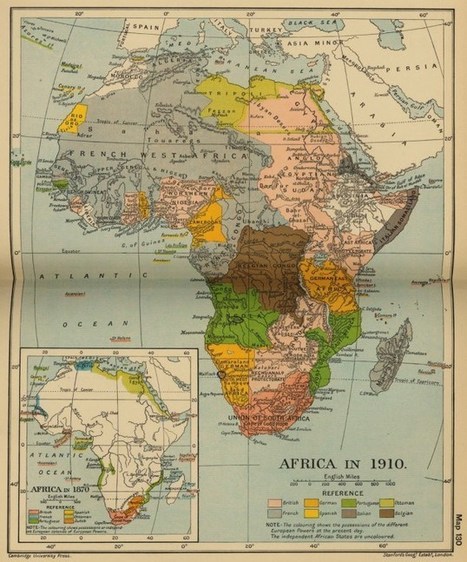
Most people will be forgiven for thinking Africa's borders were always the way they are today. In-fact European colonisation of Africa developed rapidly.
Archaeological evidence shows that the Khoikhoi entered South Africa from Botswana through two distinct routes-travelling west, skirting the Kalahari to the west coast, then down to the Cape, and travelling south-east out into the Highveld and then southwards to the south coast. Chiefly, the largest group of the Khoikhoi to remain as a group are the Namas.
The Khoikhoi (/ˈkɔɪˌkɔɪ/; "people people" or "real people") or Khoi, spelled Khoekhoe in standardised Khoekhoe/Nama orthography, are the native pastoralist people of southwestern Africa. They had lived in southern Africa since the 5th century AD.[1] When European immigrants colonised the area after 1652, the Khoikhoi were practising extensive pastoral agriculture in the Cape region, with large herds of Nguni cattle. The Dutch settlers labelled them Hottentots (/ˈhɒtənˌtɒts/), in imitation of the sound of the Khoekhoe language,[2] but this term is today considered derogatory.[3]
Archaeological evidence shows that the Khoikhoi entered South Africa from Botswana through two distinct routes—travelling west, skirting the Kalahari to the west coast, then down to the Cape, and travelling south-east out into the Highveld and then southwards to the south coast.[4] Chiefly, the largest group of the Khoikhoi to remain as a group are the Namas.
The Khoikhoi, originally part of a pastoral culture and language group to be found across Southern Africa, originated in the northern area of modern Botswana. Southward migration of the ethnic group was steady, eventually reaching the Cape approximately 2,000 years ago. Khoikhoi subgroups include the Namaqua to the west, the Korana of mid-South Africa, and the Khoikhoi in the south. Husbandry of sheep, goats and cattle grazed in fertile valleys across the region, provided a stable, balanced diet, and allowed the Khoikhoi to live in larger groups in a region previous occupied by the subsistence hunter-gatherers, the San. Advancing Bantu in the 3rd century AD encroached the Khoikhoi territory forcing movement into more arid areas. There was some intermarriage between Migratory Khoi bands living around what is today Cape Town and the San. However the two groups remained culturally distinct as the Khoikhoi continued to graze livestock and the San to subsist on hunting-gathering.
Arrival of Europeans
The Khoi initially came into contact with European explorers and merchants in approximately AD 1500. The ongoing encounters were often violent. Local population dropped when the Khoi were exposed to smallpox by Europeans. Active warfare between the groups flared when the Dutch East India Company enclosed traditional grazing land for farms. Over the following century the Khoi were steadily driven off their land, which effectively ended traditional Khoikhoi life.
Khoikhoi social organisation was profoundly damaged and, in the end, destroyed by colonial expansion and land seizure from the late 17th century onwards. As social structures broke down, some Khoikhoi people settled on farms and became bondsmen (bondservants) or farm workers; others were incorporated into existing clan and family groups of the Xhosa people. The first mission station in southern Africa,[5]Genadendal, was started in 1738 among the Khoi people in Baviaanskloof in the Riviersonderend Mountains by Georg Schmidt a Moravian Brother from Herrnhut, Saxony, now Germany.
Early European settlers sometimes intermarried with the indigenous Khoikhoi, producing a sizeable mixed population known at the time as "Basters" and in some instances still so called, e. g., the Bosluis Basters of the Richtersveld and the Baster community of Rehoboth, Namibia.
Like many Khoikhoi and mixed-race people, the Griqua left the Cape Colony and migrated into the interior. Responding to the influence of missionaries, they formed the states of Griqualand West and Griqualand East which were later absorbed into the Cape Colony of the British Empire.
The Kat River settlement (1829–1856) and the Khoi in the Cape Colony
By the early 1800s, the remaining Khoi of the Cape Colony were suffering from restricted civil rights and discriminatory laws on land ownership. With this in mind, the powerful Commissioner General of the Eastern Districts, Andries Stockenstrom, facilitated the creation of the "Kat River" Khoi settlement near the eastern frontier of the Cape Colony. The more cynical motives were probably to create a buffer-zone on the Cape's frontier, but the extensive and fertile lands in the region did allow the Khoi to own their land and build their communities in peace. The settlements thrived and expanded, and Kat River quickly became a large and successful region of the Cape that subsisted more or less autonomously. The people were predominantly Afrikaans-speaking Gonaqua Khoi, but the settlement also began to attract numbers from other Khoi, Xhosa and mixed-race groups of the Cape.
The Khoi were known at the time for being remarkably good marksmen, and were frequent and invaluable allies of the Cape Colony in its frontier wars with the neighbouring Xhosa. In the Seventh Frontier War (1846–1847) against the Gcaleka Xhosa, the Khoi gunmen from Kat River distinguished themselves under their leader Andries Botha in the assault on the "Amatola fastnesses". (The young John Molteno, later Prime Minister, led a mixed Commando in the assault, and later praised the Khoi as having more bravery and initiative than most of his white soldiers.)[6]
Harsh laws were still implemented in the Eastern Cape however, to encourage the Khoi to leave their lands in the Kat River region and to work as labourers on white farms. The growing resentment exploded in 1850. When the Xhosa rose against the Cape Government, large numbers of the Khoi, for the first time, joined the Xhosa rebels.
After the war and the defeat of the rebellion, the new Cape Government endeavoured to grant the Khoi meaningful political rights to avert any future racial discontent. William Porter, the Attorney General, was famously quoted as saying that he "...would rather meet the Hottentot at the hustings, voting for his representative, than meet him in the wilds with his gun upon his shoulder",[7] and so the beginnings of the multi-racial Cape franchise was born in 1853. This law decreed that all citizens, regardless of colour, had the right to vote and to seek election in Parliament. This non-racial principle of franchise was later eroded in the late 1880s, and then finally abolished by the Apartheid Government.[8]
From 1904 to 1907, the Germans took up arms against the Khoikhoi group living in what was then German South West Africa, along with the Herero. Over 10,000 Nama, more than half of the total Nama population, perished. This was the single greatest massacre ever witnessed by the Khoikhoi people.
Culture
The religious mythology of the Khoikhoi gives special significance to the Moon, which may have been viewed as the physical manifestation of a supreme being associated with heaven. Tsui'goab is also believed to be the creator and the guardian of health, while Gunab is primarily an evil being, who causes sickness or death.[9]
World Heritage
UNESCO has recognised Khoikhoi culture through its inscription of the Richtersveld as a World Heritage Site. This important area is the only place where transhumance practices associated with the culture continue to any great extent.
The Bantu expansion is the name for a postulated millennia-long series of migrations of speakers of the original proto- Bantu language group. The primary evidence for this expansion has been linguistic, namely that the languages spoken in Sub-Equatorial Africa are remarkably similar to each other.
The Bantu expansion is the name for a postulated millennia-long series of migrations of speakers of the original proto-Bantu language group.[1][2] The primary evidence for this expansion has been linguistic, namely that the languages spoken in Sub-Equatorial Africa are remarkably similar to each other. Attempts to trace the exact route of the expansion, to correlate it with archaeological evidence and genetic evidence, have not been conclusive; thus many aspects of the expansion remain in doubt or are highly contested.[3]
The linguistic core of the Bantu family of languages, a branch of the Niger–Congo language family, was located in the adjoining region of Cameroon and Nigeria. From this core, expansion began about 3,000 years ago, with one stream going into East Africa, and other streams going south along the African coast of Gabon, Democratic Republic of the Congo, and Angola, or inland along the many south to north flowing rivers of the Congo River system. The expansion eventually reached South Africa probably as early as AD 300.[4][5][6][7][8][9][10][11]
1 = 2000–1500BC origin 2 = ca.1500BC first migrations 2.a = Eastern Bantu,2.b = Western Bantu 3 = 1000–500BC Urewe nucleus of Eastern Bantu 4–7 = southward advance 9 = 500BC–0 Congo nucleus 10 = AD 0–1000 last phase[12][13][14]
Initially archaeologists believed that they could find archaeological similarities in the ancient cultures of the region that the Bantu-speakers were held to have traversed; while linguists, classifying the languages and creating a genealogical table of relationships believed they could reconstruct material culture elements. They believed that the expansion was caused by the development of agriculture, the making of ceramics, and the use of iron, which permitted new ecological zones to be exploited. In 1966 Roland Oliver published an article presenting these correlations as a reasonable hypothesis.[15]
The hypothesized Bantu expansion pushed out or assimilated the hunter-forager proto-Khoisan, who formerly inhabited Southern Africa. In Eastern and Southern Africa, Bantu-speakers may have adopted livestock husbandry from other unrelated Cushitic- and Nilotic-speaking peoples they encountered. Herding practices reached the far south several centuries before Bantu-speaking migrants did. Archaeological, linguistic, genetic, and environmental evidence all support the conclusion that the Bantu expansion was a significant human migration.
Niger–Congo languages
The Niger–Congo family comprises a huge group of languages spread throughout Sub-Saharan Africa. The Benue–Congo branch includes the Bantu languages, which are found throughout Central, Southern, and Eastern Africa.
A characteristic feature of most Niger–Congo languages, including the Bantu languages, is their use of tone. They generally lack case inflection, but grammatical gender is characteristic, with some languages having two dozen genders (noun classes). The root of the verb tends to remain unchanged, with either particles or auxiliary verbs expressing tenses and moods. For example, in a number of languages the infinitival is the auxiliary designating the future.
A typical trait in the Niger-Kordofanian family as a group is the division of nouns. This has been juxtaposed with the gender system of the Indo-European languages.[16]
It is thought that Central African Pygmies and Bantus branched out from a common ancestral population c. 70,000 years ago.[17] Many Batwa groups speak Bantu languages; however, a considerable portion of their vocabulary is not Bantu in origin. Much of this vocabulary is botanical, deals with honey collecting, or is otherwise specialised for the forest and is shared between western Batwa groups. It has been proposed that this is the remnant of an independent western Batwa (Mbenga or "Baaka") language.[18]
Southern Africa
Proto-Khoisan-speaking peoples, whose few modern hunter-forager and linguistic descendants today occupy the arid regions around the Kalahari desert.
Eastern Africa
The Hadza and Sandawe-speaking populations in Tanzania comprise the other modern hunter-forager remnant in Africa.
It seems likely that the expansion of the Bantu-speaking people from their core region in West Africa began around 1000BC. Although early models posited that the early speakers were both iron-using and agricultural, archaeology has shown that they did not use iron until as late as 400BC, though they were agricultural.[23] The western branch, not necessarily linguistically distinct, according to Christopher Ehret, followed the coast and the major rivers of the Congo system southward, reaching central Angola by around 500BC.[24]
It is clear that there were human populations in the region at the time of the expansion, and Pygmies are their purer descendants. However, mtDNA genetic research from Cabinda suggests that only haplogroups that originated in West Africa are found there today, and the distinctive L0 of the pre-Bantu population is missing, suggesting that there was a complete population replacement. In South Africa, however, a more complex intermixing could have taken place.[25]
Further east, Bantu-speaking communities had reached the great Central African rainforest, and by 2500 years ago (500BC) pioneering groups had emerged into the savannas to the south, in what are now the Democratic Republic of Congo, Angola, and Zambia.
Another stream of migration, moving east by 3,000 years ago (1000BC), was creating a major new population center near the Great Lakes of East Africa, where a rich environment supported a dense population. Movements by small groups to the southeast from the Great Lakes region were more rapid, with initial settlements widely dispersed near the coast and near rivers, due to comparatively harsh farming conditions in areas further from water. Pioneering groups had reached modern KwaZulu-Natal in South Africa by AD 300 along the coast, and the modern Limpopo Province (formerly Northern Transvaal) by AD 500.[26][27][28]
From the 1200s to 1600s
Between the 13th and 15th centuries, the relatively powerful Bantu-speaking states on a scale larger than local chiefdoms began to emerge, in the Great Lakes region, in the savanna south of the Central African rainforest, and on the Zambezi river where the Monomatapa kings built the famous Great Zimbabwe complex. Such processes of state-formation occurred with increasing frequency from the 16th century onward. They were probably due to denser population, which led to more specialised divisions of labour, including military power, while making outmigration more difficult. Other factors were increased trade among African communities and with European, and Arab traders on the coasts; technological developments in economic activity, and new techniques in the political-spiritual ritualisation of royalty as the source of national strength and health.[28]
Rise of the Zulu Empire (18th–19th centuries)
By the time Great Zimbabwe had ceased being the capital of a large trading empire, speakers of Bantu languages were present throughout much of southern Africa. Two main groups developed, the Nguni (Xhosa, Zulu, Swazi), who occupied the eastern coastal plains, and the Sotho–Tswana who lived on the interior plateau.
In the late 18th and early 19th century, two major events occurred. The Trekboers were colonizing new areas of southern Africa, moving northeast from the Cape Colony, and they came into contact with the Xhosa, the Southern Nguni. At the same time major events were taking place further north in modern-day KwaZulu-Natal. At that time the area was populated by dozens of small clans, one of which was the Zulu, then a particularly small clan of no local distinction whatsoever. In 1816 Shaka acceded to the Zulu throne. Within a year he had conquered the neighboring clans, and had made the Zulu into the most important ally of the large Mtetwa clan, which was in competition with the Ndwandwe clan for domination of the northern part of modern day KwaZulu-Natal.
South Africa contains some of the oldest archaeological and human fossil sites in the world. Extensive fossil remains have been recovered from a series of caves in Gauteng Province. The area is a UNESCO World Heritage site and has been termed the Cradle of Humankind.
South Africa is a multiethnic society encompassing a wide variety of cultures, languages, and religions. Its pluralistic makeup is reflected in the constitution's recognition of 11 official languages, which is among the highest number of any country in the world.[11] Two of these languages are of European origin: Afrikaans developed from Dutch and serves as the first language of most white and coloured South Africans, based on history; English reflects the legacy of British colonialism, and is commonly used in public and commercial life, though it is fourth-ranked as a spoken first language.[11]
About 80 percent of South Africans are of black sub-Saharan African ancestry,[5] divided among a variety of ethnic groups speaking different Bantu languages, nine of which have official status.[11] The remaining population consists of Africa's largest communities of European (white), Asian (Indian), and multiracial (coloured) ancestry. Since 1994, all ethnic and linguistic groups have had political representation in the country's constitutional democracy, which comprises a parliamentary republic and nine provinces. South Africa is often referred to as the "Rainbow Nation," a term coined by Archbishop Desmond Tutu and later adopted by then-President Nelson Mandela as a metaphor to describe the country's newly developing multicultural diversity in the wake of segregationist apartheid ideology.[13]
The country is one of the few in Africa never to have had a coup d'état, and regular elections have been held for almost a century. But the vast majority of black South Africans were not enfranchised until 1994. During the 20th century, the black majority sought to recover its rights from the dominant white minority, with this struggle playing a large role in the country's recent history and politics. The National Party imposed apartheid in 1948, institutionalizing previous racial segregation. After a long and sometimes violent struggle by the African National Congress and other anti-apartheid activists, discriminatory laws began to be repealed or abolished from 1990 onwards.
South Africa is ranked as an upper-middle income economy by the World Bank, and is considered to be a newly industrialised country.[14][15] Its economy is the second-largest in Africa, and the 34th-largest in the world.[6] In terms of purchasing power parity, South Africa has the seventh-highest per capita income in Africa. But poverty and inequality remain widespread, with about a quarter of the population unemployed and living on less than US$1.25 a day.[16][17] Nevertheless, South Africa has been identified as a middle power in international affairs, and maintains significant regional influence.[18][19]
The name "South Africa" is derived from the country's geographic location at the southern tip of Africa. Upon formation the country was named the Union of South Africa, reflecting its origin from the unification of four formerly separate British colonies. Since 1961 the long form name has been the "Republic of South Africa". In Dutch the country was named Republiek van Zuid-Afrika, replaced in 1983 by the AfrikaansRepubliek van Suid-Afrika. Since 1994 the Republic has had an official name in each of its 11 official languages.
Settlements of Bantu-speaking peoples, who were iron-using agriculturists and herdsmen, were already present south of the Limpopo River (now the northern border with Botswana and Zimbabwe) by the fourth or fifth century CE. (See Bantu expansion.) They displaced, conquered and absorbed the original Khoisan speakers, the Khoikhoi and San peoples. The Bantu slowly moved south. The earliest ironworks in modern-day KwaZulu-Natal Province are believed to date from around 1050. The southernmost group was the Xhosa people, whose language incorporates certain linguistic traits from the earlier Khoisan people. The Xhosa reached the Great Fish River, in today's Eastern Cape Province. As they migrated, these larger Iron Age populations displaced or assimilated earlier peoples. In Mpumalanga, several stone circles have been found along with the stone arrangement that has been named Adam's Calendar.
Portuguese contacts
At the time of European contact, the dominant ethnic group were Bantu-speaking peoples who had migrated from other parts of Africa about one thousand years before. The two major historic groups were the Xhosa and Zulu peoples.
In 1487, the Portuguese explorer Bartolomeu Dias led the first European voyage to land in southern Africa.[27] On 4 December, he landed at Walfisch Bay (now known as Walvis Bay in present-day Namibia). This was south of the furthest point reached in 1485 by his predecessor, the Portuguese navigator Diogo Cão (Cape Cross, north of the bay). Dias continued down the western coast of southern Africa. After 8 January 1488, prevented by storms from proceeding along the coast, he sailed out of sight of land and passed the southernmost point of Africa without seeing it. He reached as far up the eastern coast of Africa as, what he called, Rio do Infante, probably the present-day Groot River, in May 1488, but on his return he saw the Cape, which he first named Cabo das Tormentas (Cape of Storms). His King, John II, renamed the point Cabo da Boa Esperança, or Cape of Good Hope, as it led to the riches of the East Indies.[28] Dias' feat of navigation was later immortalised in Luís de Camões' Portuguese epic poem, The Lusiads (1572).
In 1652, a century and a half after the discovery of the Cape Sea Route, Jan van Riebeeck established a refreshment station at the Cape of Good Hope, at what would become Cape Town,[29] on behalf of the Dutch East India Company. The Dutch transported slaves from Indonesia, Madagascar, and India as labour for the colonists in Cape Town. As they expanded east, the Dutch settlers met the southwesterly migrating Xhosa people in the region of the Fish River. A series of wars, called the Cape Frontier Wars, were fought over conflicting land and livestock interests.
Great Britain took over the Cape of Good Hope area in 1795, to prevent it from falling under control of the French First Republic, which had invaded the Dutch Republic. Given its standing interests in Australia and India, Great Britain wanted to use Cape Town as an interim port for its merchants' long voyages. The British returned Cape Town to the Dutch Batavian Republic in 1803, the Dutch East India Company having effectively gone bankrupt by 1795.
The British annexed the Cape Colony in 1806, and continued the frontier wars against the Xhosa; the British pushed the eastern frontier through a line of forts established along the Fish River and they consolidated the territory by encouraging British settlement. During the 1820s both the Boers (original Dutch, Flemish, German, and French settlers) and the British 1820 Settlers claimed land in the north and east of the country. Conflicts arose among the Xhosa, Zulu, Sotho and Boer groups who competed to expand their territories.
Depiction of a Zulu attack on a Boer camp in February 1838
In the first two decades of the 19th century, the Zulu people grew in power and expanded their territory under their leader, Shaka.[30] Shaka's warfare led indirectly to the Mfecane ("crushing") that devastated and depopulated the inland plateau in the early 1820s.[31][32] An offshoot of the Zulu, the Matabele people created a larger empire that included large parts of the highveld under their king Mzilikazi.
During the early 1800s, many Dutch settlers departed from the Cape Colony, where they had been subjected to British control. They migrated to the future Natal, Orange Free State, and Transvaal regions. The Boers founded the Boer Republics: the South African Republic (now Gauteng, Limpopo, Mpumalanga and North West provinces) and the Orange Free State (Free State).
The discovery of diamonds in 1867 and gold in 1884 in the interior started the Mineral Revolution and increased economic growth and immigration. This intensified the European-South African efforts to gain control over the indigenous peoples. The struggle to control these important economic resources was a factor in relations between Europeans and the indigenous population and also between the Boers and the British.[33]
The Anglo-Zulu War was fought in 1879 between the British Empire and the Zulu Kingdom. Following Lord Carnarvon's successful introduction of federation in Canada, it was thought that similar political effort, coupled with military campaigns, might succeed with the African kingdoms, tribal areas and Boer republics in South Africa. In 1874, Sir Henry Bartle Frere was sent to South Africa as High Commissioner for the British Empire to bring such plans into being. Among the obstacles were the presence of the independent states of the South African Republic and the Kingdom of Zululand and its army. The Zulu nation spectacularly defeated the British at the Battle of Isandlwana. Eventually though the war was lost resulting in the end of the Zulu nation's independence.
The Boer Republics successfully resisted British encroachments during the First Boer War (1880–1881) using guerrilla warfare tactics, which were well suited to local conditions. The British returned with greater numbers, more experience, and new strategy in the Second Boer War (1899–1902) but suffered heavy casualties through attrition; nonetheless, they were ultimately successful.
Within the country, anti-British policies among white South Africans focused on independence. During the Dutch and British colonial years, racial segregation was mostly informal, though some legislation was enacted to control the settlement and movement of native people, including the Native Location Act of 1879 and the system of pass laws.[34][35][36][37][38] Power was held by the ethnic European colonists.
Eight years after the end of the Second Boer War and after four years of negotiation, an act of the British Parliament (South Africa Act 1909) granted nominal independence, while creating the Union of South Africa on 31 May 1910. The Union was a dominion that included the former territories of the Cape and Natal colonies, as well as the republics of Orange Free State and Transvaal.[39]
The Natives' Land Act of 1913 severely restricted the ownership of land by blacks; at that stage natives controlled only 7% of the country. The amount of land reserved for indigenous peoples was later marginally increased.[40]
In 1931 the union was fully sovereign from the United Kingdom with the passage of the Statute of Westminster, which abolishes the last powers of the British Government on the country. In 1934, the South African Party and National Party merged to form the United Party, seeking reconciliation between Afrikaners and English-speaking "Whites". In 1939 the party split over the entry of the Union into World War II as an ally of the United Kingdom, a move which the National Party followers strongly opposed.
"For use by white persons" – apartheid sign
In 1948, the National Party was elected to power. It strengthened the racial segregation begun under Dutch and British colonial rule. The Nationalist Government classified all peoples into three races and developed rights and limitations for each. The white minority (less than 20%[41]) controlled the vastly larger black majority. The legally institutionalised segregation became known as apartheid. While whites enjoyed the highest standard of living in all of Africa, comparable to First World Western nations, the black majority remained disadvantaged by almost every standard, including income, education, housing, and life expectancy. The Freedom Charter, adopted in 1955 by the Congress Alliance, demanded a non-racial society and an end to discrimination.
Despite opposition both within and outside the country, the government legislated for a continuation of apartheid. The government harshly oppressed resistance movements, and violence became widespread, with anti-apartheid activists using strikes, marches, protests, and sabotage by bombing and other means. The African National Congress (ANC) was a major resistance movement. Apartheid became increasingly controversial, and some Western nations and institutions began to boycott business with South Africa because of its racial policies and oppression of civil rights. International sanctions, divestment of holdings by investors accompanied growing unrest and oppression within South Africa.
F. W. de Klerk and Nelson Mandela shake hands in January 1992
In 1990 the National Party government took the first step towards dismantling discrimination when it lifted the ban on the African National Congress and other political organisations. It released Nelson Mandela from prison after twenty-seven years' serving a sentence for sabotage. A negotiation process followed. The government repealed apartheid legislation. South Africa destroyed its nuclear arsenal and acceded to the Nuclear Non-Proliferation Treaty. South Africa held its first universal elections in 1994, which the ANC won by an overwhelming majority. It has been in power ever since. The country rejoined the Commonwealth of Nations.
In post-apartheid South Africa, unemployment has been extremely high as the country has struggled with many changes. While many blacks have risen to middle or upper classes, the overall unemployment rate of blacks worsened between 1994 and 2003.[45] Poverty among whites, previously rare, increased.[46] In addition, the current government has struggled to achieve the monetary and fiscal discipline to ensure both redistribution of wealth and economic growth. Since the ANC-led government took power, the United Nations Human Development Index of South Africa has fallen, while it was steadily rising until the mid-1990s.[47] Some may be attributed to the HIV/AIDS pandemic, and the failure of the government to take steps to address it in the early years.[48]
In May 2008, riots left over sixty people dead.[49] The Centre on Housing Rights and Evictions estimates over 100,000 people were driven from their homes.[50] The targets were mainly migrants and refugees seeking asylum, but a third of the victims were South African citizens.[49] In a 2006 survey, the South African Migration Project concluded that South Africans are more opposed to immigration than anywhere else in the world.[51] The United Nations High Commissioner for Refugees in 2008 reported over 200,000 refugees applied for asylum in South Africa, almost four times as many as the year before.[52] These people were mainly from Zimbabwe, though many also come from Burundi, Democratic Republic of the Congo, Rwanda, Eritrea, Ethiopia and Somalia.[52] Competition over jobs, business opportunities, public services and housing has led to tension between refugees and host communities.[52] While xenophobia is still a problem, recent violence has not been as widespread as initially feared.[
Colonialism is the establishment, exploitation, maintenance, acquisition, and expansion of colony in one territory by a political power from another territory. It is a set of unequal relationships between the colonial power and the colony and often between the colonists and the indigenous population.
To get content containing either thought or leadership enter:
To get content containing both thought and leadership enter:
To get content containing the expression thought leadership enter:
You can enter several keywords and you can refine them whenever you want. Our suggestion engine uses more signals but entering a few keywords here will rapidly give you great content to curate.


 Your new post is loading...