Your new post is loading...
In 1892, a group of adventurers settled on a new idea for Arctic exploration. Rather than using a regular sailing vessel, optimized for speed on the open ocean but weak to the crushing forces of sea ice, they built a ship designed to freeze. As ice closed in, this ship’s rounded hull would allow it to “float” above, riding the icepack through the winter and, hopefully, making it through the Northwest Passage. They named this ship Fram, Norwegian for “forward.” Fram would participate in three polar expeditions: one, led by Fridtjof Nansen in an attempt to reach the North Pole; a second, led by Otto Sverdrup, which charted a massive section of the Northwest Passages and charted the islands now known as the Sverdrup Islands in the Canadian Arctic Archipelago; and a third, led by Roald Amundsen, on the first expedition to reach the South Pole. Amundsen later led the first successful ship-borne journey through the Northwest Passage on a different ship, the Gjøa, in 1906. Today, in 2024, a different group of adventurers will pioneer another new idea for Arctic exploration. They will not travel by ship, skis, sled, or plane - instead, they’ll travel by spacecraft. They’ll become the first people to orbit the Earth in a polar orbit, “floating” over the North and South poles approximately every ninety minutes as they conduct science experiments and observations. Launching from Cape Canaveral on a SpaceX Falcon 9 rocket, they’ll fly onboard a SpaceX Crew Dragon spacecraft. But they call their mission Fram2. The Fram2 expedition is only the most recent example of the relationship between space exploration and the Arctic region. Since the days of Sputnik, launched in 1957 during the International Polar Year of international cooperation, these two domains have been tied together by geography and necessity. During the Cold War, the Arctic was heavily militarized, with radar stations and satellite ground antennas strategically placed to cover the shortest distance between the two superpowers, ready to track ballistic missiles. Now, as competition between NATO, the Russian Federation, and the People’s Republic of China heats up, the Arctic is well-understood as a military domain influenced by space - the latest DoD Arctic Strategy, released in July 2024, mentions space capabilities nineteen times; an increase from thirteen mentions in the 2019 edition. The US and China currently operate independent military branches dedicated to space (the US Space Force - which has a base in Greenland - and the People’s Liberation Army Aerospace Force, while the Russian military is quick to demonstrate and deploy offensive space capabilities. However, the ties between space and the Arctic expand beyond military maneuvering. There is a larger political, economic, and social relationship that not only impacts the millions of people who call the Arctic home, but everyone on Earth who stands to be affected by climate change. It can even teach us important lessons about life on other planets. In August, I was able to spend two weeks in the Arctic studying this relationship on an expedition sponsored by The Explorers Club and Adventure Canada, and this post includes some observations from that research. First, we need to talk about physics and geography. Activities in space are intrinsically tied to the geography of the Earth. The most efficient way to launch a rocket is directly to the East and right at the equator, taking maximum advantage of the Earth’s rotation. This is why the main American launch sites are in Florida and southern California; European rockets launch from French Guiana; and the heaviest Chinese rockets take off from Hainan Island in the South China Sea. Sometimes, however, rockets launch in less efficient directions to place payloads in specific orbits. Polar orbits, in which a spacecraft passes over the North and South poles, are used for Earth observation, reconnaissance, weather monitoring, and some telecommunications satellites. Certain near-polar orbits, known as sun-synchronous, are timed to allow a spacecraft to pass over the same spot on the Earth at the same time each day - so that shadows remain the same in every image. Other orbits, such as Molniya and Tundra orbits, are highly elliptical and allow for longer “dwell time” over high latitude areas. No matter the orbit, spacecraft need to be in communication with the ground as they travel around the planet - about once every ninety minutes, in a polar orbit - and require ground stations with powerful antennas. This results in stations scattered across the globe, from the Australian outback to South Pacific Islands, and, of course, the Arctic. In order to expand their satellite control ability beyond their borders, the PRC operates a fleet of satellite command ships and built a ground station in Argentina. In another example of political geography determining space activities, the orbit of the International Space Station (ISS), which is in Low Earth Orbit at an inclination of about 51.6 degrees, was selected by a joint committee of NASA and Roscosmos. It was chosen over lower (more efficient) orbits because it is the lowest inclination reachable from Baikonur Cosmodrome (the southernmost launch site operated by Russia) without overflying mainland China. Due to these geographic facts, space and the Arctic are intrinsically connected. The United States, Norway, and Russia each operate launch sites in or near the Arctic Circle, specifically for placing satellites into polar orbits. Original map from the DOD Arctic Strategy 2024, edited by the author to include dark triangles representing launch sites in Kodiak Island, Alaska; Andøya, Norway; Esrange, Sweden; and Plesetsk, Russia. Not only are Arctic ground stations, like those in Svalbard, Norway and Gilmore Creek, Alaska, required to maintain continuous contact with these polar-orbiting satellites, but space-based capabilities often represent the most efficient way to monitor the Arctic due to remote communities and extreme environments. Some of the earliest comprehensive analysis of Arctic and Antarctic ice sheets was conducted via satellite, such as NASA’s GRACE (Gravity Recovery and Climate Experiment) and ICESat (Ice, Cloud, and land Elevation Satellite) programs in the 2000s, which provide key data sets for understanding the progression of climate change. Just this year, two major Arctic-related weather missions launched, both products of international cooperation. First, the Environmental Defense Fund (EDF), an American NGO, partnered with the New Zealand Space Agency to build and launch MethaneSAT, a satellite designed to monitor global methane emissions. Placed into a sun-synchronous orbit by a SpaceX Falcon 9 rocket (with New Zealand launch competitor Rocket Lab contributing a mission operations center), MethaneSAT will track Arctic oil and gas facilities. In August, the European Space Agency’s (ESA) Arctic Weather Satellite mission launched (again on a Falcon 9). This satellite, with industrial contributions from twelve ESA member-states, carries a microwave radiometer to measure humidity and temperature. NASA’s Landsat program, culminating in Landsat9 launched in 2021, has been gathering images of the Earth for more than fifty years. A stable of commercial imagery services, like Maxar, Planet, Spire (all publicly traded) and other smaller startups image every inch of the planet and offer their data to paying customers. These services continue to expand - there were over 1,000 Earth observation satellites orbiting in 2023. While these types of satellite missions gather terabytes of data every day, that data is only relevant to Arctic communities if it can be accessed when needed and linked to real situations on the ground. Projects likeSMARTIce, which pairs local knowledge with satellite data and employs indigenous observers, and IcySea, a commercial mapping application that provides timely, low-bandwidth imagery, weather, and navigation data to Arctic operators, help promote this accessibility. But without reliable access to the internet, these data and services are operationally useless. Satellite communication networks like Iridium, Telesat, and SpaceX’s Starlink provide internet access to the most remote communities, those unreachable by fiber optic or submarine cables. These networks, and the chase to build and expand them, result in some huge economic figures. SpaceX’s Starlink generates more than six billion USD in revenue per year. The Canadian government has invested nearly two billion USD in Telesat’s domestic alternative to Starlink, called Lightspeed; and an indigenous-owned private equity group, Sixty North Unity, is buying Northwestel, the leading northern Canadian communications utility, from Bell Canada. Northwestel has signed deals with both Telesat and OneWeb for satellite services. Beyond commercial services, the US military has pushed for enhanced communication capabilities in high latitudes. The Arctic Satellite Broadband Mission, a partnership between the US Space Force and Space Norway, consists of two interoperable satellites carrying a variety of commercial and government payloads to support communications about sixty-five degrees. Launched in August 2024 onboard a (you guessed it!) SpaceX Falcon 9, this mission is the first time an operational Department of Defense payload is carried on an international spacecraft. As climate change continues, more commercial activity takes place in the region, and geopolitical tensions increase, the resilience of communication services, navigation capabilities like GPS, and other tracking capabilities such as AIS and ADS-B will be critical to ensuring safe operations and peaceful cooperation. When we talk about space, it’s not just satellites. Space exploration also involves people. Whether the civilian crew of Fram2 or the International Space Station astronauts from NASA and other space agencies, human exploration has always been a driver of our reach into the cosmos. As NASA prepares to send humans back to the Moon and SpaceX prepares Starship for eventual Martian landings, the Arctic plays a role here, too. Devon Island, the largest uninhabited island in the world, hosts two “analog astronaut” facilities: one, the Haughton Mars Project (HMP) is operated by NASA; the other, the Flashline Mars Arctic Research Station (FMARS) is owned by a private, non-profit organization, the Mars Society. Both of these analogs are located within the Haughton crater, a thirty-million-year-old impact site, and host temporary crews of “astronauts”, who go through the motions of living and working on other planets. The environment on Devon Island - windswept, barren, and rocky - simulates the Martian surface, and the analog astronauts conduct their work as if they really were on Mars - including wearing spacesuits outside and imposing a delay on their communication with the outside world (light takes between three and twenty minutes to travel from the Earth to Mars, depending on their orbital alignment). These expeditions gather valuable information about crew psychology and group dynamics while testing equipment, procedures, and techniques for future space-bound missions. When Fram2 launches, it will also carry amateur radio equipment, which will be used to conduct a STEM competition amongst universities and secondary education organizations around the globe. Just as the Northwest Passage captured the attention of adventurers for centuries, space is an opportunity to inspire the next generation of scientists, leaders, and explorers. The Arctic is a perfect place to see how those achievements in space matter for the people who live on Earth - no matter where they call home.
The Trilateral Commission convened in 2021 distinguished business leaders, scholars, and policymakers from around the world in its Task Force on Global Capitalism in Transition.
The time was right for this effort. Capitalism or market-based economies are at a historic transition point. Capitalism’s positive impact on prosperity and well-being is unmatched. Nonetheless, many people are frustrated today by its inability to handle some of the greatest challenges facing society. There are growing concerns about whether market-based economies will be able to address three major challenges. First, climate change. Second, the disruptions triggered by the digital revolution. Third, rising inequalities.
This report represents the culmination of this Trilateral effort to understand these challenges and chart a path forward. This report calls for a new “Social Compact with the Next Generations.” This compact prioritizes equality of opportunity. The report does not offer one-size-fits-all solutions. Rather, it suggests an overall direction for governments, businesses, and nonprofit institutions and specific steps they can take to achieve critical common goals.
Moving toward a more sustainable and inclusive capitalism is a defining challenge of our age. The task force hopes its work stimulates discussion, debate, and, ultimately, decision.
A renaissance among Native communities has been powered by the energy and determination of the country’s American Indian nations. And, since 1987, by the Indigenous Governance and Development program. THERE IS A RENAISSANCE among native communities throughout the world. In the United States, that resurgence has been powered by the energy and determination of the country’s more than 570 American Indian nations. And, since 1987, those efforts have been supported by the Harvard Kennedy School Project on Indigenous Governance and Development, a program housed at the Ash Center for Democratic Governance and Innovation and founded and led by Joe Kalt, Ford Foundation Professor of International Political Economy, Emeritus. Through the work of its staff and advisory groups, a majority of them Indigenous, the project has helped develop, share, and honor best practices in Indigenous governance by way of its flagship national awards program, Honoring Nations, which is celebrating its 25th year (and is generously supported by the Bush Foundation). “It would be almost impossible to overstate the importance and impact of the Harvard Project and Honoring Nations. The program has changed the way Indian Country think about questions of governance and government performance.” Honorable Chief Oren Lyons, faithkeeper of the Onondaga Nation The project has found that success in Indigenous self-determinations rests on four core principles: sovereignty, institutions, culture, and leadership. Read about some of the program awardees below. SOVEREIGNTY MATTERS Self-determination through local self-government works. When Indigenous nations make their own decisions, they consistently outperform non-tribal decision-makers. School-Based Health Centers, Fort Peck Tribes Located in the unhealthiest county in Montana, the Fort Peck Tribes’ School-Based Health Centers bring quality health care into the schools, serving all youth, Native and non-Native. The centers are an outstanding example of self-determination and a powerful reminder that having healthy citizens is critical for building strong nations. Air Quality Program, Gila River Indian Community The Gila River Indian Community’s Air Quality Program reviews operating permits of Native- and non-Native-owned industrial facilities located on the reservation. It monitors compliance and issues fines when necessary. Not only do their efforts improve air quality for the tribe, but they also improve it for the entire Phoenix, Arizona, metropolitan area. Child Welfare Program, Port Gamble S’Klallam Tribe The Port Gamble S’Klallam Tribe created its own Child Welfare Program and took control over federal funds for child welfare, a first among tribes in the United States. Governing guardianship assistance, foster care, and adoption assistance, Port Gamble has reclaimed control over the placement of children and changed Washington State law to redefine “family” as “tribe.” INSTITUTIONS MATTER Assertions of sovereignty must be backed by effective governance. Stable systems, independent dispute resolution, and sound management are key. Wellness Programming, Yurok Tribe Grounded in Yurok values of reciprocal responsibility, the Yurok tribal court’s Wellness Court Programming is reclaiming its people—and its future. The court practices concurrent jurisdiction with the state of California and infuses traditional tribal values into contemporary jurisprudence to serve tribal citizens in effective and culturally appropriate ways. Ho-Chunk, Inc., Winnebago Tribe of Nebraska Ho-Chunk, Inc. is a vehicle for self-sufficiency by diversifying the Winnebago Tribe’s economic landscape. It creates jobs through its business enterprises, joint ventures, and passive investments, reducing unemployment rates from 78% to 5% in just 10 years. The revenue funds key governmental services and supports the region’s infrastructure beyond the reservation boundaries. Fisheries Department, Nez Perce Tribe In an effort to restore salmon populations that were decimated by dams and habitat destruction, the Nez Perce Tribe built one of the largest and most successful fisheries departments in the United States. Working with federal, state, and tribal counterparts, the fisheries department reclaimed a leadership role in managing natural resources throughout the region. It was instrumental in restoring salmon to the Columbia River Basin. Agricultural Programs, Quapaw Nation The Quapaw Tribe Agricultural Programs are a farm-to-table initiative that houses the first USDA-certified meat processing plant in Indian Country. Promoting healthy diets and job creation, the programs focus on sustainable and humane methods of breeding, raising, and processing livestock as well as planting and harvesting crops for the community. CULTURE MATTERS Nation-building success requires culturally grounded institutions of self-government. The huge diversity of Indigenous cultures means that one size does not fit all, and effective governing solutions do not have to look “Western.” Environmental Program, Native Village of Kotzebue The Native Village of Kotzebue Environmental Program advances village research priorities that meld Iñupiat traditional knowledge with Western science, influences state and federal policy, and fully participates in the management of natural resources critical to protecting and sustaining their cultural, nutritional, and spiritual lifeways. Myaamiaki Eemamwiciki Program, Miami Tribe of Oklahoma The Miami Tribe of Oklahoma created the Myaamiaki Eemamwiciki Program to strengthen kinship ties and culture, reconnecting citizens with their Indigenous value system. The program is reviving a dormant language, restoring cultural traditions, overcoming centuries of displacement and assimilation, and demonstrating the resilience of the Myaamia people. Archie Hendricks, Sr. Skilled Nursing Facility, Tohono O’odham Nation For decades Tohono O’odham elders in need of skilled nursing had two choices: move far away from home to receive care, or forgo long-term care services. With the opening of the Archie Hendricks, Sr. Skilled Nursing Facility, O’odham elders can now remain in the community. Grounded in their traditional core value of Himdag, the facility fuses the latest technologies and world-class clinical care with traditional values. The nursing home is also a major employer in the area, creating good, stable jobs. It has become one of the finest elder care facilities anywhere in the country, receiving a five-star certification. LEADERSHIP MATTERS Self-determined success in nation building rests upon leaders who can both carry out community decisions and act as educators who inform and inspire their fellow citizens. Walleye Recovery Project, Red Lake Nation As one of the most successful fish population recoveries in North America, the Red Lake Walleye Recovery Project demonstrates how tribal governments can strengthen their sovereignty by preserving precious resources for future generations. This recovery effort restores the promise of cultural continuity, economic means, and pride to the community. Health Aide Training Programs, Alaska Native Tribal Health Consortium Visiting a medical professional is rarely easy in rural Alaska. Communities are isolated, medical needs are significant, and patients’ cultural and linguistic backgrounds can affect diagnoses and treatments. As the backbone of the Alaska Native health care system, the Alaska Native Tribal Health Consortium trains and certifies aides in community, dental, and behavioral health, serving over 170 communities in rural Alaska and cities across the state. Prison Reintegration Program, Muscogee Nation Working closely with Oklahoma corrections officials and district judges, the Muscogee Nation operates a prisoner reintegration program to rehabilitate Muscogee citizens who have gotten into trouble with the law. Ex-offenders come home to the Muscogee Nation and, once settled, begin to make their own contributions to strengthening the Nation and the state of Oklahoma. —
Photos courtesy of: Alaska Native Tribal Health Consortium, Blue Lake Rancheria, Citizen Potawatomi Nation, Sarah Grucza, Megan Minoka Hill, Moana Palelei Iose, Amy Besaw Medford, John Rae/NYC, Martha Stewart, Santa Ynez Band of Chumash Indians, Sitka Tribe of Alaska, and Yukon Kuskokwim Health Corporation
Reflections by Mathias Risse, Carr Center Faculty Director On this Indigenous Peoples’ Day, I am moved to share some thoughts on why this holiday is so important. Much of my own research in recent years has been about Indigenous thought and how to integrate it better into mainstream debates. I am in the process of completing a book tentatively called Indigenous Thought: A Renewed Engagement for the 21st Century, and I’ve started to teach a new class at Harvard Kennedy School called “Indigenous Philosophies for the Technological Era.” The motivation for both is that, for a variety of reasons, it behooves us all to take Indigenous thought more seriously, if only to have better ways of thinking about our relationship with the rest of nature. I often ask my students four questions to assess how much they know about the role of Indigenous peoples in American history. Typically, and troublingly, nobody knows the answer to any of these questions, even though we are talking about major events in American history. And I will admit that I didn’t know the answer to any of these questions either until a few years ago. It’s clear that we need to try to do better in this domain. Question 1: Have You Heard of King Philip’s War? King Philip’s War was a major conflict in New England in the 1670s that killed several thousand people, both Native Americans and settlers. This amounted to a considerable share of the population at the time, making it a conflict of existential proportions. English settlement in what then came to be known as Massachusetts began systematically in the mid-1620s, and Boston itself was founded in 1630. When English settlers began to arrive in larger numbers, most Indigenous people in the area—including most Massachusett and large numbers of Wampanoag—had already perished from European diseases spread by earlier sporadic encounters. They had no biological defenses against smallpox, measles, and the like. English settlers arrived in a landscape where, in many locations, about 80% of the population had already perished. While initial relations with the remaining Wampanoag and other groups were fairly peaceful, that changed quickly as more and more settlers arrived. Within a few decades it was clear to Indigenous Americans that they were in a struggle for survival, and a war resulted in which many settlements in New England were burned down. Eventually the tides turned, and the Native Americans were defeated and basically ceased to exist as a political and military force to be reckoned with in New England. (To be sure, to this day there continue to be both Massachusett and Wampanoag.) Their leader was Metacom, known to the English as King Philip. This conflict set the stage for future encounters between settlers and Indigenous people. A good book to read on this is Jill Lepore’s King Philip’s War and the Origin of American Identity. Question 2: Have You Heard of the Haudenosaunee (Iroquois) Confederacy and How it Influenced the American Constitution? The Iroquois Confederacy—or in their own terminology, the Haudenosaunee Confederacy—was a group of initially five, later six, tribes in upstate New York, including the Mohawk and the Seneca. After a history of bitter fighting, they united under the leadership of a legendary peacemaker and governed themselves through federal structures. In the decades preceding the American Revolution, the Confederacy had regular encounters with some of the people later involved in the Revolution, including Benjamin Franklin. It will be hard to prove conclusively just how these encounters shaped the mindset of the revolutionaries, but it is hard to ignore the fact that the United States ended up with a constitution that enshrined both federalism and democracies—neither of which were practiced in England, but both of which were practiced by their Haudenosaunee neighbors. Recent research has delivered insights as to the larger impact of encounters with Indigenous peoples and their governance structures on the Enlightenment era. A good book to read on this is The Dawn of Everything, by David Graeber and David Wengrow. Question 3: Have You Heard of the California Genocide? The United States took over California in the late 1840s, at the same time as a major gold rush. This was awful news for the hundreds of Indigenous groups who lived there. The arrival of many thousands of gold diggers caused a population decline among Indigenous peoples steeper than any other in U.S. history. Between 1848 and 1860, the Native population fell from an estimated 150,000 to about 30,000. Many of them, as before, died from diseases brought by the new arrivals. But many others were enslaved and perished that way, or they were simply killed. In 2019, California Governor Gavin Newsom recognized this historical episode as a genocide and signed an executive order formally apologizing to California's Native American populations. A good book to read about this, and about a number of other awful episodes in the history of California, is Jean Pfaelzer’s California: A Slave State. Question 4: Have You Heard of the Wounded Knee Massacre of 1890? The United States Army conducted decades of wars against Native American tribes following the conclusion of the Civil War as part of westward expansion. In the 1860s and 1870s, the Lakota and other groups in the Northern Great Plains had still managed to offer fierce resistance and inflicted a number of noteworthy defeats on the army, especially in the 1876 Battle of Little Big Horn (also known as Custer’s Last Stand). In late 1890, however, a major struggle occurred between the U.S. Army and a group of Lakota in Wounded Knee, South Dakota. As a result, about 300 Lakota, including many women and children, were massacred by the army. This mass shooting marks a major turning point in American history, symbolizing the conclusive end of American westward expansion and the end of any kind of effective Native American resistance. The defeat of Native American tribal resistance gave way to the full-fledged implementation of policies of allocation (breaking apart Native American community properties) and boarding-school education that traumatized generations of Native Americans. A good book to read on this is David Treuer’s The Heartbeat of Wounded Knee: Native America from 1890 to the Present. On this Indigenous Peoples’ Day, we remember these events—and the other small and large events like it that shaped this country. As for myself, I commit to continuing to learn more about the Indigenous nations, scholars, and leaders that are thriving across the United States today. Their knowledge, history, and valuable contributions are integral to the fabric of our nation.
Governing the urban fringes: the impacts of Africa’s urban growth on peri-urban areas Thursday 26 September 2024 At Ifri — 27 rue de la Procession, 75015 Paris French and English with simultaneous translation in hybrid format Related centers and programs The rapid expansion of Africa’s cities is considered as one of the continent’s main socio-economic challenges. Unlike in Europe, North America and East Asia, the spatial trend of urban expansion in sub-Saharan Africa is horizontal. Rather than growing upward through taller buildings, Africa’s cities expand into their peri-urban rural outskirts. Thus, peri-urban areas are undergoing considerable spatial, socio-economic and administrative change: farmland is absorbed by buildings and commercial activities, land prices are spiking and new class dynamics can be observed. The outward expansion of Africa’s cities happens randomly without large-scale urban planning, which makes the governance of peri-urban areas difficult. The aim of this conference, which is part of the programme “Governing Africa’s Urban Transitions” is to unpack the rapid transformations occurring in peri-urban areas: experts and professionals will zoom into dynamic land markets and land use change, infrastructure development and economic value chains at the crossroads of urban and rural areas. Speakers : Divine Asafo, Senior Lecturer in Human Geography, University of Hull, England Alix Beranger, Consulting & Operations, Egis Bérénice Bon, Research Fellow in Geography, Urban Dynamics in the South, IRD, France Jackson Kago, Senior Lecturer, Department of Spatial Planning and Environment, School of Architecture and Built Environment, Kenyatta University, Kenya Moderation: Sina Schlimmer, Head of the “Governing Urban Transitions in Africa” program, Ifri, France The event will be held face-to-face and in hybrid format (via zoom) in French, with English translation.
- Published
- September 28, 2017 2:25 p.m.
John Campbell Ralph Bunche Senior Fellow for Africa Policy Studies The government of Nigeria has formally labeled the Indigenous People of Biafra (IPOB) a terrorist organization. Following a September 14 military attack on his house in Umuahia, the capital of Abia state, the organization’s leader Nnamdi Kanu is nowhere to be found. Kanu’s lawyer maintains that government security services are holding him and members of his family in secret, including his father Eze Israel Kanu, a traditional ruler, and his mother. Government spokesmen are maintaining that Kanu, who has been under house arrest and is facing charges of treason, has jumped bail. According to the Nigerian media, there is speculation that Kanu is dead, killed by the security forces. IPOB agitates for Biafran independence, but asserts that it is non-violent. In 2015, Kanu was arrested and charged with treason. After some eighteen months, he was released, apparently to house arrest, pending his trial, which is scheduled to take place in the next few weeks. Kanu’s lawyer is insisting that the security services are holding him and therefore must present him at the trial. Government spokesmen of variable authority are saying or implying that Kanu has jumped bail. There is speculation that he is hiding out with militants in the creeks. Kanu was born in 1967 in Nigeria. He went to England and attended the University of North London. In the UK, he was the director of Radio Biafra, an advocate for Biafran independence. He maintains that he is a convert to Judaism. The 1967-70 civil war over the independence of Biafra was in many ways the central event in Nigeria’s post-colonial history. Estimates of those who died before Biafra was re-incorporated into Nigeria range from one to two million. For Nigerian president Muhammadu Buhari and for much of the political class, Biafran separatism is unacceptable. The concern must be that if the government overreacts, it will fuel sympathy for a renewed Biafran independence movement.
Commentary by Daniel Cardenas, Rick Tallman, Brad Handler, and Morgan Bazilian Published November 9, 2023 The demand for minerals critical to both the energy transition and U.S. national security is growing rapidly. At the same time, the reliability of the global supply chain is being challenged by geopolitical events. The result is a growing call to bring more mining for these critical minerals back to the United States, where the vast majority of critical mineral reserves are located on or within 35 miles of Native American reservations. Tribal communities are some of the poorest in communities in the United States. Even though they are collectively the largest landowners outside the federal government, Native Americans continue to experience persistent poverty by every measure. How can the United States have a legitimate critical minerals discussion knowing that its most vulnerable population sits on the largest concentration of mineral wealth left in this nation? Historically, mining on tribal lands has been a tale of economic exploitation, abrogated agreements, stolen lands, environmental disasters, and life-altering health impairments inflicted on the Native American community. Indian country continues to grapple with the consequences to this day. On Navajo lands alone, nearly 30 million tons of uranium ore were extracted between 1944 and 1989. This has caused lingering health problems for the Navajo people, from both environmental contamination at the mine and mill sites, and from living in houses built with mine and mill waste. Today, there is a generational opportunity to learn from this very difficult history and introduce a new age of equitable U.S. mining in partnership with tribal communities. Modern sustainable techniques can limit the physical impact of mining and processing activities, and new international protocols have been developed around the world, such as in Canada, to ensure local tribal communities are engaged throughout the process. Unlike most current policies in the United States, these protocols are mandated to seek the consent of local Indigenous peoples before regulatory approval is given. The potential for tribes to benefit from mining is significant. An example is the Thacker Pass lithium mine in northern Nevada. This mine, which is expected to produce enough lithium to supply batteries to roughly one million electric vehicles per year, will at its peak provide 1,100 jobs. The project is located on federal land that are the traditional lands of the Fort McDermitt Paiute and Shoshone Tribe and is culturally, historically, and spiritually significant to the tribe. Tribes can benefit from the Thacker Pass project and others like it by working with developers on community benefits plans (CBPs). These CPBs could include commitments related to construction of the mine related to jobs, workforce development, childcare service capacity and procurement opportunities for tribal member businesses to sell goods and services to the mine. In the long term, the CPBs could include entrepreneurial-focused initiatives, such as business incubation, educational scholarships, housing, and access to clean water and electricity for tribal members. Most importantly, any new approach to mining in the American West should recognize and respect tribal sovereignty, and provide tribes more control over and access to mining profits. This might be as simple as granting affected tribes an ownership stake, a strategy that was constitutionally provided for in Alaska in 1971 and benefited the communities surrounding the Red Dog Mine in Northwest Alaska, but has never been enjoyed elsewhere in the United States. A logical further ambition is for tribes to develop the capacity to run their own mining companies, staffed with leadership and engineering talent from tribal communities. In order to do this, potential tribal developers need to gain expertise in the mining and processing of critical minerals, which is different from the sand and gravel enterprises, coal mines, or oil and natural gas drilling they know well. It is worth noting that the Interagency Working Group on Mining Laws, Regulations, and Permitting, in its recently issued final report on ways to improve the way mining is conducted on U.S. public lands, included recommendations that would help tribes negotiate CPBs. Specifically, the report recommended early and regular tribal engagement on the design of a new leasing system and environmental review processes and to provide “Grants for Tribes and communities to obtain technical assistance, or support technical reviews during permitting, engagement and consultations.” If the United States is going to develop new critical minerals domestically, it needs to find a new pathway that acknowledges sins of the past, is inclusive to local Native American communities, encourages the financial participation of tribal governments, and provides a legitimate social license to operate. At least three things can help: First, a national dialogue is needed immediately. The long and sordid history of battle between tribal communities, federal and state governments, the mining industry, and environmental groups, as well as disagreements between and within tribal communities, should be resolved. This begins with a full and formal acknowledgement of inequities, both past and present. What could initially be uncomfortable lines of communication have to be established between former adversaries and a common agreement of basic tribal rights established before the United States can move forward as a country. Second, existing U.S. laws and regulations should be updated and improved to include new protocols that are more in line with today’s international community and seek not just consultation with affected tribal communities, but their consent. It is imperative that tribal governments and their citizens be adequately consulted and included in any proposed mine’s planning, development, construction, and ultimate reclamation—from the start, and on their terms. Third, the federal government needs to create an ecosystem that will allow tribally owned corporations to invest profits into creating and increasing wealth and income over the next decades. New federal economic incentives would greatly accelerate this effort. Tax policy levers could be considered that would make critical minerals development on tribal lands more economically attractive. This could incorporate existing tax credit-based programs, like Opportunity Zones, New Market Tax Credits, or Production and Investment Tax Credits, to specifically encouraging investment in critical mineral operations on tribal lands. There could also be new specific tax credits for things like hiring Native American employees to support critical mineral development and operations. Tribal communities have sacrificed enormously on behalf of the American people for centuries. Now they are being asked once again to offer their lands in the name of a greater good. Their willingness to do so is deeply inspiring and deserves the best of the American people and their government. It also deserves real and lasting economic and social benefits to the tribes. Commentary is produced by the Center for Strategic and International Studies (CSIS), a private, tax-exempt institution focusing on international public policy issues. Its research is nonpartisan and nonproprietary. CSIS does not take specific policy positions. Accordingly, all views, positions, and conclusions expressed in this publication should be understood to be solely those of the author(s). © 2023 by the Center for Strategic and International Studies. All rights reserved.
What do you do when you realize moral failure has underwritten your life? The global community faced that same reckoning in 1926. The passage of the 1926 Slavery Convention highlighted the dramatic tension between what is right, what is possible, and what sets up a flourishing future. In 1926, the world was addicted, not to opium or an intoxicating substance, but to the profitable exploitation of people. The same year, as world leaders gathered to craft the Slavery Convention, they admitted that the systems prior generations handed down to them were utterly corrupt. Yet, deconstructing those systems seemed absurd because they propped up the global economy and power structures. The hull of the ship of state was rotten, rendering it unseaworthy, even as it sailed. Complicated Mixed Motives Untangling exploitation from the economy was a massive undertaking. Any first step of progress would seem insufficient in isolation. Like learning one’s letters for the illiterate or adopting a modest diet for the chronically unhealthy, the first steps toward a better way are not an ultimate fix and do not generate immediate results. Yet, without the first step, there can be no second or third steps in the better direction. This is the context in which the authors of the 1926 Slavery Convention wrestled. They were thoughtful and imperfect individuals who knew that forced labor and sex trafficking were a moral abomination and who likely wished prior generations had not kicked the proverbial can of abolition down the historic road. Yet, like a bloated national debt haphazardly passed to future generations, slavery’s bill came due. The 1926 Slavery Convention may be one of the short-lived League of Nations’ greatest contributions. It was the first international legal instrument to attack the pernicious practice of slavery. At that time, the United Kingdom had already ended its transatlantic slave trade and emancipated many enslaved people, and the United States’ Thirteenth Amendment, which outlawed slavery, was 61 years old. By 1926, industrialization had transformed the global economy, marginalizing the plantation-based slavery model. Concerns about the “white slave trade” were also sweeping Europe and North America, generating a fresh wave of selective empathy. Although the convention’s drafters were not united in their motivations or strategies, they were all in a world that was shifting away from a legal ownership slavery model toward a system of forced labor based on coercion. The Slavery Convention’s Compromises There were those debating the 1926 Slavery Convention who wanted complete abolition of slavery in all its forms, including private and public forced labor. Others sought only to solidify the gains already made over the prior 119 years since William Wilberforce led the end of the UK slave trade. It was a duel between those seeking what was best and right and those seeking what was politically possible. Ultimately, the Slavery Convention compromised principle and only banned slavery-as-ownership, not slavery-as-practice: Article 1 defines slavery as “the status or condition of a person over whom any or all of the powers attaching to the right of ownership are exercised.” The convention legalistically framed slavery as a property issue, sidestepping forms of bondage where no one claimed formal “ownership.” That gap is why forced labor and sex trafficking compelled by force, fraud, and coercion went unaddressed in this first international legal step. The Slavery Convention also did not apply to forced labor in the British, French, and other imperial powers’ colonies, and Article 9 of the Slavery Convention gave governments an additional line-item opt-out provision from the Slavery Convention’s requirements if they wanted to enslave people. The Slavery Convention seemed like a lackluster social signaling exercise rather than a bold commitment. Progress Since 1926 With a century of distance, the many additional steps toward abolition that followed the Slavery Convention are visible. It is easy to criticize the 1926 leaders for not condemning human trafficking in all its forms, but perhaps people can only leap so far from the gravitational pull of their historic context. Since the 1926 Slavery Convention, the international community has taken many more steps away from slavery and toward freedom. The most significant may be the 1948 Universal Declaration of Human Rights, which renounced slavery in Article 4 and expanded the definition beyond formal legal ownership. The 2000 UN Protocol against trafficking in persons, which addresses the coercive means modern human traffickers employ, is one of the most adopted international legal instruments, ratified by 185 countries. The UN Protocol matched the reach of the U.S. Trafficking Victims Protection Act. Since 2000, the United Kingdom and other Commonwealth countries have passed increasingly stringent modern slavery acts. Now, virtually every country in the world has a law against human trafficking. Although they vary in quality, this legal consensus signals a 180-degree shift in global thinking on human trafficking since the abolition of the slave trade and the Slavery Convention. Many countries have also passed laws to ensure that governments do not prosecute human trafficking victims for the unlawful acts their traffickers compel them to engage in, sometimes called “forced criminality.” Seeing governments arresting sex trafficking victims for selling commercial sex, many countries enacted laws that only hold those purchasing sex or managing the sale of others for sex accountable. The world has also witnessed supply chain laws, transparency laws, forced labor bans, due diligence laws, as well as tariffs and sanctions to discourage modern human trafficking. These subsequent steps beyond the Slavery Convention reached not just slavery-as-ownership, but slavery-as-practice. And these important developments occurred while combating new forms of exploitation, such as online sex trafficking, peer-to-peer file sharing of child sexual abuse material (CSAM), live streaming of CSAM, and sextortion rings. In the last six years, internet-fueled scam centers have developed a model of double victimization. Traffickers use forced labor victims within the scam centers to create financial fraud victims around the world. A tremendous amount of work remains unfinished. Today’s Unfinished Business The global community has come a long way. An honest assessment of the 1926 Slavery Convention should not be too simplistic; it was not a “one and done” international instrument that fully addressed slavery. The convention was incomplete at its creation, yet it also holds an important place in history as the first international legal instrument to redirect all cultures away from a shared barbaric past. It is right and good to celebrate this historic centennial. Despite the Slavery Convention and all the other important steps that have followed since 1926, human trafficking continues. As laws, culture, political will, technology, and economic circumstances have changed, traffickers have adapted and modernized. While most governments have backed away from publicly supporting human trafficking, 13 governments continue to traffic at least 3.9 million people in forced labor and sex trafficking. These examples of state-sanctioned forced labor resist traditional intervention efforts. Unable to operate in the open, traffickers have now embedded human trafficking into the global economy. The International Labor Organization estimates that traffickers are exploiting 27.6 million people in sex trafficking and forced labor, in farms, factories, mining operations, manufacturing facilities, and massage parlors. Cobalt for batteries, cocoa for chocolate bars, and silica for solar panels are the foundation for industries relying on modern slavery. Many consumers have become accustomed to fast fashion, cheap electronics, and accessible consumer goods without considering how traffickers impact commerce. Yet, it is the companies using forced labor who receive a significant financial benefit from modern slavery and are in a unique position to demand fair markets. On the 1926 Slavery Convention’s centennial, September 25, let us celebrate incomplete progress without allowing complacency to mute the urgency to take additional steps. The millions of victims suffering today should motivate all to drive another century of effort to build a principled foundation for freedom. John Cotton Richmond is a senior adviser (non-resident) with the Human Rights Initiative at the Center for Strategic and International Studies in Washington, D.C., and a former U.S. ambassador-at-large to monitor and combat trafficking in persons. Commentary is produced by the Center for Strategic and International Studies (CSIS), a private, tax-exempt institution focusing on international public policy issues. Its research is nonpartisan and nonproprietary. CSIS does not take specific policy positions. Accordingly, all views, positions, and conclusions expressed in this publication should be understood to be solely those of the author(s). © 2026 by the Center for Strategic and International Studies. All rights reserved.
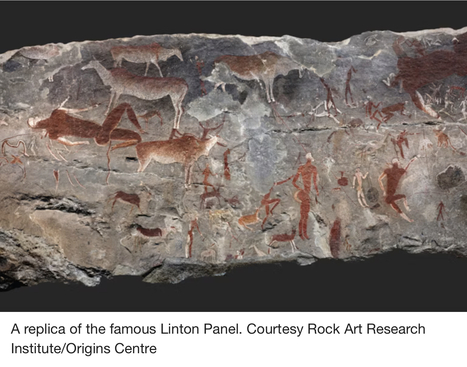
"KhoiKhoiBushman Indigenous People of South Africa put on record the attempt to ERASE ORIGINAL Southern Africa Rock Art History in Partnership with Universities and the Rupert Foundation.. We do not acknowledge this "New Rock Art" as the original Linton Panel discovered in 1918." KhoiKhoiBushman Indgenous People of South Africa, as official recognnized by the United Nations in 2007does not include Bantu Xhosa West African Settlers, who are the Black Majority in South Africa. We REJECT this claim by Bantu Xhosa's in its entirety. __________________________________________________________________ 9 January 2023 - Wits University The exhibition titled ǃke e꞉ ǀxarra ǁke [‘People who are different’, ‘come together’], celebrates the rock art of the San people and is on display now at the Or The Rock Art Research Institute (RARI), in collaboration with the Origins Centre at Wits University, launched an exhibition of a new ultra-high-resolution facsimile of the exceptional San rock art panel. The panel contains the original painted image chosen for the national coat of arms. The exhibition, titled ǃke e꞉ ǀxarra ǁke , which translates to ‘people who are different’, ‘ come together’, celebrates the rock art of the San people, the first inhabitants of southern Africa. The exhibition explores the tales of the San people’s way of life, from religion and beliefs, to the way they hunted or experienced weather. It is an indigenous archive of San tradition. “The Rock Art Research Institute here at Wits is the first of its kind in the world. From the 1980s, its scholars, led by Professor David Lewis-Williams, joined the academic world to bring indigenous history and images to life,” said Professor Zeblon Vilakazi, Wits Vice-Chancellor and Principal. He added that this archive provided an almost inexhaustible resource for the arts. It was in the year 2000 that former President Thabo Mbeki approached RARI in search of an indigenous art image for the coat of arms of the new South Africa. Scholars referred Mbeki to the famous Linton panel, a large slab of rock measuring 2m by .8m and recovered from a rock shelter on a farm named Linton in 1918. The panel came to prominence after a male figure from the panel became the figure we see today in the national coat of arms. Wits Emeritus Professor and rock art specialist David Lewis-Williams was invited to translate the ancient San language for the national motto. He chose the |Xam words “ǃke e꞉ ǀxarra ǁke” from the phrases “people who are different” and “come together”. “One of the things we constantly come across is the genocide of the Khoi San people in the 18th and 19th centuries. So it is wonderful to have their language displayed in our coat of arms,” said Lewis-Williams. The exhibition also showcases new artwork by |Xam descendant artists at the Bushman Heritage Museum in Nieu-Bethesda. Their work forms part of the Origins Centre exhibition, in a modern |Xam take on the imagery in the national coat of arms. In addition to the Origins Centre exhibition, rock art specialist Jeremy Hollmann released his comprehensively revised second edition book, titled Custom and Beliefs of the /Xam, published by Wits University Press as part of its centenary celebrations in 2022. Hollmann has worked extensively with the Bleek and Lloyd Collection over the past 20 years, using the |Xam testimony as an inspiration and source for exploring the meanings of southern African rock art. “I spent about 69 hours in my chair writing this edition. For roughly two years, this book has been part of our household. The first edition came out in 2004 and I often thought that I am now older and wiser, and I feel that I was able to bring more to the material for this new edition,” said Hollmann. Based on the articles published in the 1930s by Dorothea Bleek in the journal Bantu Studies, Hollman’s revised and expanded edition brings together a wide range of |Xam beliefs and key narratives, as told to Bleek and Lloyd by |Xam teachers. Order Hollmann’s book online via Wits University Press.
17 February 2025 - Nicky Falkof Rural violence is a huge problem in South Africa that deserves a strong response. But white people are not the only casualties. American president Donald Trump has issued an executive order to withdraw aid from South Africa. He was reacting to what he has called the South African government’s plan to “seize ethnic minority Afrikaners’ agricultural property without compensation”. Afrikaners are an ethnic and linguistic community of white South Africans whose home language is Afrikaans. Trump’s outrage is based on a misinterpretation of a new law – the Expropriation Act which came into effect in January 2025. Trump’s action, amplified by provocative comments from billionaire Elon Musk, has reignited debate about the concept of “white victimhood”. We asked Nicky Falkof, who has researched the idea of white victimhood, for her insights. What does ‘white victimhood’ mean? White victimhood refers to a powerful set of beliefs that treats white people as special and different, but also as uniquely at risk. Within this narrative white people see themselves, and are sometimes seen by others, as extraordinary victims, whose exposure to violence or vulnerability is more concerning and important than anyone else’s. White victimhood is usually speculative. It relates not to actual events that have happened, but to white people’s feelings of being threatened or unsafe. Entire political agendas develop around the idea that white people must be protected because they face exceptional threats, which are not being taken seriously by a contemporary world order that fails to value whiteness. This is by no means particular to South Africa; we see it wherever whiteness is predominant. Indeed, ideas about white victimhood play a significant role in the popularity of Trump, whose call to “make America great again” harks back to an idealised past where white people (particularly men) could easily dominate the nation, the workplace and the home. The South African case is important because it plays a central role in global white supremacist claims. These mythologies claim that white South Africans, specifically Afrikaners, are the canary in the coalmine: that the alleged oppression they are facing is a blueprint for what will happen to all white people if they don’t “fight back”. What is its history? We can trace this idea back to the start of the colonial project. In 1660 Dutch East India Company administrator Jan van Riebeeck planted a hedge of bitter almond shrubs to separate his trading station from the rest of South Africa’s Cape. This hedge was part of a defensive barrier intended to keep indigenous people out of the Dutch trading post, which had been built on top of ancient Khoikhoi grazing routes. On a practical level, van Riebeeck’s hedge was meant to shield Dutch settlers and livestock from Khoikhoi raiders. On a philosophical level, the hedge situated the invaders as the “real” victims, who desperately needed protection from the violence and wildness of Africa. The bitter almond hedge is still seen as an enduring symbol of white supremacy in the country. This early paranoia and securitisation has had a significant effect on white South African culture and anxiety. White people who can afford to do so barricade themselves in gated communities and boomed-off suburban streets, behind high walls topped with razor wire, on the assumption that they are the primary victims of South Africa’s crime rate. In what ways has victimhood been used over the centuries or decades? Ideas about white victimhood have played a role in many of South Africa’s most influential social formations. The 1930s saw a major panic around “poor whites”, which led to commissions of inquiry, upliftment programmes and other attempts at social engineering. The people and institutions behind these initiatives weren’t concerned about poverty in South Africa in general, even though it was becoming more of a problem as the population urbanised. Their only interest was in poverty among white people, drawing on the assumption that it’s wrong or abnormal for white people to be poor, and that this needed to be urgently remedied. These moves were not simply about philanthropy and offering better life chances to poor people; they were about protecting the boundaries of whiteness. Poor whites were seen as a threat to the establishment because they proved that whiteness wasn’t inherently superior. More recently, the victimhood narrative has been a central part of the panic around farm murders and claims of “white genocide”, an old idea that has been popularised and spread online. Rural violence is a huge problem in South Africa that deserves a strong response. But white people are far from its only casualties. Indeed, violent crime affects pretty much everyone in South Africa. When the deaths of white people are explained as part of a targeted genocide undertaken on the basis of race, the message is that they matter more than the deaths of everyone else. Again, this suggests a kind of naturalisation of violence and harm. When terrible things happen to other people they simply happen and are not remarked on. It’s only when white people are affected that they become a pressing issue. Has it helped white South Africans? Has it been effective as a mobilising tool? White victimhood, like the racial anxiety it is part of, is not good for white people. It doesn’t keep them safer or help them to live better lives. That said, it’s been quite effective as a mobilising tool. The apartheid-era National Party was skilled at using white fear for political gain. Its communications constantly played on white fears of the swart gevaar, the “black danger”, which encapsulated the powerful belief that whites were more at risk from black people than vice versa, despite all evidence to the contrary. Similarly, contemporary organisations like the Afrikaner “minority rights” pressure group AfriForum and the Afrikaans trade union Solidarity activate and manipulate white people’s senses of extraordinary victimhood. This drives them further into a defensive position, where everything from farm murders and road name changes to the National Health Insurance bill is designed to attack them personally. White support for these kinds of organisations and the political positions they espouse, whether overtly or covertly, is at least in part driven by the effective manipulation of white victimhood. How effective is it still? It remains disturbingly powerful. The architecture of white supremacy depends on the idea that white people are extraordinary victims. This is the driving notion beneath the great replacement theory, a far-right conspiracy theory claiming that Jews and non-white foreigners are plotting to “replace” whites. It also underpins violent reactions to the global migration crisis and the rise of populism in the north. I don’t think it’s going too far to say that whiteness as a social construction is intrinsically tied to victimhood. The idea that whiteness actually makes people more rather than less vulnerable is likely to remain a central part of white people’s collective psychic imaginary for some time.
Nicky Falkof, Professor, University of the Witwatersrand This article is republished from The Conversation under a Creative Commons license. Read the original article.
Approving Work Programme, Fourth Committee Agrees to Consider Decolonization, University of Peace, Outer Space, Atomic Radiation Items 1 October 2009 General AssemblyGA/SPD/421 Department of Public Information • News and Media Division • New York Approving Work Programme, Fourth Committee Agrees to Consider Decolonization, University of Peace, Outer Space, Atomic Radiation Items
In a brief organizational meeting today, the Fourth Committee (Special, Political and Decolonization) approved its work programme for the current session, during which it planned to consider more than a dozen topics, ranging from the peaceful uses of outer space to the University of Peace and the decolonization of the remaining non-self-governing territories.
Meeting for the first time since the start of the General Assembly’s sixty-fourth session, the Committee elected Vice-Chairperson Heidi Schroderus-Fox(Finland). Following that action, Chairperson Nassir Abdulaziz Nassir (Qatar) introduced the other Vice-Chairs, Reniery Valladares (Honduras)and Ridas Petkus (Lithuania), as well as the Committee’s Rapporteur Khalid Ali (Sudan).
According to its work programme (document A/C.4/64/L.1),the Committee would consider a cluster of items relating to decolonization, among them, implementation of the Declaration on the Granting of Independence to Colonial Countries and Peoples, during its general debate from 5 to 9 October.
Further in that regard, an aide-mémoire and an addendum (documents 01/09 and 01/09/Add.1), containing 96 requests for hearings related to the questions of Gibraltar, Guam, New Caledonia, Western Sahara and the United States Virgin Islands, were issued. The Chief Minister of Gibraltar and the President of the Government of New Caledonia would make statements, the Chairperson announced.
The Committee would devote one meeting to the University of Peace, on 12 October. Three meetings would be devoted to considering peaceful uses of outer space, from 20 to 22 October. The Committee also agreed, as was its tradition, to establish a working group on outer space, to be chaired this year by Colombia.
During three meetings on 13, 14 and 15 October, the Committee would consider questions relating to information. Delegations would also consider the effects of atomic radiation on 16 October, and would hold a comprehensive review of the whole question of peacekeeping operations, from 23 to 28 October. On 29 and 30 October, they would consider assistance in mine action.
In addition, the Committee would consider the United Nations Relief and Works Agency for Palestine Refugees in the Near East (UNRWA) from 2 to 4 November. From 6 to 10 November, it would take up the report of the Special Committee to Investigate Israeli Practices Affecting the Human Rights of the Palestinian People and other Arabs of the Occupied Territories.
Panels and interactive dialogues were scheduled under items on the University for Peace, outer space, questions relating to information, peacekeeping and assistance in mine action, as well as UNRWA.
The Committee expected to complete its work by Wednesday, 11 November, once action had been taken on all draft resolutions submitted under the last two agenda items related to the Middle East.
The Fourth Committee will meet again at 3 p.m. on Monday, 5 October, to begin its consideration of the issues relating to the implementation of the decolonization Declaration.
Special Committee on Decolonization Approves Text Reaffirming Principle of Self-Determination as Fundamental Human Right 19 June 2009 General AssemblyGA/COL/3197 Department of Public Information • News and Media Division • New York Special Committee on Decolonization 10th Meeting (AM)
special committee on decolonization approves text reaffirming principle
of self-determination as fundamental human right
Members Conclude Consideration of Falkland Islands (Malvinas) Question
The Special Committee on Decolonization approved a two-part draft resolution today by which the General Assembly would reaffirm that there was no alternative to the principle of self-determination, which was a fundamental human right.
Acting without a vote, the Special Committee approved the “omnibus” text on 11 Non-Self-Governing Territories, recommending that the Assembly also reaffirm the inalienable rights of their peoples to self-determination, in conformity with the United Nations Charter and General Assembly resolution 1514 (XV) containing the Declaration on the Granting of Independence to Colonial Countries and Peoples.
By part A of the text, the Assembly would reaffirm also that it was ultimately for the peoples of the Territories to determine freely their future political status in accordance with the Charter, the Declaration and the relevant resolutions. It would reiterate its long-standing call for the administering Powers, in cooperation with the territorial governments and appropriate United Nations bodies, to develop education programmes to foster awareness of their right to self-determination in conformity with the legitimate political status options.
The text ‑‑ titled “Questions of American Samoa, Anguilla, Bermuda, British Virgin Islands, Cayman Islands, Guam, Montserrat, Pitcairn, Saint Helena, Turks and Caicos Islands, and the United States Virgin Islands” ‑‑ would have the Assembly stress the importance of the Special Committee being apprised of the views and wishes of the peoples of those Territories and enhancing its understanding of their conditions, including the nature and scope of the existing political and constitutional arrangements between them and their respective administering Powers.
Further by the text, the Assembly would stress the importance of the various constitutional exercises in the respective Territories administered by the United Kingdom and the United States, and led by the territorial governments, designed to address internal constitutional structures within the present territorial arrangements. It would, by further terms, request the administering Powers to continue to transmit regularly to the United Nations Secretary-General information called for under Article 73 e of the United Nations Charter. It would also call upon the administering Powers to participate in the work of the Special Committee in order to implement the provisions of Article 73 eand the Declaration.
With an eye on the ongoing global economic turmoil, the Assembly would reaffirm the responsibility of the administering Powers to promote the economic and social development of the Territories and help soften the impact of the crisis, while consulting with the respective territorial governments with the aim of strengthening and diversifying their respective economies.
On environmental issues, the Special Committee would recommend that the Assembly request the Territories and the administering Powers to protect and conserve the environment of the Territories against any degradation. It would also request specialized agencies to continue monitoring environmental conditions in the Territories and provide assistance, in accordance with their prevailing rules of procedure.
Part B of the text deals with each of the 11 Non-Self-Governing Territories. On American Samoa, the Assembly would stress the importance of the invitations previously extended to the Special Committee by the Governor to send a visiting mission, and call upon the administering Power to facilitate such a mission if the territorial government so desired.
Regarding Anguilla, the Assembly would welcome the Constitutional and Electoral Reform Commission’s report of 2006, including the holding of a public forum in April 2008 to address constitutional reform issues and the subsequent agreement to seek full internal self-government, short of political independence. It would request the administering Power to assist the Territory in its current efforts with regard to advancing the internal constitutional review exercise, if requested.
In the case of Bermuda, the Special Committee recommended that the Assembly stress the importance of the 2005 report of the Bermuda Independence Commission, which provided a thorough examination of the facts surrounding independence. It would express regret that the plans for public meetings and the presentation of a Green Paper to the House of Assembly followed by a White Paper outlining the policy proposals for an independent Bermuda had so far not materialized.
On the British Virgin Islands, the Assembly would welcome the Territory’s new constitution, which took effect in June 2007, and note the continued need expressed by the territorial government for minor constitutional amendments in the years to come. It would also welcome the Territory’s efforts to focus its economic base more on local ownership and professional industries other than financial services.
Concerning the Cayman Islands, the Assembly would welcome the finalization of a new draft constitution in February 2009 and its subsequent acceptance by referendum in May. It would also welcome the efforts of the territorial government to address cost-of-living issues in various economic sectors, and welcome also the Territory’s participation as a new associate member of the Economic Commission for Latin America and the Caribbean (ECLAC).
On Guam, the Assembly would request the administering Power to take into consideration the expressed will of the Chamorro people as supported by Guam voters in the referendum of 1987. It would request the administering Power to continue to transfer land to the original landowners of the Territory, and continue to recognize and respect their political rights, culture and ethnic identity as Chamorro people of Guam, while taking all measures necessary to address the concerns of the territorial government with regard to immigration.
The Assembly would, in respect of Pitcairn, request the administering Power to continue its assistance for the improvement of the population’s economic, social, educational and other conditions, and to continue its discussions with the territorial government on how best to support economic security in Pitcairn.
Regarding Saint Helena, the Assembly would request the administering Power and relevant international organizations to continue to support the territorial government’s efforts to address socio-economic challenges, including unemployment and limited transport and communications infrastructure.
Concerning the Turks and Caicos Islands, the Assembly would recall the Constitution of the Territory, which took effect in 2006, and note the territorial government’s view that that there remained scope for a degree of delegation of the Governor’s power to the Territory so as to secure greater autonomy. It would note with concern the ongoing situation and also the need to restore good governance and sound financial management. The Assembly would welcome the territorial government’s continuing efforts to address the need for enhanced social cohesion.
With regard to the United States Virgin Islands, the Assembly would request the administering Power to facilitate the process of approval for the territorial draft constitution in the United States Congress, once agreed upon by the territorial government. It would also reiterate its call for the Territory’s inclusion in regional programmes of the United Nations Development Programme (UNDP), consistent with the participation of other Non-Self-Governing Territories.
In other business, the Special Committee concluded its consideration of the question of the Falkland Islands (Malvinas), following its approval yesterday of a draft resolution recommending that the Assembly call for direct negotiations between Argentina and the United Kingdom over that Non-Self-Governing Territory. That text, approved without a vote, acknowledged the “special and particular colonial situation”, which differed from others because of a sovereignty dispute between the Governments of Argentina and the United Kingdom.
In today’s debate, some speakers again questioned the application of the self-determination principle to that situation. The representative of Uruguay noted that, according to General Assembly resolution 1514 (XV), the right to self–determination had its limits.
Others speaking today were the representatives of Mali, Brazil, Peru, Honduras, Guatemala, El Salvador, Grenada and Saint Lucia.
The Special Committee will meet again at 10 a.m. on Monday, 22 June, to take up the report of the Caribbean Regional Seminar.
Background
The Special Committee on the Situation with Regard to the Implementation of the Declaration on the Granting of Independence to Colonial Countries and Peoples met this morning to continue its consideration of the question of the Falklands Islands (Malvinas).
Known informally as the Special Committee of 24 on Decolonization, it was also expected to take action on an “omnibus” draft resolution entitled “Questions of American Samoa, Anguilla, Bermuda, British Virgin Islands, Cayman Islands, Guam, Montserrat, Pitcairn, Saint Helena, Turks and Caicos Islands and the United States Virgin Islands”.
Statements
DONATUS KEITH ST. AIMEE ( Saint Lucia) noted that the issue had been before the Special Committee for many years and it was caught “between a rock and a hard place” as both Governments claimed sovereignty over the Islands. That made negotiations very difficult, and there was a need to create a sound basis for such talks to proceed. While concerned about the Special Committee’s efforts to pass many resolutions over the years rather than resolving the issue, he said the text approved yesterday included issues that could let the situation move forward. It was logical to take into account the interests of the inhabitants, he said, expressing the hope that negotiations would take into account the interests of all three parties, the third party being the islanders, whose interest could not be negotiated away. In such a spirit, negotiations could lead to a resolution.
OUMAR DAOU (Mali), reaffirming his country’s attachment to the principles of the United Nations Charter, said the question of the Malvinas had been on the agenda for many years, with the Special Committee having approved a number of related resolutions by consensus. It was regrettable that the matter had not yet been resolved, he said, appealing to the United Kingdom and Argentina to create conditions favourable to implementation of the relevant resolutions. Mali would continue to support all efforts to bring both parties to the negotiating table in pursuit of a peaceful and lasting solution.
MARIA LUIZA RIBEIRO VIOTTI (Brazil), associating herself with yesterday’s statement on behalf of MERCOSUR (Southern Common Market), said a special and particular colonial situation remained in the Malvinas that, as recognized in resolution 2065 (XX), Argentina and the United Kingdom must settle by peaceful means, in accordance with relevant resolutions. Brazil supported the legitimate rights of Argentina in the sovereignty dispute over the Islands, she said, recalling that the Presidents of MERCOSUR’s member and associated States had reaffirmed in December 2006 the provisions of the 1996 Declaration of Portero de los Funes, which reiterated the incompatibility of recent initiatives with the existence of the sovereignty dispute.
Several other regional organizations and forums, including last week’s General Assembly of the Organization of American States shared the call for a prompt resumption of negotiations, she said. Brazil welcomed the diplomatic facilitation, announced on 26 May by Argentina and the United Kingdom, of the initiative by the Commission of Relatives of the Fallen in the Malvinas and South Atlantic Islands to inaugurate the monument at the Darwin Cemetery, with the expected trip of hundreds of Argentine relatives to the Malvinas in October. She encouraged a similar spirit of dialogue for a prompt, early and successful resumption of bilateral negotiations and a substantive solution to the Malvinas question.
The year 2010 would not only mark the conclusion of the Second International Decade for the Eradication of Colonialism, she noted, but also 45 years since the General Assembly had expressed, for the first time, the need for bilateral negotiations between the two parties. Almost five decades since that call concerning a colonial occupation that had continued for more than 175 years, the resolutions of the Assembly and the Special Committee deserved respect and a willingness to negotiate on the part of both parties. Brazil expected that, in its next session, the Special Committee would succeed in contributing to substantive progress in the peaceful resolution of the sovereignty dispute over the Malvinas, according to the specificity of that colonial situation, the principles of the Charter and relevant resolutions.
GONZALO GUTIÉRREZ (Peru), associating himself with the MERCOSUR statement, said his country supported the efforts by the United Nations to end colonialism, a process that had seen great success over the years. It was a trend that could not be stopped. However, the question of the Malvinas was unique. Peru’s support for Argentina’s sovereignty over the Islands was based on history, geography and the law. Noting that Argentina had enjoyed control over the Territory until the plundering in 1833, he called for the resumption of negotiations between the Governments of Argentina and the United Kingdom, saying there was no other path.
JORGE ARTURO REINA IDIAQUEZ (Honduras) emphasized the “hemispherical dimension” of the Malvinas question, saying that the countries of the region advocated a peaceful solution, with full respect for Argentina’s sovereignty and territorial integrity. Heads of State attending the General Assembly of the Organization of American States in Honduras at the beginning of June had called upon Argentina and the United Kingdom to resume negotiations for a peaceful solution as soon as possible and for the normalization of relations between the two countries. The resolution adopted following Argentina’s presentation at that Summit welcomed its declaration of willingness to stand by its commitment to look into all possible ways to resolve the situation. Honduras believed in recourse to international forums and dialogue whenever bilateral negotiations failed, but, in accordance with international law, no territory obtained by force could be considered legally owned.
GERT ROSENTHAL (Guatemala) said that one of the principles of the United Nations was to ensure that the people of the world enjoyed the greatest level of self-government possible and that millions of people had freed themselves. Decolonization was one of the Organization’s successes and many countries had managed to achieve it. Despite that great success, the United Nations had not met all its targets and 16 Non-Self-Governing Territories remained on its list, including the Malvinas, South Georgia and South Sandwich Islands, as well as the surrounding maritime areas.
Since 1965 the United Nations had recognized a sovereignty dispute over that Territory, which was a special situation, he said. In 1833, part of Argentina’s territory had been occupied by force and its Argentine population displaced. Guatemala supported the special mandate and hoped that the Governments of Argentina and the United Kingdom would resume bilateral negotiations as soon as possible to achieve a just and lasting solution. Argentina had shown its willingness to resolve the dispute in a manner recognized by the Organization. Guatemala urged the United Kingdom to follow up on appeals for a resumption of the talks, and hoped that the new call for negotiations, set out by the draft resolution approved yesterday, would continue to move towards the aim set out by the United Nations in 1965.
CARMEN MARÍA GALLARDO HERNÁNDEZ (El Salvador) said the Malvinas question should be resolved on the basis of Argentina’s sovereignty and territorial integrity, a view based not only on bilateral and regional solidarity, but also on the fundamental principles of international law and natural rights that were geographical, legal and historical in nature. The need to resolve that situation had been reaffirmed in numerous resolutions of the United Nations and the Organization of American States.
She said various arguments presented by the colonial Power, seeking to justify its presence on the Islands and to remain there, represented a unilateral interpretation of how to address the question, she said. It failed to take into account that the Malvinas question was a sovereignty dispute, as recognized by the colonial Power in the 1965 notification regarding the willingness of both parties to initiate negotiations, in keeping with resolution 2065, which had been adopted unanimously by the General Assembly.
That resolution contained a mutual recognition by the parties of the existence of a colonial situation, she said. Both Governments had agreed to initiate negotiations towards a peaceful resolution of the problem and the same appeal to resume negotiations had been reiterated at a recent Ibero-American Summit held in El Salvador. It was the colonial Power’s moral and political duty to follow a diplomatic path.
JOSÉ LUIS CANCELA (Uruguay), endorsing the MERCOSUR statement, said his country supported the legitimate right of the Argentine Republic to sovereignty over the Malvinas, South Georgia and South Sandwich Islands and the surrounding maritime areas. Uruguay reiterated the justness of the Argentine claim and called for the matter to be resolved in a manner approved by the United Nations and the Organization of American States. The Malvinas question was a special case since it involved a sovereignty dispute. General Assembly resolution 1514 pointed out the limits to the right of self–determination. This Malvinas question was also one of the territorial integrity of Argentina. Studies and legal experts had acknowledged that country’s connection with the islands until 1833. A peaceful solution was the obligation of both sides and he urged them to implement the resolutions already passed by the Assembly for the benefit of the entire South Atlantic.
DESSIMA M. WILLIAMS (Grenada), noting that her statement yesterday had not discussed the issue of rights and obligations, reiterated her country’s long-standing position that there were contending rights of self-determination and sovereignty in the matter of the Falklands (Malvinas). Those were the Charter principles that Saint Lucia encouraged the parties to take into consideration in their discussions.
Action on Draft
The Special Committee then took up a draft resolution titled “Questions of American Samoa, Anguilla, Bermuda, British Virgin Islands, Cayman Islands, Guam, Montserrat, Pitcairn, Saint Helena, Turks and Caicos Islands, and the United States Virgin Islands” (document A/AC.109/2009/L.9), which addresses the situation in each of those Non-Self-Governing Territories. By its terms, the Special Committee would recommend that the General Assembly reaffirm that, in the process of decolonization, there was no alternative to the principle of self-determination, which was also a fundamental human right.
By other terms of the text, the Assembly would reaffirm the responsibility of administering Powers to promote the economic and social development of Non-Self-Governing Territories, preserve their cultural identity and to mitigate, as a priority, the effects of the current financial crisis, where possible, in consultation with the territorial governments concerned, towards the strengthening and diversification of their respective economies.
Also by the text, the Assembly would further request the Territories and the administering Powers to protect and conserve the environment against any degradation, while also requesting the specialized agencies concerned to continue to monitor environmental conditions in the Territories and to provide assistance to them, consistent with their prevailing rules of procedure. The Assembly would, by further terms, stress the importance of constitutional exercises in the Territories administered respectively by the United Kingdom and the United States, and led by territorial governments, and decide to follow closely developments concerning their future political status.
The Special Committee approved the draft resolution without a vote.
Special Committee on Decolonization Unanimously Approves Text Calling for Direct Negotiations over Falkland Islands (Malvinas) 18 June 2009 General AssemblyGA/COL/3196 Department of Public Information • News and Media Division • New York Special Committee on Decolonization 9th Meeting (AM)
special committee on decolonization unanimously approves text calling for direct
negotiations over falkland Islands (malvinas)
Members Hear from Foreign Minister of Argentina, Petitioners, Including Members of Territorial Legislative Assembly
Having heard a statement by the Foreign Minister of Argentina in addition to petitioners from the Falkland Islands (Malvinas), the Special Committee on Decolonization recommended today that the General Assembly call for direct negotiations between Argentina and the United Kingdom over that Non-Self-Governing Territories.
Introducing the draft resolution, which the Special Committee approved without a vote, Chile’s representative said the text reflected the main elements of the doctrine formulated by the United Nations over the years with regard to the question of the Falkland Islands (Malvinas). It acknowledged the “special and particular colonial situation”, which differed from other colonial situations owing to the existence of a sovereignty dispute between Argentina and the United Kingdom. The text also specified that the only way to put an end to the question was through a negotiated settlement of the dispute between the Governments of the two countries.
Noting that the text requested the parties to consolidate the process of dialogue and cooperation by resuming negotiations in pursuit of a solution, in accordance with United Nations resolutions on the subject, he expressed regret that, despite the time and numerous resolutions adopted by the United Nations to date, there had been no commencement of direct diplomatic negotiations between the parties with a view to finding a fair and definitive solution to the pending dispute relating to sovereignty over the Malvinas Islands, South Georgia and South Sandwich Islands and surrounding maritime areas.
Addressing the Special Committee prior to action on the draft, Jorge Taiana, Argentina’s Minister for Foreign Affairs, International Trade and Worship, reiterated his country’s “solid and permanent protest” since 1833 over “what was a manifest eviction of the Argentine authorities and population present on the Islands at the time”. The United Kingdom’s actions had fractured Argentina’s political unity and territorial integrity, by an act of usurpation which had been reaffirmed by the ensuing implantation of an alien population and systematic impediments blocking continental Argentines wishing to settle or own lands on the Islands. That alien population could never be considered a subjugated population or one subjected to a colonial Power. To pretend to apply the principle of self-determination to that population was a blunt distortion of reason, justice, law and history.
He pointed out that the United Kingdom called for the application of the principle of self-determination while simultaneously refusing to resume negotiations on sovereignty, thus ignoring the explicit and reiterated mandate of the international community. The United Kingdom alleged that it would only accept a resumption of negotiations should the inhabitants of the Islands so wish, thereby ignoring the will of United Nations Member States. That country was thus unilaterally introducing a precondition that did not figure in any of the relevant resolutions. For its part, Argentina reiterated its willingness to negotiate on the basis of international law, the principles of the United Nations Charter and the provisions of numerous resolutions.
Petitioner Richard Stevens, a Member of the Legislative Assembly of the Falkland Islands (Malvinas), said in that regard that it would be unfair to apply sovereignty rights to the Falklands case alone. “Imagine every country complying with these demands with every international border reverting back to how it was in 1833. Would America for example, return part of California to Mexico, or Russia demand Alaska?” That view of territorial integrity would also lead to unbelievable global chaos.
He went on to say that whoever would be elected to the Legislative Assembly toward the end of 2009 would come to power with a strong mandate regarding the Islands’ right to self-determination. They would ask the Special Committee to examine Argentina’s rhetoric, regardless of that country’s size and influence, and recognize the islanders’ right, as a small community, to live lives of their own choice rather than being swallowed up by an alien Power that saw them as impostors in their own land.
Another Member of the Legislative Council, Janet Robertson, said there were fundamental reasons why there was “no foreseeable prospect” that the United Kingdom would agree to negotiate. Argentina asserted that the principle of self-determination was not applicable due to the pre-existing sovereignty dispute, and that the principle of territorial integrity was of superior validity to that of self-determination.
Annexation by the Argentine State was, therefore, the only acceptable solution to the Government of Argentina, a goal enshrined in its Constitution, she said. That pre-determined outcome was wholly contrary to the wishes and interests of the islanders and, consequently, unacceptable to the United Kingdom. A resumption of negotiations between Argentina and the United Kingdom, without the participation and agreement of the islanders, could not, by definition, lead to a peaceful solution.
Addressing the Committee on behalf of the Southern Common Market (MERCOSUR), the representative of Paraguay said the grouping and its associated States had repeatedly reaffirmed Argentina’s legitimate right in the dispute, a position supported by representatives of several Latin American countries. They had expressed full support for Argentina’s just claim of sovereignty over the Malvinas, South Georgia and South Sandwich Islands and adjoining maritime areas, and urged the resumption of negotiations between Argentina and United Kingdom with a view to finding a peaceful and final settlement to the sovereignty dispute.
Sierra Leone representative, however, while encouraging the parties to engage in peaceful dialogue, taking into account the interests and wishes of the islanders, expressed support for the right of the islanders to exercise their right to self-determination.
Other speakers were representatives of China, Russian Federation, Syria, Venezuela, Cuba, Indonesia, Bolivia, Ecuador, Grenada, Tunisia and Saint Lucia.
Also addressing the Special Committee were two Argentinean petitioners: Dolores Reynolds and Marcelo Luis Vernet.
The Special Committee will continue its debate on the Falkland Islands (Malvinas) at 10 a.m. Friday, 19 June, when it is also expected to take up the situation in all 16 Non-Self-Governing Territories.
Background
The Special Committee on the Situation with Regard to the Implementation of the Declaration on the Granting of Independence to Colonial Countries and Peoples met this morning to hear petitioners on the question of the Falkland Islands (Malvinas). Before it was a Secretariat working paper on the Falkland Islands (Malvinas) (document A/AC.109/2009/13) outlining constitutional and political developments, as well as progress on mine clearance, economic and social conditions, and the future status of the Territory, among other things.
A new Constitution was approved in 2008 and entered into force on 1 January 2009, the working paper says. According to the administering Power, the new document, as compared with the 1985 Constitution, enhances local democracy, establishes a greater degree of internal self-government and provides greater transparency and accountability, such as through the creation of a Public Accounts Committee and a Complaints Commissioner. Moreover, it is in line with the provisions of the European Convention on Human Rights and the International Covenant on Civil and Political Rights. By its terms, the Governor, with the advice and consent of the Legislative Assembly, may make laws for the peace, order and good government of the Territory, but full power to make laws is reserved for the British Crown.
On 6 November 2008, the paper states, the Government of Argentina protested against a “unilateral act” by the United Kingdom “whereby it claims to have adopted a new ‘constitution’ for the Malvinas Islands”, in disregard of General Assembly and Special Committee resolutions and in “violation of the spirit of the provisional understandings under the sovereign formula” reached by Argentina and the United Kingdom. In response, the United Kingdom rejected those assertions on 3 December 2008.
The paper says that on 28 November 2008, the Ninth Meeting of the States Parties to the Convention on the Prohibition of the Use, Stockpiling, Production and Transfer of Anti-personnel Mines and on Their Destruction -- known as the Ottawa Convention -- decided by consensus to grant the United Kingdom an extension until 1 March 2019 to complete mine clearance. At that meeting, the United Kingdom announced its intent to clear three mined areas and set up a national mine action authority.
According to the working paper, the representative of the United Kingdom noted, in a letter to the Assembly President dated 26 September 2008, that the Falkland Islands are not a colonial enclave. Their inhabitants have chosen to retain their link with the United Kingdom and there can be no negotiations on the sovereignty of the Islands unless the islanders wish to do so. In his New Year’s message to the Territory in January 2009, Prime Minister Gordon Brown restated his commitment to the islanders’ right to self-determination against the backdrop of the twenty-fifth anniversary of the conflict over the islands between the United Kingdom and Argentina.
The paper recalls that President Cristina Fernandez de Kirchner of Argentina criticized the United Kingdom in her 23 September 2008 address to the General Assembly, for resolutely refusing to discuss the issue of the Falkland Islands (Malvinas) Territory, requesting that the United Nations once again urge the United Kingdom to comply with international law and demonstrate a serious wish to build a different world and a different citizenry. At a meeting of the Special Committee on 12 June 2008, Argentina’s Foreign Minister, Jorge Taiana, reiterated his country’s inalienable rights over the Malvinas Islands, South Georgia, and the South Sandwich Islands and surrounding maritime areas, unlawfully occupied by the United Kingdom through an act of force.
In a draft resolution on the question of the Falkland Islands (Malvinas), the Special Committee recommends that the General Assembly reiterate that the way to end the special and particular colonial situation of the Falkland Islands (Malvinas) is through a peaceful negotiated settlement of the sovereignty dispute between the Governments of Argentina and the United Kingdom. The Assembly would, by other terms of the draft (contained in document A/AC.109/2009/L.8), take note of the views expressed by the President of Argentina and express regret that implementation of its resolutions on the question of the Falkland Islands (Malvinas) has not yet started in spite of widespread international support for negotiations between the two Governments. The Assembly would further request the two Governments to consolidate the current process of dialogue and cooperation through the resumption of negotiations in order to find a peaceful solution to the sovereignty dispute as soon as possible.
Petitioners
RICHARD STEVENS, Member of the Legislative Assembly of the Falkland Islands (Malvinas), said the Argentines would argue on four main topics: the Spanish colonial claim inherited at independence in 1816; the brief partial and sporadic post-independence occupation before 1833; the Islands’ proximity to Argentina; and the transient nature of the Falklands population. It would be unfair to determine sovereignty rights by those arguments and apply them to the Falklands case alone, but otherwise, the implications would be huge.
“Imagine every country complying with these demands with every international border reverting back to how it was in 1833,” he said, asking whether the United States, for example, would return part of California to Mexico, or the Russian Federation demand Alaska. Such claims of territorial integrity would also mean unbelievable global chaos. It was better to concentrate on the islanders and their achievements, while demonstrating how they had earned their right to determine their own future.
He said that, while the islanders were accused by Argentina of being an itinerant, planted people shipped in by the British, their historic diversity continued to the present time, with individuals and families hailing from all over the world. They had a strong identity and knew the people who had built the Territory, from its roads, farms, shops and hotels to its businesses and modern private sector. All reasonable nations looked to negotiations as the way forward in the modern world, but Argentina was talking about the islanders’ total capitulation, a completely different concept.
Argentina would introduce the modern equivalent of the very thing that the Special Committee had been created to dissolve, he continued. Whoever was elected to the Legislative Assembly towards year’s end would come to power with a strong mandate regarding the Islands’ right to self-determination. They would ask the Special Committee to examine Argentina’s rhetoric, regardless of its size and influence, and recognize the islanders’ right, as a small community, to live lives of their own choice rather than be swallowed up by an alien Power that saw them as impostors in their own land.
JANET ROBERTSON, Member of the Legislative Assembly, said there were fundamental reasons why there was no foreseeable prospect that the United Kingdom would agree to negotiate. First of all, the islanders’ right to self-determination had been extended through the Constitution. Argentina asserted that the principle of self-determination was not applicable to the Falkland Islands due to a pre-existing sovereignty dispute and that the principle of territorial integrity was of superior validity to the principle of self-determination. The Argentine State’s annexation of the Islands was therefore the only acceptable solution to the Government of Argentina and, as such, was a goal enshrined in its Constitution. That predetermined outcome was wholly contrary to the wishes and interests of the islanders and consequently unacceptable to the United Kingdom.
She said that a resumption of negotiations between Argentina and the United Kingdom without the participation and agreement of the inhabitants could not, by definition, lead to a peaceful solution unless the express wishes of the islanders were deliberately and cynically silenced by force. While there was no apparent threat of a repetition of Argentina’s 1982 invasion, it was evident that other types of force were an ongoing facet of relations between the two countries, thereby pre-empting peaceful negotiations. They included withdrawal from regional cooperation on fisheries and hydrocarbons until such time as sovereignty was placed on the agenda; the ban on charter flights across Argentine airspace unless Argentine carriers were used to and from Argentine airfields; and the insistence on the use of “Puerto Argentino” instead of “ Stanley” for the Territory’s capital. Those actions pointed to a level of aggression that was not peacefully intended.
Such actions made peaceful cooperation on areas of mutual interest an ever-receding dream in the South Atlantic, she continued. Argentina claimed that those actions were in response to “unilateral” actions by the Government of the United Kingdom, such as the extension of its fisheries licensing regime to include 25‑year fishing quotas. In fact, those legitimate measures were the result of the Falkland Islands Government using its powers to develop long-term protection and development of its fisheries and represented sound management practices for the benefit of the islanders and the environment. Resolutions on the questions of Gibraltar and the Falkland Islands (Malvinas) were alone in referring, not to the inalienable right of the respective inhabitants to self-determination, but merely to the interests of the population.
It had never been clearly established why the Special Committee considered that, of all remaining denominated colonial peoples in the world, only Gibraltarians and Falkland Islanders were denied that right, she said. When a 2008 meeting of the Fourth Committee (Special Political and Decolonization) had approved an amendment to remove a recent insertion into a draft resolution –- thus qualifying the principle of self-determination with the words “and where there is no dispute over sovereignty” –-delegates speaking in favour of the motion had expressed their deepest concern at the attempt to qualify one of the principles of the United Nations Charter. In any case, the principle of self-determination did not apply to the Falkland Islands. The Argentine occupation had been very brief, having occurred while their ownership was in plain and documented dispute. Therefore, the Territory had never formed a part of Argentina. They existed as a political entity in its current form for considerable time before the establishment of Argentina’s modern boundaries in the mid-nineteenth century.
DOLORES REYNOLDS, an Argentine economist, said she graduated from the Universidad Nacional de Buenos Aires and was a direct descendent of Tomas Bridges, an Anglican pastor whose name was intimately linked with the history of the Malvinas Islands and Tierra del Fuego.
Stressing that she had spent her childhood in that province of South Argentina, she said there were many deep links between the islanders and the Argentine mainland, and her family’s story illustrated those links. Many British people who had arrived after 1833 understood that the two lands were linked by powerful bonds. The Argentine Republic’s just claim of sovereignty had been taken by force.
She said members of her family and other inhabitants, as well as many British inhabitants, had made a contribution to the culture and life of Argentina. The islanders’ isolation was absurd in the present era of globalization, and everybody would benefit from an end to it. Integration with the Argentine Republic would help provide many benefits, including in the areas of energy, public health, education, tourism and vibrant culture. The Special Committee should insist that the United Kingdom resume negotiations.
MARCELO LUIS VERNET said that, as a citizen of Argentina, he was tied to the Islands through family history. The Malvinas were naturally Argentine land and, since 1824, they had “an estancia”, with workers arriving from all corners of Argentina. “We were the people of the Malvinas”, who had formed a hard-working and hospitable population. An ancestor, Luis Vernet, had been a military commander on the Islands, monitoring compliance with fishing rules.
“Our land was stolen from us by an imperial Power for its own interests, but the Malvinas remained an Argentine land,” he said, stressing that usurpation was a violation not only of civil and political rights, but also of natural law. The sacred duty of the Argentine nation was to ensure the integrity of its name and respect for its rights. The Soledad and Malvina Islands were symbols of national identity and the name “Malvina” was very popular in Argentina. Those truths could not be invented or imposed.
One could not refuse to recognize that there was a sovereignty conflict, he said. Argentina’s Constitution contained a temporary clause which conveyed its conviction of the rightful nature of its claim. The clause was temporary because the country hoped the Islands would be returned. However, the Constitution also referred to respect for the Malvinas way of life. The inhabitants were also part of the Islands’ history. They were citizens of the usurping nation, living on the usurped land, but if one asked their names, one would discover that their fathers were English workers who had arrived during the industrial revolution, without land or future.
He said their history was very similar to that of his own predecessors, adding that people could think alike and work together. One of the possible ends to the story was that the two peoples’ respective grandchildren could go to the port of Soledad to recognize the first Argentine settler on the Islands. They might fall in love, thus closing a wide circle. The Special Committee should promote constructive dialogue between Argentina and the United Kingdom to find a peaceful, just and lasting solution to the sovereignty dispute.
Statements
HERALDO MUÑOZ ( Chile) introduced the draft resolution on the “Question of the Falklands Islands (Malvinas)” (document A/AC.109/2009/L.8), saying it reflected the main elements of the doctrine formulated by the United Nations over the years with regard to that question. The text acknowledged the special and particular colonial situation, which differed from others because of the existence of a sovereignty dispute between the Argentine Republic and the United Kingdom. It also specified that the only way to put an end to that question was a negotiated settlement of the dispute.
He expressed regret that, despite the time and numerous resolutions adopted to date, direct diplomatic negotiations between the parties had not commenced. Chile endorsed fully the statement to be made by the delegation of Paraguay on behalf of the Southern Common Market (MERCOSUR) countries and associated States. Like other Latin American countries, Chile supported Argentina’s rights in the sovereignty dispute.
The issue was of concern to the Western Hemisphere, he said, noting that the thirty-ninth General Assembly of the Organization of American States, held in San Pedro Sula, Honduras, on 2-4 June, had adopted resolution AG/DEC 61, “Declaration on the Question of the Malvinas Islands”. The issue was also a matter of concern to the Ibero-American community. Chile reiterated that there was no valid reason for delaying the solution to the Malvinas question.
JORGE TAIANA, Minister for Foreign Affairs, International Trade and Worship of Argentina, reiterated his country’s “solid and permanent protest” since 1833 over “what was a manifest eviction of the Argentine authorities and population present on the Islands at the time”. The land had been under Argentine sovereignty and peaceful and uninterrupted rule, when in 1833 it had been seized by the United Kingdom, thus fracturing the political unity and territorial integrity of the Argentine Republic. Argentina had never consented to that act of usurpation, which had been reaffirmed with the ensuing implantation of an alien population and systematic impediment to continental Argentines settling or owning land on the Islands. That population could never be considered a subjugated population or one subject to a colonial Power. To pretend to apply the principle of self-determination to that population was a blunt distortion of reason, justice, law and history.
Noting that that the United Kingdom called for the application of the principle of self-determination while simultaneously refusing to resume negotiations on sovereignty, he said it thus ignored the explicit and reiterated mandate of the international community, as contained in successive resolutions of the United Nations, the Organization of American States and many other forums. The United Kingdom alleged that it would only accept a resumption of negotiations if the islanders so wished, ignoring the will of United Nations Member States. It was thus unilaterally introducing a precondition that did not figure in any of the relevant resolutions, seeking to benefit from General Assembly resolution 1514 (XV), distorting its interpretation and altering its primary goal, which was none other than ending colonial situations rather than perpetuating them.
He said that subjecting the resumption of negotiations to the dispute to the “wish” of the islanders was nothing but a trick to which the United Kingdom resorted in order to elude the United Nations imperative. Argentina reiterated its commitment to the right of self-determination but rejected the manipulation of that key principle by a Member State, in favour of a population artificially implanted by that country in a land usurped from Argentina by force, and which formed an indivisible part of Argentine territory. Argentina was not alone in that line of reasoning; the General Assembly had unequivocally ratified the applicability of the principle of territorial integrity to the “Question of the Malvinas Islands” each time that the United Kingdom had sought to include references to the principle of self-determination in draft resolutions on that matter.
The United Kingdom had carried out unilateral actions in the disputed area, distorting the bilateral cooperation agreed under the sovereignty formula, he said. Among those actions were the illicit application of a quota regime on fisheries resources, the illegitimate granting of licences to carry out hydrocarbon activities, and the British refusal to carry out non-scheduled flights between mainland Argentina and the Malvinas Islands. The United Kingdom had also attempted to include parts of the Argentine national territory in its submission to the 1982 United Nations Convention on the Law of the Sea Commission on the Limits of the Continental Shelf, and erected a military base on the Islands. Those actions violated the mandate contained in Assembly resolution 31/49 (1976), which called upon the parties to refrain from taking decisions that would imply the introduction of unilateral modifications while the Islands were going through the process recommended by the United Nations.
He said his country had immediately protested the “constitution” that the United Kingdom had granted to the Islands in November 2008, yet another unilateral action on a part of Argentine territory that contravened United Nations resolutions. The United Kingdom pretended to disguise, behind a supposedly “modern” or “post-colonial” constitutionalism, a colonial situation of special and particular characteristics resulting from the usurpation of Argentine territory by force, the expulsion of a local population and its replacement by one of British origin. Argentina expected the United Kingdom to pursue the path of dialogue in compliance with what had been established by the international community in many resolutions. For its part, Argentina reiterated its permanent willingness to negotiate on the basis of international law, the principles of the Charter and the provisions of numerous resolutions.
ELADIO LOIZAGA (Paraguay), speaking on behalf of the Southern Common Market (MERCOSUR), said MERCOSUR and associated States had reaffirmed repeatedly since the group’s creation the legitimate right of the Argentine Republic in the dispute regarding the Question of the Malvinas Islands. At a meeting in June 1996 the Presidents of the MERCOSUR member countries, as well as the Presidents of Bolivia and Chile, had approved the “Declaración Sobre las Malvinas”, which recorded that the interests of the Hemisphere backed a resolution to the dispute and urged that the two Governments find a quick resolution in conformity with the United Nations and the Organization of American States.
That position had been repeated in June 1999, when the sixteenth meeting of MERCOSUR had approved a new declaration and repeated their commitment to urge the two Governments to resume negotiations. More recently, at the last Summit of MERCOSUR in Salvador, Brazil, in December 2008, the group had reaffirmed the terms of the 1996 Declaration and repeated their support for Argentina’s legitimate rights in the sovereignty dispute. It had also said that unilateral measures were not compatible with decisions of the United Nations. MERCOSUR urged the Special Committee to call on the two Governments to resume negotiations and quickly find a just solution to their long dispute.
LIU ZHENMIN ( China) noted that the General Assembly and Special Committee had always paid attention to the question of the Falklands (Malvinas) and passed resolutions appealing to Argentina and the United Kingdom to engage in negotiations in accordance with the principles of the United Nations Charter. That reflected the aspiration of the overwhelming majority of the United Nations membership. China always held that territorial disputes should be resolved through peaceful negotiations, a principle that should be promoted by the international community. Hopefully the United Kingdom and Argentina would continue to engage in peaceful, constructive dialogue on the question of the Falklands (Malvinas) in pursuit of a peaceful and fair resolution of the issue.
VICTORIA SULIMANI ( Sierra Leone) reaffirmed her delegation’s commitment to the principle of self-determination of all peoples, noting that colonialism in all its forms and manifestations was incompatible with the principles of the Charter, Chapter 11 of which ensured the responsibility of administrating Powers to promote the well-being of the peoples of Non-Self-Governing Territories. It was in that spirit that Sierra Leone supported the position that the population of the Falkland Islands (Malvinas) should be allowed to exercise their right to self-determination.
Sierra Leone believed equally that the sovereignty dispute between Argentina and the United Kingdom should be resolved through peaceful means, in accordance with relevant resolutions, she said. The two countries should be encouraged to engage in peaceful dialogue, taking into account the interests and wishes of the islanders. At the end of the Second International Decade for the Eradication of Colonialism, Sierra Leone remained committed to decolonization, believing that self-determination was a prerequisite for the realization of fundamental human rights
KONSTANTIN DOLGOV ( Russian Federation) voiced support for the draft resolution, saying he hoped it would be approved without a vote. Hopefully it would be in accordance with the framework of bilateral negotiations and resolutions adopted by the General Assembly.
BASHAR JA’AFARI ( Syria) said the statement by the Argentine Minister showed his country’s desire for a peaceful settlement of the issue. Today’s meeting reaffirmed Argentina’s importance to the tasks of the Special Committee. The statement also showed Argentina’s belief in democracy in international relations, which was a foundation of that country’s foreign policy.
He said his country agreed with the stance taken at the Arab-Latin American Summit, held in Doha in March 2009, as well that taken by the “Group of 77” developing countries and China and the Non-Aligned Movement. Syria supported the draft resolution and believed that its approval by consensus would reaffirm the international community’s role in resolving the issue. The resumption of dialogue and meetings between the two Governments would help lead to a solution.
JORGE VALERO (Venezuela), endorsing the MERCOSUR statement, said his country was among the co-sponsors of the draft resolution, as in previous years, and reiterated its full support for Argentina’s just claim of legitimate sovereignty over the Malvinas, South Georgia and the South Sandwich Islands, as well as adjoining maritime areas. Venezuela also reaffirmed that resuming bilateral negotiations for a peaceful, just and lasting solution to the dispute was the right way to resolve the anachronistic colonial situation of the Malvinas. Its firm support of that position had been ratified once again in a joint declaration issued during a visit by President Hugo Chavez to Argentina in May.
At the multilateral level, there had been successive resolutions of the United Nations and statements of the Organization of American States, he noted. Many other forums had urged a prompt solution to the long sovereignty dispute, in support of Argentina’s claims. “We must insist on the need to put an end, as contained in many resolutions on the question of the Malvinas Islands, to the long sovereignty dispute between Argentina and United Kingdom.” In that context, Venezuela encouraged the good offices conferred by the General Assembly and the Secretary-General, aimed at bringing the parties closer together.
He went on to say that 176 years had passed since the act that had disrupted Argentina’s territorial unity and integrity. At that time, the United Kingdom had expelled the population, practising expansion. The Malvinas, South Georgia and the South Sandwich Islands belonged to Argentina, and Venezuela supported the statement by that country’s Foreign Minister, who had justly shown that his country’s claim was entirely just.
ABELARDO MORENO ( Cuba) said the question of the Falkland Islands (Malvinas) was among the issues that had been, for the longest time, under permanent consideration by the United Nations. The Special Committee had approved 43 draft resolutions on that matter, and the General Assembly had adopted 10 resolutions. As defined in resolution 2065 (XX), the question of the Malvinas involved a dispute over the sovereignty of the Islands between Argentina and the United Kingdom. It was clearly stipulated that the dispute should be settled through negotiations, taking into account the objectives and provisions of the Charter, as well as the interests of the islanders. It was a fact that the Malvinas had been occupied in 1833 by the United Kingdom, which had then forcefully expelled the population settled there, subsequently replacing Argentine settlers with British ones. Now Argentine citizens were not even allowed to return or settle on the Islands.
Since then, he said, the Argentine Government had been willing to recover, through negotiations, the exercise of its sovereignty over the Falkland Islands (Malvinas), South Georgia and the South Sandwich Islands, in accordance with relevant resolutions. Regrettably, despite continuous calls by the Special Committee and various Assembly resolutions, a definitive solution to the long sovereignty dispute was no closer today. Cuba reiterated its support for Argentina’s legitimate right in the dispute over the Islands, which were part of that Latin American sister nation. The support had been reiterated at the highest levels and in different regional forums, such as the Rio Group, the Iberoamerican Community of Nations and the South American Community of Nations.
He reiterated his country’s call for a negotiated, just and definitive solution to the dispute at the earliest possible time, taking into account both respect for Argentine territorial integrity and recognition of the islanders’ interests. Cuba urged the United Kingdom to consider the successive calls by the Special Committee to hold negotiations and give a positive response to Argentina’s reiterated willingness to renew the bilateral negotiations process. There must be no unilateral actions modifying the situation of the Islands. As one of the co-sponsors of the draft, Cuba called upon all members of the Special Committee to support it so it could be approved without a vote.
HASAN KLEIB ( Indonesia) said the historical and political background of the Falkland Islands (Malvinas) case formed a particular and special dimension that differed from so-called traditional situations. Resolutions 2065 (XX) and 3160 (XXVIII) took note of the existence of a sovereignty dispute between Argentina and the United Kingdom, and encouraged both parties to seek a peaceful solution to the problem. Both resolutions also identified the need to accelerate negotiations for an early settlement.
Other relevant United Nations resolutions provided guidance on the need to address the case by means of a peaceful negotiated settlement, in the best interests of the islanders, he said, adding that his country therefore urged the resumption of negotiations, in accordance with relevant resolutions and decisions, and based on the principle of territorial integrity and full acknowledgement of the interests of the Islands’ population. Indonesia was heartened to learn of the good relationship established between the two Governments in various areas, and wished to encourage both parties to use that good relationship as a foundation for resuming negotiations and exploring all possible means towards a peaceful and mutually acceptable solution.
PABLO SOLON ROMERO (Bolivia), noting that his country was a co-sponsor of the draft resolution and endorsed the MERCOSUR statement, urged the Governments of Argentina and the United Kingdom to resume negotiations and quickly find a just solution to their dispute. The country that had refused dialogue in that situation enjoyed a privileged seat on the Security Council and the Falklands (Malvinas) situation confirmed that the existence of permanent members was no safeguard of peaceful solutions to conflict. Permanent membership should be abolished in the twenty-first century.
MARIA FERNANDA ESPINOSA ( Ecuador) endorsed the MERCOSUR statement and noted that since 1945, the Argentine Republic had reaffirmed, within the United Nations, its international right to the Malvinas. Ecuador supported consensus approval of the draft before the Special Committee and urged both parties to resume talks as soon as possible. Bolivia also urged the United Kingdom to meet the appeals of the United Nations.
DESSIMA M. WILLIAMS ( Grenada) said she had heard the long and entwined history of the region and lamented the fact that unresolved issues from previous centuries had been carried into the twenty-first century. The numerous resolutions passed by the United Nations on the Falklands (Malvinas) issue should guide the Special Committee. Grenada called for a resumption of talks between the two Governments and looked forward to consensus approval of the draft resolution.
Action on Draft
As the draft resolution was presented for action, the representative of Saint Lucia, speaking in explanation of position, proposed that the last preambular paragraph, reaffirming the need for the parties to take due account of the interests of the Islands’ population, should be included in the operative part of the text in order add “give weight and substance” to it.
The representative of Chile said that in order to continue with the Special Committee’s work, his delegation favoured maintaining the text as presented.
The representative of Saint Lucia responded by saying he was not suggesting a change in language, but wished to highlight something that was dealt with “almost en passant”.
The representatives of Bolivia, Cuba, Venezuela, Ecuador and Grenada voiced their support for the text in its original form, saying it reflected practically all concerns and points of view expressed during consultations. Perhaps the suggestions made would be considered in the future, but for now, members of the Special Committee should support the text, which traditionally was approved by consensus.
The representative of Grenada added in that regard his country’s concerns could be identified in other parts of the text.
MARTY M. NATALEGAWA ( Indonesia) Chair of the Special Committee, said those comments would be duly reflected in the meeting’s records.
Acting without a vote, the Special Committee then approved the draft resolution on the question of the Falkland Islands (Malvinas).
Explanations of Vote
Mr. DONATUS KEITH ST. AIMEE (Saint Lucia) said he had never said that he did not want the draft resolution approved by consensus, but had made a constructive suggestion, and was disappointed that his remarks had been interpreted to mean he was against the draft. Saint Lucia hoped to have an opportunity in a future statement to explain its difficulties with the text.
JALEL SNOUSSI ( Tunisia) welcomed the consensus approval, saying it showed the international community’s commitment to solving the matter definitively. Tunisia hoped the two Governments would return to the negotiating table in pursuit of a just solution.
|
Russia’s Indigenous Communities and the War in Ukraine Russia’s recruitment of soldiers to fight in its war in Ukraine has disproportionately drawn from the country’s Indigenous peoples. Individuals from these communities—most notably Buryats, Tuvans, Kalmyks, as well as members of small-numbered nations—have been recruited at above-average rates and experienced higher-than-average combat death rates. While these elevated recruitment and death rates affects the entire regions where these groups reside—often some of the poorest regions in the country—it is their specific ethnic communities that face the most long-lasting and potentially devastating consequences. Disproportionate Losses According to Alexandra Garmazhapova, president of the Free Buryatia Foundation, at least 2,470 Buryatia residents have been killed in action since the start of Russia’s full-scale invasion of Ukraine. The figure, which is based on open sources and therefore is likely to be an undercount, includes both ethnic Buryats and Russians. In a republic with a population of only 980,000, of which 30 percent are Buryat, this translates to 252 combat deaths per 100,000 residents. For comparison, the number of Muscovites killed in action is estimated at 1,215. In a city of 13.2 million, this translates into 9.2 combat deaths for 100,000 residents. Looking at the broader Moscow region (population 8.7 million), it has suffered 1,236 combat deaths, equating to 14.2 deaths per 100,000 residents. (Data about soldiers killed in action is from Mediazona). Data for Saint Petersburg and the Leningrad region likewise show figures that are much lower than those in Buryatia. “Rational Economic Choice” The Kremlin prefers to recruit troops from remote, impoverished, and sparsely populated regions for both political and economic reasons. Russian law prohibits sending conscripts into active combat zones, especially abroad. The Kremlin, therefore, relies on contract soldiers to fill the ranks of those fighting in Ukraine. In these regions, high levels of poverty make outsized signing and death bonuses an attractive proposition. Buryatia is a case in point. It is one of the poorest regions in the country and has “one of the highest concentrations of military units or military bases in the region per capita,” Maria Vyushkova, a scholar at the University of Notre Dame, told the Kennan Institute’s Russia File podcast last year. According to her, the army has long been one of the region’s largest and most stable employers, offering benefits such as “housing, mortgages, and other perks” that are especially attractive to men with young families. With the start of Russia’s invasion of Ukraine, enlisting in the military became “a rational economic choice,” the Wall Street Journal reported last fall. New recruits are offered high salaries and bonuses that can exceed the national average wage by up to five times. In poor regions, families of killed in action receive “life-changing” sums of up to $150,000—more than a 35-year-old could earn in total “working as a civilian until the age of 60,” according to economist Vladislav Inozemtsev. The Journal also noted that from January of 2022 to November 2024, bank deposits in Buryatia grew by 81 percent. Residential construction was up 32 percent for the year in November 2024, compared with the 2 percent national average. Devastating Impact The smaller the Indigenous group, the higher the impact of these cynical recruitment policies. For some communities, the stakes are existential. According to Pavel Sulyandziga, president of the International Indigenous Fund for Development and Solidarity “Batani” and lifelong advocate for Indigenous peoples, there are 42 small-numbered Indigenous nations living in Siberia and the Russian Far East. Of these, 7 have fewer than 1,000 members, 12 have fewer than 2,000, and none exceed 50,000. For these groups, every loss to recruitment—and certainly every combat death—poses a potential threat to the survival of the entire ethnos. Sulyandziga’s organization estimates that in Khabarovsk region, where military casualties among Indigenous men are disproportionately high, Indigenous communities were targeted for recruitment nearly three times more often than non-Indigenous ones, he said at a recent Kennan Institute webinar. This suggests that the “disproportionately high military casualties among the Indigenous population” in this region are the result of a “disproportionate forced recruitment into the war.” He described a village in Khabarovsk region where, during the “partial mobilization” drive of 2022, the entire male population aged 18 to 50 got recruited, leaving behind only women, children and the elderly. It was only after the women began to raise the alarm that the authorities relented and allowed some of the men to return. Sulyandziga warns that this could have generational consequences. Many small Indigenous communities are already on the brink of extinction, he explained. The recruiting of men from these communities is pushing them even closer the edge—the final step in a long process of dispossession, stemming from loss of their lands and access to traditional hunting, herding, and fishing grounds. If widespread deforestation caused by rapacious logging practices previously accelerated these trends, the war may prove to be the final blow against these communities. Propaganda Does Its Work As in other parts of the country, men returning in coffins have not sparked serious protests in the regions disproportionately impacted by casualties. There are many reasons for that. For one thing, speaking out against the war and the regime has dire consequences. Psychological factors play a role as well. “For a mother who lost her son in the war, it’s hard to accept that his death may have been in vain,” Garmazhapova said. On top of that, “Kremlin propaganda is always one step ahead,” quickly seizing on new cultural trends and repurposing them for its own aims. One example is the patriotic song “Russians Don’t Surrender, Buryats Don’t Run,” which has become a hit. Inspired by an interview with Putin, in which he praised the courage of Buryat soldiers, it invokes pride in Buryat ethnicity while underscoring unity with Russia and Russian patriotism. Propaganda outlets now frequently spotlight Buryat war heroes, portraying them as brave defenders of the “Russian world,” Garmazhapova explained. She noted the “sticky” quality of the song: “You catch yourself humming it even though you disagree with the message.” Russia has also coopted the United Nations to shield itself from international scrutiny and prop up its narratives internationally. According to Sulyandziga, the Kremlin has placed its own representatives in both UN bodies dealing with Indigenous issues: the UN Permanent Forum on Indigenous Issues and the UN Expert Mechanism on the Rights of Indigenous Peoples. Rather than represent genuine Indigenous interests, they are using their positions to promote Russian propaganda and deflect attention from Russia’s abuses of Indigenous populations. Religious authorities in Russia, including Buddhist leaders, are fully under the heel of the state and actively promote pro-war narratives as well, she said. According to one popular narrative, the Buryats are fighting for the “Russian world” in order to preserve the “Mongolian world.” (One possible interpretation of this overt non-sequitur is that the “corrupt” West and “Nazi” Ukraine threaten both.) Buryat Diaspora Growing While few risk protesting, anecdotal evidence suggests that those who can are doing their best to leave the country. In a recent investigation, award-winning journalist Olga Mutovina documented the growing Buryat diaspora in the US. Today, an estimated 10,000 ethnic Buryats live in the US, making it one of the largest Buryat diaspora communities in the world. Gathering information about this group can be a challenge, she notes. When the emigrant society Shambala tried to run a community census, many people declined to participate. Many feared harming their relatives back home. Some did not even tell their loved ones that they had moved to the US. When it comes to Russia’s Indigenous peoples, the effect of Russia’s war in Ukraine goes beyond the tragedy experienced by individual families. Its devastating toll on its Indigenous communities and small-numbered peoples is one of the many unforeseen consequences of this war that Russia will be grappling with for years and decades to come. The opinions expressed in this article are those solely of the author and do not reflect the views of the Kennan Institute.
Attempts to shift the ways disasters have traditionally been managed away from authoritarian, top-down approaches toward more bottom-up and inclusive processes often involve incorporating viewpoints from marginalised and vulnerable groups. Recently as part of this process, there have been calls for greater inclusion of Indigenous peoples in disaster management. In theory, this also suggests a shift in power structures, towards recognising Indigenous peoples as experts in disaster management. However, in popular imagination and policy Indigenous peoples often appear to be caricatured and misrepresented, for instance through tropes of Indigenous peoples as custodians of the environment or especially vulnerable to environmental change. These framings matter because they can result in disaster management policies and practices that do not capture Indigenous peoples' complex realities. However, these framings have not been analysed in the context of disasters. In this article, we aim to better understand these framings through a critical discourse analysis of how Indigenous peoples in disasters are represented in the expert news media. We identify five discourses, including a dominant one of disasters as natural phenomena to be addressed through humanitarianism and technocratic interventions. Such discourses render Indigenous peoples helpless, depoliticize disasters and are justified by framing governments and NGOs as caring for Indigenous peoples. However, we also identify competing discourses that focus on systems of oppression and self-determination in disaster management. These discourse recognise disasters as political and include discussion of the role of colonialism in disaster creation. As care emerged as a means through which intervention was justified, we conclude by asking questions of who is cared for/about in disasters and how that care is performed.
On today’s episode of Justice Matters, co-host Mathias Risse talks with Angela Riley, Chief Justice of the Citizen Potawatomi Nation and Professor of Law and American Indian Studies at UCLA, about indigenous sovereignty and human rights in the United States. Together, they discuss the Citizen Potawatomi Nation, what sovereignty means for tribes in the U.S. compared to indigenous communities globally, the tribal government’s relationship to U.S. federal and state governments, recent changes to the Citizen Potawatomi Nation’s constitution, the Potawatomi judiciary system, and Intellectual Property law in the U.S. and its relation to indigenous knowledge.
The 2021 Indigenous Women Convening for Peace, Justice, and Reconciliation Conference brought together Indigenous scholars and female leaders from seven Indigenous socio-cultural zones around the world. Together, they shared stories of war and conflict in their territories and discussed collective ways of ideating Indigenous conflict resolution and peacemaking processes. The event was organized by the Carr Center for Human Rights Policy; the Committee on Ethnicity, Migration, and Rights; the Scholars at Risk Program; and the Global Alliance of Indigenous Peoples, Gender, Justice, and Peace. Co-sponsors included the Center for the Study of World Religions; the Department of Slavic Languages and Literatures; the Harvard College Writing Program; HUNAP; Religion, Conflict, and Peace Initiative; and the Weatherhead Center for International Affairs. The event was moderated by Jacqueline Bhabha, FXB Director of Research and Professor of the Practice of Health and Human Rights at the Harvard School of Public Health, and Shelly Lowe, Executive Director of the Harvard University Native American Program. Opening remarks were provided by Raquel Vega-Duran, Chair of the Committee on Ethnicity, Migration, and Rights, and Sushma Raman, Executive Director of the Carr Center for Human Rights Policy. This publication features the 10 speakers of the conference and their profound statements on the state of human rights and peacemaking in their respective Indigenous zones. Citations Carr Center Human Rights for Policy. 10/12/2021. Conflict, Militarization, and Exploitation of Indigenous Land and Resources. Cambridge, MA: Harvard Kennedy School.
The World Conference on Indigenous Peoples: A View From Indonesia Global Memo by Authors: Vidhyandika Perkasa, Senior Researcher, Department of Politics and International Relations, Centre for Strategic and International Studies (CSIS), Jakarta; and Nukila Evanty, Executive Director, Rights Foundation, Jakarta PublishedSeptember 22, 2014 3:25 p.m. There are approximately 370 million indigenous peoples comprising around 5,000 tribes in more than ninety countries around the world. While indigenous peoples make up only 6 percent of the world’s population, indigenous territories hold around 80 percent of the world’s remaining biodiversity. Yet, despite this natural wealth, the majority of indigenous populations suffer from economic hardship and poverty, as well as political marginalization by majority groups and discrimination at the hands of their governments. Building on this progress, the UN General Assembly will hold the first UN World Conference on Indigenous Peoples on September 22 and 23, 2014, in New York. This meeting provides a significant forum for indigenous populations and their governments, as well as the private sector, to develop best practices on the realization of the rights of indigenous peoples. The conference will be attended by over 1,000 indigenous representatives, among which will be the Masyarakat Adat communities of Indonesia, including groups such as the Dayak Benuaq, the Orang Tengger, and the Orang Badui. Indonesia represents a worthy case study for countries struggling to adjust policies to help indigenous peoples. Approximately 50-70 million people in Indonesia could be classified as indigenous and they live in almost every province. The upcoming conference presents an important opportunity for Indonesia’s indigenous population to be heard, and for the incoming government to recognize the rights of its indigenous peoples while enacting a reformed strategy to ensure their rights. Indonesia’s Indigenous Peoples Indonesia—a country with more than 13,000 islands spanning over 7 million square km—has a population of 253 million comprising more than 1000 ethnic and sub ethnic groups. While Indonesia has a single national language, Bahasa Indonesia, there are at least 700 local languages spoken throughout the country’s thirty-four provinces. Indonesia’s diversity and multiculturalism form the nation’s rich heritage, but also present significant challenges, particularly relating to the existence of indigenous peoples. Indigenous peoples are often associated with negative labels in Indonesia, such as “living in poverty,” “disadvantaged,” “marginalized,” or “extinct.” Yet, compared to their status during the authoritarian rule in the 1970sthrough thelate 1990s, indigenous peoples tend to be relatively better off in the current democratic era. And they have become engaged in the struggle for their rights, building up their organizational capacity, receiving support from civil society, and pushing for the state to acknowledge indigenous groups through policies, regulations, and the ratification of international treaties. At the forefront of these efforts, the Aliansi Masyarakat Adat Nusantara (Indigenous Peoples Alliance of the Archipelago or AMAN) is a nongovernmental organization that acts as a representative of the indigenous peoples in their struggle for the right to exist and their right to sovereignty in managing their lives and natural resources. AMAN, which is supported by other NGOs such as Forest Watch Indonesia and Friends of the Earth of Indonesia, fronted a major victory in May 2013 when Indonesia’s Constitutional Court adopted a law submitted by the group, effectively handing control of more than sixty million of hectares of government-controlled forest land back to indigenous communities. Despite such progress, indigenous groups still face significant challenges to maintaining their rights vis-a-vis state policies, regulations, and development processes. The outgoing administration of President Yudhoyono has faltered on his election promises to uphold the rights of indigenous peoples. The May 2013 law to return control of forest lands to indigenous groups, for instance, has yet to be implemented by the government, and in May 2014 the government launched a national inquiry due to the continued violation of indigenous groups’ rights, especially related to the rejection or violation of the law by extractives companies and others working under the guise of conservation efforts. In 2012 Indonesia received a troubling assessment in the UN’s first Universal Periodic Review—a report assessing the state of human rights in the UN’s 193 member countries over the course of four years. Commenting on this review, Survival International summed up the continued violation of indigenous communities’ right, noting frankly that “Indonesia treats its indigenous and tribal people…worse than any other country in the world.” The continued denial of the very existence of indigenous peoples in Indonesia is symptomatic of the government’s disregard for indigenous rights. Challenges Facing Indonesia’s Indigenous Peoples There is indeed complexity when talking about the challenges faced by indigenous peoples in Indonesia. The lack of accurate data about the number and locations of indigenous peoples in the country impedes efforts to fully understand their current state. Despite the lack of data, it is commonly understood that indigenous peoples are facing hardship, and widespread poverty is one of the main indicators. Indigenous people frequently lose the rights to their land and other natural resources in the name of development. In addition, the state continues to transfer land ownership to private industrial companies without implementing the process of free, prior, and informed consent. In this case, impoverishment of indigenous peoples is due to the lack of legal recognition of their right to adat (local) and natural resources. In an era of decentralization and increased regional autonomy, governor and heads of district have significant power over land use and the transfer of natural resources. Due to practices of collusion and nepotism made by local elites with national or foreign investors, indigenous communities tend to be disadvantaged. A 2012 report from the International Fund for Agricultural Development (IFAD) points to the example of East Kalimantan, where, due to the lack of legal recognition and protection of customary rights over land and natural resources, “the local government took lands and forests of indigenous peoples and allocated it for logging concessions, mining, and plantations without prior consultation with or adequate compensation to the affected communities.” Due to poverty and remoteness, many indigenous peoples do not have access to proper health and education services. Lack of infrastructure and transportation also poses a barrier that hampers indigenous peoples’ ability to pursue a better life. Another problem is the inability to sell their lands due to the loss of legal rights. The IFAD report notes that “structural inequities and inequalities were further reinforced by the legislation of discriminatory and oppressive land laws which ignored indigenous peoples’ customary land tenure systems and laws. In Indonesia, the indigenous peoples are limited by government policies that do not acknowledge their rights to their traditional lands and natural resources.” In addition, massive logging, plantation, and mining activities have caused pollution and destruction—the UN Environmental Programme estimates that around 98 percent of Indonesia’s natural rainforests could be lost by 2022. This degradation of indigenous peoples’ land and natural resources furthers the cycle of oppression and hardship. The government’s ambitious fifteen-year economic plan (Master Plan for Acceleration and Expansion of Indonesia’s Economic Development) unveiled in 2011 has provoked strong resistance from indigenous peoples and local communities. This includes, the Merauke indigenous community’s opposition to the Merauke Integrated Food and Energy Estate at Urumuka and Mamberamo hydropower stations in Papua, as well as the indigenous community of Central Kalimantan’s opposition to that province becoming a center for large-scale mining. Such projects tend to aggravate conflicts between indigenous or rural communities, and companies or the government. In 2012 alone, HuMa (a local NGO) recorded seventy-two ongoing cases of forestry-related conflicts in an area of more than two million hectares; the conflicts have already resulted in many deaths. The Regulatory Dimensions From a regulatory standpoint, there has been some progress in recognizing indigenous peoples’ rights and sovereignty on paper, but most of these legal conventions have yet to be implemented or enforced by the government in reality. The Second Amendment to the 1945 Indonesian Constitution, for instance, ensures state recognition and respect for societies that live by customary law (that is according to the customs or usual practices of the indigenous communities). Another—the People’s Consultative Assembly Decree No 9/2001 on Agrarian Reform and Natural Resources Management—acknowledges societies that live by customary law with respect to agrarian reform and the management of natural resources. And the Basic Agrarian Law No 5/1960 and Indonesian Forestry Act No 41/1999, both regulate customary law on land, water, and forests. Just as important and related to regional autonomy is Local Government Act No. 32, Year 2004 (which replaced Act No. 22, Year 1999), which states that “Villages, or other forms of settlement henceforth called villages, are units of law-based society which have the authority to manage and take care of local communities’ interests based on their origins and local customs, within district territory and as recognized by the national government system.” It also states that “local government regulations…must recognize and respect villages’ rights, origins and customs”. Act No 39 of 1999 on Human Rights clearly provides an explicit formulation of the recognition and protection of indigenous peoples and their cultural identity. It also recognized property rights and acquisition of property rights, respectively, which become relevant in the framework of protection of indigenous rights. Finally there is also Act No 27/2007 on Coastal and Small Islands Management which recognizes the rights of indigenous peoples to manage coastal and small islands. Indonesia has adopted the International Covenant on Civil and Political Rights and the International Covenant on Economic, Social and Cultural Rightswhich were ratified by the government in 2006. In 2007, the Indonesian government supported the UN General Assembly’s adoption of the Declaration on the Rights of Indigenous Peoples (UNDRIP), which sets the international minimum standard for the protection, respect, and fulfilment of the rights of indigenous peoples, but noted that the text did not apply in the context of Indonesia. Yet the Indonesian government has ratified a number of international conventions on human rights relating to indigenous peoples in the past, including the International Covenant on Civil and Political Rights and the International Covenant on Economic, Social and Cultural Rights. In addition, the government ratified Law No 29/1999 on the Ratification of the International Convention on the Elimination of all Forms of Racial Discrimination 1965and Law No 7/1984 on the Ratification of the Convention on the Elimination of All Forms of Discrimination against Women. Many regulations concerning indigenous peoples often lack clarity. For instance, Act No 32 on the Management and the Protection of Environmentsays “the State admits and respect the unity of indigenous peoples and their traditional rights as long as they are still existing and in accordance with the society development and based on the foundation of Unitary States of the Republic of Indonesia.”And a formal definition of “indigenous peoples” is hard to find in Indonesian laws. National laws use many terms instead of “indigenous peoples,” such as alien tribal communities, neglected communities, remote communities,customary law communities, and communities governed by custom. Moreover, the development of economic policies on the allocation and management of natural resources have often been tailored to benefit the private sector, and have led to environmental and ecological abuses and damage. The victims of these environmental damages are more ofen than not the indigenous communities that reside near the forests or mining locations. And even though Indonesia has ratified the UN Declaration on the Rights of the Indigenous People, the International Covenant on Civil and Political Rights, and the International Covenant on Economic, Social and Cultural Rights,they have not yet been implemented, and no formal state recognition of indigenous peoples exists. In addition to the regulatory issues, there are some recent developments that could support indigenous rights, but which fail to do so in practice. The National Parliament, for instance, has adopted a draft of the Indigenous Peoples Law (RUU PRHMA). Unfortunately the Ministry of Forestry, designated to coordinate the four ministries within the national parliament to finalize RUU PPHMA for adoption, appears to be deliberately delaying the process. If the law is adopted, it will be a significant step toward the recognition and protection of the constitutional rights of Indonesia’s indigenous peoples and will present an opportunity for reconciliation by eliminating discrimination of indigenous groups. However, an initial observation on the RUU PPHMA indicates that the law does not resolve the structural conflicts emerging in Indonesia that concern indigenous peoples. In addition, the new Village Law No 6/2014 was initially expected to present new opportunities and benefits for indigenous peoples in the context of decentralization, since they mostly reside at the village level. However, this law only concerns the governing system without addressing the rights of indigenous peoples. Finally, the previously mentioned constitutional court ruling that customary forest is not state forest means that indigenous peoples of the archipelago will get back their rights over their customary forests, seized by the state through forestry law, which could potentially secure land tenure for up to seventy million indigenous peoples in Indonesia. However, as with many legal matters concerning indigenous peoples, this ruling has yet to be implemented. There is still a long way to go in securing the rights of indigenous peoples. Existing regulations that address the rights of indigenous peoples tend to be cosmetic in nature and lack enforcement capacity. Such regulations tend to focus almost exclusively on economic development, while neglecting indigenous peoples as the subject of that development. In addition, many of these regulations are highly fragmented. In Indonesia, the election of Joko Widodo in July 2014 presents an opportunity to enact change. The president-elect should ensure state recognition of the existence of Indonesia’s indigenous population, while leading legal reforms synergize, coordinate, and integrate laws regarding indigenous populations. In addition, the newgovernment should implement the Indigenous Peoples Law (RUU PPHMA), while incorporating the rights of indigenous peoples into the law andharmonizingRUU PPHMA with existinglegislation. Finally, the new government should include the condition of indigenous peoples in their State Report and Universal Periodic report. At the international level, countries should take action to implement the recommendations set out by the UN Declaration on the Rights of Indigenous Peoples to ensure the civil, political, social, economic, and cultural rights of their indigenous populations. It is important to recognize that the upcoming World Conference on Indigenous Peoples, while an important platform to highlight indigenous people’s issues, is just a forum. Real change will require actionable goals from indigenous populations’ governments. To that end, countries should help their indigenous populations achieve the development goals specified in the conference’s forthcoming outcome document, as well as committing to specific and actionable goals to achieve the recommended human rights standards. Information Global Memos are briefs by the Council of Councils that gather opinions from global experts on major international developments.
The World Today Published 1 April 2001 Updated 26 October 2020 —6 minute READ Britain is about to elect a new government. But how democratic will it be and how does the present one fare on this front? An international audit of democracy, being applied to a number of countries, has produced disturbing findings about the United Kingdom. The centralised executive is seen as an obstacle to protecting civil and political rights. Checks on this power are a myth and there has been a reluctance to redress the imbalance between executive and parliamentary power. David Beetham - Director, Centre for Democratisation Studies, University of Leeds Stuart Weir - Director of Democratic Audit, University of Essex Representative democracy is making fitful progress around the world, with remarkable advances in some regions and major setbacks in others. Its progress is menaced by religious fundamentalism, ethnic domination and conflicts, military coups and war. For every Yugoslavia where the people rose in protest against rigged elections, there is a Zimbabwe where a brutal electoral dictator seeks to perpetuate his corrupt rule by subverting the rule of law, using state and irregular forces to terrorise political opponents and the media, and systematically spreading fear. But there are other more insidious menaces too. People in new and democratising states embrace the idea of democracy with enthusiasm, but that enthusiasm too often turns to disillusionment when they find that they still have limited purchase on power and their daily lives are little changed.
November 14, 2024 • 2:00 – 3:30 pm EST In September the UN Secretary General’s Panel on Critical Energy Transition Minerals released its report Resourcing the Energy Transition: Principles to Guide Critical Energy Transition Minerals Towards Equity and Justice. These principles aim to center human rights as well as the integrity of the planet and environment. They also recognize that “[a] world powered by renewables is a world hungry for critical minerals.” The vital and irreplaceable nature of these minerals alongside the human rights, environmental justice, and equity focus often come into conflict. Human history is rife with examples of this conflict being borne by indigenous peoples. As recognized by the report, “Mining, at all scales, large and small, has too often been linked with human rights abuses, environmental degradation and conflict. Indigenous Peoples’ lands and resources have been dispossessed and the lives of local peoples upended.” The ILO has similarly recognized this concern, resolving to “establish a mechanism for dialogue with indigenous and tribal peoples so as to acquire knowledge and develop a road map for a just transition.” The first of these dialogues is set to be held in Brazil in December 2024. This past cannot be repeated. A just transition would be a boon for populations near mineral wealth that have too often been neglected and would create wealth and advancement for developing states. In order for prosperity to be shared and past human rights abuses to be avoided, real consultation and cooperation is necessary. This discussion aims to bring together experts in indigenous rights and critical minerals to discuss what real consultation and cooperation would look like and how human rights protections can play a vital role in the current critical minerals environment. This event is made possible through generous support from the International Labour Organisation office for the United States and Canada.
South Africa’s land and mining crisis is political and structural, and experts at the 2026 Mining Indaba agree that reform requires collective, democratic community control over land. The coffee was strong, the room was tense, and the choreography of politeness was slipping. At the Investing in Africa Mining Indaba 2026, during a co-hosted breakfast by CNV Internationaal and the Initiative for Responsible Mining Assurance (IRMA) on customary governance and accountability, one question refused to stay quiet: Who truly speaks for the land? It is the question South Africa has tried to dodge for three decades. It unravels the politics of mining, land, legitimacy, identity and justice. It exposes what many communities, activists and even some traditional leaders have long known: our land governance system is collapsing under pressures it was never built to withstand. Across our panel spanning traditional authorities, mining executives, labour, community foundations and social auditors, a rare consensus emerged: the crisis is not technical. It is political. It is structural. It is about power. But amenable through dialogue. This echoes the persistent warning from land activists, who have illuminated the core problem: South Africans cannot meaningfully negotiate mining, conservation, or development without secure, democratic governance over land. Without land rights, communities do not participate; they plead. SA’s land and mining governance framework still carries the imprint of a 20th-century logic: centralised authority, extraction-first economics, and a technocratic state that presumes legitimacy without earning it. Meanwhile: This is unjust and obsolete in a world defined by rising community expectations, AI-powered transparency, climate-driven land pressures and global solidarity networks. Largely, this is why SA’s land and mining debate remains trapped in a zero-sum struggle: commodity versus identity, traditional authority versus democracy, white majority-owned multinational mining house (except Patrice Motsepe and a few others) versus black community. This binary is not a failure of policy. It is a failure of imagination. To break the stalemate, we must flip the script entirely and build a new system in the cracks of the old. Four Innovations That Could Transform SA’s Land Future These aren’t policy tweaks. They are deep systemic redesigns, which are practical, ambitious, and aligned with the urgent demands for land justice voiced across the country. 1. The “Living Land Title”: A Legal Hybrid That Ends the False Choice SA’s land debate has been trapped between two inadequate options: individual freehold (land as commodity) and insecure communal tenure (land as identity without protection). The Living Land Title creates a third way. It is issued to a democratically constituted community entity, such as a trust, cooperative or certified Traditional Council, and guarantees perpetual, secure tenure. Embedded in the title is a Community Consent clause, requiring a supermajority for any lease or sale, protecting against elite capture. A mandatory Intergenerational Commons, including a school, cooperative garden, grazing land, or renewable energy microgrid, ensures shared benefit and intergenerational equity. This title makes land generative commons, not an elite possession. This land reform strengthens democracy, not weakens it. 2. The “Soil & Soul Fund”: Financing Land Justice Without a Bankrupt Fiscus Land reform is trapped because it relies on state budgets and commercial banks, both incapable of funding transformation at scale. The Soil & Soul Fund breaks this dependency. It is capitalised through: - A time-bound Common Good Levy on agricultural exports, mining revenues and commercial farming profits.
- Diaspora bonds inviting global South Africans to invest in land justice.
- A mandated allocation from large pension funds, especially those built on the labour of communities that lost land.
The fund finances land acquisition, post-settlement support, regenerative agriculture and cultural restoration, such as memorials, heritage sites and renewal centres. It shifts the narrative from “state must pay” to a shared national social contract, acknowledging historical debt while investing in collective futures. 3. The “Customary Constitution”: Renewing Ancestral Governance in a Modern Era One of the deepest tensions in rural SA lies in the gap between imposed forms of traditional authority and the lived expectations of communities whose governance practices have always been collective, relational and accountable. The Customary Constitution draws directly from these indigenous principles. It offers a community-driven, culturally grounded process through which people can affirm, in their own language, customs and values, the rules that guide their shared life. Through inclusive dialogue, the community defines: - How leaders emerge and are entrusted with authority, based on service, lineage, merit and community confidence.
- How land is held, shared and allocated, reflecting ancestral practices of custodianship rather than ownership.
- How disputes are resolved, using restorative and consensus-based mechanisms.
- How consent for mining or development is given, through collective deliberation rather than individual signatures.
Once affirmed through broad community agreement, the Customary Constitution becomes a recognised expression of the community’s will, binding on all, including companies seeking access to land. This approach renews the oldest African governance principle: authority flows from the people, not over them. It moves power away from individuals acting without accountability and restores it to the collective, where Free, Prior and Informed Consent becomes a living practice rooted in tradition, not a bureaucratic ritual imposed from outside. 4. The “Generational Tribunal”: A Living Archive of Land and Renewal SA operates a mixed legal system, a hybrid of Roman-Dutch civilian law, English common law, customary law and religious personal law, yet cannot process the full weight of historical land dispossession. Many claims are lost, undocumented or buried in trauma. The Intergenerational Tribunal is a non-judicial, statutory body that: - Investigates and publicly witnesses past and ongoing land injustices.
- Collects oral histories and genealogies.
- Maintains a public digital archive.
- Issues Certificates of Moral Claim that communities can use in land negotiations.
- Protects the intergenerational wealth and wellbeing of future generations.
It transforms buried pain into visible knowledge. It creates a national memory too powerful for policymakers to ignore. More importantly, it allows healing, not forgetting, to shape the future. These innovations matter because each disrupts a different layer of the system: - The Living Land Title rewrites the rules of property.
- The Soil & Soul Fund rewrites the financing logic.
- The Customary Constitution rewrites the power dynamics.
- The Intergenerational Tribunal rewrites the national narrative.
Together, they form the foundation of a new land governance regime, embedded with pluralistic, generative, democratic principles. They answer the question that echoed in that Mining Indaba room: Who speaks for the land? The response should be: The people rooted in it. Democratically. Collectively. With dignity and power. It is clear that SA’s mining crisis is not technical; it is a crisis of governance and imagination, a land crisis, a democracy crisis. The land is speaking. Communities are speaking. History is speaking. The future is calling. The only question left is: Will we finally listen? This article was first published by the Daily Maverick. The views expressed in this publication/article are those of the author/s and do not necessarily reflect the views of the South African Institute of International Affairs (SAIIA).
"KhoiKhoiBushman Indigenous People of South Africa put on record the attempt to ERASE ORIGINAL Southern Africa Rock Art History in Partnership with Universities and the Rupert Foundation.. We do not acknowledge this "New Rock Art" as the original Linton Panel discovered in 1918." KhoiKhoiBushman Indgenous People of South Africa, as official recognnized by the United Nations in 2007does not include Bantu Xhosa West African Settlers, who are the Black Majority in South Africa. We REJECT this claim by Bantu Xhosa's in its entirety. ______________________________________________________________ A new exhibition in Johannesburg titled ǃke e꞉ ǀxarra ǁke – People who are Different: Come Together celebrates the rock art of the San people, the first inhabitants of southern Africa. Presented by the University of the Witwatersrand’s Rock Art Research Institute and the Origins Centre, the exhibition includes an ultra-high-resolution facsimile of a San rock art panel called the Linton Panel. The panel contains the image chosen for South Africa’s national coat of arms. The exhibition also features a new artwork by descendants of the San people, as well as a book launch. We asked the head of the institute, Sam Challis, to tell us how the painting rose to such national prominence. Who are the San and what’s their rock art about? The names San and Bushman refer to the indigenous hunter-gatherers of southern Africa, and their descendants, whose ancestors lived here for many thousands of years. Both names have been used pejoratively – as demeaning terms – for centuries. But now both have been reclaimed as identities to be worn with pride. Some groups prefer either one term or the other, depending on the historical use in their region. South Africans prefer the word San while those in the Kalahari Desert region – and the artists from Nieu Bethesda in South Africa whose work we commissioned for the new exhibition – prefer Bushman. The rock art is an indigenous archive of San religion: their beliefs about how to transcend realms to heal the sick, influence the movements of animals and control the weather. It is not a “menu” of animals they liked to eat, and these are no idle doodles or simple “records” of events. An explanation of the Linton Panel (click to enlarge). Courtesy Rock Art Research Institute In the 1860s and 1870s, two linguists, Bleek and Lloyd, recorded the language of San Bushmen prisoners being held in Cape Town. Later, scholars realised that these |Xam (San/pronounced “Kgamm”) testimonies produced a “fit” with rock art images, which until then had been poorly understood. Dorothea Bleek’s 1932 study Customs and Beliefs of the |Xam Bushmen proved an almost inexhaustible resource for understanding this religious art from the perspective of the artists. Especially when these beliefs intersected with those of the Maloti Mountain San and Kalahari Bushmen, and other communities who inherited them. What San painting was used in the coat of arms? In 2000, President Thabo Mbeki’s office approached the Rock Art Research Institute because they wanted an indigenous rock art image to grace the coat of arms of the new South Africa. (The old shield had contained ox wagons and other colonial images.) The institute’s scholars offered several appropriate options, and the government chose the human figures from the famous Linton Panel, which is displayed at Iziko South African Museum in Cape Town. The design for the coat of arms. Courtesy Rock Art Research Institute With various partners we have reproduced the panel digitally. The art can now be viewed on an interactive zoom console in which visitors can highlight various motifs with explanations. The two human figures come from one painting of a male figure. In the original, he most likely represents a San healer and game control specialist. He’s been mirrored and stylised to form a gesture of greeting. How did a San phrase become a national motto? Mbeki’s office also asked the institute to deliver a new national motto using the |Xam San language. Our professor, David Lewis-Williams, chose the |Xam words “ǃke e꞉ ǀxarra ǁke” from the phrases “people who are different” and “come together”. It can be translated as “diverse people, unite”. The language is no longer spoken (and so does not favour any of the country’s 11 official languages) but it is important to recognise that the people survive. There will be 16 individuals of |Xam descent at the opening, from the Bushman Heritage Museum. Three of these are the artists whose work forms part of the exhibit, in a modern |Xam take on the imagery in the national coat of arms. There’s also a book being launched? It is very fortunate timing that the institute’s honorary research fellow, Jeremy Hollmann, is launching a revised edition of his book Customs and Beliefs of the |Xam with Wits University Press at this time. Based on Dorothea Bleek’s 1932 Customs and Beliefs of the |Xam Bushmen, it brings the testimony of the |Xam to a wider audience, making San beliefs more accessible. Why is this exhibition important? As part of Wits University’s centenary celebrations, the new exhibit takes a fresh look at the symbols of what it means to be South African while also reflecting on what it means to be colonised and marginalised, as the San were and are. We celebrate the efforts to illuminate the indigenous archive, and to decolonise the images of these and other African ancestors. The Rock Art Research Institute is the first and foremost centre of its kind in the world. Wits University Press From the 1980s, its scholars, with David Lewis-Williams, joined the academic fight to bring to light the religious, and serious, nature of indigenous images and history. From the 1990s, its teachings have spanned the globe and influenced hunter-gatherer studies from Spain to Siberia and from Cape Town to Canada. From the late 1990s, under Ben Smith, it strengthened connections across Africa (hosting the digital collections of several other nations) and in the 2000s created the Origins Centre (which then became a separate entity). The exhibition opens at Origins Centre in Johannesburg on 28 November 2022 Author - Sam Challis
Senior Researcher, University of the Witwatersrand Disclosure statement Sam Challis works for Wits University's Rock Art Research Institute. He receives funding from the National Research Foundation African Origins Platform (Grant no. AOP117735). RARI acknowledges the generous sponsorship of Canon SA and the Rupert Art Foundation. The exhibit is funded by the Wits Centenary Fund. Partners University of the Witwatersrand provides support as a hosting partner of The Conversation AFRICA. The Conversation is funded by the National Research Foundation, eight universities, including the Cape Peninsula University of Technology, Rhodes University, Stellenbosch University and the Universities of Cape Town, Johannesburg, Kwa-Zulu Natal, Pretoria, and South Africa. It is hosted by the Universities of the Witwatersrand and Western Cape, the African Population and Health Research Centre and the Nigerian Academy of Science. The Bill & Melinda Gates Foundation is a Strategic Partner. more DOI https://doi.org/10.64628/AAJ.93s7gw4dn We believe in the free flow of information Republish our articles for free, online or in print, under Creative Commons licence. Republish this article Support non-profit journalism Dear Reader, I’m reaching out because The Conversation Africa is facing financial strain. As the philanthropic landscape shifts rapidly, funding for independent media is shrinking, putting our newsroom at real risk. We bring you free, evidence-based analysis straight from academic experts, helping millions make sense of our world. But quality journalism comes at a cost. To keep our content accessible to all without paywalls, we urgently need your help. If you value trusted, educational information in a world full of noise, please donate today. Your support right now will keep us publishing.
13 January 2020 - Tammy Hodgskiss and Amanda Esterhuysen The Origin Centre has added a new wing that's perfect for a visit, the Rock Engraving Archive. The Origins Centre housed on the campus of the University of the Witwatersrand in Johannesburg has just opened a new Rock Engraving Archive to the public. This is the biggest collection of rock engravings on display on the continent. It is the culmination of decades of shifting policy – and perceptions – of how South Africa should curate its rock art heritage. The exhibition marks a coming home of these extraordinary rocks that it’s now recognised should never have been removed from their natural environment. The archive contains 76 boulders engraved with intricate images. The engravings depict animals (both realistic and mythological or zoomorphic) and geometric designs. Some have depictions of wagons or text. Most of the engravings of animals may have been created by San hunter-gatherers, or their ancestors who were among the first people of southern Africa. There is an ongoing debate about whether the geometric images mark the arrival and movement of the Khoi or Khoekhoen stock-herding people. The geometrics may represent the spread and change of ideas among the San and a change in their hunter-gatherer way of life. The majority of the engravings are on hard dolerite rocks. The mains techniques used to engrave the rocks are pecking or fine-lines, where the markings are made with a sharp object (such as a harder, denser rock or metal). Some of the engravings can only be seen with lighting at a certain angle, as would have been the case when they were in their place of origin in the landscape – at certain times of day, and in certain light, the engravings would have ‘magically’ appeared. The sound that some rocks made when struck would have added to the experience on an auditory level, and a mark would have been left with each strike. Marks from the sharpening of tools and weapons against the hard surfaces also add a layer of meaning to the rocks. A brand new installation at the Origins Rock Engraving Archive. Tammy Hodgskiss There are other non-human traces to be found on some of the rock surfaces. Marks made by the repeated rubbing of animals against the rock surface, or through wind and water erosion. The epic journey of the rocks Today, every effort is made to conserve rock engravings in their original context. But in the first half of the 1900s many painted and engraved panels were removed to museum collections. At the time it was believed that this was the best way to protect them. In the 1960s Wits University’s Dr Emil Paul Friede and Prof Revil Mason from the South African Archaeological Society assembled a major collection of rock engravings that had been removed from their original locations. The rocks had come from the Magaliesberg and around the Klerksdorp and Schweizer-Reneke region of the North West Province. The engravings were arranged for exhibition to the public in a special display in the Johannesburg Zoological Gardens (now the Johannesburg Zoo). This was officially opened on 5 September 1970 as the Museum of South African Rock Art. Workers move the boulders to Wits University’s Origins Centre. Tammy Hodgskiss However, the exhibit was difficult to maintain, and staff and public grew increasingly uncomfortable about the social implications of displaying indigenous art in a zoo. In the early 1990s the rock engraving exhibit was closed. The smaller pieces were taken to Museum Africa, but 36 larger pieces were left on display at the zoo. Over time the rock engravings at the zoo were neglected and became covered in moss. In May 2000 the boulders were removed to Wits University under the curation of the Rock Art Research Institute, with funding from the Department of Arts and Culture. Between 2000 and 2004 a team of conservators worked on cleaning, conserving and restoring these engravings. The engraved boulders housed in Museum Africa were moved to Wits University in 2005. The boulders at the new museum, still wrapped in plastic to protect them. Tammy Hodgskiss In 2017 these boulders were moved to the Origins Centre’s new wing and in 2019 the archive was opened to the public. The completion of the archive was funded by the National Institute for Humanities and Social Sciences. The stories that the engravings tell The first debates and publications about South African rock art centred on who made the rock art and why. Most incorrectly attributing the art to foreigners. While these early interpretations were entirely untrue, the interest in rock art raised an awareness about the need to protect it from damage and destruction. This led to South Africa’s first heritage legislation – the Bushman-Relic Protection Act of 1911 – which protected rock art, artefacts, and burials, and controlled the export of material to foreign museums. One of the intricate engravings on a boulder in the museum. Origins Rock Engraving Archive/ Tammy Hodgskiss Until the 1980s little attention was given to recording the original context of the rock engravings. This changed when researchers began to appreciate how the engravings interacted with the landscape – how the experience of the art transforms with the light, wind, rain, sounds and the perspective of the viewer. Many of the meanings of the engravings may be unknown to us but the stories and beliefs of numerous individuals have been carefully engraved on these boulders. The Origins Centre Rock Engraving Archive is the largest archive of rock engravings in the country. With the Rock Art Research Institute, it aims to facilitate the collection and organising of information and interpretations about these displaced pieces of art. These national treasures are now a permanent component of the Origins Centre Museum experience – go and explore it for yourself. Tammy Hodgskiss, Curator at the Origins Centre Museum, University of the Witwatersrand and Amanda Esterhuysen, Associate professor School of Geography, Archaeology and Environmental Studies, University of the Witwatersrand. This article is republished from The Conversation under a Creative Commons license. Read the original article.
Special Committee on Decolonization Approves Draft Resolution on Tokelau as It Concludes 2009 Resumed Session 23 June 2009 General AssemblyGA/COL/3198 Department of Public Information • News and Media Division • New York Special Committee on Decolonization 11th Meeting (AM)
SPECIAL COMMITTEE ON DECOLONIZATION APPROVES DRAFT RESOLUTION ON TOKELAU
AS IT CONCLUDES 2009 RESUMED SESSION
Members Hear from Titular Head of Government, Approve Report of Regional Seminar
The Special Committee on Decolonization concluded its resumed session this morning by taking up the question of Tokelau, the report of the Caribbean Regional Seminar and the report on issues related to its own work.
Acting without a vote, the Special Committee approved a draft resolution on the question of Tokelau, a Pacific Non-Self-Governing Territory administered by New Zealand, recommending that the General Assembly note the continued recognition by the Government of New Zealand of the right of the Territory’s people to self-determination and the firm commitment of both Tokelau and New Zealand to ongoing development for the long-term benefit of the Territory’s people.
While noting that referendums in 2006 and 2007 had not produced the two-thirds majority required to change the Territory’s non-self-governing status, the Assembly would further acknowledge the decision of the General Fono (the national Parliament) that consideration of any future act of self-determination would be deferred, and that New Zealand and Tokelau would devote renewed efforts to strengthening essential services and infrastructure on the atolls, thereby ensuring an enhanced quality of life for the people. The Assembly would also acknowledge Tokelau’s initiative in devising a strategic economic development plan for the period 2007-2010.
Introducing the draft resolution, the representative of Papua New Guinea said the text welcomed the assurance by the Government of New Zealand that it would continue to meet its obligations with respect to Tokelau. It also welcomed the cooperative attitude of other States and territories of the region and their support for Tokelau’s economic and political aspirations, and the Territory’s increasing participation in regional and international affairs. He reiterated the co-sponsors’ commendation for New Zealand’s readiness to cooperate with the Special Committee and its exemplary efforts in assisting the people of Tokelau in their endeavours to realize self-determination.
The representative of Fiji, the second co-sponsor, thanked New Zealand for its financial support of Tokelau, while also acknowledging the work of the United Nations and stressing his recognition of the decolonization processes in Tokelau and New Caledonia. Fiji saw no better way to achieve the Special Committee’s mandate.
Echoing that sentiment, Faipule Foua Toloa, Ulu o Tokelau (Titular Head of Government of Tokelau), said: “I believe that Tokelau is moving in the right direction and, already, the wind that fills our sails grows stronger day by day as we strengthen the capacity of our resources and develop our infrastructure.
Speaking as a petitioner prior to the Special Committee’s approval of the draft resolution, he said Tokelau would not give up its aspirations for self-determination, while stressing that the challenge for its leaders continued to be the strengthening of institutions and the unity of the people. The General Fono had resolved in February 2008 that a lot of work remained to be done in strengthening local capacity and infrastructure, and in promoting economic development. While work on self-determination would continue, it would be several years before another referendum was considered.
Like all nations around the globe, Tokelau was feeling the effects of the global financial crisis and taking measures to address it, while instilling confidence that its policies made the best use of scarce resources, he said. It was establishing its development priorities, setting realistic targets and working towards integrating good governance practices into its public management systems. Tokelau would then realign public expenditure to reflect the focus on those areas.
The relationship between Tokelau and New Zealand was significant, he said, as witnessed by their Joint Principles of Partnership signed in 2003 and the current support arrangement, which stood at NZ$43.1 million for 2008-2010. During its upcoming first meeting with the Prime Minister of New Zealand, the Council of Ongoing Government hoped to convey the importance of that special relationship. Tokelau would continue to seek New Zealand’s support as it strove to determine its own future.
He also outlined Tokelau’s efforts to contain the outbreak of H1N1 influenza and to address the effects of global warming and rising sea levels, pointing out that access to funding from the climate change adaptation programme had been thwarted by its status as a Non-Self-Governing Territory of New Zealand. He called on the international community to continue to advocate Tokelau’s position on that issue, and to take practical and immediate steps to reduce the types of activities that impacted negatively on the environment and caused global warming.
For its part, Tokelau was working on an energy policy that would allow its small atolls to operate on 100 per cent renewable energy, he said, adding that the Territory’s development priorities were identified in its National Strategic Plan for the next five years. Its other programmes included a joint Tokelau-New Zealand shipping project; the construction of two schools and a health centre under its infrastructure project; efforts to develop human resources capacity; a project to strengthen the delivery of village-level judicial services; and a waste management programme.
The Tokelau Trust Fund now stood at some NZ$56 million, he continued, pointing out that the Territory continued to build a reputable status in the region and at the international level. The ingredients of nation-building were now in place, including the Constitution and the flag. The Constitutional Committee would meet later this year to discuss governance structures. “We will line our canoe with the support from our main partner, New Zealand, in cooperation with this Committee, but at all times we will keep the interests of the people of Tokelau at the heart of our efforts. Our canoe will be lined with the elements of good governance, sustainable development strategies, robust infrastructure, qualified and experienced personnel and a clear vision for the direction that we want to take.”
New Zealand’s representative said the past year had been a challenging one for Tokelau, yet considerable achievements had been made. The global economic crisis had not bypassed the Territory, despite the isolation of its three remote atolls. Ensuring that the 1,500 people of the three atolls had access to essential services and enjoyed a good quality of life were core objectives for both Tokelau and New Zealand.
She said substantial efforts had been devoted to enhancing economic development and making improvements in the core sectors of water and sanitation and waste management. Finding programmes and strategies that worked for Tokelau and were fully compatible with local values was an important goal for New Zealand, as well as agencies of the international community. New Zealand was committed to working closely and cooperatively with the Ulu, his fellow leaders and officials to deliver the best possible service for the people of Tokelau in the present challenging times.
The increasing spread of H1N1 influenza had not left Tokelau untouched and its health system was under pressure as it dealt with a number of possible cases, she said. However, through very close cooperation with the World Health Organization and the New Zealand Ministry of Health, Tokelau was very well prepared and had support for the challenges that lay ahead. The new Prime Minister, during a forthcoming visit to Samoa, would meet with Tokelau’s leaders in Apia for the first time since the change of Government in November 2008. It would be an important opportunity to affirm New Zealand’s commitment to Tokelau, and the shared determination of both parties to work for a viable and forward-looking community on the atolls of Tokelau.
Also this morning, the Special Committee adopted the report of the Caribbean Regional Seminar on Implementation of the Second International Decade for the Eradication of Colonialism, to be annexed to the Special Committee’s report for the current session of the General Assembly. The Seminar took place in Saint Kitts and Nevis on 12-14 May.
In other action, the Committee approved, also without a vote, a text on matters related to its work (document A/AC.109/2009/L.14), including the convening of a series of meetings away from Headquarters; representation at seminars, meetings and conferences of intergovernmental and other organizations; the pattern of conferences; control and limitation of documentation; consideration of the list of Territories to which the Declaration on the Granting of Independence is applicable; the Second International Decade for the Eradication of Colonialism; and participation by representatives of Non-Self-Governing Territories in the Special Committee’s work.
In connection with the Second International Decade, the Special Committee would inform the Assembly of its decision to organize, in 2010, a seminar in the Pacific region, to be attended by representatives of all Non-Self-Governing Territories.
Closing the session, Special Committee Chair R.M. Marty M. Natalegawa ( Indonesia) reiterated his conviction that the Committee must redouble its efforts to help ensure that the decolonization process became more relevant and beneficial to the 16 Non-Self-Governing Territories under its purview. Throughout its substantive session, the Special Committee had endorsed 11 draft resolutions and 3 reports, and would submit all relevant information and documents to the General Assembly through the Fourth Committee (Special Political and Decolonization).
The Special Committee, he continued, had an ongoing responsibility to make tangible progress in implementing the Declaration on the Granting of Independence to Colonial Countries and Peoples (resolution 1514 (XV) of 14 December 1960), subsequent relevant General Assembly resolutions, and the principles and provisions of the United Nations Charter. The Special Committee must also continue exploring further how to guide the decolonization process through the many challenges and opportunities of the contemporary world.
He said the upcoming conclusion of the Second International Decade underlined the urgent need to support the Non-Self-Governing Territories in establishing the conditions for full self-government, which would allow them to demonstrate their will regarding their future political status through a valid internationally recognized act of self-determination, eventually leading to their “de-listing”.
Special Committee on Decolonization Unanimously Approves Text Calling for Direct Negotiations over Falkland Islands (Malvinas) 18 June 2009 General AssemblyGA/COL/3196 Department of Public Information • News and Media Division • New York Special Committee on Decolonization 9th Meeting (AM)
special committee on decolonization unanimously approves text calling for direct
negotiations over falkland Islands (malvinas)
Members Hear from Foreign Minister of Argentina, Petitioners, Including Members of Territorial Legislative Assembly
Having heard a statement by the Foreign Minister of Argentina in addition to petitioners from the Falkland Islands (Malvinas), the Special Committee on Decolonization recommended today that the General Assembly call for direct negotiations between Argentina and the United Kingdom over that Non-Self-Governing Territories.
Introducing the draft resolution, which the Special Committee approved without a vote, Chile’s representative said the text reflected the main elements of the doctrine formulated by the United Nations over the years with regard to the question of the Falkland Islands (Malvinas). It acknowledged the “special and particular colonial situation”, which differed from other colonial situations owing to the existence of a sovereignty dispute between Argentina and the United Kingdom. The text also specified that the only way to put an end to the question was through a negotiated settlement of the dispute between the Governments of the two countries.
Noting that the text requested the parties to consolidate the process of dialogue and cooperation by resuming negotiations in pursuit of a solution, in accordance with United Nations resolutions on the subject, he expressed regret that, despite the time and numerous resolutions adopted by the United Nations to date, there had been no commencement of direct diplomatic negotiations between the parties with a view to finding a fair and definitive solution to the pending dispute relating to sovereignty over the Malvinas Islands, South Georgia and South Sandwich Islands and surrounding maritime areas.
Addressing the Special Committee prior to action on the draft, Jorge Taiana, Argentina’s Minister for Foreign Affairs, International Trade and Worship, reiterated his country’s “solid and permanent protest” since 1833 over “what was a manifest eviction of the Argentine authorities and population present on the Islands at the time”. The United Kingdom’s actions had fractured Argentina’s political unity and territorial integrity, by an act of usurpation which had been reaffirmed by the ensuing implantation of an alien population and systematic impediments blocking continental Argentines wishing to settle or own lands on the Islands. That alien population could never be considered a subjugated population or one subjected to a colonial Power. To pretend to apply the principle of self-determination to that population was a blunt distortion of reason, justice, law and history.
He pointed out that the United Kingdom called for the application of the principle of self-determination while simultaneously refusing to resume negotiations on sovereignty, thus ignoring the explicit and reiterated mandate of the international community. The United Kingdom alleged that it would only accept a resumption of negotiations should the inhabitants of the Islands so wish, thereby ignoring the will of United Nations Member States. That country was thus unilaterally introducing a precondition that did not figure in any of the relevant resolutions. For its part, Argentina reiterated its willingness to negotiate on the basis of international law, the principles of the United Nations Charter and the provisions of numerous resolutions.
Petitioner Richard Stevens, a Member of the Legislative Assembly of the Falkland Islands (Malvinas), said in that regard that it would be unfair to apply sovereignty rights to the Falklands case alone. “Imagine every country complying with these demands with every international border reverting back to how it was in 1833. Would America for example, return part of California to Mexico, or Russia demand Alaska?” That view of territorial integrity would also lead to unbelievable global chaos.
He went on to say that whoever would be elected to the Legislative Assembly toward the end of 2009 would come to power with a strong mandate regarding the Islands’ right to self-determination. They would ask the Special Committee to examine Argentina’s rhetoric, regardless of that country’s size and influence, and recognize the islanders’ right, as a small community, to live lives of their own choice rather than being swallowed up by an alien Power that saw them as impostors in their own land.
Another Member of the Legislative Council, Janet Robertson, said there were fundamental reasons why there was “no foreseeable prospect” that the United Kingdom would agree to negotiate. Argentina asserted that the principle of self-determination was not applicable due to the pre-existing sovereignty dispute, and that the principle of territorial integrity was of superior validity to that of self-determination.
Annexation by the Argentine State was, therefore, the only acceptable solution to the Government of Argentina, a goal enshrined in its Constitution, she said. That pre-determined outcome was wholly contrary to the wishes and interests of the islanders and, consequently, unacceptable to the United Kingdom. A resumption of negotiations between Argentina and the United Kingdom, without the participation and agreement of the islanders, could not, by definition, lead to a peaceful solution.
Addressing the Committee on behalf of the Southern Common Market (MERCOSUR), the representative of Paraguay said the grouping and its associated States had repeatedly reaffirmed Argentina’s legitimate right in the dispute, a position supported by representatives of several Latin American countries. They had expressed full support for Argentina’s just claim of sovereignty over the Malvinas, South Georgia and South Sandwich Islands and adjoining maritime areas, and urged the resumption of negotiations between Argentina and United Kingdom with a view to finding a peaceful and final settlement to the sovereignty dispute.
Sierra Leone representative, however, while encouraging the parties to engage in peaceful dialogue, taking into account the interests and wishes of the islanders, expressed support for the right of the islanders to exercise their right to self-determination.
Other speakers were representatives of China, Russian Federation, Syria, Venezuela, Cuba, Indonesia, Bolivia, Ecuador, Grenada, Tunisia and Saint Lucia.
Also addressing the Special Committee were two Argentinean petitioners: Dolores Reynolds and Marcelo Luis Vernet.
The Special Committee will continue its debate on the Falkland Islands (Malvinas) at 10 a.m. Friday, 19 June, when it is also expected to take up the situation in all 16 Non-Self-Governing Territories.
Background
The Special Committee on the Situation with Regard to the Implementation of the Declaration on the Granting of Independence to Colonial Countries and Peoples met this morning to hear petitioners on the question of the Falkland Islands (Malvinas). Before it was a Secretariat working paper on the Falkland Islands (Malvinas) (document A/AC.109/2009/13) outlining constitutional and political developments, as well as progress on mine clearance, economic and social conditions, and the future status of the Territory, among other things.
A new Constitution was approved in 2008 and entered into force on 1 January 2009, the working paper says. According to the administering Power, the new document, as compared with the 1985 Constitution, enhances local democracy, establishes a greater degree of internal self-government and provides greater transparency and accountability, such as through the creation of a Public Accounts Committee and a Complaints Commissioner. Moreover, it is in line with the provisions of the European Convention on Human Rights and the International Covenant on Civil and Political Rights. By its terms, the Governor, with the advice and consent of the Legislative Assembly, may make laws for the peace, order and good government of the Territory, but full power to make laws is reserved for the British Crown.
On 6 November 2008, the paper states, the Government of Argentina protested against a “unilateral act” by the United Kingdom “whereby it claims to have adopted a new ‘constitution’ for the Malvinas Islands”, in disregard of General Assembly and Special Committee resolutions and in “violation of the spirit of the provisional understandings under the sovereign formula” reached by Argentina and the United Kingdom. In response, the United Kingdom rejected those assertions on 3 December 2008.
The paper says that on 28 November 2008, the Ninth Meeting of the States Parties to the Convention on the Prohibition of the Use, Stockpiling, Production and Transfer of Anti-personnel Mines and on Their Destruction -- known as the Ottawa Convention -- decided by consensus to grant the United Kingdom an extension until 1 March 2019 to complete mine clearance. At that meeting, the United Kingdom announced its intent to clear three mined areas and set up a national mine action authority.
According to the working paper, the representative of the United Kingdom noted, in a letter to the Assembly President dated 26 September 2008, that the Falkland Islands are not a colonial enclave. Their inhabitants have chosen to retain their link with the United Kingdom and there can be no negotiations on the sovereignty of the Islands unless the islanders wish to do so. In his New Year’s message to the Territory in January 2009, Prime Minister Gordon Brown restated his commitment to the islanders’ right to self-determination against the backdrop of the twenty-fifth anniversary of the conflict over the islands between the United Kingdom and Argentina.
The paper recalls that President Cristina Fernandez de Kirchner of Argentina criticized the United Kingdom in her 23 September 2008 address to the General Assembly, for resolutely refusing to discuss the issue of the Falkland Islands (Malvinas) Territory, requesting that the United Nations once again urge the United Kingdom to comply with international law and demonstrate a serious wish to build a different world and a different citizenry. At a meeting of the Special Committee on 12 June 2008, Argentina’s Foreign Minister, Jorge Taiana, reiterated his country’s inalienable rights over the Malvinas Islands, South Georgia, and the South Sandwich Islands and surrounding maritime areas, unlawfully occupied by the United Kingdom through an act of force.
In a draft resolution on the question of the Falkland Islands (Malvinas), the Special Committee recommends that the General Assembly reiterate that the way to end the special and particular colonial situation of the Falkland Islands (Malvinas) is through a peaceful negotiated settlement of the sovereignty dispute between the Governments of Argentina and the United Kingdom. The Assembly would, by other terms of the draft (contained in document A/AC.109/2009/L.8), take note of the views expressed by the President of Argentina and express regret that implementation of its resolutions on the question of the Falkland Islands (Malvinas) has not yet started in spite of widespread international support for negotiations between the two Governments. The Assembly would further request the two Governments to consolidate the current process of dialogue and cooperation through the resumption of negotiations in order to find a peaceful solution to the sovereignty dispute as soon as possible.
Petitioners
RICHARD STEVENS, Member of the Legislative Assembly of the Falkland Islands (Malvinas), said the Argentines would argue on four main topics: the Spanish colonial claim inherited at independence in 1816; the brief partial and sporadic post-independence occupation before 1833; the Islands’ proximity to Argentina; and the transient nature of the Falklands population. It would be unfair to determine sovereignty rights by those arguments and apply them to the Falklands case alone, but otherwise, the implications would be huge.
“Imagine every country complying with these demands with every international border reverting back to how it was in 1833,” he said, asking whether the United States, for example, would return part of California to Mexico, or the Russian Federation demand Alaska. Such claims of territorial integrity would also mean unbelievable global chaos. It was better to concentrate on the islanders and their achievements, while demonstrating how they had earned their right to determine their own future.
He said that, while the islanders were accused by Argentina of being an itinerant, planted people shipped in by the British, their historic diversity continued to the present time, with individuals and families hailing from all over the world. They had a strong identity and knew the people who had built the Territory, from its roads, farms, shops and hotels to its businesses and modern private sector. All reasonable nations looked to negotiations as the way forward in the modern world, but Argentina was talking about the islanders’ total capitulation, a completely different concept.
Argentina would introduce the modern equivalent of the very thing that the Special Committee had been created to dissolve, he continued. Whoever was elected to the Legislative Assembly towards year’s end would come to power with a strong mandate regarding the Islands’ right to self-determination. They would ask the Special Committee to examine Argentina’s rhetoric, regardless of its size and influence, and recognize the islanders’ right, as a small community, to live lives of their own choice rather than be swallowed up by an alien Power that saw them as impostors in their own land.
JANET ROBERTSON, Member of the Legislative Assembly, said there were fundamental reasons why there was no foreseeable prospect that the United Kingdom would agree to negotiate. First of all, the islanders’ right to self-determination had been extended through the Constitution. Argentina asserted that the principle of self-determination was not applicable to the Falkland Islands due to a pre-existing sovereignty dispute and that the principle of territorial integrity was of superior validity to the principle of self-determination. The Argentine State’s annexation of the Islands was therefore the only acceptable solution to the Government of Argentina and, as such, was a goal enshrined in its Constitution. That predetermined outcome was wholly contrary to the wishes and interests of the islanders and consequently unacceptable to the United Kingdom.
She said that a resumption of negotiations between Argentina and the United Kingdom without the participation and agreement of the inhabitants could not, by definition, lead to a peaceful solution unless the express wishes of the islanders were deliberately and cynically silenced by force. While there was no apparent threat of a repetition of Argentina’s 1982 invasion, it was evident that other types of force were an ongoing facet of relations between the two countries, thereby pre-empting peaceful negotiations. They included withdrawal from regional cooperation on fisheries and hydrocarbons until such time as sovereignty was placed on the agenda; the ban on charter flights across Argentine airspace unless Argentine carriers were used to and from Argentine airfields; and the insistence on the use of “Puerto Argentino” instead of “ Stanley” for the Territory’s capital. Those actions pointed to a level of aggression that was not peacefully intended.
Such actions made peaceful cooperation on areas of mutual interest an ever-receding dream in the South Atlantic, she continued. Argentina claimed that those actions were in response to “unilateral” actions by the Government of the United Kingdom, such as the extension of its fisheries licensing regime to include 25‑year fishing quotas. In fact, those legitimate measures were the result of the Falkland Islands Government using its powers to develop long-term protection and development of its fisheries and represented sound management practices for the benefit of the islanders and the environment. Resolutions on the questions of Gibraltar and the Falkland Islands (Malvinas) were alone in referring, not to the inalienable right of the respective inhabitants to self-determination, but merely to the interests of the population.
It had never been clearly established why the Special Committee considered that, of all remaining denominated colonial peoples in the world, only Gibraltarians and Falkland Islanders were denied that right, she said. When a 2008 meeting of the Fourth Committee (Special Political and Decolonization) had approved an amendment to remove a recent insertion into a draft resolution –- thus qualifying the principle of self-determination with the words “and where there is no dispute over sovereignty” –-delegates speaking in favour of the motion had expressed their deepest concern at the attempt to qualify one of the principles of the United Nations Charter. In any case, the principle of self-determination did not apply to the Falkland Islands. The Argentine occupation had been very brief, having occurred while their ownership was in plain and documented dispute. Therefore, the Territory had never formed a part of Argentina. They existed as a political entity in its current form for considerable time before the establishment of Argentina’s modern boundaries in the mid-nineteenth century.
DOLORES REYNOLDS, an Argentine economist, said she graduated from the Universidad Nacional de Buenos Aires and was a direct descendent of Tomas Bridges, an Anglican pastor whose name was intimately linked with the history of the Malvinas Islands and Tierra del Fuego.
Stressing that she had spent her childhood in that province of South Argentina, she said there were many deep links between the islanders and the Argentine mainland, and her family’s story illustrated those links. Many British people who had arrived after 1833 understood that the two lands were linked by powerful bonds. The Argentine Republic’s just claim of sovereignty had been taken by force.
She said members of her family and other inhabitants, as well as many British inhabitants, had made a contribution to the culture and life of Argentina. The islanders’ isolation was absurd in the present era of globalization, and everybody would benefit from an end to it. Integration with the Argentine Republic would help provide many benefits, including in the areas of energy, public health, education, tourism and vibrant culture. The Special Committee should insist that the United Kingdom resume negotiations.
MARCELO LUIS VERNET said that, as a citizen of Argentina, he was tied to the Islands through family history. The Malvinas were naturally Argentine land and, since 1824, they had “an estancia”, with workers arriving from all corners of Argentina. “We were the people of the Malvinas”, who had formed a hard-working and hospitable population. An ancestor, Luis Vernet, had been a military commander on the Islands, monitoring compliance with fishing rules.
“Our land was stolen from us by an imperial Power for its own interests, but the Malvinas remained an Argentine land,” he said, stressing that usurpation was a violation not only of civil and political rights, but also of natural law. The sacred duty of the Argentine nation was to ensure the integrity of its name and respect for its rights. The Soledad and Malvina Islands were symbols of national identity and the name “Malvina” was very popular in Argentina. Those truths could not be invented or imposed.
One could not refuse to recognize that there was a sovereignty conflict, he said. Argentina’s Constitution contained a temporary clause which conveyed its conviction of the rightful nature of its claim. The clause was temporary because the country hoped the Islands would be returned. However, the Constitution also referred to respect for the Malvinas way of life. The inhabitants were also part of the Islands’ history. They were citizens of the usurping nation, living on the usurped land, but if one asked their names, one would discover that their fathers were English workers who had arrived during the industrial revolution, without land or future.
He said their history was very similar to that of his own predecessors, adding that people could think alike and work together. One of the possible ends to the story was that the two peoples’ respective grandchildren could go to the port of Soledad to recognize the first Argentine settler on the Islands. They might fall in love, thus closing a wide circle. The Special Committee should promote constructive dialogue between Argentina and the United Kingdom to find a peaceful, just and lasting solution to the sovereignty dispute.
Statements
HERALDO MUÑOZ ( Chile) introduced the draft resolution on the “Question of the Falklands Islands (Malvinas)” (document A/AC.109/2009/L.8), saying it reflected the main elements of the doctrine formulated by the United Nations over the years with regard to that question. The text acknowledged the special and particular colonial situation, which differed from others because of the existence of a sovereignty dispute between the Argentine Republic and the United Kingdom. It also specified that the only way to put an end to that question was a negotiated settlement of the dispute.
He expressed regret that, despite the time and numerous resolutions adopted to date, direct diplomatic negotiations between the parties had not commenced. Chile endorsed fully the statement to be made by the delegation of Paraguay on behalf of the Southern Common Market (MERCOSUR) countries and associated States. Like other Latin American countries, Chile supported Argentina’s rights in the sovereignty dispute.
The issue was of concern to the Western Hemisphere, he said, noting that the thirty-ninth General Assembly of the Organization of American States, held in San Pedro Sula, Honduras, on 2-4 June, had adopted resolution AG/DEC 61, “Declaration on the Question of the Malvinas Islands”. The issue was also a matter of concern to the Ibero-American community. Chile reiterated that there was no valid reason for delaying the solution to the Malvinas question.
JORGE TAIANA, Minister for Foreign Affairs, International Trade and Worship of Argentina, reiterated his country’s “solid and permanent protest” since 1833 over “what was a manifest eviction of the Argentine authorities and population present on the Islands at the time”. The land had been under Argentine sovereignty and peaceful and uninterrupted rule, when in 1833 it had been seized by the United Kingdom, thus fracturing the political unity and territorial integrity of the Argentine Republic. Argentina had never consented to that act of usurpation, which had been reaffirmed with the ensuing implantation of an alien population and systematic impediment to continental Argentines settling or owning land on the Islands. That population could never be considered a subjugated population or one subject to a colonial Power. To pretend to apply the principle of self-determination to that population was a blunt distortion of reason, justice, law and history.
Noting that that the United Kingdom called for the application of the principle of self-determination while simultaneously refusing to resume negotiations on sovereignty, he said it thus ignored the explicit and reiterated mandate of the international community, as contained in successive resolutions of the United Nations, the Organization of American States and many other forums. The United Kingdom alleged that it would only accept a resumption of negotiations if the islanders so wished, ignoring the will of United Nations Member States. It was thus unilaterally introducing a precondition that did not figure in any of the relevant resolutions, seeking to benefit from General Assembly resolution 1514 (XV), distorting its interpretation and altering its primary goal, which was none other than ending colonial situations rather than perpetuating them.
He said that subjecting the resumption of negotiations to the dispute to the “wish” of the islanders was nothing but a trick to which the United Kingdom resorted in order to elude the United Nations imperative. Argentina reiterated its commitment to the right of self-determination but rejected the manipulation of that key principle by a Member State, in favour of a population artificially implanted by that country in a land usurped from Argentina by force, and which formed an indivisible part of Argentine territory. Argentina was not alone in that line of reasoning; the General Assembly had unequivocally ratified the applicability of the principle of territorial integrity to the “Question of the Malvinas Islands” each time that the United Kingdom had sought to include references to the principle of self-determination in draft resolutions on that matter.
The United Kingdom had carried out unilateral actions in the disputed area, distorting the bilateral cooperation agreed under the sovereignty formula, he said. Among those actions were the illicit application of a quota regime on fisheries resources, the illegitimate granting of licences to carry out hydrocarbon activities, and the British refusal to carry out non-scheduled flights between mainland Argentina and the Malvinas Islands. The United Kingdom had also attempted to include parts of the Argentine national territory in its submission to the 1982 United Nations Convention on the Law of the Sea Commission on the Limits of the Continental Shelf, and erected a military base on the Islands. Those actions violated the mandate contained in Assembly resolution 31/49 (1976), which called upon the parties to refrain from taking decisions that would imply the introduction of unilateral modifications while the Islands were going through the process recommended by the United Nations.
He said his country had immediately protested the “constitution” that the United Kingdom had granted to the Islands in November 2008, yet another unilateral action on a part of Argentine territory that contravened United Nations resolutions. The United Kingdom pretended to disguise, behind a supposedly “modern” or “post-colonial” constitutionalism, a colonial situation of special and particular characteristics resulting from the usurpation of Argentine territory by force, the expulsion of a local population and its replacement by one of British origin. Argentina expected the United Kingdom to pursue the path of dialogue in compliance with what had been established by the international community in many resolutions. For its part, Argentina reiterated its permanent willingness to negotiate on the basis of international law, the principles of the Charter and the provisions of numerous resolutions.
ELADIO LOIZAGA (Paraguay), speaking on behalf of the Southern Common Market (MERCOSUR), said MERCOSUR and associated States had reaffirmed repeatedly since the group’s creation the legitimate right of the Argentine Republic in the dispute regarding the Question of the Malvinas Islands. At a meeting in June 1996 the Presidents of the MERCOSUR member countries, as well as the Presidents of Bolivia and Chile, had approved the “Declaración Sobre las Malvinas”, which recorded that the interests of the Hemisphere backed a resolution to the dispute and urged that the two Governments find a quick resolution in conformity with the United Nations and the Organization of American States.
That position had been repeated in June 1999, when the sixteenth meeting of MERCOSUR had approved a new declaration and repeated their commitment to urge the two Governments to resume negotiations. More recently, at the last Summit of MERCOSUR in Salvador, Brazil, in December 2008, the group had reaffirmed the terms of the 1996 Declaration and repeated their support for Argentina’s legitimate rights in the sovereignty dispute. It had also said that unilateral measures were not compatible with decisions of the United Nations. MERCOSUR urged the Special Committee to call on the two Governments to resume negotiations and quickly find a just solution to their long dispute.
LIU ZHENMIN ( China) noted that the General Assembly and Special Committee had always paid attention to the question of the Falklands (Malvinas) and passed resolutions appealing to Argentina and the United Kingdom to engage in negotiations in accordance with the principles of the United Nations Charter. That reflected the aspiration of the overwhelming majority of the United Nations membership. China always held that territorial disputes should be resolved through peaceful negotiations, a principle that should be promoted by the international community. Hopefully the United Kingdom and Argentina would continue to engage in peaceful, constructive dialogue on the question of the Falklands (Malvinas) in pursuit of a peaceful and fair resolution of the issue.
VICTORIA SULIMANI ( Sierra Leone) reaffirmed her delegation’s commitment to the principle of self-determination of all peoples, noting that colonialism in all its forms and manifestations was incompatible with the principles of the Charter, Chapter 11 of which ensured the responsibility of administrating Powers to promote the well-being of the peoples of Non-Self-Governing Territories. It was in that spirit that Sierra Leone supported the position that the population of the Falkland Islands (Malvinas) should be allowed to exercise their right to self-determination.
Sierra Leone believed equally that the sovereignty dispute between Argentina and the United Kingdom should be resolved through peaceful means, in accordance with relevant resolutions, she said. The two countries should be encouraged to engage in peaceful dialogue, taking into account the interests and wishes of the islanders. At the end of the Second International Decade for the Eradication of Colonialism, Sierra Leone remained committed to decolonization, believing that self-determination was a prerequisite for the realization of fundamental human rights
KONSTANTIN DOLGOV ( Russian Federation) voiced support for the draft resolution, saying he hoped it would be approved without a vote. Hopefully it would be in accordance with the framework of bilateral negotiations and resolutions adopted by the General Assembly.
BASHAR JA’AFARI ( Syria) said the statement by the Argentine Minister showed his country’s desire for a peaceful settlement of the issue. Today’s meeting reaffirmed Argentina’s importance to the tasks of the Special Committee. The statement also showed Argentina’s belief in democracy in international relations, which was a foundation of that country’s foreign policy.
He said his country agreed with the stance taken at the Arab-Latin American Summit, held in Doha in March 2009, as well that taken by the “Group of 77” developing countries and China and the Non-Aligned Movement. Syria supported the draft resolution and believed that its approval by consensus would reaffirm the international community’s role in resolving the issue. The resumption of dialogue and meetings between the two Governments would help lead to a solution.
JORGE VALERO (Venezuela), endorsing the MERCOSUR statement, said his country was among the co-sponsors of the draft resolution, as in previous years, and reiterated its full support for Argentina’s just claim of legitimate sovereignty over the Malvinas, South Georgia and the South Sandwich Islands, as well as adjoining maritime areas. Venezuela also reaffirmed that resuming bilateral negotiations for a peaceful, just and lasting solution to the dispute was the right way to resolve the anachronistic colonial situation of the Malvinas. Its firm support of that position had been ratified once again in a joint declaration issued during a visit by President Hugo Chavez to Argentina in May.
At the multilateral level, there had been successive resolutions of the United Nations and statements of the Organization of American States, he noted. Many other forums had urged a prompt solution to the long sovereignty dispute, in support of Argentina’s claims. “We must insist on the need to put an end, as contained in many resolutions on the question of the Malvinas Islands, to the long sovereignty dispute between Argentina and United Kingdom.” In that context, Venezuela encouraged the good offices conferred by the General Assembly and the Secretary-General, aimed at bringing the parties closer together.
He went on to say that 176 years had passed since the act that had disrupted Argentina’s territorial unity and integrity. At that time, the United Kingdom had expelled the population, practising expansion. The Malvinas, South Georgia and the South Sandwich Islands belonged to Argentina, and Venezuela supported the statement by that country’s Foreign Minister, who had justly shown that his country’s claim was entirely just.
ABELARDO MORENO ( Cuba) said the question of the Falkland Islands (Malvinas) was among the issues that had been, for the longest time, under permanent consideration by the United Nations. The Special Committee had approved 43 draft resolutions on that matter, and the General Assembly had adopted 10 resolutions. As defined in resolution 2065 (XX), the question of the Malvinas involved a dispute over the sovereignty of the Islands between Argentina and the United Kingdom. It was clearly stipulated that the dispute should be settled through negotiations, taking into account the objectives and provisions of the Charter, as well as the interests of the islanders. It was a fact that the Malvinas had been occupied in 1833 by the United Kingdom, which had then forcefully expelled the population settled there, subsequently replacing Argentine settlers with British ones. Now Argentine citizens were not even allowed to return or settle on the Islands.
Since then, he said, the Argentine Government had been willing to recover, through negotiations, the exercise of its sovereignty over the Falkland Islands (Malvinas), South Georgia and the South Sandwich Islands, in accordance with relevant resolutions. Regrettably, despite continuous calls by the Special Committee and various Assembly resolutions, a definitive solution to the long sovereignty dispute was no closer today. Cuba reiterated its support for Argentina’s legitimate right in the dispute over the Islands, which were part of that Latin American sister nation. The support had been reiterated at the highest levels and in different regional forums, such as the Rio Group, the Iberoamerican Community of Nations and the South American Community of Nations.
He reiterated his country’s call for a negotiated, just and definitive solution to the dispute at the earliest possible time, taking into account both respect for Argentine territorial integrity and recognition of the islanders’ interests. Cuba urged the United Kingdom to consider the successive calls by the Special Committee to hold negotiations and give a positive response to Argentina’s reiterated willingness to renew the bilateral negotiations process. There must be no unilateral actions modifying the situation of the Islands. As one of the co-sponsors of the draft, Cuba called upon all members of the Special Committee to support it so it could be approved without a vote.
HASAN KLEIB ( Indonesia) said the historical and political background of the Falkland Islands (Malvinas) case formed a particular and special dimension that differed from so-called traditional situations. Resolutions 2065 (XX) and 3160 (XXVIII) took note of the existence of a sovereignty dispute between Argentina and the United Kingdom, and encouraged both parties to seek a peaceful solution to the problem. Both resolutions also identified the need to accelerate negotiations for an early settlement.
Other relevant United Nations resolutions provided guidance on the need to address the case by means of a peaceful negotiated settlement, in the best interests of the islanders, he said, adding that his country therefore urged the resumption of negotiations, in accordance with relevant resolutions and decisions, and based on the principle of territorial integrity and full acknowledgement of the interests of the Islands’ population. Indonesia was heartened to learn of the good relationship established between the two Governments in various areas, and wished to encourage both parties to use that good relationship as a foundation for resuming negotiations and exploring all possible means towards a peaceful and mutually acceptable solution.
PABLO SOLON ROMERO (Bolivia), noting that his country was a co-sponsor of the draft resolution and endorsed the MERCOSUR statement, urged the Governments of Argentina and the United Kingdom to resume negotiations and quickly find a just solution to their dispute. The country that had refused dialogue in that situation enjoyed a privileged seat on the Security Council and the Falklands (Malvinas) situation confirmed that the existence of permanent members was no safeguard of peaceful solutions to conflict. Permanent membership should be abolished in the twenty-first century.
MARIA FERNANDA ESPINOSA ( Ecuador) endorsed the MERCOSUR statement and noted that since 1945, the Argentine Republic had reaffirmed, within the United Nations, its international right to the Malvinas. Ecuador supported consensus approval of the draft before the Special Committee and urged both parties to resume talks as soon as possible. Bolivia also urged the United Kingdom to meet the appeals of the United Nations.
DESSIMA M. WILLIAMS ( Grenada) said she had heard the long and entwined history of the region and lamented the fact that unresolved issues from previous centuries had been carried into the twenty-first century. The numerous resolutions passed by the United Nations on the Falklands (Malvinas) issue should guide the Special Committee. Grenada called for a resumption of talks between the two Governments and looked forward to consensus approval of the draft resolution.
Action on Draft
As the draft resolution was presented for action, the representative of Saint Lucia, speaking in explanation of position, proposed that the last preambular paragraph, reaffirming the need for the parties to take due account of the interests of the Islands’ population, should be included in the operative part of the text in order add “give weight and substance” to it.
The representative of Chile said that in order to continue with the Special Committee’s work, his delegation favoured maintaining the text as presented.
The representative of Saint Lucia responded by saying he was not suggesting a change in language, but wished to highlight something that was dealt with “almost en passant”.
The representatives of Bolivia, Cuba, Venezuela, Ecuador and Grenada voiced their support for the text in its original form, saying it reflected practically all concerns and points of view expressed during consultations. Perhaps the suggestions made would be considered in the future, but for now, members of the Special Committee should support the text, which traditionally was approved by consensus.
The representative of Grenada added in that regard his country’s concerns could be identified in other parts of the text.
MARTY M. NATALEGAWA ( Indonesia) Chair of the Special Committee, said those comments would be duly reflected in the meeting’s records.
Acting without a vote, the Special Committee then approved the draft resolution on the question of the Falkland Islands (Malvinas).
Explanations of Vote
Mr. DONATUS KEITH ST. AIMEE (Saint Lucia) said he had never said that he did not want the draft resolution approved by consensus, but had made a constructive suggestion, and was disappointed that his remarks had been interpreted to mean he was against the draft. Saint Lucia hoped to have an opportunity in a future statement to explain its difficulties with the text.
JALEL SNOUSSI ( Tunisia) welcomed the consensus approval, saying it showed the international community’s commitment to solving the matter definitively. Tunisia hoped the two Governments would return to the negotiating table in pursuit of a just solution.
|