Your new post is loading...

|
Scooped by
ulcriv
October 21, 2022 3:15 PM
|
Information on restoration science and practice is dispersed across large numbers of scientific papers, reports, books, and other resources, and there is a lack of synthetic approaches and of linkages between ecological theory and practice. With recent calls for scaling up ecological restoration, there is an urgent need for improving the effectiveness of restoration ecology by presenting existing knowledge in an organized and accessible form. Practitioners benefit from knowing which theories explain patterns and processes in a specific ecosystem, and scientists need an overview of empirical evidence supporting current theories. Strengthening links between restoration practice and science benefits both areas. Based on a new approach used for organizing and assessing hypotheses in invasion biology, we suggest the development of an interactive online platform that promotes the integration of restoration science and practice by (i) presenting an overview of restoration ecology, (ii) mapping theoretical work relevant for ecological restoration, (iii) displaying direct links to relevant publications, and (iv) providing summaries of empirical evidence for ecological theories in specific settings. This online knowledge base should be developed in an open process, bringing together the restoration community with experts in semantic web and natural language processing, library scientists, web designers, and other specialists. The platform should become an evolving, searchable, openly accessible, and intuitively organized tool for future ecological restoration.
|
|
Scooped by
ulcriv
October 21, 2022 3:11 PM
|
The use of microalgae-bacteria consortium coupled with biomass valorization is promising for environmentally friendly and economical wastewater treatment. However, a significant challenge associated with microalgae consortia grown in wastewater is predicting how different species will grow together and how this will affect both, the composition and the productivity of different batches. Therefore, this study aimed to examine microbiome associated with a green alga consortium versus a cyanobacteria consortium, both evolved from the same initial consortium, to compare their wastewater treatment efficiency as well as the metabolites of interest produced. Cultures of both consortia were conducted in a semi-continuous mode in 2 L photobioreactors for 51 days with standard culture medium with or without wastewater. Analysis of individual OTUs (operational taxonomic units) from the microbial community revealed that 1) Trebouxiophyceae and Gomphosphaeriaceae are the most abundant organisms in the green algae and cyanobacteria consortia respectively; and 2) both consortia shared 28% and 15% of identified prokaryotes and eukaryotes OTUs, respectively. Although the cultures enriched with wastewater did not achieve the yields obtained with a standard medium, growth was observed with a nutrient removal efficiency up to 91% and 63% for total nitrogen and total carbon respectively. The algal biomass as well as the supernatants from the two consortia were analyzed by UPLC-QTOF-MS and GC–MS. Results showed valuable bioactive compounds such as lecanoric acid (antimicrobial, antioxidant and anticancer) and high added-value lipids. Also, polyunsaturated fatty acids were the most abundant fatty acids in our samples (51% to 66%). Results suggest that even though an initial native consortium evolved into two different consortia, both can grow in presence of wastewater. Moreover, both were able to remove a high part of nitrogen and carbon while producing interesting compounds, which paves the way for a potential economically viable wastewater treatment process.
|
|
Scooped by
ulcriv
October 21, 2022 2:55 PM
|
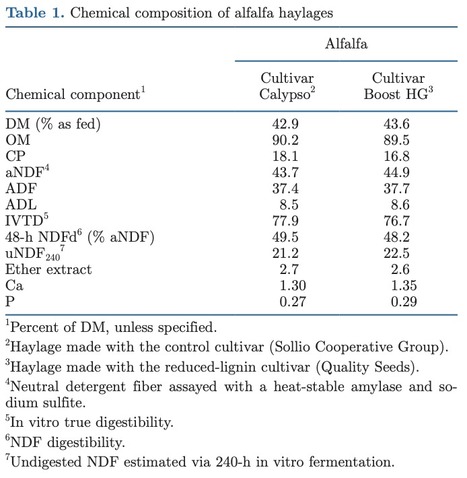
Alfalfa has a lower fiber digestibility and a greater concentration of degradable protein than grasses. Dairy cows could benefit from an increased digestibility of alfalfa fibers, or from a better match between nitrogen and energy supplies in the rumen. Alfalfa cultivars with improved fiber digestibility represent an opportunity to increase milk production, but no independent studies have tested these cultivars under the agroclimatic conditions of Canada. Moreover, decreasing metabolizable protein (MP) supply could increase N use efficiency while decreasing environmental impact, but it is often associated with a decrease in milk protein yield, possibly caused by a reduced supply of essential AA. This study evaluated the performance of dairy cows fed diets based on a regular or a reduced-lignin alfalfa cultivar and measured the effect of energy levels at low MP supply when digestible His (dHis), Lys (dLys), and Met (dMet) requirements were met. Eight Holstein cows were used in a double 4 × 4 Latin square design, each square representing an alfalfa cultivar. Within each square, 4 diets were tested: the control diet was formulated for an adequate supply of MP and energy (AMP_AE), whereas the 3 other diets were formulated to be deficient in MP (DMP; formulated to meet 90% of the MP requirement) with deficient (94% of requirement: DMP_DE), adequate (99% of requirement: DMP_AE), or excess energy supply (104% of requirement; DMP_EE). Alfalfa cultivars had no significant effect on all measured parameters. As compared with cows receiving AMP_AE, the dry matter intake of cows fed DMP_AE and DMP_EE was not significantly different but decreased for cows fed DMP_DE. The AMP_AE diet provided 103% of MP and 108% of NEL requirements whereas DMP_DE, DMP_AE, and DMP_EE diets provided 84, 87, and 87% of MP and 94, 101, and 107% of NEL requirements, respectively. In contrast to design, feeding DMP_EE resulted in a similar energy supply compared with AMP_AE, although MP supply has been effectively reduced. This resulted in a maintained milk and milk component yields and improved the efficiency of utilization of N, MP, and essential AA. The DMP diets decreased total N excretion, whereas DMP_AE and DMP_EE diets also decreased milk urea-N concentration. Reducing MP supply without negative effects on dairy cow performance is possible when energy, dHis, dLys, and dMet requirements are met. This could reduce N excretion and decrease the environmental impact of milk production.
|
|
Scooped by
ulcriv
October 21, 2022 2:52 PM
|
Crinum biflorum Rottb. (syn. Crinum distichum) is an Amaryllidaceae plant used in African traditional medicine but very few studies have been performed on this species from a chemical and applicative point of view. Bulbs of C. biflorum, collected in Senegal, were extracted with ethanol by Soxhlet and the corresponding organic extract was purified using chromatographic methods. The pure compounds were chemically characterized by spectroscopic techniques (1D and 2D 1H and 13C NMR, HR MS and ECD) and X-ray analysis. Four homoisoflavonoids (1–4) and one alkylamide (5) were isolated and characterized as 5,6,7-trimethoxy-3-(4-hydroxybenzyl)chroman-4-one (1), as 3-hydroxy-5,6,7-trimethoxy-3-(4-hydroxybenzyl)chroman-4-one (2), as 3-hydroxy-5,6,7-trimethoxy-3-(4-methoxybenzyl)chroman-4-one (3) and as 5,6,7-trimethoxy-3-(4-methoxybenzyl)chroman-4-one (4), and the alkylamide as (E)-N-(4-hydroxyphenethyl)-3-(4-hydroxyphenyl)acrylamide (5), commonly named N-p-coumaroyltyramine. The relative configuration of compound 1 was verified thanks to the X-ray analysis which also allowed us to confirm its racemic nature. The absolute configurations of compounds 2 and 3 were assigned by comparing their ECD spectra with those previously reported for urgineanins A and B. Flavanoids 1, 3 and 4 showed promising anticancer properties being cytotoxic at low micromolar concentrations towards HeLa and A431 human cancer cell lines. The N-p-coumaroyltyramine (5) was selectively toxic to A431 and HeLa cancer cells while it protected immortalized HaCaT cells against oxidative stress induced by hydrogen peroxide. Compounds 1–4 also inhibited acetylcholinesterase activity with compound 3 being the most potent. The anti-amylase and the strong anti-glucosidase activity of compound 5 were confirmed. Our results show that C. biflorum produces compounds of therapeutic interest with anti-diabetic, anti-tumoral and anti-acetylcholinesterase properties.
|
|
Scooped by
ulcriv
October 21, 2022 2:49 PM
|
Plant-derived folates (Vitamin B9) are essential components of the human diet. They provide one-carbon units that are required for the synthesis of nucleic acids and proteins, and folate deficiency is associated with numerous adverse health conditions. The development of high-folate cultivars of common bean (Phaseolus vulgaris L.) and other staple crops is an important tool to combat folate deficiency. A population of 96 P. vulgaris accessions, representing major North American market classes, was grown in 2 years in Ontario, Canada. The population was genotyped for 5,361 molecular markers with an Illumina Infinium platform. Total folate was extracted from mature seeds using the tri-enzyme extraction method and quantified based on a microbiological assay with Lactobacillus rhamnosus. Significant genetic diversity for folate content was observed among the population in both years of study, and folate content had a range 113–222 μg per 100 g of seeds. Quantitative trait loci (QTL) for seed folate content were identified based on a genome-wide association study (GWAS). Six QTL were identified on Chr. 4, 6, 8, and 11, with three in each year of field trials. Both QTL on Chr. 11 occurred in genomic regions that were syntenic to seed folate QTL detected in previous work with P. vulgaris, Z. mays, and O. sativa. Candidate genes were identified for these QTL that might be targets for the development of molecular markers for selecting P. vulgaris cultivars with improved seed folate content. This work reports the largest survey of genetic diversity for seed folate content in P. vulgaris and identified several genotypes, including SCN4, Bat 93, OAC Redstar, and Pompadour 1014, that would be useful for breeding beans with higher than average folate levels.
|
|
Scooped by
ulcriv
October 21, 2022 2:44 PM
|
Genetic improvement of soybean, one of the major crops providing edible oil and protein-rich food, is important to ensure balanced nutrition for the growing world population. To make soybean cultivation more rewarding, an increase in seed oil and protein content is most desirable. Here, a critical review of the efforts employed over a half-century to accomplish the improvement of soybean oil and protein content has been presented. Many studies have used diverse parental lines to map and characterize quantitative trait loci (QTL)/genes regulating these two essential traits. Here, we highlighted such genomic loci that were consistently identified with different mapping approaches, like QTL mapping, genome-wide association studies (GWAS), and meta-QTL analysis. In addition, the information generated through efforts utilizing omics approaches, such as genomics, transcriptomics, and proteomics has also been compiled to anticipate the molecular mechanism. Several innovative approaches like multi-parental mapping, induced mutagenesis, genomic selection, transgenics, and genome-editing have been discussed in terms of effective utilization of technological advances to improve the oil and protein content in soybean. Information provided here will be helpful for better understanding and designing an effective strategy for simultaneous improvement in seed oil and protein content in soybean.
|
|
Scooped by
ulcriv
October 21, 2022 2:34 PM
|
Across Canada's boreal forest, disturbances from in situ oil sands mining, including well-pads, significantly impact vast areas of the landscape. The creation of well-pads requires removal of vegetation and placement of mineral fill which essentially stops any carbon (C) sequestration on the once peatland ecosystem. It is important that, once no longer in use, these well-pads are restored as long-term C (peat) accumulation is what defines peatland ecosystem. However, little is known about the recovery of greenhouse gas exchange post-restoration of these features. We studied a decommissioned well-pad located in a treed poor fen that was restored using three soil adjustment treatments (SATs): 1) complete mineral fill removal (Peat-Dec), 2) partial pad removal and burial under peat (BUPL), and 3) mixing mineral and peat by inversion (Mixed-P-M). The recreated peat surface was revegetated with donor peatland species using the Moss Layer Transfer Technique (MLTT). The objectives of this paper were to 1) quantify plot-scale seasonal carbon dioxide (CO2) and methane (CH4) exchange of the SATs, two to four years post-restoration compared to reference sites, and 2) determine the influence of several environmental variables on CO2 and CH4 exchange. All SATs proved effective in recreating a soil surface needed to support peatland vegetation as shown by similar rates of net ecosystem exchange (NEE). Equally, both types of vegetation reintroduced led this site on a trajectory towards functioning as a net C sink.
|
|
Scooped by
ulcriv
October 21, 2022 1:45 PM
|
Key Message Genetic analysis identified a unique combination of major QTL for resistance to important soybean nematodes concurrently present in a single soybean accession, which has not been reported earlier. Abstract An exotic soybean [Glycine max (L.) Merr.] accession, PI 567,305, was reported to be highly resistant to three important nematode species, soybean cyst (SCN), root-knot (RKN), and reniform (RN) nematodes. However, genetic basis controlling broad-spectrum resistance in this germplasm has not been investigated. We report results of genetic analysis to identify genomic loci conferring resistance to these nematode species. A bi-parental population consisting of 242 F8-derived recombinant inbred lines (RILs) was developed from a cross of a nematode susceptible cultivar, Magellan, and resistant accession, PI 567,305. The RILs were phenotyped for nematode resistance to three SCN HG types. They were genotyped using the Infinium SoySNP6K BeadChips and genotype-by-sequencing (GBS) methods in an attempt to evaluate the cost-effectiveness and efficiency of these two genotyping platforms. Genetic analysis confirmed the major QTL on chromosomes (Chrs) 10 and 18 with broad-spectrum resistance to the three nematodes present in this germplasm. Haplotype and copy number variation analyses of SCN resistance QTL indicated that PI 567,305 has a different haplotype, which is associated with likely a unique SCN resistance mechanism different from Peking- or PI 88,788-type resistance. The evaluations of both Infinium Beadchip- and GBS-based genotyping technologies provided comprehensive insights for researchers to choose a cost-effective and efficient platform for QTL mapping and for other genomic studies in soybeans.
|
|
Scooped by
ulcriv
October 21, 2022 1:41 PM
|
Plasmodiophora brassicae is a devastating obligate, intracellular, biotrophic pathogen that causes clubroot disease in crucifer plants. Disease progression is regulated by effector proteins secreted by P. brassicae. Twelve P. brassicae putative effectors (PbPEs), expressed at various stages of disease development [0, 2, 5, 7, 14, 21, and 28 days post inoculation (DPI)] in Arabidopsis and localizing to the plant endomembrane system, were studied for their roles in pathogenesis. Of the 12 PbPEs, seven showed an inhibitory effect on programmed cell death (PCD) as triggered by the PCD inducers, PiINF1 (Phytophthora infestans Infestin 1) and PiNPP1 (P. infestans necrosis causing protein). Showing the strongest level of PCD suppression, PbPE15, a member of the 2-oxoglutarate (2OG) and Fe (II)-dependent oxygenase superfamily and with gene expression during later stages of infection, appears to have a role in tumorigenesis as well as defense signaling in plants. PbPE13 produced an enhanced PiINF1- induced PCD response. Transient expression, in Nicotiana benthamiana leaves of these PbPEs minus the signal peptide (SP) (1spPbPEGFPs), showed localization to the endomembrane system, targeting the endoplasmic reticulum (ER), Golgi bodies and nucleo-cytoplasm, suggesting roles in manipulating plant cell secretion and vesicle trafficking. 1spPbPE13GFP localized to plasma membrane (PM) lipid rafts with an association to plasmodesmata, suggesting a role at the cell-to-cell communication junction. Membrane relocalization of 1spPbPE13GFP, triggered by flagellin N-terminus of Pseudomonas aeruginosa (flg22 – known to elicit a PAMP triggered immune response in plants), supports its involvement in raft-mediated immune signaling. This study is an important step in deciphering P. brassicae effector roles in the disruption of plant immunity to clubroot disease.
|
|
Scooped by
ulcriv
October 21, 2022 11:03 AM
|
Common scab is a potato disease characterized by the formation of scab-like lesions on the surface of potato tubers. The actinobacterium Streptomyces scabiei is the main causal agent of common scab. During infection, this bacterium synthesizes the phytotoxin thaxtomin A which is essential for the production of disease symptoms. While thaxtomin A can activate an atypical programmed cell death in plant cell suspensions, it is possible to gradually habituate plant cells to thaxtomin A to provide resistance to lethal phytotoxin concentrations. Potato ‘Russet Burbank’ calli were habituated to thaxtomin A to regenerate the somaclone RB9 that produced tubers more resistant to common scab than those obtained from the original cultivar. Compared to the Russet Burbank cultivar, somaclone RB9 generated up to 22% more marketable tubers with an infected tuber area below the 5% threshold. Enhanced resistance was maintained over at least two years of cultivation in the field. However, average size of tubers was significantly reduced in somaclone RB9 compared to the parent cultivar. Small RB9 tubers had a thicker phellem than Russet Burbank tubers, which may contribute to improving resistance to common scab. These results show that thaxtomin A-habituation in potato is efficient to produce somaclones with increased and durable resistance to common scab.
|
|
Scooped by
ulcriv
October 3, 2022 4:31 PM
|
Herring milt hydrolysate (HMH) presents the disadvantage of being associated with an unpleasant smell limiting its use. Thus, to develop a new effective and easy-to-use deodorization method, this research aimed to deepen the knowledge regarding the impacts of pH (pH 7 vs. pH 10), overnight stirring with nitrogen (+N vs. −N) and deaerator treatment (+D vs. −D) on the odorous content of HMH. This latter included dimethylamine (DMA), trimethylamine (TMA), trimethylamine oxide (TMAO) and the most potent odor-active compounds of HMH. Results showed that pH had a huge impact on the targeted compounds resulting in higher detected concentrations of DMA, TMA and TMAO at pH 10 than at pH 7 (p < 0.05) while the opposite trend was observed for the most potent odor-active compounds of HMH (p < 0.05). Moreover, independently of the pH condition, the overnight stirring with or without nitrogen had no impact (p > 0.05). Finally, the deaerator treatment was more effective to remove TMA and DMA at pH 10 than at pH 7 (p < 0.05) while the opposite trend was observed for the most potent odor-active compounds (p < 0.05). Sensory analysis confirmed that the application of pH 10 −N +D and pH 7 −N +D + alkalization pH 10 conditions led to the least odorous products (p < 0.05).
|
|
Scooped by
ulcriv
October 3, 2022 4:27 PM
|
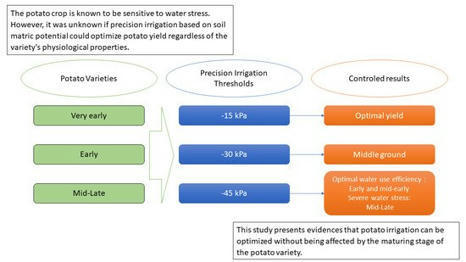
Potato is one of the most cropped plants worldwide. Hundreds of different varieties are cultivated only in North America. Potato growers usually crop multiple varieties on their farms to answer the market demands for potato’s specific physical properties. However, few pieces of information are available regarding the optimal management of irrigation across potato varieties. Knowing that modern potatoes share genetics similarities, the optimal irrigation comfort zone for the potato crop might be the same for different groups of varieties. This study evaluates the effect of precision irrigation thresholds on the potato yields of three varieties (Envol: very early, Kalmia: early, and Red Maria: mid-late) with different maturity classes. In a greenhouse, a soil matric potential sensor network used in combination with a precise irrigation system allows the identification of a common optimal precision irrigation threshold, allowing optimal yields for the three varieties. This paper presents the first identification of an optimal irrigation threshold, −15 kPa, shared by different potato varieties. The optimal irrigation threshold identified in this study is not dependent on the maturity class, plant height or tuber potential production. The determination of an optimal precision irrigation threshold will allow potato growers to adapt their farm management processes to integrate more sustainable water management practices as they will be able to irrigate a field with multiple varieties with the same threshold.
|
|
Scooped by
ulcriv
October 3, 2022 3:58 PM
|
The functional traits of organisms within multispecies assemblages regulate biodiversity effects on ecosystem functioning. Yet how traits should assemble to boost multiple ecosystem functions simultaneously (multifunctionality) remains poorly explored. In a multibiome litter experiment covering most of the global variation in leaf trait spectra, we showed that three dimensions of functional diversity (dispersion, rarity, and evenness) explained up to 66% of variations in multifunctionality, although the dominant species and their traits remained an important predictor. While high dispersion impeded multifunctionality, increasing the evenness among functionally dissimilar species was a key dimension to promote higher multifunctionality and to reduce the abundance of plant pathogens. Because too-dissimilar species could have negative effects on ecosystems, our results highlight the need for not only diverse but also functionally even assemblages to promote multifunctionality. The effect of functionally rare species strongly shifted from positive to negative depending on their trait differences with the dominant species. Simultaneously managing the dispersion, evenness, and rarity in multispecies assemblages could be used to design assemblages aimed at maximizing multifunctionality independently of the biome, the identity of dominant species, or the range of trait values considered. Functional evenness and rarity offer promise to improve the management of terrestrial ecosystems and to limit plant disease risks.
|
|
|
Scooped by
ulcriv
October 21, 2022 3:12 PM
|
Water productivity enhancement in farming systems is one of the most critical challenges facing the agricultural sector in the twenty-first century. Precision irrigation based on soil matric potential (SMP) measurements effectively enhances water productivity. However, the temporal effect of an SMP-based comfort zone on potato crops is lacking. This paper evaluates the temporal effect of a range of soil matric potential thresholds (namely, −7, −10, −15, −18, −21, −24, −30, and −45 kPa) in a sandy soil on the marketable yield and irrigation water productivity (WP) of potato grown in containers in a greenhouse with the Partial Least Square algorithm (PLS) and a mixed model. The results of this study suggest that a comfort zone maximizing potato yield is located between − 10 and − 24 kPa. The − 24 kPa threshold generated the highest yield while reducing the irrigation water use up to 47% and generating the highest WP. The average yield in the comfort zone reached 496.4 g per plant, an increase of 88% over the lowest yield achieved at an SMP of –45 kPa. In addition, the leaf expansion and tuber initiation physiological stages are the most important periods where the daily SMP had the most influence on the marketable yield. This information will assist potato growers in maintaining high yields while optimizing their use of irrigation water.
|
|
Scooped by
ulcriv
October 21, 2022 2:57 PM
|
Blueberry stunt phytoplasma (BBSP; ‘Candidatus Phytoplasma asteris’) is an insect-vectored plant pathogen that causes severe yield losses in blueberry (Vaccinium corymbosum), which is the most valuable fruit crop in Canada. Rapid, field-based diagnostic assays are desirable tools for the control of BBSP, as part of an integrated, proactive approach to production management termed biovigilance. We designed and validated a chaperonin-60 (cpn60)-targeted LAMP assay for detection of BBSP, providing a rapid, low cost, field-deployable diagnostic option. Our validation demonstrates that the assay is reproducible, with high analytical specificity and improved sensitivity when compared with 16S rRNA nested PCR. We applied the validated LAMP assay to nearly 2000 blueberry samples from Québec and Nova Scotia over three growing seasons (2016–2018). Our surveys revealed that BBSP is present in most sites across both provinces, though detection of the pathogen in individual plants varied in different tissues across sampling dates and across years, and evidence of spread between plants was limited. To quantify pathogen load in select plants, we designed additional qPCR and ddPCR assays, also based on cpn60. We found that pathogen load fluctuates in individual plants, both within and between growing seasons. Finally, we designed an interactive map to visualize the results of our surveys. These results provide a validated diagnostic assay that can be used as part of a biovigilance strategy for detecting and controlling infections caused by BBSP.
|
|
Scooped by
ulcriv
October 21, 2022 2:55 PM
|
Background The importance of organic farming has increased through the years to promote food security allied with minimal harm to the ecosystem. Besides the environmental benefits, a recurring problem associated with organic management is the unsatisfactory yield. A possible solution may rely on the soil microbiome, which presents a crucial role in the soil system. Here, we aimed to evaluate the soil bacterial community structure and composition under organic and conventional farming, considering the tropical climate and tropical soil. Methodology Our organic management treatments were composed by composted poultry manure and green manure with Bokashi. Both organic treatments were based on low nitrogen inputs. We evaluated the soil bacterial community composition by high-throughput sequencing of 16S rRNA genes, soil fertility, and soil enzyme activity in two organic farming systems, one conventional and the last transitional from conventional to organic. Results We observed that both organic systems evaluated in this study, have higher yield than the conventional treatment, even in a year with drought conditions. These yield results are highly correlated with changes in soil chemical properties and enzymatic activity. The attributes pH, Ca, P, alkaline phosphatase, and β- glucosidase activity are positively correlated with organic systems, while K and Al are correlated with conventional treatment. Also, our results show in the organic systems the changes in the soil bacteria community, being phyla Acidobacteria, Firmicutes, Nitrospirae, and Rokubacteria the most abundant. These phyla were correlated with soil biochemical changes in the organic systems, helping to increase crop yields. Conclusion Different organic management systems, (the so-called natural and organic management systems, which use distinct organic sources), shift the soil bacterial community composition, implying changes in their functionalities. Also, our results contributed to the identification of target bacterial groups and changes in soil chemical properties and enzymatic activity in a trophic organic farming system, which may contribute to higher crop yields.
|
|
Scooped by
ulcriv
October 21, 2022 2:52 PM
|
Dairy farm management practices can modify milk microbiota and therefore modulate non-starter lactic acid bacteria (NSLAB) found in cheese. These NSLAB can cause organoleptic defects. This study aimed to investigate the impact of two potential NSLAB in Cheddar cheesemaking: Lactiplantibacillus plantarum RKG 2–212 a strain isolated both in corn silage and raw milk, and Lactobacillus delbrueckii RKG R10, a strain isolated after pasteurisation of milk from a farm using grass and legume silage, and corn silage. The whole genome of these two lactobacilli was first sequenced. Then, the thermoresistance was evaluated after treatment at 60 °C for 5 min and compared to reference strains. Both lactobacilli were highly thermoresistant compared to other three lactic acid bacteria which are Lactococcus lactis subsp. cremoris ATCC 19257 and SK11, and L. plantarum ATCC 14917 (P < 0.0001). They lost less than 1 log cfu/mL (Δlog) and their genome contained a great number of copy number of genes coding for heat shock protein. During a Pearce test activity simulating Cheddar cheesemaking, the two lactobacilli did not show interaction with the starter Lcc. lactis subsp. cremoris SK11, and their population remained stable. During a ripening simulation, L. delbrueckii RKG R10 had a slight loss in viability in cheese slurry samples incubated at 30 °C for 12 d. However, L. plantarum RKG 2–212 had considerable growth, from 6.51 to 8.3 log cfu/g. This growth was associated with the acidification of the slurries (P < 0.0001). The presence of the lactobacilli modified the profile of volatile compounds evaluated by gas chromatography–mass spectrometry, accounting for 10.7% of the variation. The strain L. plantarum RKG 2–212 produced volatile compounds in greater quantity that could be associated with organoleptic defects such as acetic acid and 2-methylbutyraldehyde. Therefore, silage can be a vector of thermoresistant lactic acid bacteria for milk which can lead to flavor defects in cheese.
|
|
Scooped by
ulcriv
October 21, 2022 2:46 PM
|
Apples (Malus domestica Borkh) are prone to preharvest fruit drop, which is more pronounced in ‘Honeycrisp’. Hexanal is known to improve fruit retention in several economically important crops. The effects of hexanal on the fruit retention of ‘Honeycrisp’ apples were assessed using physiological, biochemical, and transcriptomic approaches. Fruit retention and fruit firmness were significantly improved by hexanal, while sugars and fresh weight did not show a significant change in response to hexanal treatment. At commercial maturity, abscisic acid and melatonin levels were significantly lower in the treated fruit abscission zone (FAZ) compared to control. At this stage, a total of 726 differentially expressed genes (DEGs) were identified between treated and control FAZ. Functional classification of the DEGs showed that hexanal downregulated ethylene biosynthesis genes, such as S-adenosylmethionine synthase (SAM2) and 1-aminocyclopropane-1-carboxylic acid oxidases (ACO3, ACO4, and ACO4-like), while it upregulated the receptor genes ETR2 and ERS1. Genes related to ABA biosynthesis (FDPS and CLE25) were also downregulated. On the contrary, key genes involved in gibberellic acid biosynthesis (GA20OX-like and KO) were upregulated. Further, hexanal downregulated the expression of genes related to cell wall degrading enzymes, such as polygalacturonase (PG1), glucanases (endo-β-1,4-glucanase), and expansins (EXPA1-like, EXPA6, EXPA8, EXPA10-like, EXPA16-like). Our findings reveal that hexanal reduced the sensitivity of FAZ cells to ethylene and ABA. Simultaneously, hexanal maintained the cell wall integrity of FAZ cells by regulating genes involved in cell wall modifications. Thus, delayed fruit abscission by hexanal is most likely achieved by minimizing ABA through an ethylene-dependent mechanism.
|
|
Scooped by
ulcriv
October 21, 2022 2:34 PM
|
In this study, our goal was to adapt the Moss Layer Transfer Technique (MLTT), first developed to restore degraded Sphagnum-dominated peatland explicitly with a bryophyte layer, to a former in-situ oil sands well-pad constructed with nearby mineral fill in northwestern Alberta, Canada. Mineral fill was either completely removed or partially removed with residual fill buried under excavated and decompacted peat, followed by the transfer of donor moss collected from nearby linear features with different plant communities in peatlands. Three years after MLTT, peatland vegetation covers 63% of the site. Carex spp. dominate with 36% coverage, followed by mosses at 12%, including 3% Sphagnum spp. and 8% fen mosses, and shrubs at 8%. Different substrate adjustment treatments and types of donor moss had negligible impact on vegetation development although areas without MLTT remained devoid of mosses and had the lowest peatland species cover. Instead, surface elevation, moisture conditions, and substrate chemistry played important roles in shaping the vegetation communities. The prompt introduction and establishment of peatland donor species through MLTT was crucial to the overall re-establishment of peatland vegetation. This is the first full pad scale study to prove that a flat, moist peat surface created by the removal and/or burial of mineral fill can support peatland vegetation development, particularly ground layer bryophytes. Overall, the reclaimed well-pad appears to be on trajectory towards becoming a functional peatland and our approaches should be considered and tested in future well-pad reclamation trials.
|
|
Scooped by
ulcriv
October 21, 2022 2:33 PM
|
Roots of perennial grasses, with their fibrous architecture, are difficult to separate from the surrounding soil. We assessed the effect of five soaking solutions [sodium bicarbonate, sodium chloride, disodium ethylenediamine tetraacetic acid (disodium EDTA), distilled water, and sodium hexametaphosphate] and three soaking durations (15 min, 2 h, and 16 h) on root recovery and root elemental composition, with and without a mathematical correction for residual soil adhering to roots. Roots were collected by soil coring in a timothy (Phleum pratense L.) sward on a loam soil. After soaking, roots were washed, digitized, and analyzed for elemental composition. Soaking duration did not affect root mass and length, but the 16-h duration resulted in the lowest ash concentration [136.7 vs. 146.4 g kg–1 dry matter (DM) on average across shorter durations], indicating a lower contamination by soil. The greatest root recovery was obtained with sodium bicarbonate (0.118 vs. 0.101 g DM core–1 on average across other solutions). Sodium hexametaphosphate led to the lowest root ash and element concentrations, but left a P residue on the roots. Distilled water did not impair root cell integrity and led to a similar root recovery as sodium chloride, sodium EDTA, and sodium hexametaphosphate. A mathematical correction improved the estimates of (i) root mass for all soaking solutions, and (ii) root elemental composition for elements with higher concentrations in soils than in roots. Soaking solutions should be chosen as a function of the study objectives because of the trade-off between root recovery and contamination by adhering soil.
|
|
Scooped by
ulcriv
October 21, 2022 1:41 PM
|
Blueberry stunt phytoplasma (BBSP; ‘Candidatus Phytoplasma asteris’) is an insect-vectored plant pathogen that causes severe yield losses in blueberry (Vaccinium corymbosum), which is the most valuable fruit crop in Canada. Rapid, field-based diagnostic assays are desirable tools for the control of BBSP, as part of an integrated, proactive approach to production management termed biovigilance. We designed and validated a chaperonin-60 (cpn60)-targeted LAMP assay for detection of BBSP, providing a rapid, low cost, field-deployable diagnostic option. Our validation demonstrates that the assay is reproducible, with high analytical specificity and improved sensitivity when compared with 16S rRNA nested PCR. We applied the validated LAMP assay to nearly 2000 blueberry samples from Québec and Nova Scotia over three growing seasons (2016–2018). Our surveys revealed that BBSP is present in most sites across both provinces, though detection of the pathogen in individual plants varied in different tissues across sampling dates and across years, and evidence of spread between plants was limited. To quantify pathogen load in select plants, we designed additional qPCR and ddPCR assays, also based on cpn60. We found that pathogen load fluctuates in a given plant within and between growing seasons. Finally, we designed an interactive map to visualize the results of our surveys. These results provide a validated diagnostic assay that can be used as part of a biovigilance strategy for detecting and controlling infections caused by BBSP.
|
|
Scooped by
ulcriv
October 21, 2022 11:03 AM
|
Genome-wide association study (GWAS) is currently one of the important approaches for discovering quantitative trait loci (QTL) associated with traits of interest. However, insufficient statistical power is the limiting factor in current conventional GWAS methods for characterizing quantitative traits, especially in narrow genetic bases plants such as soybean. In this study, we evaluated the potential use of machine learning (ML) algorithms such as support vector machine (SVR) and random forest (RF) in GWAS, compared with two conventional methods of mixed linear models (MLM) and fixed and random model circulating probability unification (FarmCPU), for identifying QTL associated with soybean yield components. In this study, important soybean yield component traits, including the number of reproductive nodes (RNP), non-reproductive nodes (NRNP), total nodes (NP), and total pods (PP) per plant along with yield and maturity were assessed using 227 soybean genotypes evaluated across four environments. Our results indicated SVR-mediated GWAS outperformed RF, MLM and FarmCPU in discovering the most relevant QTL associated with the traits, supported by the functional annotation of candidate gene analyses. This study for the first time demonstrated the potential benefit of using sophisticated mathematical approaches such as ML algorithms in GWAS for identifying QTL suitable for genomic-based breeding programs.
|
|
Scooped by
ulcriv
October 3, 2022 4:38 PM
|
Subsidence, erosion, and degradation in agricultural peatlands are leading to the disappearance of highly fertile farmland. This study investigated two strategies aimed at extending the lifespan of cultivated peat soils: the application of straw and wood chips to compensate for soil losses; and the application of copper to slow peat decomposition, based on previous recommendations. Peat soil samples (270 g) were amended with 11 t ha–1 of biomass materials (14.8 g kg–1) and 235.6 mg Cu kg–1 and incubated in glass jars at constant temperature and water content. Thirty chemical parameters were then monitored over a 56‐day period through repeated soil sampling. Discriminant analysis showed that the addition of biomass had the greatest impact on nitrogen availability, immobilizing 7.8 to 12.1 kg of inorganic N per metric ton of incorporated biomass. Considering that peat soils may require from 4 to 40 t biomass ha–1 yr–1 to reach carbon equilibrium, the tested biomass materials could immobilize from 34 to 500 kg ha–1 of nitrogen if confirmed at the field scale. This may help capture excess N, but may also limit crop growth. Alternatively, slowing decomposition could reduce both biomass requirements and nitrogen immobilization. However, the results show that copper had little effect on parameters linked to organic matter decomposition. Indeed, dissolved organic carbon was decreased by 11% in copper treated soils. A longer‐term study should be conducted to confirm these observations at the field scale, thus helping to develop conservation strategies suitable for agricultural production.
|
|
Scooped by
ulcriv
October 3, 2022 4:27 PM
|
Lodging resistance is an important objective for soybean [Glycine max (L.) Merr.] breeding, but selection for this trait has been difficult since the resistance is controlled by multiple genes and these genes interact with the environment. One hundred thirty of 139 lines constituting a soybean GWAS panel were phenotyped for stem pushing resistance, which is defined as the push-back strength when the plant stem is inclined, by measuring the force required to push a stem to a 45° angle using a force gauge in a greenhouse, and also for lodging, plant height, seed yield and maturity at three locations in total in Eastern Canada in 2013 or 2017. Two QTLs for pushing resistance were identified, on chromosome 5 and 11, and each QTL accounted for 16.0% of phenotypic variation. In our panel, the alleles for higher pushing resistance were always of lower frequency than the alternate allele. Examining the panel at these QTLs identified that higher pushing resistance was associated with lower lodging on chromosome 5 and 11, and that the difference for lodging between alleles was significant on chromosome 5. There was no difference in plant height or yield at the QTL on chromosome 5 or 11, while higher pushing resistance was associated with later maturity at both QTLs. The pushing resistance QTL on chromosome 11 will be useful for decreasing lodging in Canadian short-season soybean.
|
|
Scooped by
ulcriv
October 3, 2022 3:59 PM
|
Abstract. "Barley (Hordeum vulgare L.) is one of the most important global crops. The six-row barley cultivar Morex reference genome has been used by the barley research community worldwide. However, this reference genome can have limitations when used for genomic and genetic diversity analysis studies, gene discovery, and marker development when working in two-row germplasm that is more common to Canadian barley. Here we assembled, for the first time, the genome sequence of a Canadian two-row malting barley, cultivar AAC Synergy. We applied deep Illumina paired-end reads, long mate-pair reads, PacBio sequences, 10X chromium linked read libraries, and chromosome conformation capture sequencing (Hi-C) to generate a contiguous assembly. The genome assembled from super-scaffolds had a size of 4.85 Gb, N50 of 2.32 Mb and an estimated 93.9% of complete genes from a plant database (BUSCO, benchmarking universal single-copy orthologous genes). After removal of small scaffolds (< 300 Kb), the assembly was arranged into pseudomolecules of 4.14 Gb in size with seven chromosomes plus unanchored scaffolds. The completeness and annotation of the assembly were assessed by comparing it with the updated version of six-row Morex and recently released two-row Golden Promise genome assemblies."
|