

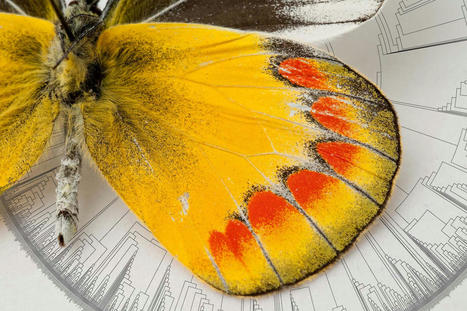
A new map of butterfly heritage suggests an origin in North or Central America some 100 million years ago.
Get Started for FREE
Sign up with Facebook Sign up with X
I don't have a Facebook or a X account


 Your new post is loading...
 Your new post is loading...
Your new post is loading...
 Scoop.it!
A new map of butterfly heritage suggests an origin in North or Central America some 100 million years ago. 
No comment yet.
Sign up to comment
Scoop.it!
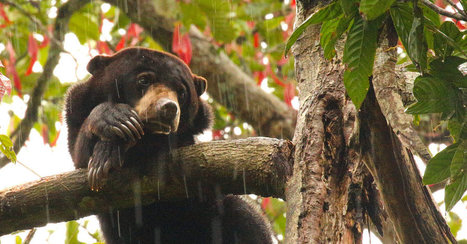
The world’s forests are being carved into pieces. In tropical regions, animals are likely to pay a heavy price.
Scoop.it!
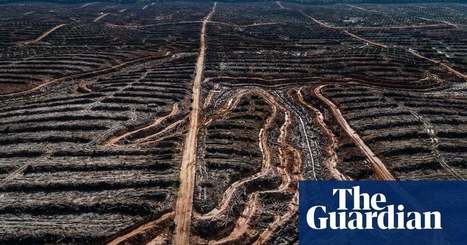
Scientists reveal one million species at risk of extinction in damning UN report
Scoop.it!
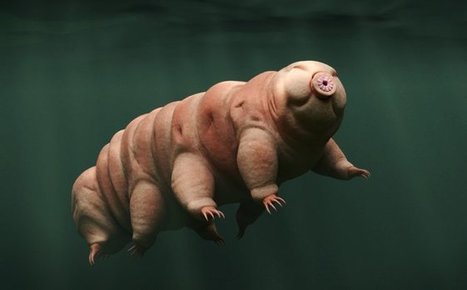
The world's newest species of water bear has eight legs and eggs covered with tentacles. And it was discovered in a parking lot.
Scoop.it!
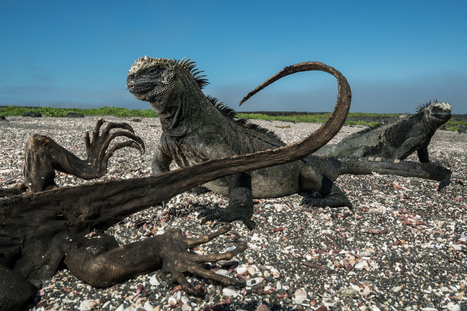
"Failure to take pressure off the Galápagos’ flora and fauna could kill the booby that laid the golden egg: Of the seven animal species that tourists rank most important to their visit—tortoises, sea turtles, marine and land iguanas, penguins, blue-footed boobies, and sea lions—all are expected to decline because of climate change, according to a…

's curator insight, May 28, 2017 3:01 PM
This beautifully illustrated story gives details on a number of species being harmed by climate change. All animals must struggle to survive. Now, with human-caused global warming, their struggle is becoming more difficult. Deaths are increasing, and extinction has appeared on the horizon.
Scoop.it!

How much life can you find in one cubic foot? Via Jim Lerman
Scoop.it!

Florida Lionfish: Thousands turn out to hunt, grill and savor a marine invader
PIRatE Lab's insight:
Grill them suckers up!
Scoop.it!
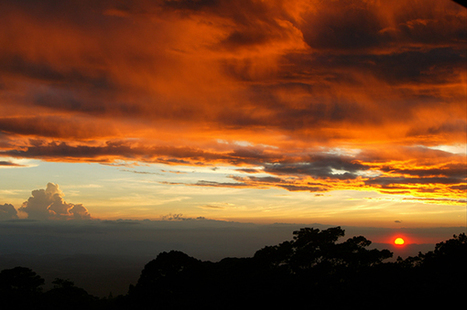
In a just published study, researchers contend that clouds could help us predict in unprecedented accuracy where threatened and endangered species live.
Scoop.it!
Josianne Claudia Sales Rosa and Luis E. Sánchez have published a new paper on "Is the ecosystem service concept improving impact assessment? Evidence from recent international practice" in Environmental Impact Assessment Review (Volume 50, January 2015, Pages 134–142).
PIRatE Lab's insight:
The "ecosystem service" concept has certainly taken hold in some areas/disciplines. Evidence here is mixed, but suggests that it is spreading beyond the traditional North American/European/Australian strongholds.
See also:
Scoop.it!
Invertebrate numbers have decreased by 45 percent on average over a 35 year period in which the human population doubled, reports a study on the impact of humans on declining animal numbers. This decline matters because of the enormous benefits invertebrates such as insects, spiders, crustaceans, slugs and worms bring to our day-to-day lives, including pollination and pest control for crops, decomposition for nutrient cycling, water filtration and human health.
PIRatE Lab's insight:
Crazy!
Scoop.it!
Some conservation strategies assume that the evolutionary distances between species on a phylogenetic 'tree of life' (a branching diagram of species popularized by Charles Darwin) can be used to predict how diverse their biological features will be. These distances are then used to select which species to conserve in order to maximize interesting biological features -- such as potentially useful drug compounds and resilience to climate change. But a new analysis of data from 223 studies of animals, plants, and fungi, shows that methods based on such distances are often no better at conserving interesting biological features than picking species at random.
PIRatE Lab's insight:
I have always been a bit skeptical about phylogenetic approaches to conservation. While not wrong, they often show a "non-real world" side of prioritization. And while a given scheme is not necessarily better or worse than another, these often times seem to pale compared to other schemes. They are most often used to make economic arguments about drugs or other utilitarian values.
Scoop.it!

Many people say they’d like to see more biodiversity in their city parks and gardens.
PIRatE Lab's insight:
Surprise, surprise. If people aren't trained to see what is in front of their eyes, they see wildlife as a foreign language that is too complicated to decipher.
Scoop.it!

Submarine canyons play an important role in maintaining high levels of biodiversity of small invertebrates in the seafloor sediments of the main and northwestern Hawaiian Islands, according to new research. Via Gaye Rosier
|
Scoop.it!

From
www

Pope Francis has said the coronavirus pandemic is one of "nature's responses" to humans ignoring the current ecological crisis.
PIRatE Lab's insight:
The Pope correctly sees the link between environmental degradation and dangerous, reckless environmental policies and the emergence of novel diseases such as the coronavirus.
Scoop.it!
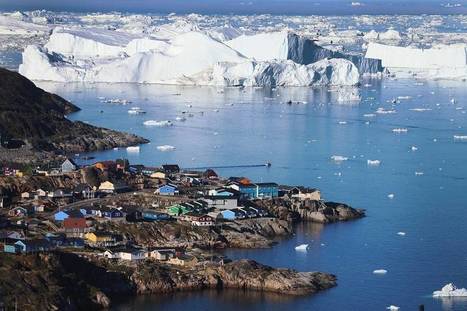
Dangerous shifts are already underway. If fossil fuel use continues at this pace, the world will see sweeping consequences for nature and humans, report authors say.
Scoop.it!
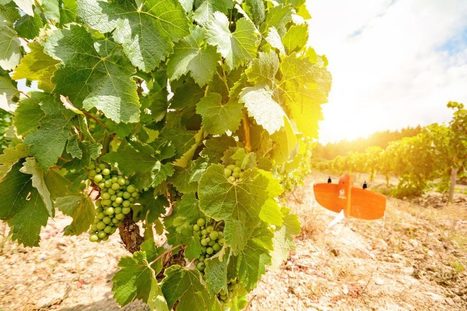
Vineyard surveying with the WingtraOne drone helps to make better decisions, and possibly even better wine?
PIRatE Lab's insight:
Very interesting assumptions here and scary commentary on our possible future: that a heavily degraded and managed landscape such as a vineyard can be seen as an important region for "wildlife" speaks volumes about the degradation of the surrounding region. To be sure a vineyard is better than a subdivision per se, but it is not better than a grassland, oak woodland, scrubland, etc.
While better management of these wine resources is great and this drone looks to be an able tool, we should all be wary of "science" when it comes with a pitch for a product.
Scoop.it!

DAVIS, Calif. — Nature itself can be the best defense against climate change for many species -- at least in the short term -

DAIPO Emmanuel's curator insight,
December 1, 2017 11:32 AM
L'environnement naturel, la nature s'avère être la meilleure défense contre tous les évènements climatiques, dramatiques et catastrophiques, pas pour tout le monde, mais pour de nombreuses espèces néanmoins , mais cela a court terme. Plusieurs études ont montrer que l'habitat naturel influence, les espèces végétales et animales qui sont aux alentours. Pour s'assurer de ses dires, une expérience a été réalisée en Californie. De nombreuses espèces végétales ou animales jouent un rôle écologique plus qu'important , car elles s'adaptent aux différentes conditions qu'il lui sont soumises.
Scoop.it!

Researchers are now able to capture the cells of animals, sequence their DNA and identify which species were present in water at a point in time. A new University of Washington study is the first to use these genetic markers to understand the impact urbanization has on the environment — specifically, whether animal diversity flourishes or suffers.
PIRatE Lab's insight:
eDNA is still in its infancy, so we need to be cautious with these insights.
Scoop.it!

Exclusive: All mentions of Australia were removed from the final version of a Unesco report on climate change and world heritage sites after the Australian government objected on the grounds it could impact on tourism. Guardian Australia can reveal the report “World Heritage and Tourism in a Changing Climate”, which Unesco jointly published with the…
PIRatE Lab's insight:
Wow...how disappointing.
Scoop.it!

Genetic data from more than 1,000 newly sequenced microorganisms show bacteria make up most of the genetic diversity of life on Earth.
PIRatE Lab's insight:
Nothing new here: we've had something very similar for two decades in our Intro Bio courses. But it is noteworthy that most of the public seem to have been schooled by textbooks written before, oh I don't know...1990? The fact that the public and reporters see this as something new and worthy of highlighting in news stories tells us that our basic biological education is woefully out of date. Nothing new there, I suppose...
...Man! I think I sound like a grumpy old professor.
Scoop.it!
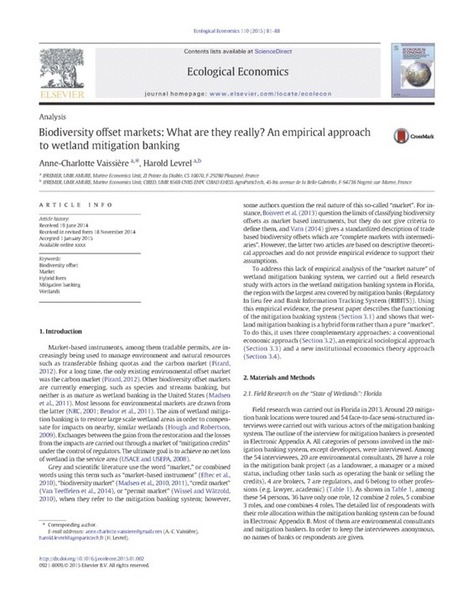
How might we use offsets for existing or future impacts to biological diversity via mitigation banks?
PIRatE Lab's insight:
See also: Amrei von Hase, Andrew Cooke, Aristide Andrianarimisa, Rivolala Andriamparany, Vanessa Mass, Robin Mitchell, Kerry ten Kate 2015 Working towards NNL of Biodiversity and Beyond Ambatovy, Madagascar – A Case Study (2014). - Forest Trends, Ambatovy, Wildlife Conservation Society. 59 p.
Scoop.it!

The National Oceanic and Atmospheric Administration (NOAA) and NASA are funding three demonstration projects that will lay the foundation for the first national network to monitor marine biodiversity at scales ranging from microbes to whales. Via Marian Locksley
PIRatE Lab's insight:
Hmmmm....this could end of being really cool.
....or it could end up being just another expenditure of funds on some whiz-bang imaging that translates into little if anything for managers.
Scoop.it!
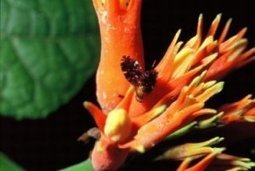
Scientists found greater diversity among insects in a rainforest in Peru than theory would predict. Scientists have been studying flies in the tropics for years, and now report evidence that there is more to a fly's ecological niche than where it lives and what it eats -- you have to look at what eats the fly, as well.
PIRatE Lab's insight:
Ah! More fodder for my intro to biodiversity lectures!
Scoop.it!

Scientists have made a surprising discovery in the waters off the coast of Iraq: a coral reef made up of more than half a dozen species of the marine animals.
PIRatE Lab's insight:
You never know what you will find until you look.
Scoop.it!
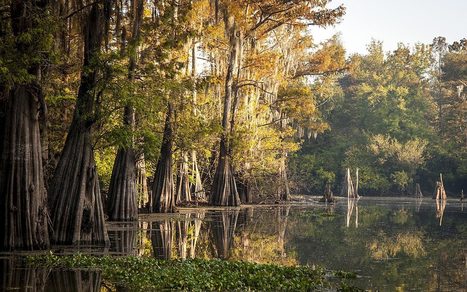
Environmentalists say swaths of Southeastern woodlands are being cut down for green energy efforts across Atlantic
PIRatE Lab's insight:
Nice. This falls under the "Rob Peter to save Paul" file.
|




