


Carnet de santé, prise de rendez-vous, réseau social... 20 Minutes a sélectionné quatre sites qui permettent d'améliorer son quotidien, santé et son bien-être.

 Your new post is loading...
 Scoop.it! Carnet de santé, prise de rendez-vous, réseau social... 20 Minutes a sélectionné quatre sites qui permettent d'améliorer son quotidien, santé et son bien-être. 
No comment yet.
Sign up to comment
Scoop.it!

Scoop.it!

Le laboratoire Pfizer lance un nouveau site web consacré à la gamme de produit IMEDEEN® : imedeen.fr. Découverte. Pour présenter l'ensemble de la gamme des produits IMEDEEN®, leader mondial de la n...
Scoop.it!

Plusieurs initiatives, soutenues par la commission européenne, s'appuient sur les technologies du cloud computing et de la big data pour rendre accessibles, compatibles et comparables les données de différents hôpitaux relatives à des pathologies... Via algrappe
Scoop.it!

Le 24 mars prochain, CCM Benchmark organise une grande conférence "e-Santé 2014". Présentation. Face au développement de l’e-santé et de toutes ces nouvelles tendances (Msanté, Quantified self, E-r...
Scoop.it!

L'Afipa vient de publier un classement des laboratoires du selfcare en France (médicaments, dispositifs médicaux et compléments alimentaires d’automédication) dans le cadre de son 2ème Baromètre de l’automédication 2013 rendu public mercredi.
Scoop.it!

In a world frantically scrambling to adapt to the changing digital landscape, how has healthcare fared? Has the Internet and social media helped or hindered its development? Should the public turn to the Internet for medical advice? I enlisted the help of some leading voices in the field to unravel these questions and shed some much needed light on the topic.
Information technologies have already prompted a massive shift in the way medical information is accessed, with its capacity to transfer important knowledge from health professionals to the wider public. Social media, in particular, is a perfect vehicle for this. As the tentacles of social media permeate into everyday life, doctors and healthcare organisations alike can leverage this power to circulate valuable information about health problems as well as self-care and prevention techniques.
As Lee Aase, Director at Mayo Clinic Social Media, confirms: “By engaging in public, knowledgeable professionals can offer help and insights on a scale that was previously impossible. And by bringing their science-based perspective they can hopefully counter some of the bad information that has been so harmful to public health” “The Journal of Internet Medical Research have suggested that 60% of adults used the internet to find health information” It’s exactly this ‘bad information’ that makes searching online for medical advice fraught with dangers. For the more Internet savvy, this may not pose a problem, but, for the less educated, and the elderly, finding credible information on the web may be a troublesome task. The reality is that anyone can publish on the internet, regardless of quality, which means that you could be confronted with information that is conflicting, confusing, or quite simply wrong.
From a runny nose to something more serious like a suspicious lump, people are heading to the web more and more; but, with more than 70,000 websites disseminating medical information, where should you visit?
According to Dr. Sarah Jarvis, clinical consultant at Patient.co.uk, your doctor can advise you on trusted sites to visit. Here in the UK, sites which have been awarded The Information Standard by the NHS, are particularly useful as medical resources:
"Patient.co.uk is fully accredited, and all the articles on the site are written by GPs, for GPs and their patients. They also provide full references to back up their content. Of the 11 million people who access the information onsite every month, almost a million are GPs and practice nurses – a ringing endorsement of the quality of the information." However, can even the most reputable sites compare to the value of a face-to-face appointment with your GP? Dr. Leana Wen, physician and author of When Doctor’s Don’t Listen believes that the Internet should only be used to accompany a visit to the doctors: "Don't use the Internet to make your diagnosis, but rather use it to formulate better questions to ask your doctor. Internet search engines can't replace seeing your doctor, because symptoms alone don't make your diagnosis--your history and physical exam do."
This is true; the benefits of a physical diagnosis cannot be completely replaced by a search online. However, the Internet and social media have other abilities that can improve healthcare, namely it’s capacity to bring patients with similar diseases together. Through Twitter chats and Facebook groups, like-minded patients can connect with one another for mutual support and knowledge sharing. Introducing trained medical professionals into these conversations will undoubtedly make these discussions more helpful.
“Doctors should always exercise caution when using Twitter as it can often lead to a conflict of interest, but as long as it’s used in responsible manner, Twitter can be the perfect platform to educate the public on a wide range of health issues.”Healthexpress Chief medical Advisor, Dr. Hilary Jones Facebook is particularly good at grouping patients together. In one simple click, you can become an active member of a community alongside others with similar interests. These groups supply valuable opportunities to talk to one another while offering important information on breakthrough studies, news and advice for a specific condition, all of which will feature on a daily newsfeed.
A perfect example of a successful social media campaign can be observed with Diabetes.co.uk, a community website which has successfully built a global network to help people with diabetes worldwide. As well as promoting awareness for Diabetes, their social media platforms unite people with similar worries so they can share their stories and seek support.
In fact, the benefits of an extended support network on a persons health has been confirmed by several studies. Researchers from California carried out a large-scale study in 1979, which concluded that people with relatively low levels of social interaction died earlier than those with strong social networks.
By using social media, people are more likely to partake in social interaction and support. The possibilities have moved beyond the restraints of face-to-face contacts to an unlimited pool of people with shared interests and concerns. As Medical Expert for NBC and regular on air guest for Fox News, Dr. Kevin Campbell testifies, "Support groups are extremely valuable for patients--social media allows for patients from geographically diverse regions to interact in real time without even leaving their own homes." “Social media connects. Social Media informs both patients and doctors. It enhances knowledge. It facilities communication. In healthcare, is there anything more powerful than knowledge and human connection?”Dr.John Mandrola, cardiologist As well as improving doctor/patient relationships, Dr. Campbell believes that social media can develop relationships within doctors’ circles themselves. Doctors can now consult each other from anywhere in the world, meaning that ideas can be more easily disseminated, thus improving research and patient care.
However, many healthcare institutions are worried that the use of social media by their doctors may compromise patient privacy while threatening a doctor’s professional reputations. This has lead to many organisations devising their own guidelines for their doctors. Dr. John Mandrola, a cardiac electro physiologist and regular Twitter user, has created his own ‘Rules for Doctors on Social Media.’
There may be some risks to consider when integrating social media into a healthcare model, but the overwhelming power of social media as a tool to educate and distribute medical information cannot be ignored. If social media is to revolutionize healthcare and improve public health on a global level, health professionals must be actively involved in the process to guarantee that the information is completely reliable. With a community of doctors and specialists already discussing ethical problems and how to overcome these obstacles, the future of social media in healthcare is in good hands.
Via Plus91

Anthony Carnesecca's curator insight,
January 24, 2014 2:40 AM
This article brings up an interesting point about whether vital areas of our lives, such as medicine and health, should fully utilize social media platforms to advocate and push for consumers to act in certain ways.
Scoop.it!
L’impression 3D est considérée par certains comme la prochaine révolution industrielle et qui dit révolution dit bouleversements technologiques, économiques et sociétaux. La santé est un domaine d’...
Scoop.it!

Régulièrement, je vous propose de partir à la rencontre d’un acteur du digital santé en France. L’association Alsace Digitale organise un hackathon e-santé du 28 au 30 mars 2014 à Strasbourg : le D...
Scoop.it!

La nouvelle étude Havas Média - CSA met en lumière l'intérêt des internautes français pour les objets connectés. Et leurs craintes de voir leur vie privée mise à mal par des technologies encore mal comprises Via Nicolas Prigent

Sophie Undreiner's curator insight,
January 23, 2014 2:58 AM
Réel intérêt ou gadgétisation ?
Scoop.it!

Les premiers Trophées de la Santé Mobile ont récompensé les meilleures applications mobiles en santé de ces derniers mois. Retours sur l'évènement santé mobile de début d'année. Organisé par dmd Sa...
Scoop.it!

La bataille de chiffres concernant le coût réel du DMP reprend de plus belle. La Cour des comptes avait évalué, en juillet 2012, que ce projet pharaonique aurait plombé les comptes publics d'un demi-milliard d'euros. Via Celine Sportisse
|
Scoop.it!

L’entreprise Withings, spécialisée dans le quantified self, met à disposition du grand public un tensiomètre connecté. Présentation. Partant du constat que l'hypertension affecte aujourd'hui enviro...
Scoop.it!

Incentivizing Social Media Having media accounts is useless without followers. Few patients have a reason to follow their hospital on Facebook — it’s up to marketers to convince them otherwise. Start by asking patients to like your pages and profiles (put your info on a business card, perhaps?) and even incentivize the process with drawings of gift cards for the gift shop or discounted parking, etc. Or, if you’re really into making a splash in the online community, send patients information via social media about upcoming appointments and health information they may find informative. The same idea applies to emailed newsletters, text message appointment times, and other reminders.
Visualizations Marketers have found that people react better to bright, attractive imagery rather than boring blocks of Web text. When you’re making posts or publishing blogs on social media, accompany them with multimedia like videos, infographics, and images. People are more likely to halt their newsfeed scrolling if they come across something that pops off the page. Think visual when you start out on your campaign and find pictures and graphs that accurately reflect your information.
Website Linking Websites can be like secondary storefronts for hospitals and healthcare organizations. In terms of social medical marketing, link to and from your website with your social profiles and keep it stocked full of new, original, and accurate information about your hospital and your service lines. As mentioned, the best marketing campaigns set you up as a professional authority in a field. Writing pamphlets, articles, and blogs can help support this idea — all you have to do is link them through to your website. Enlisting the Masses It would be impossible for you, a busy healthcare marketer, to do all of this on your own. Instead, enlist help from your staff and other experts. Did you get new technology? Ask a doctor or nurse to write up a few hundred words that you then publish on your website. Don’t be afraid to try new things, either; sometimes the most successful strategies are the ones no one has ever tried before.
Going Forward The most important thing to do is to keep at it. Don’t give up if you don’t have every Facebook follower in town; focus instead on the long-term goal of creating an online brand and presence. Healthcare is a difficult, competitive field on the Internet. It is your job, and you should employ social healthcare marketing in order to support your organization as a source of valuable healthcare information and to provide patients with information. Via Plus91

Nuria Parra Macías's curator insight,
January 26, 2014 5:05 PM
"Don’t be afraid to try new things, either; sometimes the most successful strategies are the ones no one has ever tried before". Sin duda, es una de las claves del éxito. 
C. Todd Livengood's curator insight,
January 27, 2014 2:06 PM
Essential in generating awareness and developing meaningful relationships with your community, your future customers.
Scoop.it!


rob halkes's curator insight,
January 31, 2014 4:04 AM
Always good to see how things are, by an infographic.. ;-)
Scoop.it!
Premier site français d’information en continu sur les technologies de l’information et de la communication (TIC, NTIC) dans la santé - TIC santé
Scoop.it!

L'iWatch d'Apple sera aux objets connectés qui surveillent la santé ce que l'iPad a été au Kindle. Elle rendra ces objets obsolètes.
Scoop.it!

ccording to the latest IMS report on social media Wikipedia is the leading single source of healthcare information for patients and healthcare professionals. Wikipedia is used throughout the entire patient journey, not just at the point of treatment initiation or change in therapy and the correlation between Wikipedia use and medicine use can be identified for a large number of disease areas. Facebook who?
Via Alex Butler
Scoop.it!

Un Américain a inventé un bras artificiel à bas coût, fabriqué grâce à des imprimantes 3D, permettant à des personnes mutilées de recouvrer un minimum d’autonomie. Retour sur le succès du "Project Daniel".
Scoop.it!

Sur quelle meilleure base de données travailler qu'Internet, pour faire du Big Data ? Forums, réseaux sociaux, sites Internet, coffres-forts virtuels ouverts à tous les vents... En matière de santé, le volume de données est considérable.
Scoop.it!

L'Association française de l’industrie pharmaceutique pour une automédication responsable (Afipa) a rendu public mercredi les chiffres du marché du selfcare (médicaments, dispositifs médicaux et compléments alimentaires d’automédication) pour 2013.
Scoop.it!
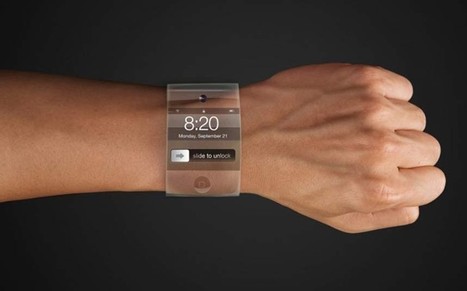
A smartwatch with next-generation health skills could help Apple beat rivals in the wearable technology sector Via Alex Butler
Scoop.it!

Grâce à ces minicentres de santé, la téléconsultation devient possible dans les déserts médicaux.
Scoop.it!

Après avoir vu diverses formes prises par les capteurs, présents ou futurs, destinés au suivi de notre état de santé, intéressons nous au format sans doute le plus abouti pour répondre à la fois au...
|






