


A l'occasion de la journée mondiale de la trisomie 21, le 21 mars, la Fondation Jérôme Lejeune lance une campagne de sensibilisation : "Être différent c'est normal". Découverte. A travers cette cam...

 Your new post is loading...
 Scoop.it! A l'occasion de la journée mondiale de la trisomie 21, le 21 mars, la Fondation Jérôme Lejeune lance une campagne de sensibilisation : "Être différent c'est normal". Découverte. A travers cette cam... 
No comment yet.
Sign up to comment
Scoop.it!

(AFP) - David Eagleman espère qu'un jour, VEST, le vêtement qu'il a inventé, pourra redonner l'"ouïe" aux sourds, faire ressentir les...
Scoop.it!

Dans plusieurs pays africains, l essentiel des médecins spécialistes sont installés dans les capitales. Il faut faire de longs trajets pour obtenir des
Scoop.it!

DirectHopital.com est le site dédié aux managers hospitaliers. Il traite d’actualités pratiques, de retour sur expérience et des nouvelles initiatives dans les domaines des RH, de la qualité / sécurité, des finances, des achats et de la logistique. Via Paris Healthcare Week
Scoop.it!

Google a obtenu un brevet décrivant une méthode de lutte contre le cancer et d'autres maladies. Celle-ci repose sur des nanoparticules chauffées par un bracelet spécial qui émettrait des impulsions de radiofréquence. Le but ? Détruire les cellules dégénérescentes sur lesquelles les na
Scoop.it!
Les nouvelles technologies ont changé le quotidien des professionnels de santé. Médecins, pharmaciens, laboratoires et autres établissements de santé sont concernés par la dématérialisation des dossiers de leurs patients.
Scoop.it!
La start-up Enovalys créée par un chimiste pour des chimistes, permet désormais la démocratisation des données scientifiques : un gain de temps et d’argent considérable pour les laboratoires comme pour les industriels.

Romain DEFOY's curator insight,
March 20, 2015 8:43 AM
"A l’heure actuelle, Enovalys recense 1 500 utilisateurs, grâce à qui une première base de données contenant près d’un million de réactions chimiques. Un projet à l’avenir prometteur : « Tous les industriels sont intéressés par le potentiel de la donnée. On s’inscrit dans une lame de fond qui est en pleine évolution : l’open data » commente Frank Hoonakker. La start-up a pour ambition de passer à plus de 15 000 utilisateurs en deux ans."
Scoop.it!

Premier site français d’information en continu sur les technologies de l’information et de la communication (TIC, NTIC) dans la santé - TIC santé Via Paris Healthcare Week
Scoop.it!

The California firm's patent details a wearable that could target any substances, when present in the blood, that may affect the health of a wearer by transmitting energy into the vessels. Via Marc Phippen

Courtney Bonner's curator insight,
March 25, 2015 12:56 PM
If this wristband ends up being approved by the FDA, it could be a major change for the medical field. Cancer is obviously devastating and ruins too many lives worldwide, so it would be awesome to see this wristband save the world. 
Lori Wilk's curator insight,
April 25, 2015 9:38 PM
This #wearable has #health and #medical life-changing possibilities. I can't wait to hear more.
Scoop.it!

Créée en juin 2014, la startup Care Labs vient d'annoncer avoir bouclé une levée de fonds de 2 millions d'euros auprès de 4 fonds d'investissement
Scoop.it!

Recent studies show that nurses are among the most active medical professions online, and they are frequently looking for new ways to be able to connect with their peers through social media. After Te... Via Richard Meyer
Scoop.it!

Comment améliorer la qualité de vie et l’autonomie des patients souffrant de la maladie de Parkinson ? La réponse nous vient d’Espagne. L'amélioration de la qualité de vie des patients pourrait venir de trois appareils : un boîtier équipé d'un capteur, un smartphone et une oreillette. Via Philippe Marchal
Scoop.it!
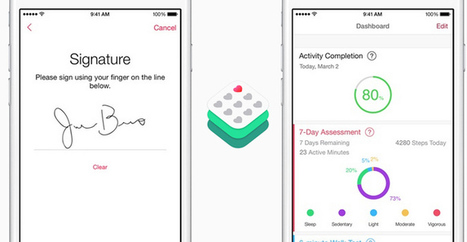
Avec ResearchKit, Apple donne aux chercheurs la possibilité d'intégrer des millions de cobayes à leurs recherches médicales, en conservant un protocole fiable. Mais les Via Celine Sportisse
|
Scoop.it!

L’Open Data s’invite à nouveau à l’Assemblée nationale. Après les données de transports, c’est au tour des données de santé d’être examinées par les députés. Critiqué sur ce dossier, le gouvernement a cependant souhaité revoir sa copie en faisant adopter plusieurs amendements à son projet de loi sur la santé, hier en commission.
Scoop.it!

Mise au point par des chercheurs australiens, une capsule équipée de capteurs spécifiques pourrait bientôt être avalée par les patients afin de...
Scoop.it!

L'usage des données s'est fortement développé dans le domaine du marketing, mais son développement bouleverse bien d'autres secteurs l'agriculture, le sport... Et la santé n'y échappe pas. De n
Scoop.it!

A l’occasion de la 12ème Semaine de la Continence, l’Association Française d’Urologie organise un chat Facebook dédié à l’incontinence, le vendredi 3 avril. Présentation. Dans le cadre de la Semain...
Scoop.it!

EN DIRECT. - Développeurs et professionnels de santé se retrouvent du 19 au 22 mars à Strasbourg pour élaborer le futur de la santé connectée.
Scoop.it!
Promettant plus d’un million d’années de survie, les procédés de stockage de données dans l’ADN sont de plus en plus concrets. Des chercheurs suisses viennent de réaliser un premier test plutôt réussi.
Scoop.it!
La numérisation des données, la gestion des outils connectés sont des vecteurs d’efficacité et de sécurité pour toute la chaîne médicale. Pas étonnant que l’industrie pharmaceutique se tourne vers des entreprises high tech pour y parvenir.
Scoop.it!

Social media can take your career to the next level, but these commonly seen mistakes will hold you down. Make sure you know how to avoid them. In the digitally driven world we live in today, businesses across all industries are constantly seeking more modern techniques to market their services to an evolving community. For doctors, one of the most powerful tools to help do so has been social media. These social platforms give doctors a digital resource that allows them to communicate, build relationships, and acquire patients.
Although social media has been around for a number of years now, many doctors are still not trained well enough to adequately utilize its capabilities. Social media can be a tremendously influential tool that allows you to connect with your patients both organically and non-organically, but it can also be detrimental to your career if you do not use it the right way. Because most blunders you make on social media will be visible to the public, they can potentially cost you money, patients, and your reputation. Deteriorating your reputation has never been a good thing, but with more people using the Internet to find a doctor than ever before, the importance of building a positive online reputation has never been greater.
There are many common mistakes you’ll see doctors make on social media. Whether you’re just beginning to build your online profile or have been doing so for years, it’s important to learn from the mistakes of others so that you can avoid them yourself.
Here are some of the more common mistakes doctors make on social media:
Not having a strategy in place The #1 reason people don’t get the results they wanted for from their social media account is the fact that they never had a clear plan on how to use it. In order for social media to play a beneficial role for you or your practice, it’s crucial to have a strategy in place that aligns why you’re using it with what you hope to get out of it. Creating an account on a social media website and blindly posting without any specific intentions is unlikely to generate positive results. Make sure you are familiar with the etiquette and customs of the specific platform you are using. Know your target audience and produce content that they will be interested in, thus increasing the likelihood they will engage in conversation with you. Take the time to set clear goals and objectives that can be measured to determine how successful they are. There is nothing wrong with adjusting your plan as you go, but it’s absolutely essential to establish some sort of a strategy to steer your social media efforts in a direction that will lead to positive results.
Shying away from conversation The whole point of social media is to provide a platform where you can interact with others. Social media is not a blog or an advertisement. There are certainly aspects of it that share similar functions as these, but more than anything social media is about creating an online community where you can connect with others. It’s not a one-way relationship where you push out information, but are unwilling engage in conversation and listen to feedback – even if that feedback is negative. Responding to positive feedback is easy, but one of the hardest things to do on social media is responding to negative reviews. Even if you cannot mend the relationship with the patient who left a bad review, responding to their concerns in a public forum shows prospective patients that you take your craft seriously and care about their health. The biggest component in creating a community is engaging with the community that you are creating. If the overarching goal of your social media strategy is to create more patients, then you simply cannot be a social media robot. You need to emit a more personal touch that allows them to build a better relationship and become comfortable with you. It’s human nature for people to be more drawn to someone who listens to them and shows an interest in what they have to say. Show them that you are a real person – show them that you care.
Over-promoting This goes back to the point that social media channels are geared to promote conversations, not advertisements. Creating a social media profile strictly for self-promotional purposes won’t do you any good. A general rule of thumb is to go with an 80/20 split – meaning no more than 20% of your posts should be directly promotional. When people are scrolling through their news feed, they want to see things that are interesting and valuable to their life, not yours. They don’t want to incessantly hear about the benefits of your practice and what you can supposedly offer them. You cannot force yourself or your practice upon them – it won’t work. Instead, acquire new patients by focusing on developing relationships and earning their trust over the long run.
Focusing on quantity over quality It’s easy to get caught up in the numbers and sacrifice quality in favor of quantity when building your social media pages. Yes, there’s value in having a lot of friends or followers, but not when it jeopardizes the validity of your online reputation. There are a number of programs out there that allow you to pay for friends, followers, likes, etc., but buying your way into forming a perception that you’re more popular than you actually are is not a good idea. Not because it’s immoral or inaccurate (which it is), but because it’s a waste of money. There is no value in your posts when the people seeing them are not even real people. On top of that, when real patients are able to see that the majority of people following you are actually bots, your credibility is diminished.
Another area where focusing on quantity over quality can come back to harm you is the frequency in which you post. Obviously, you need to post often enough that your able to build a following, but you don’t want to bombard your audience by posting so often that it gets to the point where they deliberately ignore your posts. When you make the quantity of your posts a top priority, you unknowingly create less creative and engaging content, consequently reducing the effectiveness of your posts. How often you should post depends on the social network you are using, your target market, and your social media strategy. The general rule though is to post as often as possible to the point where you are not sacrificing the quality of your content.
Not managing time and resources Managing your time wisely is absolutely vital when it comes a career as time-consuming as being a doctor. You want to be as efficient as possible when conducting your social media endeavors, thus freeing up more time throughout the day to be spent on other matters. There are many ways to do so, but most doctors make the mistake of either not knowing about, or not taking advantage of these resources available to them. There are several comprehensive social media management tools, Sproutand Hootsuite being two of the favorites, which allow you to control almost all aspects of your social profile from one easy-to-use location. These tools allow you to schedule posts ahead of time, which saves you a lot of time spent sharing posts throughout the day. This also allows you to schedule posts duringideal hours of the day. However, do make sure that you are not relying solely on these automated posts and forget to the whole meaning of social media in the first place – interaction! Another mistake many doctors make is constantly running to the join the latest and greatest social network and abandoning platforms that they had previously been using. There are dozens of social networks that doctors should be on, and more sprout up every week. There’s nothing wrong with joining additional social networks, but it shouldn’t be at the detriment of the platforms that you have already established a community with. You cannot join too many social networks that it gets to the point where you don’t have the time and manpower to manage each one of them. Use your time and resources wisely.
Unreasonable expectations If you begin your journey into social media with the expectation that you’ll see immediate results, you’ll surely be disappointed. You’ll often hear the old adage, “it’s a marathon, not a sprint,” in regards to dealing with social media for your practice. While it may be corny, it’s entirely accurate. Remember, you’re trying to build relationships with these people. Naturally, doing this takes time, even more so when you’re doing it online. You can’t get discouraged when you aren’t seeing much of a return on your investment overnight. When you design your social media strategy, understand that you need to be in it for the long haul if you hope to benefit from your efforts.
Not setting up bio and profile picture correctly In social media, your profile is your first impression. You are able to build relationships by the way you communicate with people, but your profile sets the tone that allows that relationship to build in the first place. It all starts with your profile picture – don’t make the mistake of thinking this doesn’t matter. This is the first thing that others will see on your profile and is something they’ll associate with you from there on. Having a lackadaisical or unprofessional picture isn’t exactly the initial image you want to represent you. Aside from the picture, also ensure that your bio is properly written. They need to know whom you are and what you do, but don’t overload them with unnecessary information. Your bio will vary depending on the particular social media platform you are using. However, generally your bio should be informative, yet concise.
Not knowing the line between personal and professional If there’s one aspect of social media that is most responsible for a large number of doctors shying away from using it at all, it’s the fear of it leading to legal actions against them. This fear is certainly justifiable, there are certain components of your career – patient confidentiality for example – that absolutely cannot be discussed on a public forum environment created by social media channels. Not knowing the boundary between what is ethically acceptable and unacceptable is a mistake that can indeed lead to dire consequences. However, that shouldn’t stop you from using social media, it should motivate you to understand where the line should be drawn in order to avoid negative ramifications.
Not using it Plain and simple: the biggest mistake doctor’s make in regards to social media is neglecting to use it. There are a variety of opportunities at one’s disposal through social networks that otherwise would not be obtainable. The possibilities are endless – as long as you avoid a few common mistakes.
Via Plus91
Scoop.it!
Paris, le 18 mars 2015 VISIOMED GROUP (FR0011067669 – ALVMG), société spécialisée dans l’électronique médicale nouvelle génération, présentera MyHealthbox®, sa solution innovante de télémédecine et santé connectée le 23 mars prochain à l’occasion des Renc - 18 Mars 2015 à 18:30
Scoop.it!

Les Entreprises du Médicament (Leem) proposent une nouvelle web série consacrée aux essais cliniques. Découverte. Pour permettre au grand public de mieux comprendre ce que sont les essais clinique...
Scoop.it!

Google’s changes mean that the search rankings could be at serious risk for websites that don’t meet the mobile-friendly requirements. Via COUCH Medcomms

Alexandre Gultzgoff's curator insight,
March 16, 2015 9:01 AM
a must-read article before designing a new spmsd website
Scoop.it!

Whether “doctors aren’t discussing it or if patients aren’t hearing it,” when it comes to cancer and its treatment a study found that many patients knew little. Via Richard Meyer
|




