A l'occasion de la journée mondiale de la santé ce 7 avril, l'organisation AJILA lance la campagne Go Red for Women - France pour mobiliser contre les maladies cardio-vasculaires chez la femme. Déc...
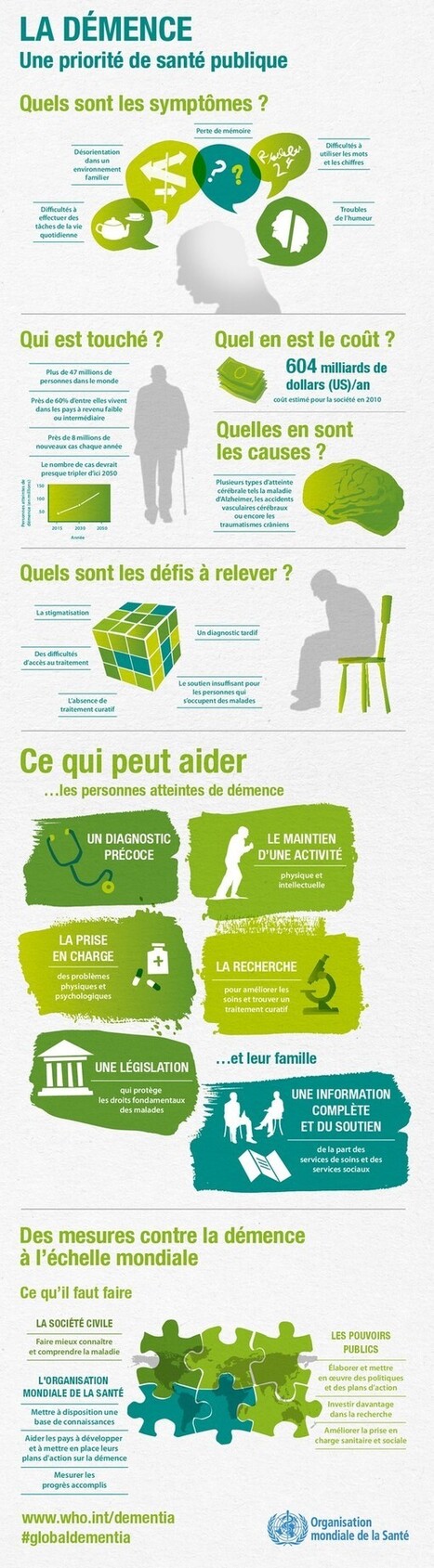
A l’occasion de la première conférence ministérielle sur l’action mondiale contre la démence qui s'est déroulé du 16 au 17 mars 2015, l’Organisation Mondiale de la Santé (OMS) a lancé une infograph...
This post is about an issue I plan to address during my visit at Mayo Clinic: the changing role of the patient and how that change is significantly powered by social media. Creating the best possible future for both patients and clinicians depends on our understanding this clearly and formally, so we can agree about what’s possible, and then practice health and care accordingly.
TransformationKnowledgeThe image at right is an updated version of a slide I’ve used for years. First published by MCCSM Advisory Board member Lucien Engelen – in 2010! – this visionary graphic illustrates how the internet has altered the flow of information.
When many of us were growing up, knowledge flowed within a truly closed system, but today it’s an open network of networks. Social media functions the way capillaries do in the body: information can flow around without centralized control. What was once never possible, is now essential. (See this simplified 50 second animated version of the diagram, first published by the BMJ.)
To understand this new future for patients and clinicians, we have to rethink things…and I don’t just mean technologically.
Most patients still don’t realize they can make real and valuable contributions, so, naturally, they haven’t worked at sharpening those skills. Nor do most clinicians realize that patient contributions and perspectives can be genuinely useful.
Still, there’s new and ever-emerging evidence that the medical establishment is accepting this movement toward enhanced patient collaboration. In 2012, in its report, Best Care at Lower Cost, the Institute of Medicine identified this as one of the four pillars of a learning healthcare system:
Patient/Clinician Partnerships Engaged, empowered patients – A learning healthcare system is anchored on patient needs and perspectives and promotes the inclusion of patients, families, and other caregivers as vital members of the continuously learning care team.
And this is why I’ve announced my plan to kick off a formal project to explore a key question: Is it time for us to define a new science of patient engagement? More specifically:
Can we formally, methodically, rigorously identify what patients can now contribute to conversations about diagnosis and treatment that wasn’t possible or permissible in the past? Can we figure out why in some cases patient engagement leads to real improvements in outcomes and costs, while in others it fails? People have a tendency sometimes to speak of social media as if it were a magical universe inside of which amazing things happen, but nobody’s sure quite what or how.
I want to encourage people to think in concrete, specific terms about how valuable information truly flows to where it’s needed, because that is what makes new things possible – especially what makes possible the world of informed, empowered, engaged e-patients who truly are partners with the medical professionals.
A physician’s online reputation is just as vital as a physician’s reputation in the community, according to Kevin Pho, MD, of KevinMD.com, social media’s lea...
Des chercheurs du MIT planchent sur un moyen de détecter plus précocement la maladie de Parkinson. Pour cela, ils veulent analyser la manière dont les individus appuient sur les touches du clavier d'ordinateur. L'idée ? Détecter des variations révélant une dégradation des fonctions
La cinquième édition de l’incontournable congrès Doctors 2.0™ & You se déroulera les 4 et 5 juin prochain à Paris. Présentation. Doctors 2.0™ & You, qu’est-ce que c’est ? Il s’agit d’un con...
Steven Keating, a graduate student at the MIT Media Lab and a brain cancer survivor, was the subject of an article this week, presented as a super data cruncher of his own patient information.
The young scientist’s collection and analysis of his own data makes him an extraordinary exception today, but physicians and health care experts say he is a sprinter along a path others are walking — toward consumers taking a more active interest in gathering, studying and sharing their medical data. Better-informed patients, they say, are more likely to take better care of themselves, comply with prescription drug regimens and even detect early-warning signals of illness, as Mr. Keating did.
Technology is advancing how medicine is practiced, giving patients the chance to participate more fully in their healthcare. These new developments have the potential to elevate the provider-patient relationship, and are being welcomed, for the most part, by both groups.
Comme la plupart des gens, vous n’allez chez le médecin que lorsque vous êtes malades ou que vous avez besoin de renouveler votre ordonnance. Le reste du temps, vous surveillez peut-être votre...
Après des années de tests et d'expérimentations, les tablettes tactiles destinées aux soignants sont enfin mûres pour être utilisées dans le cadre sanitaire ultra-strict des hôpitaux et établissements de soins. Exit les relevés papiers. Place aux transmissions en temps réel !
For months and months speculation was rife about the Apple Watch (or iWatch as was the expected moniker) and the possible implications and applications for healthcare. Then we had the 9th March launch event in San Francisco and theApple Watch seemed to sink like a lead balloon in the minds of health technology enthusiasts. This was aided by articles such as the one in the Wall Street Journal that claimed much of the exciting health sensor technology had been scrapped and asked: What Exactly Is an Apple Watch For? (Subscription required)
I believe that technology only becomes socially interesting when it becomes technologically boring. We can only really impact health at scale when we utilise technology that has true mainstream reach. However I feel there are still a number of key reasons the Apple Watch is worth thinking about for healthcare broadly, and pharmaceutical companies specifically. Here are five reasons pharma should care as we approach the April 24th Apple Watch launch date
En jouant au célèbre jeu vidéo tout en étant équipé d'un gant connecté, les personnes souffrant des séquelles d'un accident vasculaire cérébral ont pu retrouver plus rapidement une meilleure dextérité.
Le plus « structurant » des articles de la nouvelle loi sur la santé, discuté à partir du 7 avril au Parlement, touche à l’ouverture publique des données de la Caisse d’assurance-maladie. Un enjeu crucial.
La Commission belge de la protection de la vie privée met en garde dans un avis récent les services médicaux quant à l'utilisation de services "Cloud" pour stocker les dossiers médicaux des patients. Elle demande aux hôpitaux "la prise en considération des conséquences d'un accès possible aux données par des personnes extérieures à l'établissement de soins."
L'idée paraît peu croyable, elle vient pourtant d'être démontrée par des chercheurs universitaires australiens. Les requêtes Internet que l'on fait sur les moteurs de recherche permettraient de
Après ce spectacle féérique et connecté au CES de Las Vegas, il est une évidence : la santé de demain ne peut être que connectée. Il est temps de différencier le bien-être connecté de la médecine connectée. Spectateurs assidus et émerveillés, les professionnels de santé ont décidé de devenir les acteurs principaux de cette médecine connectée. Connected Doctors, né il a sept semaines, est rapidement ...
En Catalogne, le gouvernement prévoit de mettre à disposition des centres d’étude les données recueillies par le système de santé catalan. Ce service sera géré par une entreprise privée qui devra débourser 25 millions d’euros en huit ans.
La m-Santé, ou m-Health, est un secteur en plein boom. Hakisa propose une infographie que nous relayons sur Silvereco.fr et qui en dit plus sur la m-santé.
Découvrez les dernières nouveautés du digital santé francophone au cours du mois de mars 2015. Vous pouvez également retrouver toute cette veille et plus encore sur mes différents scoop it ! : Buzz...
La start-up suisse développe une application mobile pour aider les professionnels de santé à mieux suivre l'évolution des plaies et apporter un soin de meilleure qualité aux patients.
To get content containing either thought or leadership enter:
To get content containing both thought and leadership enter:
To get content containing the expression thought leadership enter:
You can enter several keywords and you can refine them whenever you want. Our suggestion engine uses more signals but entering a few keywords here will rapidly give you great content to curate.


 Your new post is loading...
 Scoop.it!