


La start-up française Gaspard annonce avoir inventé le "premier bouton d'entraide communautaire".
Une sorte de "panic button" à porter sur soi, qui donne l'alerte à un proche en cas d'urgence.

 Your new post is loading...
 Scoop.it! La start-up française Gaspard annonce avoir inventé le "premier bouton d'entraide communautaire". 
No comment yet.
Sign up to comment
Scoop.it!

Le Fonds de Dotation Pour Sa Peau Pour Sa Vie lance une opération Facebook pour sensibiliser les Français aux risques solaires : "Bébé craint le soleil"
Scoop.it!

From
tech

In a bid to relish a better standard of living, working day in and day out has become a norm. This has left people with less time to focus on their personal lives. And as a result their health is being neglected. Imagine if I told you that now you have someone who will keep an eye on our health while you keep on with your daily work!? Yes! It’s true. Smarty-pants Google’s latest health tracker has made this possible.
Via Alex Butler
Scoop.it!

Organisés dans le cadre de l'Université d'été de la e-santé, les Trophées de la e-santé ont rendus leurs verdicts. Découverte des lauréats.
Scoop.it!

In previous posts we've uncovered some some specific insights about physicians and their professional social network usage. When it comes to posting on social media in a professional capacity, there are certain trends we can notice. We know that a doctor sharing an article is much more likely to be embracing new medical technology or drugs. One of the trends we're noticing is that professional social networks are surpassing other platforms in terms of popularity and content shared. Our study results show that 58% of physicians that write/post on social networks for professional purposes choose to write/post on professional social networks vs. consumer or medical association social networks. What does this mean for advertisers? Well, potentially you as an advertiser should establish more of a presence on professional networks. If you sell new pharmaceuticals to doctors, there's definitely some good news from the March 2015 edition of the Sources & Interactions™ Study. Physicians that write/post on social networks for professional purposes are more likely to be new drug adopters. Is social media advertising part of your media plan? It should be: 67% of respondents are saying they prefer to adopt drugs as soon as they are released or after a few others have tried it successfully. The fact is that medical professionals using professional social media are among the most receptive to new pharmaceuticals and you don't want to miss out on that group. Sales teams should embrace these findings as well. Among this demographic using social media, 83% of them say they see sales reps—10 percentage points higher than the total physician population that see sales reps. It's clearly evident that social media needs to be a tool you utilize to reach the newest drug adopters. The Sources & Interactions™ Study is a detailed examination of doctors’ online and mobile activities, e-detailing experience, and exposure to (and evaluation of) information sources including traditional and emerging media, pharma reps, CME, convention and more. The study is conducted every six months and targets more than 3,000 physicians annually across 22 specialties, exploring their media preferences and habits. Sources & Interactions was designed to help marketers and their agencies cost-effectively allocate resources to their overall promotional mix, and provide publishers with specific insight about where their offerings fit into physicians (and other healthcare professionals’) information inventory. If you need specialty-specific data, let us know. We study physician media behaviors and preferences annually across 22 specialties. - See more at: http://www.kantarmedia-healthcare.com/habits-of-physicians-posting-for-professional-purposes#sthash.zYOxyuKp.dpuf Via Plus91
Scoop.it!

There are two ways that physicians can establish their online reputation. The first way is to use existing physician rating sites. What physician rating sites will do is create a profile page of every single doctor in the United States. This profile will have your name, your contact information, your board certification status, your hospital affiliation, and, of course, some of them allow patients to rate doctors online. These pages are backed my companies who are experts in search engine optimization, SEO. (That’s the science of ranking high on Google.) Unless you already have a prominent online presence, these pages that get ranked high when your name is Googled can be patients’ first impression of you online. It’s important to go on these sites, claim your profile, make sure that it information is accurate. A second way to establish your online reputation is to create content about yourself on the web. If you look at a sample Google results page, there are studies showing where readers click on that page. About a third of readers will click on the very first result. Another third will click on the second or third result. Fewer than 10 percent of readers will even go on to the second page of results, so it’s important to control those top listings of Google when your name is searched for. We need tools that are powerful in the eyes of Google and allow us to create content about ourselves online. Today, we’re in luck because we have those tools available to us. They are social media platforms: blogs, Facebook, Twitter, LinkedIn, YouTube. They get ranked high in Google search engines and give us the flexibility to create content about ourselves online. Defining ourselves online with social media is the most powerful way to establish our online reputation Via Plus91
Scoop.it!

Israeli firm Nuvo Group has unveiled a wearable pregnancy monitor designed to let expecting parents and their physicians keep an eye on how the baby is dev
Scoop.it!

Why use LinkedIn? LinkedIn is considered to be the world's largest professional network where an online identity can connect your business to others, help find businesses, and be found. It is a site where the latest news and insights can be shared as well as a place to discover professional opportunities, business deals and new ventures.
LinkedIn is the key to success for Healthcare Organizations! It can help in the following ways BrandingMarketingSalesHiring How to get startedIn order to be successful with LinkedIn, your Healthcare Organization has to have a marketing plan so that it can deliver ongoing results. The Social Media Examiner lists 5 marketing ideas that will help create a comprehensive marketing program: Build a Robust company page on LinkedIn.Launch a Linked Group based on company or industryCreate an "All hands on Deck" ongoing through leadership programLeverage paid LinkedIn ads and sponsored updatesMonitor Track and Adjust These are all great ideas, however they certainly require a commitment not only from the Organization, but employees as well. Often long and fluctuating hours worked by healthcare personnel are demanding enough, finding committed employees may be more of a challenge than expected. Finding someone to specifically monitor, track and adjust the business goals can be a full time position, and making sure that designation takes place at the beginning of this plan is crucial. Here's are four examples of Showcase pages that are used heavily for Healthcare Marketing Healthcare Data Solutions states that these pages are very beneficial to large companies who have multiple brands because each can be put in the spotlight and strategically placed into one portal. That's great, but smaller businesses can be creative and do the same even if they have less to offer. Unfortunately, a drawback with LinkedIn is that out of the one million Physicians who are a part of this social media site most are aware of this feature. LinkedIn is known for posting resumes and allowing Healthcare Organizations to find each other more easily, but with Showcase Pages LinkedIn can be greatly improved in healthcare marketing as well. More data should be collected and researched to see how Healthcare Organizations have benefited over the last two years from these Showcase Pages. The Healthcare Professional can also benefit from LinkedIn Andrea Santiago points out why and what you can do on her website about health careers It is user friendly It is easy to get connectedHealthcare hiring managers often post positions - making them easier to findHealthcare professionals can be easy to identify by placing themselves into categories: Medical Practice, Hospital and Health care, Pharmaceuticals, Medical Device, Health Wellness and FitnessYou can join groups in order to connect with other healthcare professionalsIncrease exposure by being proactive and proofreading your profile At the end of the day it really is true when people say "you get what you put into it" :O) A little bit of effort from the start can go a long way with a social media site such as LinkedIn. How much easier can it get? To have a free site that does most of the work for you is priceless. If social media did not exist life would be so much more difficult. Think about it. Newspapers used to be the go to for anyone looking for a job or looking to hire. The ability to network, find people who work in the same field, have the option for healthcare organizations to scout you out all at the same time is priceless. To be able to reach people from across the state, country or even the world at almost no cost to you is invaluable. One of the biggest features that LinkedIn has over other social media sites is the professionalism it maintains. This site is about business, and those who want to learn about it, associate with it, work in it and be a part of it. Go check it out, the world is at your fingertip! Via Plus91
Scoop.it!

The digital health market continues to mature as we move into the second half of 2015, with Fitbit's IPO and a focus on personalized medicine leading the way, according to a mid-year report from StartUp Health.While digital health funding is not outpacing 2014, which was a record year for investments in the market, capital flow is remaining steady this year, the report says. Via Alex Butler
Scoop.it!

Des chercheurs ont mis au point un algorithme permettant de détecter des interactions positives ou négatives entre des médicaments grâce à l'analyse de la twittosphère.
Scoop.it!
Je vous parle depuis quelques mois de mon goût pour l’innovation et pour un métier de médecin où la technologie prend toujours plus de place. La relation professionnel de...
Scoop.it!

A l’occasion de la Journée Nationale du Don d’Organes , l’association Maryse ! pour la vie a lancé la 1ère application mobile pour le donneur d'organes.
|
Scoop.it!

Parmi les acteurs de santé concernés et potentiellement sollicités pour l’amélioration de l’observance médicamenteuse, il en est un qui est incontournable, c’est le pharmacien d’officine. Sa place ...
Scoop.it!

Last week I published a link to 51 digital health metrics in 2013. The post had a lot of great stats but statistics without insights mean very little. Over the past 3 years I have reviewed a lot ... Via Richard Meyer
Scoop.it!

If it were up to Internet-savvy Americans, more of them would be emailing or sending Facebook messages to their doctors to chat about their health. That's the result of a national survey led by Joy Lee of Johns Hopkins Bloomberg School of Public Health in the US. The findings appear in the Journal of General Internal Medicine, published by Springer. Surveys were sent to more than 4,500 customers of a retail pharmacy. The replies of the 2,252 respondents were included in the analysis. Respondents tended to be well educated, in good health, and frequent users of Facebook. The results show that the people who responded are very interested in using email and Facebook to communicate with their physicians, and to manage their health. In the six months prior to the survey, 37 percent of patients did, in fact, contact their doctors via email, and another 18 percent through Facebook. Lee says the latter finding is notable, as most institutions actively discourage social media contact with individual patients, due to privacy and liability concerns. Non-white respondents, people younger than 45 years old and those with a higher income are more likely to make electronic contact with their doctors. It is also true for those taking care of others, and patients with chronic health conditions. College graduates are more likely than others to use Facebook to communicate with their physicians, while people with lower education levels and income do not opt for correspondence by email. The survey also shows that up to 57 percent of patients want to use their physicians' websites to access health information. Around 46 percent of patients want to be able to use email to track their health progress and access health information. Many of these functions are already possible through the electronic health records systems, developed and used by many major hospitals. However, the survey shows that despite expressing interest in such opportunities, few patients use them. Only seven percent of respondents actually use their physicians' websites to access their own health information, while another seven percent fill prescriptions via email. Lee says these results highlight a disconnect between patient interest and use. It suggests that patients might not be aware of existing services. "The findings highlight the gap between patient interest for online communication and what physicians may currently provide," says Lee. "Improving and accelerating the adoption of secure web-messaging systems is a possible solution that addresses both institutional concerns and patient demand." Click here to edit the title Via Plus91
Scoop.it!

From
techpp
here are plenty of patents out there being filed by Apple, and from time to time we catch some really ingenious ones. Such is the case with a fresh one, called Concealed Electrical Connectors, discovered by the folks over at AppleInsider.
The patent application was first filed for in December 2013 and describes a clever process which would allow Apple to endow its iPhone logos with health sensors, fingerprint readers and even a inductive charging setup. According to the patent, Apple’s engineers have invented an electrical system which can be implemented within the iPhone’s chassis in order to provide housing for various sensors.
Via Alex Butler
Scoop.it!

Derrière ce titre un peu provocateur se cachent en réalité deux phénomènes : d’un côté, l’intérêt croissant d’optimiser le parcours patient lors de son séjour à l’hôpital et de l’autre, l’avènement de technologies simples et pertinentes qui...
Via Chanfimao
Scoop.it!

The patient is the most important stakeholder in any health debate, and the digital innovations coming from doctors must always be geared toward helping those in need, rather than using technology as an end in itself. Somebody who understands this better than most is Michael Seres, an evangelising ePatient passionate about the ability of new technologies and social media to help him, his condition and his well-being. Michael has been diagnosed with the Crohn's disease but his condition grew worse, and he later required a small bowel transplant after suffering from intestinal failure. Now in his 40s, he requires life-long medical help, and represents many chronic patients who require constant monitoring and doctor visits. Speaking to PME Digital Doctors, Michael says: “For me, digital health has played a massive role in managing my conditions. Skype, text, email and social media are all as vital as my doctor and my clinical notes.” He says that in 2013 the clinic at his transplant unit started using Skype, which allows people to talk to each other face-to-face over the internet. Michael says for a chronic patient, this sort of thing is invaluable. “There was no need to travel 90 minutes for a routine follow-up appointment when Skype did the trick,” he explains. “This was then followed by texting blood results again, all with my consent, but it enabled me to manage my condition as I would manage any other part of my life. “We use technology as part of every day life - why would we not do the same with our health. Take my blog [www.michaelseres.com] for example: as a direct result of this, four patients have successfully undergone transplants that their medical teams don't even know existed.” Pharma is a vital part of any healthcare conversation. To me, I would like them to be in the room when I talk about my medications with my doctor Doctors and social media Doctors are now - although tentatively - also looking to engage more with patients online, and Michael says this can produce better clinical outcomes. He says: “I managed to teach my transplant surgeon the value of Twitter and for a while, he would tweet me my results. He also conducted a couple of tweet chats where patients could engage directly with the surgeon online. “Now, I often use Facebook Messenger to convey a comment or query when I see they are online.” But this is still a tricky area for doctors, and Michaels says: “There is a fine line here though, which patients must not cross - and that is remembering and respecting that they are still talking to their doctor. “There are boundaries and while social media are not for everyone, as long as the same respect is shown online that is shown face-to-face, then why not use it?” Uptake of digital “At the moment, we [in the UK] are still incredibly slow to adopt technology that we use in everyday life. Emailing your doctor is not common practice, and nor is texting - so why are we focusing on new technologies when we do not even use the existing ones properly? “That said, I actually think that in many ways we lead the way in the UK, and that is down to patients. We are often braver at trying new things, but then slower to adopt at scale that say those in the US.” The role of pharma online He explains: “Pharma is a vital part of any healthcare conversation. To me, I would like them to be in the room when I talk about my medications with my doctor. “They would then understand what it is like to be a patient taking one of their medicines. Only when they truly understand that can they have a proper conversation. The commercial side doesn't bother me, it never has. “Pharma can make as much as money as they want, as long as they channel it back into medicines that might save my life, or to help me live my life.” Via Plus91
Scoop.it!
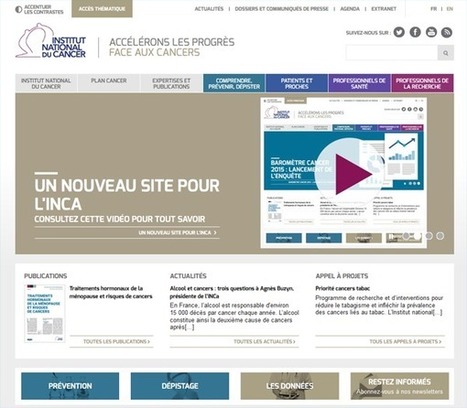
Pour s'adapter à l'ensemble de ses publics, l’Institut national du cancer (INCa) lance une nouvelle version de son site web : e-cancer.fr
Scoop.it!

We hope that by now, most individuals in the healthcare and medical device industries are aware of the value in having an online social media presence. More doctors and healthcare leaders are participating across multiple social media channels than ever before. To name a few, these are some of our favorite influential figures in the healthcare and medical device industries that are on Twitter today: @DrLeslieSaxon: Clinical Scholar · USC Keck School of Medicine & Executive Director of USC Center for Body Computing@KevinMD: Physician Author · Keynote Speaker · USA TODAY’s Board of Contributors@JohnNosta: Digital Health Philosopher and Strategist · Lead thinker at NostaLab Google Health Advisory Board@GarryChoy: Physician focused on Quality and Systems Improvement@davidmcnierney: Director of Medidata@jkvedar: Vice President of Partners News Connected Health Associate Professor at Harvard Medical School@EricTopol: Cardiologist Researcher · Editor-in-Chief at Medscape · Author of The Patient Will See You Now@Paul_Sonnier: Founder of a 30,000+ member #DigitalHealth LinkedIn group · Social Entrepreneur · Strategy ConsultantWhat are Hashtags? To describe it in an easy to understand context, a hashtag is just a fancy way of saying “keyword”. For example, if you search “healthcare” on twitter, it will automatically come up with posts that users have tagged as related to the topic of healthcare. All these influential Twitter users we mentioned above have one thing in common, the fact that they are using consistent hashtags to represent what it is they stand for and are experts in. Depending on what you specialize in and the type of content you’re sharing, you should thoroughly research hashtags that are related to your industry in order to target the right audience. After conducting our own research, these are some of the most currently used hashtags in the healthcare and medical device industries: #MedDevice#MedicalDevice#MedTech#Healthit#mHealth#HCSM#Digitalhealth#Healthcare#eHealthWhy Use Hashtags? Hashtags not only represent your field of expertise, they also become a keyword that individuals will start relating you to. Social media users will start searching for these hashtags to find the subjects that might relate to your expertise. These hashtags are a way for your followers to find your content, understand it, and engage with it. They are a great way to reach a wider audience on social media, interact with individuals interested in a specific topic, and interact with other experts in your field. How Many Hashtags Should I Use? Did you know that “tweets with hashtags get two times more engagement than tweets without?” (BufferSocial) Although these hashtags are valuable to use, you don’t want to overdo it by using too many in one tweet. Ideally, you should use no more than two hashtags per tweet.
A Hashtag is Your Brand: One of the most important things you have to think of when using hashtags is “Does this keyword match my branding pillars? Is it something I want to stand for?” Just like any other digital marketing effort, your social media presence must align with your brand image. You always have to portray the appropriate voice, messaging, and value to your followers.
Via Plus91
Scoop.it!

Biotechnologies, numérique, start-ups: face aux innovations dans la santé, les industriels mais aussi les professionnels de la médecine et les... Via Pharmacomptoir / Corinne Thuderoz
Scoop.it!

Il fait chaud, très chaud sur la France ! Retrouvez ici un kit de survie de 6 objets connectés, pour faire face aux températures les plus extrêmes.
Scoop.it!

Lors du salon Hello Tomorrow qui se tenait à la Cité des Sciences à Paris, les 25 et 26 juin, Orange présentait "Pops", un terminal de suivi destiné à fonctionner avec une multitude de produits con...
Scoop.it!

Among the 50 largest drug makers in the world, more than half still aren’t actively using social media to engage healthcare consumers or patients. Most of them primarily use social media as a broadcasting channel, and no more than 10 are on Twitter, Facebook or YouTube. Even with drug makers’ recent increases in digital spending, the pharmaceutical industry is repeatedly said to be a laggard in adoption of social media. Drugmakers’ common excuse for remaining social media wallflowers is largely due to the regulatory uncertainty and the doubts on how to measure social ROI.
1/ The rise of the empowered patient With the role of social media rapidly expanding, patients are increasingly turning to popular social networks, such as Twitter, Facebook, YouTube, blogs and forums obtaining and sharing information related to their health. In the US, for example, over one third of consumers manage their own health and are using social media to help them make important healthcare decisions. The consequent empowerment of the patient in making decisions around their treatment has led them to be more aware and have a greater say in the treatment process. But it’s not just patients who go to social media to voice their opinions. The pharma industry has multiple stakeholders who actively research and discuss online, including patients, physicians, payers, caregivers, providers and advocacy groups.
This trend only heightens the imperative need for pharmaceutical companies and regulators to take notice and contribute to the overall healthcare discussion, particularly to the appropriate use of medicines.
2/ Using social media as a research tool The most immediate benefit that social media has to offer pharmaceutical companies is as a research tool. The answers to the questions above require a more proactive embrace of social media analytics tools by pharmaceutical manufacturers. Social media analytics tools, such as Brandwatch Analytics, can mine not only Twitter but also public forums, blogs, news sites, Facebook and other social networks to uncover patients and physicians’ sentiments and opinions. One of our clients, Creation Healthcare, did exactly such a thing not too long ago. They indexed half a million healthcare professional profiles across thousands of sites using Brandwatch Analytics to understand how treatments and products are perceived by those who may prescribe them every day. The online market research consultancy was able to spot healthcare trends and concerns months before others did. Offering unrivaled insight into the views of healthcare professionals, Creation Healthcare’s research business attracted six times more clients than before. Identifying the opinions of healthcare professionals and patients is, indeed, a complicated process, particularly because of the amount of noise and spam surrounding pharmaceuticals. With boolean operators and rules, you can filter out spammy websites and irrelevant views.
3/ Using social media to foster discussions with your stakeholders Understanding the kind of people who make up the conversation in your niche can prove far more insightful than listening only to those who mention your product or brand. In a recent report we analyzed thousands of mentions online using social media analyticsto understand people’s attitude towards HIV treatment and to inform targeted messaging. Their target audience is often seen as being the healthcare professional. But when analyzing all HIV discussion on social media, it turns out it’s the patients, caregivers and those that actually aren’t directly affected by HIV who offer the most powerful insights.
The general public spoke nearly three times more about HIV treatment than healthcare professionals, suggesting a general interest in the topic and that online influencers may differ from offline. Diving deeper into this data, we noticed that the different stakeholders are chatting about HIV in entirely different places. Data like this could dramatically impact how a drug manufacturer develops its communication strategies and targets its messaging. 4/ Building tailored marketing strategies As shown below, social media analytics can be applied at various stages of a drug lifecycle; right from your drug discovery stage (understanding unmet needs) to the launch (improving your brand messaging) to the maturity stage (monitoring brand reputation and intimately connecting patients and physicians). Insights generated during each stage can be utilized across all departments in your company.
If you’re still analyzing the conversation about your own brand or products, then now is the time to rethink your social media activities. While social media is not a panacea, it provides an arguably underused opportunity across the business to research, understand and boost discussions with all healthcare consumers. There’s no such thing as having a remarkable drug without having tailored strategies to appeal to your own target audience. Forget the mass market, segment and evaluate healthcare conversations by the different stakeholders. Find out what they are talking about online and how your organization can fit into that.
Via Plus91

Pascal Kerhervé's curator insight,
July 29, 2015 9:39 AM
Social media has a rising role in collecting insights to understand the patients' unmet needs or to improve your brand messaging, are you using it? |





