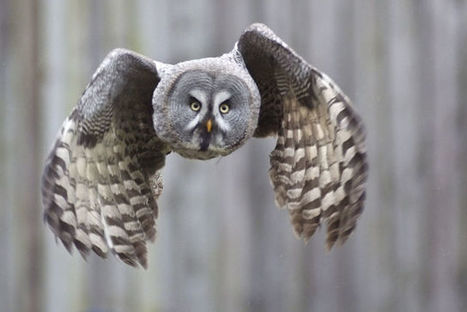
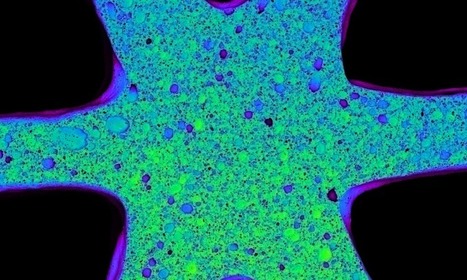
"Many species of owl are able to hunt in effective silence by suppressing their noise at sound frequencies above 1.6 kilohertz (kHz) - over the range that can be heard by humans. A team of researchers studying the acoustics of owl flight—including Justin W. Jaworski, assistant professor of mechanical engineering and mechanics at Lehigh University—is working to pinpoint the mechanisms that accomplish this virtual silence in order to improve the aerodynamic design of wind turbines, aircraft, naval ships and even automobiles. Now, the team has succeeded—through physical experiments and theoretical modeling—in using the downy canopy of owl feathers as a model to inspire the design of a 3D-printed, wing attachment that reduces wind turbine noise by 10 decibels without impacting aerodynamics."
"From a whale shark keeping unwanted freeloaders off its skin to water droplets rolling off a duck’s feathers, nature has many ingenious ways of keeping surfaces clean. The science of biomimicry, or biomimetics, seeks to harness nature’s cleverest capabilities which have taken aeons to evolve. Scientists at AkzoNobel, a global paints and coatings company, are using principles derived from nature to develop coatings that protect surfaces such as the hulls of cargo ships. And other heavy industries such as rail are experimenting with biomimicry."
"Using a mathematical model and the mackerel pectoral fin as an illustrative example, [...] researchers show how fin stiffness may be changed by applying a u-shaped curvature at the fin's base. The effect, the researchers say, might underlie the ability of fish to swim at widely varying speeds in all kinds of currents with great maneuverability. [...] The researchers say their model suggests intriguing possibilities for the design of robotic swimmers."
"It’s a technicolour dreamcoat for your crisp packet – a strong, flame-retardant and airtight new material that mimics mother of pearl. The natural version, also called nacre, is found on the inner shell of some molluscs, where it is built up of layers of the mineral aragonite separated by organic polymers such as chitin. It is remarkably strong, without being brittle or dense. We would like to use nacre and similar materials as a protective coating in many situations."
"Yu’s team is the first to demonstrate that the [Saharan silver] ants use a coat of uniquely shaped hairs to control electromagnetic waves over an extremely broad range from the solar spectrum (visible and near-infrared) to the thermal radiation spectrum (mid-infrared), and that different physical mechanisms are used in different spectral bands to realize the same biological function of reducing body temperature. [,,,] Their discovery that there is a biological solution to a thermoregulatory problem could lead to the development of novel flat optical components that exhibit optimal cooling."
In an effort to protect and preserve the Earth’s biodiversity and kick-start an inclusive bio-economy, the World Economic Forum today announced a landmark partnership between the Earth BioGenome Project, chaired by Harris Lewin, distinguished professor at UC Davis, and the Earth Bank of Codes to map the DNA of all life on Earth.
A consortium of scientists says it has gained some additional wisdom on what makes owl flight so quiet—and how to emulate the owl’s special physiology t
In some species, males and females are virtually indistinguishable. But in species where the sexes have different appearances, the males tend to be much more flamboyant and brightly colored, the better to attract a mate.
The remarkable properties of some natural materials have motivated many researchers to synthesize biomimetic nanocomposites and other nanostructured materials that attempt to reproduce Nature's achievements. Recent research has indicated that the amplification of natural materials' mechanical properties far beyond those of the components that comprise them originates mainly from: 1) a hierarchical micro-/nanoscale architecture and 2) abundant effective interface interactions. A new progress report provides insight into the development of bio-inspired structural materials.
"Our data-driven society is churning out more information than traditional storage technology can handle, so scientists are looking for a solution in Nature's hard drive: DNA. A pair of researchers at Columbia University and the New York Genome Center recently wrote a full computer operating system, an 1895 French film, an Amazon gift card and other files into DNA strands and retrieved them without errors, according to a study published in the latest edition of Science."
"Researchers from the University of Granada (UGR) have designed an algorithm, inspired by the intelligent and social behavior of bee colonies, which allows law enforcement to attack and dismantle any type of social network that poses a threat, whether physical or virtual, such as social networks linked to organized crime and jihadist terrorism."
"Ribbon halfbeak are a species of fish with the ability to fly above the sea surface - but unlike true 'flying fish', they lack the necessary hind wing fins. So how do they fly? Dr Yoshinobu Inada from Tokai University, Japan says, "Investigating the design of ribbon halfbeak could provide useful information for the optimal design of tandem wing airplanes."
"Nature does amazing things with limited design materials. Grass, for example, can support its own weight, resist strong wind loads, and recover after being compressed. The plant's hardiness comes from a combination of its hollow, tubular macrostructure and porous microstructure. These architectural features work together to give grass its robust mechanical properties. Inspired by natural cellular structures, researchers at the Harvard John A. Paulson School of Engineering and Applied Sciences (SEAS), the Wyss Institute for Biologically Inspired Engineering at Harvard University, and MIT have developed a new method to 3D print materials with independently tunable macro-and microscale porosity using a ceramic foam ink."
Our reliance on air conditioning, however magical an innovation, has become a serious environmental burden. Which is why researchers in Barcelona designed a material they say can naturally cool rooms by about 5 degrees Celsius, using a moisture-absorbing polymer that "sweats" much like our own body.
Humans have the potential to collaborate on incredibly sophisticated levels, similar to the group efforts of superorganisms such as ants and honeybees.
The success of Stefano Boeri's Boscoe Verticale in Milan has resulted in the architect replicating the greenery-covered tower elsewhere. The latest iteration on the design is slated for Eindhoven, the Netherlands, and promises to provide attractive and affordable inner-city social housing.
Taking inspiration from a sea urchin spine with highly ordered nanoparticles in the biomineral mesocrystal, German researchers report a bioinspired route toward elastic concrete materials.
To get content containing either thought or leadership enter:
To get content containing both thought and leadership enter:
To get content containing the expression thought leadership enter:
You can enter several keywords and you can refine them whenever you want. Our suggestion engine uses more signals but entering a few keywords here will rapidly give you great content to curate.


 Your new post is loading...