

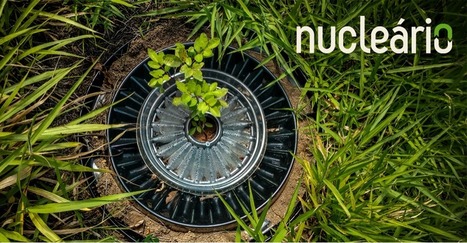
Darrell Mann Bruno Rutman Pagnoncelli grew up among the trees in Brazil’s Atlantic rainforest, learning how to kayak its whitewater rapids and soaring...


 Your new post is loading...
 Scoop.it!
Darrell Mann Bruno Rutman Pagnoncelli grew up among the trees in Brazil’s Atlantic rainforest, learning how to kayak its whitewater rapids and soaring...

No comment yet.
Sign up to comment
Scoop.it!

For a new generation of innovators, biomimicry – the imitation of nature’s ecosystems – may help solve some of humanity’s toughest resource problems...
Scoop.it!

“We are surrounded by genius” -Janine Benyus. Take a moment to slow down. Truly look at your surroundings. Breath in the oxygen that keeps us all alive, feel the security of gravity holding you in place. Now, look beyond what you know, and try to conceptualize the simple nothingness of space. The cold, the complete …
Scoop.it!

Researchers have developed a plasmonic-assisted holistic artificial muscle that can independently act as a fully functional motor system without assembling or joints.
Scoop.it!

The University of Stuttgart has used robots to create two biomimetic pavilions at the Bundesgartenschau horticultural show, in Germany...
Scoop.it!

John Craven explains how Biomimcry has a role in conventional and organic farming and how this natural solution could help the future of our farms.
Scoop.it!

Biome Renewables is introducing a new retrofit turbine device, designed to optimize wind-power generation. The PowerCone attaches directly to a turbine’s hub and co-rotates with the rotor. With no moving parts, the PowerCone’s unique biomimetic design passively channels incoming wind onto turbine blades to help them capture more of the wind that’s already blowing. The…
Scoop.it!

By learning from and emulating nature’s solutions, biomimicry can help solve complex human design and engineering problems.
Scoop.it!

So often we hear people are attracted to biomimicry because it provides hope for the future—it’s an optimistic discipline. We agree! In that spirit of hope, Earth Day is a moment to celebrate the Earth, reflect on how we can help, and then take action. We often share case studies traditionally appl
Scoop.it!

The flight of insects has fascinated physicists and biologists for more than a century. Yet, until recently, researchers were unable to rigorously quantify the complex wing motions of flapping insects or measure the forces and flows around their wings. However, recent developments in high-speed videography and tools for computational and mechanical modeling have allowed researchers to make rapid progress in advancing our understanding of insect flight. These mechanical and computational fluid dynamic models, combined with modern flow visualization techniques, have revealed that the fluid dynamic phenomena underlying flapping flight are different from those of non-flapping, 2-D wings on which most previous models were based. In particular, even at high angles of attack, a prominent leading edge vortex remains stably attached on the insect wing and does not shed into an unsteady wake, as would be expected from non-flapping 2-D wings. Its presence greatly enhances the forces generated by the wing, thus enabling insects to hover or maneuver. In addition, flight forces are further enhanced by other mechanisms acting during changes in angle of attack, especially at stroke reversal, the mutual interaction of the two wings at dorsal stroke reversal or wing–wake interactions following stroke reversal. This progress has enabled the development of simple analytical and empirical models that allow us to calculate the instantaneous forces on flapping insect wings more accurately than was previously possible. It also promises to foster new and exciting multi-disciplinary collaborations between physicists who seek to explain the phenomenology, biologists who seek to understand its relevance to insect physiology and evolution, and engineers who are inspired to build micro-robotic insects using these principles. This review covers the basic physical principles underlying flapping flight in insects, results of recent experiments concerning the aerodynamics of insect flight, as well as the different approaches used to model these phenomena.
Scoop.it!

Sustainability … …a catchy word these days! In times of population growth, climate change and environmental challenges, one should think and act in a sustainable way…right? This can mean reducing meat consumption, avoiding plastic bags or cycling instead of using the car: living a sustainable life can look differently on everyone. But still, one thing…
Scoop.it!

We launch a new campaign to allow ecosystems to recover on a massive scale, drawing down carbon from the atmosphere By George Monbiot, published in the Guardian 3rd April 2019 …
Scoop.it!

Hunting spiders easily climb vertical surfaces or move upside down on the ceiling. A thousand tiny hairs at the ends of their legs make sure they do not fall off. Like the spider's exoskeleton, these bristle-like hairs (so-called setae) mainly consist of proteins and chitin, which is a polysaccharide. To find out more about their fine structure, an interdisciplinary research team from the Biology and Physics departments at Kiel University and the Helmholtz-Zentrum Geesthacht (HZG) examined the molecular structure of these hairs in closer detail at DESY's X-ray light source PETRA III and at the European Synchrotron Radiation Facility ESRF. Thanks to the highly energetic X-ray light, the researchers discovered that the chitin molecules of the setae are specifically arranged to withstand the stresses of constant attachment and detachment. Their findings could be the basis for highly resilient future materials. They have been published in the current issue of the Journal of the Royal Society Interface.
|
Scoop.it!

BUGA WOOD PAVILION 2019 Robotically Fabricated Lightweight Timber Shell, Bundesgartenschau Heilbronn, 2019 The Institute for Computational Design and Construction (ICD) and the Institute for Building Structures and Structural Design (ITKE) at the University of Stuttgart are developing two highly innovative, biologically inspired pavilions for the 2019 Bundesgartenschau in Heilbronn. Both are globally unique, light-weight structures that are fully computationally designed and robotically fabricated. The two pavilions embody and express the strength of innovation typical for the State of Baden-Württemberg, which has been an internationally recognized centre for lightweight constructions, biomimetics, and the development of digital technologies in architecture for several decades. By acting as the main funding body, the state will play a prominent role in the exhibition. Plate structures are a particularly fascinating type of construction typology in living nature. Biological examples typically exhibit an arrangement of individual plate segments with specific and highly differentiated shapes. Both ICD and ITKE have conducted in-depth research into the computational design, construction, and fabrication of segmented timber shells based on biological principles, with a particular focus on the arrangement and shape of each segment, as well as the development of high-performance joints. The biological principle of morphological adaption can be applied through a computational design and simulation method, which in turn needs to be coupled with a digital production process. The entire structure, made from 400 different lightweight segments, is pre-fabricated in a fully robotic machining and assembly process. With a free span of over 25 meters, the resulting BuGa Wood Pavilion showcases structural and architectural innovation. The pavilion will be opened on 17.04.2019. More information: Bundesgartenschau Heilbronn 2019 PROJECT TEAM ICD – Institute for Computational Design and Construction, University of Stuttgart Prof. Achim Menges, Martin Alvarez, Abel Groenewolt, Monika Göbel, Oliver David Krieg, Ondrej Kyjanek, Hans-Jakob Wagner ITKE – Institute of Building Structures and Structural Design, University of Stuttgart Prof. Jan Knippers, Lotte Aldinger, Simon Bechert, Daniel Sonntag Müllerblaustein Bauwerke GmbH, Blaustein Reinhold Müller, Oliver Fried Bundesgartenschau Heilbronn 2019 With the support of: State of Baden-Württemberg University of Stuttgart GETTYLAB DFG-TRR 141
Scoop.it!

Researchers from Harvard have found a way to make their snake-inspired soft robots faster and more efficient. The secret? Using a Japanese paper craft called kirigami to create an outer shell that grips the ground, just like the scales on a real snake skin.
Scoop.it!

From
phys

As the world struggles to meet the increasing demand for energy, coupled with the rising levels of CO2 in the atmosphere from deforestation and the use of fossil fuels, photosynthesis in nature simply cannot keep up with ...
Scoop.it!

From
phys
Bioinspired materials are designed and engineered to mimic the biological functions of nature; however fast actuation is an important but challenging task to recreate in the lab. In a recent study, Wenxin Fan and co-workers ...
Scoop.it!

Climate change represents an existential, global threat to humanity, yet its delocalized nature complicates climate action. Here, the authors propose retrofitting air conditioning units as integrated, scalable, and renewable-powered devices capable of decentralized CO2 conversion and energy democratization.
Scoop.it!

Engineers and designers can learn a lot from the way that nature utilises diverse materials in complex ways.
Scoop.it!
When it comes to replicating scales, ovaries and more, 3D printing technologies are more like nature, leading to new advances in medicine and beyond.

Biomimicry Frontiers's curator insight,
April 29, 2019 8:23 AM
Emerging technologies will make the incredible ideas we abstract from nature (e.g. walls that shed) plausible. The only limitation will be our creativity.
Scoop.it!

April 20, 2019: Mohammad Yazdi posted on LinkedIn
Scoop.it!

Forgo the kind made out of hardened saliva. Collect a variety of twigs, and mold them around a fist.
Scoop.it!

From
phys
Anyone who's seen a flock of starlings twist and turn across the sky may have wondered: How do they maneuver in such close formation without colliding?
Scoop.it!

Climate Change, Desertification, and Poverty are strongly related issues. How can we fight them at the same time? With biomimetic Silvopasture and Agroforestry.
Scoop.it!

A team of researchers has designed a microengineered, slippery, rough surface inspired by plants that can efficiently harvest water.
|




