Your new post is loading...
Speech pathologists offer parents real-world advice on how to incorporate a second language with their kids at home — and demystify a misconception about bilingualism.
President Donald Trump has signed an executive order designating English the official language of the country, the first time for such a declaration in U.S. history, and leaders from around Eastern WA shared their thoughts.

|
Scooped by
Dual Language Education of New Mexico
February 28, 2025 11:39 AM
|
It is common for parents to worry about raising a child to be multilingual. They may wonder, am I harming my child’s English if I speak another language at home?
|
|
Scooped by
Dual Language Education of New Mexico
February 10, 2025 1:34 PM
|
In this edition of the Indy Education newsletter, a Las Vegas elementary school program is helping students embrace being bilingual.
New psychology research indicates that multilingual children may have enhanced executive function and perspective taking skills.
Bilingual individuals with Alzheimer’s disease showed preserved hippocampal volume compared to monolinguals, suggesting bilingualism may provide brain maintenance benefits.
What would you say if I told you that 60 of the world's population possess a skill which allows them to have better : communication, creativity and…
|
|
Scooped by
Dual Language Education of New Mexico
November 22, 2024 5:54 PM
|
Researchers in Montreal are pointing to the benefits of bilingualism for the brain's health and efficiency — suggesting it could even help prevent diseases associated with aging, including Alzheimer's.
A study shows that bilingualism may contribute to brain resilience in older adults. Researchers found that bilingual Alzheimer's patients had larger hippocampi than monolinguals.
|
|
Scooped by
Dual Language Education of New Mexico
October 18, 2024 12:55 PM
|
Why bilingualism can work wonders for your brain %
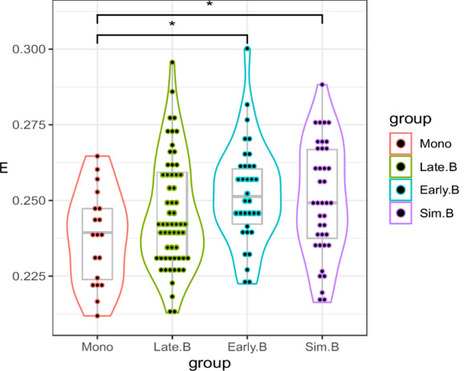
Bilingualism has a profound impact on the structure and function of the brain, but it is not yet well understood how this experience influences brain functional organization. We examine a large sample (151 participants) of monolinguals and bilinguals with varied age of second language acquisition, who underwent resting-state functional magnetic brain imaging. Whole-brain network analyses reveal higher global efficiency in bilingual individuals than monolinguals, indicating enhanced functional integration in the bilingual brain. Moreover, the age at which the second language was acquired correlated with this increased efficiency, suggesting that earlier exposure to a second language has lasting positive effects on brain functional organization. Further investigation using the network-based statistics approach indicates that this effect is primarily driven by heightened functional connectivity between association networks and the cerebellum. These findings show that the timing of bilingual learning experience alters the brain functional organization at both global and local levels. Early bilinguals showed greater brain network efficiency, driven by increased inter-hemispheric cortico-cerebellar functional connectivity, compared to monolinguals.
|
|
Scooped by
Dual Language Education of New Mexico
September 26, 2024 12:09 PM
|
Without Googling, how many P-12 students would you guess are learning English in public schools? A couple hundred thousand? A couple million? Tr
|
|
Scooped by
Dual Language Education of New Mexico
September 11, 2024 3:16 PM
|
There are cognitive and neurological benefits to bilingualism, according to a 2012 study published in the journal Cerebrum.
|
From classroom practice to family engagement, this article explains how early years educators can support EAL children
|
|
Scooped by
Dual Language Education of New Mexico
February 24, 2025 5:44 PM
|
Language learning isn’t just a skill—it’s a gateway to opportunity. In the US, where over 350 languages are spoken, multilingualism is increasingly vital in industries like healthcare, construction, and technology. The Global Seal of Biliteracy is a transformative credential that recognizes bilingual proficiency and equips students with a tangible career advantage. For career and technical education (CTE) students, this international certification goes beyond recognition: it validates their skills and positions them to meet the growing demand for multilingual professionals. Often earned before high school graduation, the Global Seal serves as a student’s first working credential, paving the way for success
Bilingualism boosts cognitive skills in autistic children, enhancing executive function and perspective-taking.
Nearly 22% of Americans speak a language other than English at home; many are English and Spanish speakers from immigrant families. Yet many children from immigrant families struggle to develop or maintain proficiency in two languages. Some may lose their heritage language in favor of English; others may fall behind in schools where their progress is evaluated only in English. Can we fix these problems?
|
|
Scooped by
Dual Language Education of New Mexico
December 5, 2024 12:57 PM
|
Researchers said California should follow Texas' lead and require districts with large numbers of English learners to offer bilingual education.
|
|
Scooped by
Dual Language Education of New Mexico
November 23, 2024 6:41 PM
|
Neuroplasticity is the brain’s ability to build connections within itself, adapting to the surrounding environment. The brain is most plastic in childhood, forming new pathways in reaction to stimuli such as language. Past research has shown that learning a second language may positively affect attention, healthy aging, and even recovery after brain injury. A new study from the Neuro (Montreal Neurological Institute-Hospital) of McGill University, the University of Ottawa, and the University of Zaragoza in Spain elaborates on bilingualism’s role in cognition, showing increased efficiency of communication between brain regions. Scientists recruited 151 participants who either spoke French, English, or
|
|
Scooped by
Dual Language Education of New Mexico
November 22, 2024 5:28 PM
|
New ELs in Delaware help boost the academic performance of students in receiving schools.
Kids from immigrant backgrounds in the US often struggle to develop fluency in two languages. Many factors — parental misconceptions, the lack of support in schools and social attitudes — play a role.
MRI data from large sample shows increased whole-brain connectivity in people with a second language Neuroplasticity is the brain’s ability to build connections within itself, adapting to the surrounding environment. The brain is most plastic in childhood, forming new pathways in reaction to stimuli such as language. Past research has shown that learning a second language may positively affect attention, healthy aging and even recovery after brain injury. A new study from The Neuro (Montreal Neurological Institute-Hospital) of McGill university, the University of Ottawa and the University of Zaragoza in Spain elaborates on bilingualism’s role in cognition, showing increased efficiency of communication between brain regions. Scientists recruited 151 participants who either spoke French, English, or both languages, and recorded the age at which they learned their second language. The participants were scanned using resting state functional magnetic resonance imaging (fMRI) to record whole-brain connectivity, rather than focusing on specific regions as was done in previous bilingualism studies. fMRI scans revealed that bilingual participants had increased connectivity between brain regions than monolingual participants, and this connectivity was stronger in those who learned their second language at a younger age. This effect was particularly strong between the cerebellum and the left frontal cortex. The results mirror previous studies which have shown that brain regions do not work in isolation, but interact with others to understand and produce language. Research has also shown that whole-brain efficiency aids cognitive performance. This latest study reveals more about how bilingualism influences the brain connections we use to think, communicate and experience the world around us. “Our work suggests learning a second language during childhood helps build a more efficient brain organization in terms of functional connectivity,” says Zeus Gracia Tabuenca, the paper’s first author. “The results indicate that the earlier the second language experience, the broader extent of brain areas involved in neuroplasticity. That's why we are observing higher connectivity of the cerebellum with the cortex in earlier exposures to a second language.” The research was published in the journal Communications Biology on Oct. 10, 2024. It was funded with the support of the Natural Sciences and Engineering Research Council of Canada, the Blema and Arnold Steinberg Family Foundation, The Centre for Research on Brain, Language and Music via the Fonds de recherche du Québec, Brain Canada, the Canada Research Chair program, the European Union's NextGeneration programme and the Spanish Ministry of Universities’ Margarita Salas Program. About The Neuro The Neuro – The Montreal Neurological Institute-Hospital – is a bilingual, world-leading destination for brain research and advanced patient care. Since its founding in 1934 by renowned neurosurgeon Dr. Wilder Penfield, it has grown to be the largest specialized neuroscience research and clinical center in Canada, and one of the largest in the world. The seamless integration of research, patient care, and training of the world’s top minds make The Neuro uniquely positioned to have a significant impact on the understanding and treatment of nervous system disorders. It was the first academic institute in the world to fully adopt Open Science, to help accelerate the generation of knowledge and discovery of novel effective treatments for brain disorders. The Neuro is a McGill University research and teaching institute and part of the Neuroscience Mission of the McGill University Health Centre. For more information, please visit www.theneuro.ca
|
|
Scooped by
Dual Language Education of New Mexico
September 25, 2024 3:28 PM
|
School is back in session and many students are in dual-language or bilingual programs. We hear from educators about the wide-ranging benefits of bilingual education.
|