




Published by Multilingual Living, October 20, 2014
Raising bilingual children? Raising multilingual children? Are you bilingual/multilingual? Here is a long list of the benefits of bi/multilingualism!

 Your new post is loading... Your new post is loading...
 Scoop.it!
Published by Multilingual Living, October 20, 2014 Raising bilingual children? Raising multilingual children? Are you bilingual/multilingual? Here is a long list of the benefits of bi/multilingualism! 
No comment yet.
Sign up to comment
Scoop.it!

Published by Bilingual Kids Rock, October 18, 2014 It stands to reason that bilingualism strengthens the language centers in the brain. That shouldn’t be a surprise! But there are some interesting — and useful — side effects. These develop passively as a result of being exposed to multiple languages. They are not instructed skills, but rather emerge as a natural result of brain development. One unique trait of bilinguals is the ability to recognize different languages, even if the bilingual is not fluent in them. And, startlingly, scientists have found that this ability starts long before verbal skills develop — even infants in bilingual households possess it!
Scoop.it!

Published by Education Week, October 14, 2014 Collinswood Language Academy's experiences with two-way language learning illustrates why North Carolina state education officials are sold on the idea.
Scoop.it!
Dual Language Education of New Mexico's insight:
Published by BBC News, October 13, 2014 Children fluent in two languages learn better in noisy classrooms than pupils who speak just one, research suggests. Bilingual and monolingual pupils at a Cambridge primary school were asked to "identify the bad animal' in a series of recorded statements. When another voice interrupted the statements, the bilingual children coped best, the study found.
Scoop.it!

Published by the Huffington Post, October 1, 2014 Learning a language can do so much for us both personally and professionally, so let's learn languages. But first, let's think about how learning a language will help us achieve our life goals....
Scoop.it!

Broadcast/Published by KQED America Works, September 29, 2014 Studies show learning another language helps people develop cognitive advantages that improve attention.
Scoop.it!

Published by USA Today, September 23, 2014 "So let’s learn languages — for our careers, for our personal lives and so we can make the world a better place. Together."
Scoop.it!

Published in Relaxnews, September 9, 2014 An international team of researchers based in Singapore says the cognitive advantages of exposure to two languages are significant and reveal themselves early on, regardless of the languages spoken. Inspired by the high proportion of Singaporean children being raised bilingually, they tested the cognitive abilities of 114 six-month-old babies by means of visual imaging and found they were able to recognise familiar images faster than their monolingual counterparts. When presented with novel images, the bilingual babies paid more attention to the unknown than those being raised in monolingual homes
Scoop.it!

Published by Live Science, July 29, 2014 Can mixing languages in your mind help you learn both? ... Those results show that translanguaging has a pretty spectacular effect on learning and long-term memory — and extend the "bilingual advantage" seen in executive functioning (the management of cognitive processes that control and regulate various abilities and behaviors) to the broader domain of learning. Beyond simply helping people learn a second language, our findings suggest that translanguaging is a useful tool for learning, more generally. After all, bilingual education is not just about learning a new language — it's also about learning other subjects (such as history, geography and others) via a medium of two languages.
Scoop.it!
Published by Exchange Magazine, April 2, 2012 A new paper by a York University professor finds speaking more than one language has wide-ranging cognitive health benefits for children, adults and seniors. Professor Ellen Bialystok and co-authors reviewed recent studies using behavioral and neuroimaging methods to examine the effects of bilingualism on cognition across the lifespan; their review builds on earlier evidence of its benefits for children’s cognitive development. The study is published today in the journal Trends in Cognitive Sciences. They found that bilingualism protects against cognitive decline by boosting cognitive reserve and delaying the onset of dementia symptoms. The review also suggests that the increasing diversity in world populations may have an unexpected positive impact on the resiliency of the adult brain. “Our conclusion is that lifelong experience in managing attention to two languages reorganizes specific brain networks, creating a more effective basis for executive control and sustaining better cognitive performance throughout the lifespan,” says Ellen Bialystok, Distinguished Research Professor in York’s Department of Psychology, Faculty of Hea
Scoop.it!
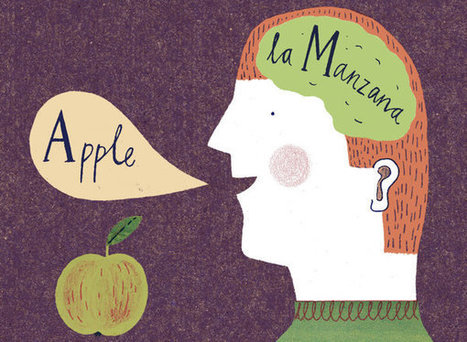
Published by the New York Times, March 17, 2012 SPEAKING two languages rather than just one has obvious practical benefits in an increasingly globalized world. But in recent years, scientists have begun to show that the advantages of bilingualism are even more fundamental than being able to converse with a wider range of people. Being bilingual, it turns out, makes you smarter. It can have a profound effect on your brain, improving cognitive skills not related to language and even shielding against dementia in old age.
Scoop.it!
Published by the DesMoines Register, November15, 2011 [Iowa's Republican] Gov. Terry Branstad called dual-language competency for students a “great suggestion,” hailing the advantages bilingual workers have when looking for jobs at companies like Pioneer Hi-Bred, a crop genetics research and development company in Iowa.
Scoop.it!
Published by the U.S. Defense Department, 2011
|
Scoop.it!

Published by Eduction Week, October 20, 2014 I've written a story all about the early success of dual-language immersion in North Carolina. And not just successful for English-language learners, but for African-American students, and low-income students. In fact, with three years of test-score analysis done by researchers Virginia P. Collier and Wayne P. Thomas in hand, it's clear that dual-language learning in that state—specifially, "two-way" dual-language learning—does not discriminate. Students in every major demographic group are outscoring their peers who are not in dual-language. The best part of reporting this story was my visit to the Collinswood Language Academy in Charlotte, North Carolina's original dual-language school. A magnet school that enrolls students through an open lottery system, Collinswood is a Title I school where more than half of students quality for free and reduced-price meals. Watch and listen to this wonderful audio slideshow to get a good flavor of what it's like to be a student and teacher in a true bilingual, bicultural, biliterate environment.
Dual Language Education of New Mexico's insight:
Be sure to watch the narrated slide show at the bottom of the article.
Scoop.it!

Published by The Atlantic, October 17, 2014 “Speaking different languages means you get different frames, different metaphors, and also you’re learning the culture of the language so you get not only different words, but different types of words,” Lakoff told me. Via Charles Tiayon
Scoop.it!

Published by The Economist, October 17, 2014 FOR years, researchers in bilingualism have been touting striking findings about how bilingualism affects the brain. Two of the most memorable involve “executive...
Scoop.it!
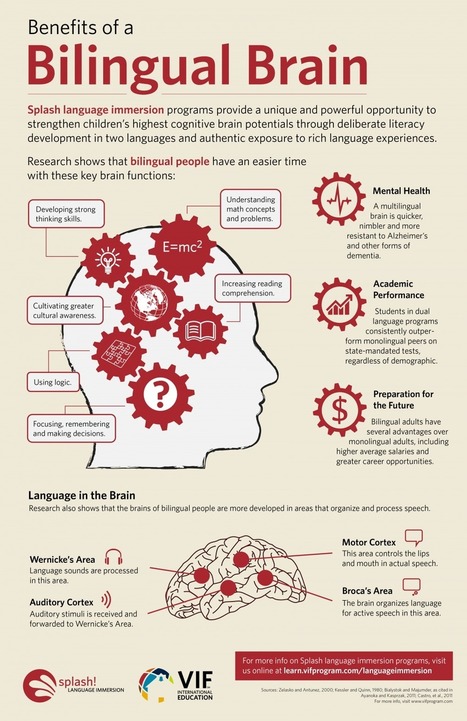
Published January 31, 2014 Dual language education provides a unique and powerful opportunity to strengthen children's highest cognitive brain potentials.
Dual Language Education of New Mexico's insight:
Infographic provides quick overview.
Scoop.it!
Published/Broadcast by You Tube American Graduate, September 8, 2014.
Scoop.it!

Broadcast by BBC Radio, September 28, 2014 How is the brain affected by juggling between different languages and how does this affect identity? And what is the impact on a child's development if they speak one language at home and another at school? Bridget Kendall talks to poet and cultural critic Gustavo Perez Firmat, developmental linguistics researcher Antonella Sorace, and cognitive development specialist Ellen Bialystok.
Dual Language Education of New Mexico's insight:
"Spoiler" note: The advantages far outweigh the disadvantages.
Scoop.it!

Published by Fox News Latino, September 10, 2014 The key, Shakira said, for Hispanics to be successful in the U.S. is learning English fluently while maintaining their native fluency in Spanish. “Being bilingual is a competitive business advantage,” she said. “Particularly for Hispanic students – which make up the majority of the English learner population – limited English proficiency in the early years is associated with low achievement and other poor school outcomes.” Shakira, who speaks Spanish, Portuguese, English, some French and Italian and is picking up Catalan, said languages open the doors to other cultures in a way that nothing else can. Hispanic students in the United States have that advantage, but it needs to be fostered from an early age.
Scoop.it!

Broadcast on BBC World Service, August 27, 2014 Ellen Bialystok on why speaking more than one language is ‘muscle building for the brain’
Scoop.it!
Published by TEDx Talks, April 15, 2014 Why dual language education is better than one language education.
Scoop.it!
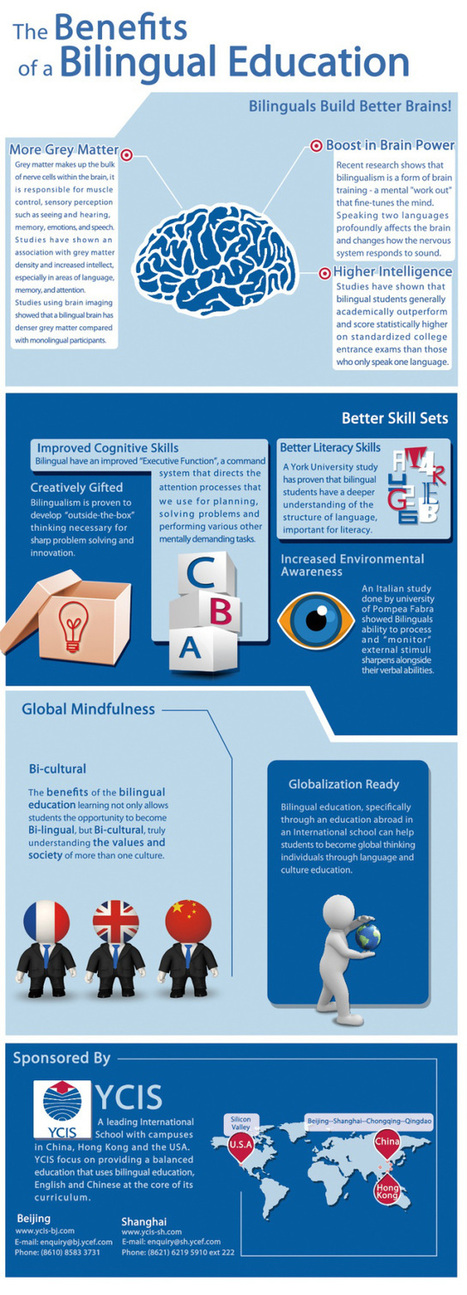
Published by VOXXI, October 4, 2013 Hispanic Heritage Month provides the perfect opportunity to explore how bilingual education positively or negatively affect our children. Despite study after study showing that bilingual education benefits students and communities, budget cuts and xenophobia nationwide have led to many dual-language programs being cut in Florida, Texas and California.
Scoop.it!

Published by CBC News, February 8, 2012 Bilingual children score higher on some cognitive tests than children who speak only English, a new Toronto study found. It's known that children who grow up speaking two languages tend to be slower in picking up each language than children raised speaking just one, but the study suggests the benefits of bilingualism outweigh any drawbacks. Bilingual children develop a deeper understanding of the structure of language, an important skill for literacy, researchers from York University said in Wednesday's online issue of the journal Child Development. "People always ask if the languages themselves matter and now we can definitively say no," study co-author, Prof. Ellen Bialystok, of York's psychology department said in a release.
Scoop.it!

Published by the Sens Public Review, October 17, 2011 The author analyses in a study the effects of linguistic skills on the export performance of German, French and Swedish SMEs. Contrary to popular belief, English does not suffice in economic relations as many tenders are lost through lack of skills in local languages.
|






Long and well annotated!