


"In Mediterranean France, the end of the Neolithic is now well-known. Many cultural groups are chronologically and geographically definite (Rhône-Ouvèze, Fontbouisse, Vérazien…) and the origin of the Beakers phenomenon seems clearly...

 Your new post is loading...
  Scoop.it! "In Mediterranean France, the end of the Neolithic is now well-known. Many cultural groups are chronologically and geographically definite (Rhône-Ouvèze, Fontbouisse, Vérazien…) and the origin of the Beakers phenomenon seems clearly... 
No comment yet.
Sign up to comment
Scoop.it!

A cache of Neolithic skulls unearthed in Syria had been exhumed, separated from their bodies, had their faces smashed in and been reburied. But why?
Scoop.it!

The Indo-European languages belong to one of the widest spread language families of the world. For the last two millenia, many of these languages have been written, and their history is relatively clear.
Scoop.it!

Il n'y a pas que la transmission génétique de parent à enfant. Le transfert "horizontal" de gènes entre deux individus est loin d'être négligeable chez les organismes unicellulaires, et notamment les bactéries et les archées. Grâce à ce phénomène, une équipe de chercheurs du laboratoire de Biométrie et biologie évolutive de Lyon (CNRS/Université Claude Bernard Lyon1/INRIA/Hospices civils de Lyon) a mis au point un modèle informatique permettant de reconstituer l'arbre "généalogique" d'un groupe d'espèces. A terme, c'est tout l'arbre du vivant qui pourrait être ainsi reconstitué.
Scoop.it!

Scoop.it!
Yves Coppens, le papa de Lucy, conjugue la préhistoire au présent pour mieux comprendre notre passé. Et surtout notre futur.
Scoop.it!

Archaeologists in southern Sweden have unearthed what is presumed to be a 5,000-year-old dolmen, or a portal tomb, near the megalithic monument Ale's Stones, sometimes referred to as "Sweden's Stonehenge".
Scoop.it!

Un ancien site cérémoniel de la taille de Stonehenge a été découvert dans les North Downs. Le but exact de ce henge néolithique, situé près de Hollingbourne, reste un mystère; mais la découverte d'une grande quantité d'os brûlés et de poteries suggèrent qu'il a été utilisé à titre rituel pendant près de 2000 ans, depuis 2500 avant JC, à la fin de l'âge de pierre.
Scoop.it!
The Near East Fertile Crescent is well recognized as a primary center of barley origin, diversity, and domestication. A large number of wild barleys have been collected from the Tibetan Plateau, which is characterized by an extreme environment. We used genome-wide diversity array technology markers to analyze the genotypic division between wild barley from the Near East and Tibet. Our results confirmed the existence of Tibetan wild barley and suggested that the split between the wild barleys in the Near East and those in Tibet occurred around 2.76 million years ago (Mya).
Scoop.it!

The 5,000-year-old Stonehenge monument in Wiltshire, England, shown here bathed in pastel twilight, has been examined by scientists for centuries. And though our understanding of the structure has increased greatly, particularly in recent years, questions persist about who built Stonehenge and why.
Scoop.it!

Scoop.it!

So when Jean-Jacques Hublin, founder and director of the Department of Human Evolution at the Max Planck Institute for Evolutionary Anthropology in Leipzig, Germany, came to Houston I jumped at the chance to speak with him. He is one of the world’s leading authorities on Neandertals and spoke last week at the Houston Museum of Natural Science (they’ve got more great lectures coming up, too.)
Scoop.it!

L'espérance de vie de l'homme serait due plus à un environnement facilité (médecine, nourriture, logement...) qu'à un processus d'évolution spécifique.
|
Scoop.it!

The latest excavation at the 7,000 year old Güvercinkaya tumulus in Aksaray Province has discovered the fossilized remains of such animals as lions and panthers.
Scoop.it!

The Dead Sea, a salt sea without an outlet, lies over 400 metres below sea level. Tourists like its high salt content because it increases their buoyancy.
Scoop.it!

Des archéologues britanniques estiment que les fragments d’objets en céramique vieux d’au moins 15 000 ans qu’ils ont découverts dans une caverne de Croatie, témoignent de l’existence d’une communauté préhistorique locale qui a réinventé cette technique indépendamment des autres cultures qui l’ont utilisée ailleurs et à des dates différentes.
Scoop.it!

Scoop.it!
Les hommes du néolithique n'étaient pas seulement d'ingénieux agriculteurs : ils savaient également soigner les dents malades. C'est ce que révèle une équipe italienne du centre international Abdus Salam de physique théorique, dans une publication relayée par la revue en ligne PLoS One.
Scoop.it!

Excavations at Çatalhöyük unearth funerary gift mirrors, a very rare finding in the ancient settlement. A technique called georadar is being used in the excavations and suggests the city was an egalitarian society
Scoop.it!

rive west from Orkney’s capital, Kirkwall, and then head north on the narrow B9055 and you will reach a single stone monolith that guards the entrance to a spit of land known as the Ness of Brodgar. The promontory separates the island’s two largest bodies of freshwater, the Loch of Stenness and the Loch of Harray. At their furthest edges, the lochs’ peaty brown water laps against fields and hills that form a natural amphitheatre; a landscape peppered with giant rings of stone, chambered cairns, ancient villages and other archaeological riches.
Scoop.it!

VOLUNTEER archaeologists in Blackbird Leys had a shock on their second day of digging yesterday, when they stumbled upon a 4,000-year-old artefact.
Scoop.it!
Une équipe de chercheurs chinois et japonais dresse mercredi dans la revue Nature "une carte complète" des variations du génome du riz asiatique, apportant ainsi un éclairage nouveau sur l'histoire d'une culture céréalière qui permet d'alimenter trois milliards d'humains.
Scoop.it!

Long before the Egyptians began the pyramids, Neolithic man built a vast temple complex at the top of what is now Scotland.
Scoop.it!
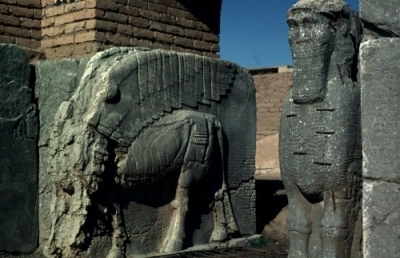
Archeologists working in northern Iraq have discovered a new Assyrian site in the vicinity of the historic Arbil city center, the head of the antiquities office in the Kurdish Province of Arbil, Haydar Hassan, was quoted as saying in an Iraqi newspaper.
Scoop.it!

From
phys

Researchers from China's Fudan University have found major prehistoric human population expansions may have begun before the Neolithic period, which probably led to the introduction of agriculture.
|




