Your new post is loading...

|
Scooped by
Gilbert C FAURE
June 25, 2017 4:07 PM
|
About T1D Type 1 diabetes (T1D) is an autoimmune disease in which a person’s pancreas stops producing insulin, a hormone that enables people to get energy from food. It occurs when the body’s immune system attacks and destroys the insulin-producing cells in the pancreas, called beta cells. While its causes are not yet entirely understood,…
|
|
Scooped by
Gilbert C FAURE
June 6, 2017 4:43 AM
|
Cellular and Molecular Immunology aims to report the dynamic progress being made in China and abroad in immunological research, and welcomes high-quality Research Articles, Reviews and Brief Reports across a broad range of topics including, but not limited to, clinical immunology, comparative immunology, immunobiology, immunogenetics, immunological techniques, immunopathology, immunopharmacology, infection immunology, neuroimmunology, transplantation immunology, tumor immunology, and veterinary immunology.
|
|
Scooped by
Gilbert C FAURE
May 25, 2017 1:46 AM
|
B lymphocytes play a key role in type 1 diabetes (T1D) development by serving as a subset of APCs preferentially supporting the expansion of autoreactive pathogenic T cells. As a result of their pathogenic importance, B lymphocyte–targeted therapies have received considerable interest as potential T1D interventions. Unfortunately, the B lymphocyte–directed T1D interventions tested to date failed to halt β cell demise. IgG autoantibodies marking humans at future risk for T1D indicate that B lymphocytes producing them have undergone the affinity-maturation processes of class switch recombination and, possibly, somatic hypermutation. This study found that CRISPR/Cas9-mediated ablation of the activation-induced cytidine deaminase gene required for class switch recombination/somatic hypermutation induction inhibits T1D development in the NOD mouse model. The activation-induced cytidine deaminase protein induces genome-wide DNA breaks that, if not repaired through RAD51-mediated homologous recombination, result in B lymphocyte death. Treatment with the RAD51 inhibitor 4,4′-diisothiocyanatostilbene-2, 2′-disulfonic acid also strongly inhibited T1D development in NOD mice. The genetic and small molecule–targeting approaches expanded CD73+ B lymphocytes that exert regulatory activity suppressing diabetogenic T cell responses. Hence, an initial CRISPR/Cas9-mediated genetic modification approach has identified the AID/RAD51 axis as a target for a potentially clinically translatable pharmacological approach that can block T1D development by converting B lymphocytes to a disease-inhibitory CD73+ regulatory state.
This article is featured in In This Issue , p.[4181][1]
[1]: /lookup/volpage/198/4181
|
|
Scooped by
Gilbert C FAURE
April 28, 2017 5:01 AM
|
Approach captures immune disease cells in vivo, may be used to better understand diabetes, other autoimmune disorders
|
|
Scooped by
Gilbert C FAURE
April 13, 2017 2:11 AM
|
Early in embryological development, the immune system learns not to attack the body's own cells. In many autoimmune diseases, including type 1 diabetes, multiple sclerosis, and rheumatoid arthritis, this self-tolerance i
|
|
Scooped by
Gilbert C FAURE
April 3, 2017 1:57 AM
|
Inhibitory receptors on T cells, including lymphocyte activation gene 3 (LAG3), serve as brakes that limit immune-mediated damage to the host. LAG3 is expressed by exhausted conventional T cells in the tumor microenvironment and has emerged as a key target for tumor immunotherapy. The role of LAG3 in regulatory T cells (Tregs) has remained unclear. Using a mouse model of autoimmune diabetes, Zhang et al. report that Treg-specific deletion of LAG3 led to enhanced Treg proliferation and reduced the incidence of type 1 diabetes. Their studies highlight the cell-type dependence and context specificity of the role of LAG3 and call for a more holistic assessment of the functions of inhibitory receptors that emerge as targets for tumor immunotherapies.
|
|
Scooped by
Gilbert C FAURE
March 29, 2017 1:40 PM
|
The gut microbiota can influence immune-cell function by the production of short-chain fatty acids. Mackay and colleagues show that diets enriched for acetate and butyrate protect non-obese diabetic mice from insulitis and diabetes progression.
|
|
Scooped by
Gilbert C FAURE
March 22, 2017 2:59 PM
|
For parents, storing their newborn baby's umbilical cord blood is a way to preserve potentially lifesaving cells. Now, a group of University of Florida Health researchers has found a way to expand and preserve certain cord-blood cells as a potential treatment for type 1 diabetes.
|
|
Scooped by
Gilbert C FAURE
February 28, 2017 1:29 PM
|
Nature Medicine | doi:10.1038/nm.4289
|
|
Scooped by
Gilbert C FAURE
February 23, 2017 7:53 AM
|
N-terminally truncated (96–585) GAD65 (tGAD65) autoantibodies may better delineate type 1 diabetes than full-length GAD65 (fGAD65) autoantibodies. We aimed to compare the diagnostic sensitivity and specificity between fGAD65 and tGAD65 autoantibodies for type 1 diabetes in relation to HLA-DQ. Sera from children and adolescents with newly diagnosed type 1 diabetes ( n = 654) and healthy control subjects ( n = 605) were analyzed in radiobinding assays for fGAD65 (fGADA), tGAD65 (tGADA), and commercial 125I-GAD65 (RSRGADA) autoantibodies. The diagnostic sensitivity and specificity in the receiver operating characteristic curve did not differ between fGADA and tGADA. At the optimal cutoff, the diagnostic sensitivity for fGADA was lower than tGADA at similar diagnostic specificities. In 619 patients, 64% were positive for RSRGADA compared with 68% for fGADA and 74% for tGADA. Using non-DQ2/non-DQ8 patients as reference, the risk of being diagnosed with fGADA and tGADA was increased in patients with DQ2/2 and DQ2/8. Notably, logistic regression analysis suggested that DQ8/8 patients had an increased risk to be diagnosed with tGADA ( P = 0.003) compared with fGADA ( P = 0.09). tGADA had a higher diagnostic sensitivity for type 1 diabetes than both fGADA and RSRGADA. As DQ8/8 patients represent 10–11% of patients with newly diagnosed type 1 diabetes <18 years of age, tGADA analysis should prove useful for disease classification.
|
|
Scooped by
Gilbert C FAURE
February 20, 2017 4:32 AM
|
Am J Clin Dermatol. 2017 Feb 16. doi: 10.1007/s40257-017-0257-1. [Epub ahead of print]
|
|
Scooped by
Gilbert C FAURE
February 15, 2017 5:06 AM
|
Autoimmune disease is a condition wherein treatment battle is hard and crucial. There is a new research that discovers how insulin-producing cells can avoid auto-immune attack particularly in Type 1 diabetes.
|
|
Scooped by
Gilbert C FAURE
February 13, 2017 9:01 AM
|
A newly identified type of T cells, involved in the development of rheumatoid arthritis, could hold the key to understanding the immune response that underlies type 1 diabetes. The researchers from Harvard Medical School, who made the discovery, reported in the journal Nature that this type of T cell could be responsible for causing most of the damage in joints affected by rheumatoid arthritis.
|
|
|
Scooped by
Gilbert C FAURE
June 12, 2017 8:46 AM
|
Repeat BCG Vaccinations for the Treatment of Established Type 1 Diabetes This study is currently recruiting participants. (see Contacts and Locations) Verified March 2017 by Denise Louise Faustman, MD, Massachusetts General Hospital Sponsor: Massachusetts General Hospital Information provided by...

|
Suggested by
Société Francaise d'Immunologie
May 27, 2017 2:28 PM
|
In NOD mice, CD11c+ cells increase greatly with islet inflammation and contribute to autoimmune destruction of pancreatic β cells. In this study, we investigated their origin and mechanism of recruitment. CD11c+ cells in inflamed islets resembled classical dendritic cells based on their transcriptional profile. However, the majority of these cells were not from the Zbtb46-dependent dendritic-cell lineage. Instead, monocyte precursors could give rise to CD11c+ cells in inflamed islets. Chemokines Ccl5 and Ccl8 were persistently elevated in inflamed islets and the influx of CD11c+ cells was partially dependent on their receptor Ccr5. Treatment with islet Ag-specific regulatory T cells led to a marked decrease of Ccl5 and Ccl8, and a reduction of monocyte recruitment. These results implicate a monocytic origin of CD11c+ cells in inflamed islets and suggest that therapeutic regulatory T cells directly or indirectly regulate their influx by altering the chemotactic milieu in the islets.
|
|
Scooped by
Gilbert C FAURE
April 28, 2017 1:21 PM
|
The gut microbiota can influence immune-cell function by the production of short-chain fatty acids. Mackay and colleagues show that diets enriched for acetate and butyrate protect non-obese diabetic mice from insulitis and diabetes progression.
|
|
Scooped by
Gilbert C FAURE
April 24, 2017 9:51 AM
|
A new study has begun in Australia to assess a drug candidate called GNbAC1 in treating type 1 diabetes. GNbAC1 is an antibody designed to inhibit a protein called MSRV-Env that has been detected in the pancreases of people with type 1 diabetes.
|
|
Scooped by
Gilbert C FAURE
April 4, 2017 2:39 AM
|
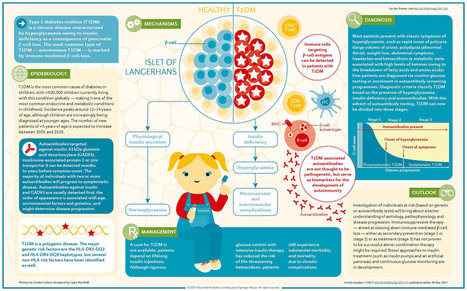
Type 1 diabetes mellitus is an autoimmune disease that is characterized by insulin deficiency due to pancreatic β-cell loss and results in hyperglycaemia.
|
|
Scooped by
Gilbert C FAURE
March 31, 2017 11:43 AM
|
Type 1 diabetes mellitus (T1DM) is a chronic disease characterized by insulin deficiency as a consequence of pancreatic β-cell loss.
|
|
Scooped by
Gilbert C FAURE
March 24, 2017 3:21 AM
|
City of Hope’s Dr. Bart Roep has been able to justify a new theory about the cause of type 1 diabetes that suggests beta cells, not the immune system, may be to blame.
|
|
Scooped by
Gilbert C FAURE
March 3, 2017 3:52 AM
|
Programmed cell death-1 and programmed death ligand 1 (PD-1/PD-L1) inhibitors trigger an immune-mediated anti-tumour response by promoting the activation of cytotoxic T lymphocytes. Although proven to
|
|
Scooped by
Gilbert C FAURE
February 24, 2017 8:54 AM
|
Sci Transl Med. 2017 Feb 22;9(378). pii: eaaf8848. doi: 10.1126/scitranslmed.aaf8848.
|
|
Scooped by
Gilbert C FAURE
February 23, 2017 7:49 AM
|
Susceptibility to type 1 diabetes involves genetic risk factors and potential environmental triggers, making it harder to predict which individuals will actually develop disease. Longitudinal samples collected starting shortly after birth from children at risk for type 1 diabetes were examined by Heninger et al . to scrutinize early immune responses. Some, but not all, of these children eventually developed autoimmunity; CD4+ T cells from those that progressed had a distinct phenotype after presentation of autoantigen, suggesting that they had already been somewhat activated, even before autoantibodies were detectable. These exciting findings indicate that cues that dictate type 1 diabetes development may be happening even earlier than expected, in infancy.
|
|
Suggested by
Société Francaise d'Immunologie
February 20, 2017 4:31 AM
|
Invariant NKT (iNKT) cells in healthy people express iNKT-TCRs with widely varying affinities for CD1d, suggesting different roles for high- and low-affinity iNKT clones in immune regulation. However, the functional implications of this heterogeneity have not yet been determined. Functionally aberrant iNKT responses have been previously demonstrated in different autoimmune diseases, including human type 1 diabetes, but their relationship to changes in the iNKT clonal repertoire have not been addressed. In this study, we directly compared the clonal iNKT repertoire of people with recent onset type 1 diabetes and age- and gender-matched healthy controls with regard to iNKT-TCR affinity and cytokine production. Our results demonstrate a selective loss of clones expressing high-affinity iNKT-TCRs from the iNKT repertoire of people with type 1 diabetes. Furthermore, this bias in the clonal iNKT repertoire in type 1 diabetes was associated with increased GM-CSF, IL-4, and IL-13 cytokine secretion among Ag-stimulated low-affinity iNKT clones. Thus, qualitative changes of the clonal iNKT repertoire with the potential to affect the regulatory function of this highly conserved T cell population are already established at the early stages in type 1 diabetes. These findings may inform future rationales for the development of iNKT-based therapies aiming to restore immune tolerance in type 1 diabetes.
|
|
Rescooped by
Gilbert C FAURE
from Mucosal Immunity
February 15, 2017 4:35 AM
|
Autoantigen-specific immunological tolerance represents a central objective for prevention of type 1 diabetes (T1D).
|


 Scoop.it!