



Investigators have suggested that HLA hyperexpression may be an important first step in the development of type 1 diabetes.


 Your new post is loading...
 Scoop.it! Investigators have suggested that HLA hyperexpression may be an important first step in the development of type 1 diabetes. 
No comment yet.
Sign up to comment
Scoop.it!
In type 1 diabetes, the pancreatic islets are an important site for therapeutic intervention because immune infiltration of the islets is well established at diagnosis.
Scoop.it!
RT @jclinicalinvest: Immunomodulatory agents preserve beta cells in type 1 diabetes patients http://t.co/GcCU8G5XMx #ClinicalMedicine #Cl… …
Scoop.it!
Immunotherapy. 2014 Dec;6(12):1239-42. doi: 10.2217/imt.14.96.
Scoop.it!

Targeting innate immunity for treatment of Type 1 diabetes - Immunotherapy December 2014, Vol. 6, No. 12, Pages 12... http://t.co/5xUyr12Jtk
Scoop.it!
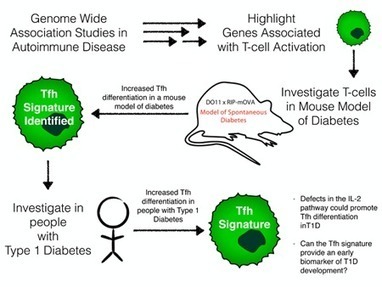
#FirstAuthorPerspective w/Rupert Kenefeck on "Follicular helper T cell signature in type 1 diabetes." http://t.co/8hlZSuIzdz #Immunology
Scoop.it!
RT @NatureRevEndo: New #genetic risk factors for autoantibody positivity identified in patients with #T1DM http://t.co/kWDPO4Nj03 #diabete…
Scoop.it!

Nutrition & Diabetes is a peer-reviewed, open access online journal publishing clinical, metabolic, genetic and epidemiological studies that describe methodologies, mechanisms, and associations in relation to diabetes and nutrition-related diseases...
Scoop.it!

A new way to treat autoimmune diseases such as type-1 diabetes and multiple sclerosis is showing promising early results.
Scoop.it!
A major barrier to treating autoimmune diseases such as Type 1 diabetes is the lack of methods to deliver the therapeutics to specific sites such as the lymph nodes.
Scoop.it!

The rate of non-Hispanic white youth diagnosed with type 1 diabetes increased significantly from 2002 to 2009 in all but the youngest age group of children, according to a new study published today in the journal Diabetes.
Scoop.it!
of fulminant type 1 diabetes profiled by laser-capture microdissection followed by mass spectrometry.
Scoop.it!
Quantitative variations in CTLA4 expression, because of genetic polymorphisms, are associated with various human autoimmune conditions, including type 1 diabetes (T1D).

Krishan Maggon 's curator insight,
October 21, 2014 3:24 PM
September 22, 2014 doi:10.4049/jimmunol.1400876 The Journal of ImmunologyNovember 1, 2014vol. 193 no. 9 4368-4380 Opposing Effects of CTLA4 Insufficiency on Regulatory versus Conventional T Cells in Autoimmunity Converge on Effector Memory in Target TissuePriyadharshini Devarajan*, Jason Miska*,1, Jen Bon Lui*, Dominika Swieboda* andZhibin Chen*,†+Author Affiliations *Department of Microbiology and Immunology, University of Miami Miller School of Medicine, Miami, FL 33136; and†Diabetes Research Institute, University of Miami Miller School of Medicine, Miami, FL 33136+Author Notes ↵1 Current address: Department of Medicine, University of Chicago, Chicago, IL. Address correspondence and reprint requests to Dr. Zhibin Chen, Department of Microbiology and Immunology, University of Miami Miller School of Medicine, RMSB 3035, 1600 Northwest 10th Avenue, Miami, FL 33136. E-mail address: zchen@med.miami.edu
Remi Creusot's curator insight,
January 21, 2015 4:53 PM
Reduced CTLA-4 expression in a mouse with susceptible MHC but otherwise resistant according to other genes (the B6-g7 mouse) is sufficient to induce T1D in about 1/3 of the mice. CTLA-4 polymorphism is found in a number of subjects with T1D or a number of other autoimmune conditions... |
Scoop.it!

Zinc transporter 8 (ZnT8) autoantibody epitope specificity and affinity examined with recombinant ZnT8 variant... http://t.co/3Ayt628Gym
Scoop.it!

Research on the gut microbiome and autoimmune diseases such as RA, MS, type 1 diabetes and IBD has exploded. Here, we review and analyze what it all means.
Scoop.it!
Upregulation of IL-17 immunity and detrimental effects of IL-17 on human islets have been implicated in human type 1 diabetes. In animal models, the plasticity of Th1/Th17 cells contributes to the development of autoimmune diabetes.
Scoop.it!

Researchers at the University of Tokyo have revealed that immune genes associated with susceptibilit
Gilbert C FAURE's insight:
In this study, the research group of then-Assistant Professor Hiroko Miyadera and Professor Katsushi Tokunaga at the Graduate School of Medicine, the University of Tokyo, profiled protein stability of diverse HLA allele products and found that HLA alleles (variations in a gene) that are associated with susceptibility to type 1 diabetes encoded extremely unstable HLA proteins.
Scoop.it!

Expression of Human Leukocyte Antigen Class I in Endocrine and Exocrine Pancreatic Tissue at Onset of ... http://t.co/g3kGqTMeVc via AJP
Scoop.it!

Islet transplantation for Type 1 diabetes: where are we now?: Expert Review of Clinical Immunology, Ahead of P... http://t.co/gPp384AagT
Scoop.it!
Infant Feeding in Relation to Islet Autoimmunity and Type 1 Diabetes in Genetically Susceptible Children: MIDIA Study http://t.co/csN3FFwN1E
Scoop.it!

There are moments during every physician’s day when she or he gives medical advice based on well-established evidence– “The data show that starting medication A for this disease will reduce the risk of death by 20%.” There are also moments when...
Scoop.it!
Diabetes. 2014 Nov 5. pii: DB_141145. [Epub ahead of print]
Scoop.it!

Abstract Via Krishan Maggon
Krishan Maggon 's curator insight,
October 28, 2014 2:38 AM
Insulin like Growth factor 1 could suppress activated immune system in multiple sclerosis, slow down myelin destruction and delay disease progression. Active in EAE model, next step clinical trials.
open access EMBO Mol Med. 2014 Oct 22. pii: e201303376. doi: 10.15252/emmm.201303376. [Epub ahead of print]Insulin-like growth factor-1 stimulates regulatory T cells and suppresses autoimmune disease.Bilbao D1, Luciani L2, Johannesson B2, Piszczek A2, Rosenthal N3.
Scoop.it!

by Mami Shimizu, Hisafumi Yasuda, Kenta Hara, Kazuma Takahashi, Masao Nagata, Koichi Yokono
Gilbert C FAURE's insight:
In conclusion, our studies demonstrated that diabetes progression was suppressed in SR-A−/− NOD mice and that acceleration of diabetes development could be induced in young mice by poly(I:C) treatment even in SR-A−/− NOD mice. These results suggest that SR-A on antigen presenting cells such as dendritic cells may play an unfavorable role in the steady state and a protective role in a mild infection. Our findings imply that SR-A may be an important target for improving therapeutic strategies for type 1 diabetes.
Scoop.it!
Autoantibodies to IA-2 in type 1 diabetes are associated with HLA-DR4, suggesting influences of HLA-DR4–restricted T cells on IA-2–specific B cell responses.
|





