


This is Ward Cunningham, who invented wikis: "Our new wiki innovates three ways. It shares through federation, composes by refactoring and wraps data with visualization. Follow our open development on GitHub or just watch our work-in-progress videos here."

Augmented Collective Intelligence
25.6K views |
+0 today
Technology enables all of us to know more than any of us
Curated by
Howard Rheingold
 Your new post is loading...
 Scoop.it! 
(BOOK): "Wikipedia's style of collaborative production has been lauded, lambasted, and satirized. Despite unease over its implications for the character (and quality) of knowledge, Wikipedia has brought us closer than ever to a realization of the centuries-old pursuit of a universal encyclopedia. Good Faith Collaboration: The Culture of Wikipedia is a rich ethnographic portrayal of Wikipedia's historical roots, collaborative culture, and much debated legacy." 
Scoop.it!

I have recently finished reading the book 'The Wisdom of Crowds: Why the Many Are Smarter Than the Few' by James Surowiecki and I can strongly recommend it to anyone that is interested in how opinions are conformed, and why self-organisation might...
Scoop.it!
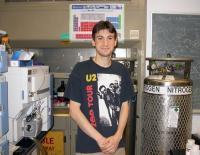
Online gamers have solved the structure of a retrovirus enzyme whose configuration had stumped scientists for over a decade. This is the first instance that researchers are aware of in which gamers solved a longstanding scientific problem.
Scoop.it!
"The general principles of this rapid-learning ecology are pretty clear.
Scoop.it!
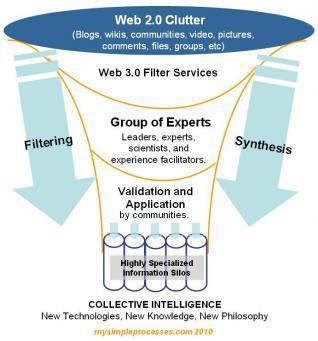
"Let’s focus on the resulting element — the “collective intelligence”. Think about it as billions of human brains working using future super computers as a platform. Massachusetts Institute of Technology (MIT) professor Srini Devadas described “collective intelligence” as consisting of two pillars: cloud computing and crowd computing. Cloud computing is using the Internet as a platform and making access to information available to everyone. Crowd computing, according to him, involves the analysis of information into “collective intelligence” far beyond what we have today." Via Zaq Mosher

ghbrett's curator insight,
December 14, 2012 3:12 PM
A good article about where we are now with the Web and All it's resources. Then it presents a scenario for Web The Next Generation or Web 3.0. This is a good read for folks needing more background and added foresight on how to manage the overwhelming abundance of what it is we call the Web.
Scoop.it!
"for an Enterprise to succeed in living social culture is going to play a key role at the same time that online communities will continue to be the major drivers of social software adoption, both inside and outside of the firewall. However, it won’t be easy. And it won’t take place overnight either. There will always be a good bunch of roadblocks, inhibitors and whatever other issues, like reluctance to change or fear to think and act differently, that would need to be addressed and all of those would be, pretty much, around augmenting your already existing corporate culture and values to address those concerns, as that social transformation continues to happen. The key question would be whether your business is well prepared to invest, heavily enough, in shaping up its own culture to re-adjust and become a truly Social Enterprise."
Scoop.it!
TED Talks Technology is evolving us, says Amber Case, as we become a screen-staring, button-clicking new version of homo sapiens. We now rely on "external brains" (cell phones and computers) to communicate, remember, even live out secondary lives.
Scoop.it!

"A few weeks ago, Science Exchange in Palo Alto, California, launched a website allowing scientists to outsource their research to 'providers' — other researchers and institutions that have the facilities and equipment to meet requesting scientists' needs. Nature asked the company's co-founder, researcher-turned-entrepreneur Elizabeth Iorns, how the website works, and what an online marketplace for experiments could mean for the future of research."
Scoop.it!
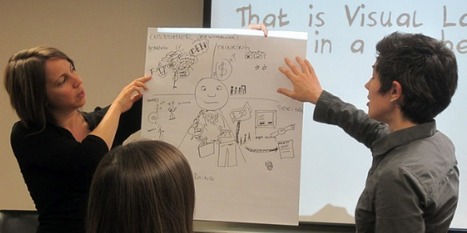
"As a nonprofit, or as a microvolunteering platform like Sparked, BrightWorks, and HelpfromHome, what do you want from microvolunteers? Genius, a big heart, experience? Well, according to two seperate studies from the MIT Center for Collective Intelligence, when it comes to problem solving within teams of 2-5 members, the determining factor of a group’s success is not IQ, expereince, or any other individual trait. Instead, the ace in the deck is a group’s overall emotional/social sensitivity. ( To test yourself for this particular trait, try this online test.)"
Scoop.it!
"Strong networks have the characteristics of strong communities. People know and look out for each other, they learn and share with each other. In weak networks, people are isolated and fragmented in cliques. Whether a network is stronger or weaker has significant implications for the nature and place of crowd sourced engagement in governance. Even today with technologies that could support otherwise, democracies still practice representational governance. People indirectly influence policy makers through informal communications and demonstrations and formal hearings and voting. In any vote on any issue, there are four kinds of engagement in networks. There are the expert informed, the informed enough, the not informed enough, and the inaccurately informed. In network structure and culture, the not informed enough and inaccurately informed are the result of three factors: weak redundancies, small reach, and low resonance."
Scoop.it!
|


|
Scooped by
Howard Rheingold
August 25, 2011 12:29 PM
|
Scoop.it!

A crowd can sometimes provide wisdom that its individual members lack. But, if you let those individuals talk among themselves, their individual errors can spread throughout the crowd, dragging its wisdom down.

|
Suggested by
Anne Caspari
September 25, 2011 2:23 PM
|
Scoop.it!
"Whether it's motivated students to build community gardens, young entrepreneurs to create innovative solutions, or youth groups to engage in local service projects, the WakeUp is mobilizing inspired, collaborative action in young people around the globe."


|
Suggested by
nukem777
September 22, 2011 1:06 PM
|
Scoop.it!
This article will make you think before jumping right into crowdsourcing and taking advice or having the crowd do your tasks. Expertise does in fact matter.
|
|
Scooped by
Howard Rheingold
September 19, 2011 7:37 PM
|
Scoop.it!

The Brain is a powerful infotention tool with an easy beginning learning curve and infinite potential. This one and a half hour recorded seminar shows how to use PersonalBrain to manage information overload -- and more, to transform it into individual knowledge and collective intelligence
|
|
Scooped by
Howard Rheingold
September 18, 2011 1:30 PM
|
Scoop.it!
"A key focus for improving our collective intelligence would be a few central websites compiling analyses of social movements and events, alongside practical pieces from key hubs and organisers on how particular events were pulled off. A collective ratings approach would allow people to quickly find needles in the electronic haystack, via Digg-It-style ‘I like this article’ tags, or collaborative bookmarking, allowing different users to see each other’s bookmarked webpages. Of course some of these types of things exist, with tagging systems well developed on sites of magazines, newspapers and blogs. However, no current website performs the function of an analysis and learning hub, as Indymedia does for news. There are other effective technologies for creating collective intelligence, such as wikis for text editing and textmob for coordinating street action, but much work needs to be done to develop, explore and deploy these tools."
|
|
Scooped by
Howard Rheingold
September 17, 2011 1:35 AM
|
Scoop.it!

Want to tap the power behind search rankings, product recommendations, social bookmarking, and online matchmaking? This fascinating book demonstrates how you can build Web 2.0 applications to mine the enormous amount of data created by people on the Internet. With the sophisticated algorithms in this book, you can write smart programs to access interesting datasets from other web sites, collect data from users of your own applications, and analyze and understand the data once you’ve found it
|
|
Rescooped by
Howard Rheingold
from Mind Amplification
September 15, 2011 2:52 PM
|
Scoop.it!
"Many people ask me what the must reads are in order to make the first steps in collective intelligence, wisdom and consciousness. As surprising as it may look, this questions opens to many domains that might seem out of scope, for instance the way we feed ourselves. Indeed, isn’t food, like so many other questions, a collective intelligence matter?
Migration towards global collective intelligence is today a journey for pioneers. Tomorrow it will be a mass migration. It’s not yet open to everyone, as we are going to places where society has not settled yet. By “going” I mean live there, find and invent practical and pragmatic ways to build tomorrow’s humanity. It doesn’t dictate a way to think or be, all this will naturally emerge. Global collective intelligence has to be seen just like a new continent, with its landscape and its intrinsic laws. It’s us to decide how we want to live there, our creativity will make the difference."
Via Zaq Mosher
|
|
Scooped by
Howard Rheingold
September 13, 2011 10:13 PM
|
Scoop.it!

"Hyperspecialization is not the same as outsourcing or offshoring, though it is enabled by the same technologies. Here’s a way to wrap your brain around the idea:
Imagine for a moment that physical goods could be transported just as easily, quickly, and cheaply as information. Suppose, for instance, that you could order an egg for breakfast that was prepared all over the world: perhaps the egg was laid in Shanghai, cracked in Stockholm, scrambled in Singapore, heated in Seoul, salted in Santiago, and served to you in San Francisco. This, essentially, is what hyperspecialization is, but
instead of making breakfast, workers all over the world can do pieces of knowledge work jobs that are today done by one person in a single place."
|
|
Scooped by
Howard Rheingold
September 10, 2011 12:03 PM
|
Scoop.it!

"From DARPA soliciting the masses to design aspects of next generation combat vehicles, to Kickstarter crowdfunding projects by artists, musicians, and filmmakers, crowdsourcing has gone mainstream. The FBI has already crowdsourced part of a murder investigation, asking the public's help in deciphering two encrypted notes found in the pocket of a victim dumped in a field. And Iceland has crowdsourced its entire constitution. Even the news is being crowdsourced now: The Washington Post, The New York Times, and others asked readers to scour an ennui-inducing trove of Sarah Palin emails written when she was Alaska governor. The Guardian crowdsourced the expense reports of British politicians. Spot.us asks users to crowdfund news stories. There are plenty of other examples. Ping me on Twitter (@penenberg) and I'll add them to the list. (See how I just crowdsourced that?)
All of this got me thinking: Why not crowdsource my next column?"
|
|
Scooped by
Howard Rheingold
September 5, 2011 12:04 PM
|
Scoop.it!
"I've used the example of the bee before. One could exhaustively study a honey bee for centuries and never see in the lone individual any of the behavior of a bee hive. it is just not there, and can not emerge until there are a mass of bees. A single bee lives 6 weeks, so a memory of several years is impossible, but that's how long a hive of individual bees can remember. Humanity is migrating towards its hive mind. Most of what "everybody knows" about us is based on the human individual. Collectively, connected humans will be capable of things we cannot imagine right now. These future phenomenon will rightly seem impossible. What's coming is so unimaginable that the impossibility of wikipedia will recede into outright obviousness."
|
|
Scooped by
Howard Rheingold
August 29, 2011 2:10 PM
|
Scoop.it!

"The MIT Approach to Collective Intelligence
According to the Center for Collective Intelligence, a good collective intelligence platform (CI) must address the following themes:
Goals, referring to the desired outcome;
Incentives, referring to the motivational factors;
Structure/process, referring to the business model and organizational structure to complete the task; and
Staffing, referring to the people required to support the business model and sustainability of CI within the organization.
These four themes then translate into the following four questions:
What is to be accomplished?
Why should anyone help out?
How are they meant to contribute?
Who will perform the necessary work?"
|
|
Scooped by
Howard Rheingold
August 26, 2011 2:31 PM
|
Scoop.it!
People will come across an article, realize either they don’t have time to read it (or aren’t sure if they want to), plug that link into gis.to, and voila, you’ve got 5 to 10 summaries that other people who have read that article have written. That will be the majority of users on the network. A smaller portion will be folks who simply read a lot and want to curate great long-form content for others. Just like some people are passionate about being editors on Wikipedia and manage knowledge of things, people, and events, gis.to authors will be managers of content.
|
|
Scooped by
Howard Rheingold
August 25, 2011 12:35 PM
|
Scoop.it!

Over the past decade, the rise of the Internet has enabled the emergence of surprising new forms of collective intelligence. Examples include Google, Wikipedia, Threadless, and many others. To take advantage of the possibilities these new systems represent, it is necessary to go beyond just seeing them as a fuzzy collection of "cool" ideas. What is needed is a deeper understanding of how these systems work.
This article offers a new framework to help provide that understanding. It identifies the underlying building blocks - to use a biological metaphor, the "genes" - at the heart of collective intelligence systems. These genes are defined by the answers to two pairs of key questions:
- Who is performing the task? Why are they doing it?
- What is being accomplished? How is it being done?
The paper goes on to list the genes of collective intelligence - the possible answers to these key questions - and shows how combinations of genes comprise a "genome" that characterizes each collective intelligence system. In addition, the paper describes the conditions under which each gene is useful and the possibilities for combining and re-combining these genes to harness crowds effectively.
Using this framework, managers can systematically consider many possible combinations of genes as they seek to develop new collective intelligence systems.




