Your new post is loading...

|
Scooped by
Howard Rheingold
December 5, 2011 1:43 PM
|
Video: "With knowledge and data, a smarter world will divide work between humans and computers, Google Executive Chairman Eric Schmidt said in this Nov. 15, 2011 talk at MIT Sloan.
Featuring an introduction by Patrick J. McGovern (1959) Professor of Management Thomas Malone, the talk was part of the MIT Sloan Dean's Innovative Leader Series."
|
|
Scooped by
Howard Rheingold
December 1, 2011 1:37 PM
|
"Networks are nature’s best embodiments of collective intelligence. Networks are intelligent and adaptive, which means that they grow in intelligence as they adapt to events to fulfill needs. The networks that are most important to us are: Networks of living organisms, plants and animals that feed and protect us;
Networks of cells that make up our immune systems;
Networks of neurons that make up our brains;
Personal and social networks that make up our friendship and support networks, and health, transportation, economic, learning, and communication networks.
Our technology is now more than ever creating, using, and maintaining networks. All networks are basically made of nodes and connections. The intelligence of the nodes is important, but the real intelligence of networks is in the connections. There are two super-attributes of connections that are especially important in all types of networks: Connection Strength and Context."
|
|
Scooped by
Howard Rheingold
November 24, 2011 3:47 PM
|
"In a culture which some have described according to information overload, it is impossible for any one of us to hold all of the relevant pieces of information in our heads at the same time. Because there is more information out there on any given topic than we can store in our heads, there is an added incentive for us to talk amongst ourselves about the media we consume. This conversation creates buzz and accelerates the circulation of media content Consumption has become a collective process and that's what I mean in this book by collective intelligence. None of us can know everything; each of us knows something; we can put the pieces together if we pool our resources and combine our skills."
|
|
Scooped by
Howard Rheingold
November 24, 2011 12:26 PM
|
"Collective Intelligence (CI) is complex by nature. It is not merely the sum of what a group knows, but the intelligence that emerges from it. This “emergent” behavior is of a different nature and we can see it at play in perfectly balanced ecosystems where swarm-like behavior produces astounding results that exceed the intelligence of any one creature acting alone. The most familiar example involves the mounts built by ants and termites. Swarm Intelligence (SI) is a scientific field of CI that looks at the behavior of these species and seeks to understand how does collective intelligence emerges."
|
|
Scooped by
Howard Rheingold
November 16, 2011 1:56 PM
|
By observing these systems in nature, scientists have theorized that such systems harness a sort of leaderless, collective intelligence. By leveraging these kinds of consensus-based systems, groups of independently-acting ...
|
|
Scooped by
Howard Rheingold
November 16, 2011 1:54 PM
|
Google's Schmidt: 'Global mind' offers new opportunitiesMIT NewsSchmidt's talk was part of a day of events marking the fifth anniversary of the MIT Center of Collective Intelligence, which considers ways humans and computers can connect to act more...
|
|
Scooped by
Howard Rheingold
November 7, 2011 12:33 PM
|
"mmowgli is both the coolest project I have ever worked on and the hardest to describe in words, but here it goes: mmowgli is an experiment in generating collective intelligence and a pilot project being developed by the Office of Naval Research. Beyond that, mmowgli is ultimately the answer to a few questions, ones that haunted me every day during my tour as a Science Advisor at the Pentagon: why did I experience such a disconnect between technologists and “innovators,” on one hand, and warfighters and end users on the other? Why didn’t “game changing innovations” generate more enthusiasm from those who were “in the game?” And what was I doing to make it better? As my Pentagon tour drew to a close, these questions nagged at me and morphed into a thousand others: What if we took a heavy, formal approach, and made it lighter and more of a continuous conversation instead of a blueprint? What if you didn’t need a fully formed idea to make a contribution? What if ideas, even half-formed ones, could meet up in space and recombine with other ideas to form new ones? What if this conversation engaged more stakeholders and tolerated more excursions? Finally, what if this conversation became so rich and compelling that, instead of truncating the debate, it actually enlarged the universe of possibilities?"
|
|
Scooped by
Howard Rheingold
November 4, 2011 9:50 PM
|
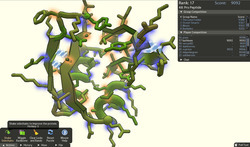
"Foldit is a revolutionary new computer game enabling you to contribute to important scientific research. This page describes the science behind Foldit and how your playing can help."
|
|
Scooped by
Howard Rheingold
October 23, 2011 9:55 PM
|
"New advances in digital media offer unprecedented memory capacities, an omnipresent channel of communication, and ever-growing computational power.
We must ask ourselves how we can exploit this medium in order to augment our own social cognitive processes for human development.
Through a combination of a profound knowledge of humanities and social sciences, and an understanding of computer sciences, Pierre Lévy proposes a collaborative construction of a global hyper-cortex, coordinated by a computable metalanguage.
By fully recognizing the symbolic and social nature of human cognition, we could transform our current, opaque, global brain into a reflexive collective intelligence."
|
|
Scooped by
Howard Rheingold
October 19, 2011 2:15 PM
|
In this podcast, I discuss how the collective intelligence influence the foundation of Google. James Surowiecki's The Wisdom of Crowds allows us to discover the latter of our natural inclination of finding “experts”.

|
Suggested by
Guillaume Decugis
October 19, 2011 2:13 PM
|
"Is Quora collective intelligence in the making? Dan Kaplan of Twilio says yes. With Siri as the perfect user interface to complete it. "
|
|
Scooped by
Howard Rheingold
October 6, 2011 1:40 PM
|
"By looking at collective intelligence (CI) through four distinct lenses, this paper draws on recent research in organizational design, evolutionary economics, cognitive sciences, knowledge ecology and political economy to built a twin path forward: collective intelligence and collective leadership. It lays out elements of a framework for building this twin path beyond chaos. It is our intent to invite conversations designed to engage questions surrounding this interdependent evolutionary path. How might we develop criteria for a design capable of supporting a large range of collective intelligence phenomena in an integrated way? Will the emergent socio-economic life forms be strong enough to balance the destructive power of our global crises if and when "the perfect storm" hits? When everything goes worse and worse, and better and better, at the same time, and they do it faster and faster, how do we deal with the ensuing chaos? In order to bring forth desirable futures, we must be ready to navigate through it, using a twin path of collective intelligence and collective leadership. This is our global challenge. This paper is the first in that will delve into the topic more deeply, expanding certain sections of this overall expose into separate albeit inter-related lines of inquiry"
|
|
Scooped by
Howard Rheingold
September 29, 2011 2:38 PM
|
Tim O'reilly: "Man-machine symbiosis isn’t just about knowledge retrieval, it’s also about knowledge creation. Our computers have no intelligence without us, but they accelerate our collective intelligence at a speed that has never been seen before. When the web goes mobile, even more interesting things start to happen. A human with a smartphone can literally see around corners and through time. What’s more, our phones are eyes and ears for what is starting to look increasingly like a global brain. Photos are automatically uploaded to vast cloud databases, each one tagged with its location and the time it was taken. Applications like Shazam can listen to a song and tell you who is singing it. The ambient sound of a room can be used to pinpoint your location."
|
|
|
Scooped by
Howard Rheingold
December 5, 2011 1:29 PM
|
"Let’s focus on the resulting element — the “collective intelligence”. Think about it as billions of human brains working using future super computers as a platform. Massachusetts Institute of Technology (MIT) professor Srini Devadas described “collective intelligence” as consisting of two pillars: cloud computing and crowd computing. Cloud computing is using the Internet as a platform and making access to information available to everyone. Crowd computing, according to him, involves the analysis of information into “collective intelligence” far beyond what we have today."
|
|
Scooped by
Howard Rheingold
November 29, 2011 1:20 PM
|
"Context for this post: I’m currently working on a social network application that demonstrates the value of connection strength and context for making networks more useful and intelligent. Connection strength and context are currently only rudimentarily and mushily implemented in social network apps. This post describes some of the underlying theory for why connection strength and context are key to next generation social network applications."
|
|
Scooped by
Howard Rheingold
November 24, 2011 12:55 PM
|
"As stigmergy is a method of communication in which individuals communicate with one another by modifying their local environment, it is a logical extension to apply the term to many types (if not all) of Web-based communication, especially media such as the wiki. The concept of stigmergy therefore provides an intuitive and easy-to-grasp theory for helping understand how disparate, distributed, ad hoc contributions could lead to the emergence of the largest collaborative enterprises the world has seen."
|
|
Scooped by
Howard Rheingold
November 18, 2011 2:17 PM
|
The next generation is growing up in a collaborative world and are instinctual in their use of collective intelligence and networks. We have become ‘informational hunters and gatherers” (Jenkins, 2006, location 2480) and while elder generations may still be isolated in old media, the younger generations, and especially gamers, are learning to work together in a way we have never done before. Games bring people together and allow for collaboration in problem solving, a skill that many of us could benefit in practicing.
|
|
Scooped by
Howard Rheingold
November 16, 2011 1:55 PM
|
Here's 5 Real World Examples of Collective Intelligence; Google , Google + , Open Source Projects , BRAIN (Behaviorally Robust Aggregation of Information in Networks) , KuiSchi (Knowledge Unifying Initiator for Science and Technology).

|
Suggested by
Ken Morrison
November 12, 2011 12:38 PM
|
While Twitter generates mass interest and curates collective thought, its trends cannot represent the true pulse of world conversation. That needs to change.
|
|
Scooped by
Howard Rheingold
November 6, 2011 3:03 PM
|
"While I appreciate and agree with the comment that the people implicated thus far have highly evolved competencies around self-management and collaboration, there is much more to this story that is illustrative of the ingredients in the special sauce that has imbued this large scale cross-sectoral collaborative system change effort. Here are 10 factors that might explain our relative and collective success to date:"
|
|
Scooped by
Howard Rheingold
November 4, 2011 1:33 PM
|
"Liberating Structures are simple methods that make it easy for groups of people to liberate their energy, tap into their collective intelligence, be creative, adaptable, build on each other's ideas, and get results."
|
|
Scooped by
Howard Rheingold
October 20, 2011 10:49 PM
|
Researchers are busy trying to use Twitter to predict everything from disease outbreaks and financial markets to elections and even revolutions. New research from Topsy Labs shows that Twitter can provide a window into events like the Arab Spring.
|
|
Scooped by
Howard Rheingold
October 19, 2011 2:15 PM
|
Metropolis MagazineThe Living Technology of Christopher AlexanderMetropolis MagazineAdaptive design has to engage multiple actors, forming a “collective intelligence” to explore the universe of available solutions and non-solutions.
|
|
Scooped by
Howard Rheingold
October 7, 2011 6:49 PM
|
(Full article is behind WSJ Firewall, but this intro is interesting, including the pencil example) "So dispersed is knowledge, that, as Leonard Reed famously observed in his 1958 essay “I, Pencil,” nobody on the planet knows how to make a pencil. The knowledge is dispersed among many thousands of graphite miners, lumberjacks, assembly line workers, ferrule designers, salesmen and so on. This is true of everything that I use in my everyday life, from my laptop to my shirt to my city. Nobody knows how to make it or to run it. Only the cloud knows."

|
Suggested by
Philippe Vallat
October 2, 2011 11:40 AM
|
"BRAIN, Behaviorally Robust Aggregation of Information in Networks), created by Hewlett Packard, is a fascinating example of collective intelligence. According to the creators, “Existing processes tend to be either too data-driven, and therefore lacking the perspective of human insight, or too ad hoc, and therefore inconsistent with the data. “ BRAIN was developed to gain more accurate information for prediction markets using data side-by-side with team surveys. It’s worked for HP, and other companies, such as IBM and Ford, have implemented prediction markets as well."
|


 Scoop.it!