Your new post is loading...

|
Scooped by
Jacques Urbanska
December 15, 2014 12:53 PM
|
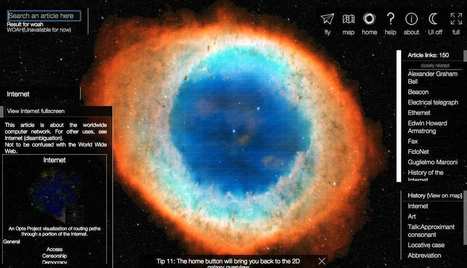
Si Wikipedia peut être un cosmos à lui tout seul de par les millions d’articles et connaissances qui y sont stockés. Owen Cornec, jeune étudiant français, a eu l’idée géniale de créer un nouvel astre lumineux de l’encyclopédie en ligne pour en faire un immense réseau interactif d’articles nommé WikiGalaxy. Se retrouver dans un réseau d’étoiles fait de milliers d’informations n’est pas simple et les liens deviennent des chemins intersidéraux – presque performatif – menant d’une découverte à une autre. ....
http://wiki.polyfra.me
|
|
Scooped by
Jacques Urbanska
December 15, 2014 9:41 AM
|
performer's voice is processed in eight independent channels and feeded to the speakers, movement of each speaker is directly connected with frequency and amplitude of the generated sound...
artbits.pl
rondosztuki.pl
pangenerator.com
|
|
Scooped by
Jacques Urbanska
December 12, 2014 9:11 AM
|
Entre ce qui a déjà été fait et ce qui est interdit, les artistes n'osent plus grand-chose, estime Yves Michaud, penseur singulier passé de la philosophie à l'art. Désormais, dit-il, les plus audacieux sont ceux qui croisent les disciplines. Voilà un penseur iconoclaste et offensif, qui ne craint pas de secouer tous les landerneaux. En 2003, dans L'Art à l'état gazeux, il enterrait la notion d'œuvre d'art mais voyait de la beauté partout, dans la rue, au supermarché ou chez soi. Depuis, ce philosophe issu d'un milieu modeste se considère volontiers comme un « pestiféré » dans l'Hexagone, quand il est célébré et sollicité à l'étranger - il a enseigné à Berkeley comme à São Paulo. Reçu premier à l'agrégation de philosophie en 1968, Yves Michaud a toujours fui les chapelles en passant pour un libéral-libertaire. Il a pourtant dirigé l'Ecole nationale des beaux-arts (de 1989 à 1997), puis lancé l'Université de tous les savoirs et ses conférences très courues. Sceptique mais curieux de tout, jonglant avec les disciplines, il s'est distingué par ses réflexions inattendues sur la culture, la violence ou la politique. Solide d'esprit comme de corps (il est sportif), à la fois terrien et technophile, c'est un partisan du gai savoir. Un esprit libre, en somme. ...
|
|
Scooped by
Jacques Urbanska
December 10, 2014 5:22 PM
|
La 6e édition de 3D Stereo MEDIA (Liège, 9-11 décembre 2014) est l’occasion de présenter la première conférence internationale sur le thème du 3D Food Printing, rencontre professionnelle organisée à l’initiative des équipes de Gembloux Agro-Bio Tech (Université de Liège).
Imprimer soi-même, où l’on veut, quand on veut, ses propres aliments n’est plus une utopie. Experts et visionnaires s’accordent pour prédire que l’alimentation et la gastronomie deviendront digitales et 3D, ce qui signifie que les recettes et les menus dans leur forme digitale pourront prendre concrètement forme grâce à des imprimantes 3D. Pour d’aucuns, les imprimantes alimentaires 3D sont les micro-ondes de demain !
To celebrate the partnership between TRAKK, the new creative hub in Namur in which KIKK is involved as a partner and The Smart Gastronomy Lab. KIKK and Gembloux Agro Bio Tech have decided to offer you some free tickets to attend the pioneering Food Printing Conference taking place in Liège tomorrow during 3D Stereo Media.
|
|
Scooped by
Jacques Urbanska
December 10, 2014 1:07 PM
|
Locus Sonus is a France-based research network that mainly focuses on the relationship between sound and space. The Centre’s first inception and early projects date back to 2005, and during this ten-year activity Locus Sonus has collaborated with several international research labs, such as the sociology lab CNRS, LAMES in Aix en Provence, the CRESSON, the architecture lab CNRS in Grenoble, the School of the Art Institute in Chicago (SAIC) and other partners worldwide.
At the heart of Locus Sonus there is a strong interest in the multidisciplinary nature of audio art forms within the framework of networked/multiuser sonic spaces. Peter Sinclair – together with Jérôme Joy, is Locus Sonus research director. ....
|
|
Scooped by
Jacques Urbanska
December 10, 2014 12:49 PM
|
Focused ultrasound creates haptic shape of a virtual sphere (credit: Bristol Interaction and Graphics group, University of Bristol) University of Bristol
University of Bristol researchers have developed a method for using ultrasound to generate an 3D haptic shape that can be added to 3D displays so that invisible images can be felt in mid-air. The new technology could enable surgeons to explore a CT scan by enabling them to feel a disease, such as a tumor, using haptic feedback. ...
|
|
Scooped by
Jacques Urbanska
December 10, 2014 12:36 PM
|
Registrations are opened to the 16th edition of FILE – Electronic Language International Festival, from November 7, 2014 to January 15, 2015.
The FILE SP 2015 exhibition will happen in June 2015, at the Sesi-SP’s Art Gallery in Centro Cultural Fiesp – Ruth Cardoso. Since 2000 FILE is a non-profit cultural organization that has been promoting exhibitions, workshops and gatherings that seek to investigate the appropriations of the technologic media in artistic accomplishments. With annual exhibitions in São Paulo, editions in Rio de Janeiro and Belo Horizonte, in addition to participations in international events, FILE is the biggest digital art event in Latin America.
For 2015, artists and researchers can submit their works in three main categories – Interactive Art, Digital Language and Electronic Sonority – with all the animations enrolled in Digital Language competing for the FILE Anima+ Award.
|
|
Scooped by
Jacques Urbanska
December 10, 2014 6:28 AM
|
Digitalarti has announced its partnership with APSYS, one of the largest European shopping mall companies, to create and install 15 pieces of digital artwork for a new mall. The new mall, Muse, is located in Metz, France. The artwork will be produced and installed between 2015 and 2017.
|
|
Scooped by
Jacques Urbanska
December 9, 2014 8:32 AM
|
COMPUTABILITY, SURVIVAL AND CYBERGENESIS
In times of electronic warfare, global communication and mass surveillance, we see the emergence of a new obsolescence: us.
Set between computer science and new media art, NN describes a prototype of a New Nature, a cybernetically generated, virtualized and abstracted one. Four artworks are sketching standpoints and endpoints in the development towards a technogene future.
Green Hill Gallery, Kulturschöpfer eV, Grünberger Str. 13, Friedrichshain, Berlin
|
|
Scooped by
Jacques Urbanska
December 8, 2014 4:44 PM
|
°•÷ýŞ38÷ This is not art. What is not art? This is not art. 4¦8 b• ×›lëśßwp© Pixxelpoint 2014 showcases the best non-artistic works by media artists 2ô†YC X™ 4¤i$"dw top names in media art, and standing next to them as equals are art students Ű ž$ .‰˘ ăóy LJSAT QI 7Ž –j(" The most radical art an artist can create/code/showcase in this day and age is that which they in fact fail to make/create. This means that instead of creating art, the artist deliberately chooses not to do so, letting it remain a captive of its potential, even abandoning it. This year’s festival thus showcases the most beautiful and the most radical examples of the so-called abandoned art. N€M wŘů z$ÂCQ EE As the curator of Pixxelpoint, what I was looking for in artists is the absence of art. Nothing else. {ˇ\wě„ Łźhµ ŕ @Ţ}"…óDm˙a=tF² – to find the art (a), you multiply the time (t) by the square of the force (F) YĎă ].J,6 í9 I invite the visitors of the festival to create their own art. They should not expect us, the artists and myself as the para-curator, to make, select and arrange it for them (I am like the paramilitary: they pretend to be an army, but really they are little more than a private militia.) ż^®,}…¨Ťô¤ "żľx”Úż ¤>Łň őXÜ c9c}ÁŃ… While art is beautiful, it takes too much work. And as Marx says, work is disease. ‡w 4(â‰yD 2ŕ < ľn What is on the other side? Is it the other, non-artistic side, the dark side of art? Or is it the bright side (of life)? How does non-art look, sound and act?h +űe7Ö®» A man, a plan, a canal: Panama. ˛O) w Á€$¤†’Ę" †\ÂĎÎ
|
|
Scooped by
Jacques Urbanska
December 8, 2014 11:45 AM
|
Ever get tired of high-resolution, full-color videos on YouTube? Free yourself with these text-only, black-and-white versions. Simply enter the URL of a YouTube video, wait as my poor little laptop overheats while it converts it to text, then sit back and enjoy the show! Be sure to turn up your speakers. Audio is included!
Pretty impressive; convert ANY YouTube video into animated ascii art: http://t.co/sz1LImQgA2
|
|
Scooped by
Jacques Urbanska
December 8, 2014 11:27 AM
|
An inventive and visionary engineer, Baer helped create the world’s first consumer video game console.
It is rare that any creative industry can look at a single person and say with any confidence that they started it all. But perhaps that is possible with video game consoles, and perhaps that person is Ralph Baer, who has died at the age of 92.
Widely known as the “father of video games” Baer, a lifelong inventor and innovator, was instrumental in the design of the Magnavox Odyssey, the first ever commercial digital games console. With its futuristic looks, electronic game cards and strange analogue controller, it introduced consumers to the concept of interacting with games on their television sets. Released in the US in August 1972, it pre-dated Atari’s Pong arcade cabinet by several months.
|
|
Scooped by
Jacques Urbanska
December 8, 2014 11:07 AM
|
Le « Call for Transmedia Projects » est un projet pilote de la Fondation pour la culture Pro Helvetia et de l’Office fédéral de la culture et est organisé en collaboration avec les Journées de Soleure et la Fondation de formation continue pour le cinéma et l’audiovisuel (FOCAL).
L’appel à projets transmédia s’adresse aux créateurs de projets artistiques innovants, qui développent un récit fictionnel ou documentaire sur deux plateformes différentes au moins. Il a pour objectif de favoriser l’émergence de nouvelles formes narratives numériques. Les contenus des projets doivent être conçus spécifiquement pour l’internet et les supports mobiles. Ils doivent en outre comporter au moins une composante audiovisuelle (film, série web, web-documentaire, blog vidéo, etc.) et une composante interactive (jeu vidéo, BD interactive, réalité augmentée, réseaux sociaux, etc.). Les diverses composantes disposeront de contenus spécifiques qui se complèteront. Les projets qui impliquent le public dans des processus participatifs sont particulièrement recherchés. ...
|
|
|
Scooped by
Jacques Urbanska
December 15, 2014 9:48 AM
|
Making short GIFs of YouTube videos is a pretty well-established practice now -- so much so that there's dozens of websites dedicated to this finest of art forms. But YouTube might be about to make them all obsolete, thanks to a new built-in GIF maker.
|
|
Scooped by
Jacques Urbanska
December 15, 2014 9:13 AM
|
Following last week's raid on The Pirate Bay many sites appeared claiming to have brought the site back to life. While that was to be expected, the site that has gained the most traction is now deliberately lying to the press and faking user uploads to give the impression that leading uploaders support them. The Pirate Bay was without doubt the most iconic BitTorrent site in history before it was abruptly shutdown last week following a raid on a Swedish datacenter.
Even today it seems strange talking about The Pirate Bay in the past tense. Many believe it’s simply a question of time before the site reappears but for others any amount of time is too long to wait. ...
|
|
Scooped by
Jacques Urbanska
December 12, 2014 4:50 AM
|
10,000 people attended CYBERFEST's first international leap last year. CYLAND now marks its 8th year of iconic new media activities by going global...
CYBERFEST is the original, biggest festival for tech based art in Russia. Founded in 2007, CYBERFEST expanded to Germany in 2013. In 2014, CYBERFEST reaches international levels by branching to 5 innovative cities on the Art & Tech frontier, strengthening cultural exchange among innovators.
In 2014, CYBERFEST «The Other Home (s)» explores the commonalities and differentiations among physical, emotional and cultural manifestations attached to the concept of «home».
|
|
Scooped by
Jacques Urbanska
December 10, 2014 1:30 PM
|
Logiciel, éducation, conception industrielle, données, science, art et culture, les open models sont partout. Les acteurs qui utilisent ces approches ouvertes remettent en cause les positions établies par les acteurs traditionnels. Souvent, des communautés s'organisent pour résoudre collectivement des problèmes sur lesquels buttent les organisations centralisées. Tabby, la voiture en kit open source, Protei, le drone marin open source, Open street map, en sont quelques exemples. ...
Changer de modèle c'est aussi changer son propre regard. Ainsi, pendant votre lecture, posez votre smartphone à côté du livre, lancez OpenModels.fr et tournez les pages au fur et à mesure de votre lecture. Vidéos, interviews, commentaires en direct, flux twitter, votes, le numérique vous offre un autre contexte, une autre façon de comprendre les choses.
|
|
Scooped by
Jacques Urbanska
December 10, 2014 1:00 PM
|
transmediale is a Berlin-based festival and year-round project that draws out new connections between art, culture and technology.
|
|
Scooped by
Jacques Urbanska
December 10, 2014 12:45 PM
|
Gilberto Esparza, prizewinner at VIDA 9.0 and VIDA 13.0, is presenting his individual exhibition Cultivos at the Espacio Fundación Telefónica de Lima in Peru. Curated by Tatiana Cuevas, the exhibition brings together three main projects from the artist’s research career: Parásitos urbanos (2006-2008), Plantas nómadas (2008-2013) and Plantas autofotosintéticas (2013-2014). These projects show the intersection between robotics, biology, and special attention to the relationship between nature and urban space, the imbalances between the ecosystem and the action of human beings. In the case of Planas nómadas (Nomad plants), the project can be applied to the city of Lima, whose residual waters are converted to energy to sustain a rudimentary ecosystem made up of protozoa, crustaceans and microalgae which visitors will be able to see at the exhibition. Esparza’s projects, which according to Sally-Jane Norman, co-founder of VIDA, have a “visionary use in their conception and assembly” of available technology, stand out due to the quality of their research and their social and political commitment.
|
|
Rescooped by
Jacques Urbanska
from Vrlab.fr
December 10, 2014 12:33 PM
|
L'INRIA a présenté un prototype de casque permettant de voir devant soi, sur les côtés, mais aussi derrière soi. C'est le premier produit de son genre, et sa marge de progression, comme ses domaines d'applications, sont vastes. Maxisciences était là et vous livre les premières informations sur un outil qui a de l'avenir. Imaginez la Terre, sous sa forme de globe terrestre. Et maintenant, dépliez-la jusqu'à en obtenir une projection en deux dimensions, comme une carte du monde. Vous aurez là le principe du rendu de ce qui est retransmit dans les yeux de l'utilisateur du FlyViz. Il s'agit du premier visiocasque affichant une vue, en mouvement, à 360 degrés. Il a été présenté à l'INRIA, à Paris, et son prototype final sera dévoilé à la conférence "Virtual Reality Software and Technology 12" de Toronto L'INRIA a présenté un prototype de casque permettant de voir devant soi, sur les côtés, mais aussi derrière soi. C'est le premier produit de son genre, et sa marge de progression, comme ses domaines d'applications, sont vastes. Maxisciences était là et vous livre les premières informations sur un outil qui a de l'avenir. Imaginez la Terre, sous sa forme de globe terrestre. Et maintenant, dépliez-la jusqu'à en obtenir une projection en deux dimensions, comme une carte du monde. Vous aurez là le principe du rendu de ce qui est retransmit dans les yeux de l'utilisateur du FlyViz. Il s'agit du premier visiocasque affichant une vue, en mouvement, à 360 degrés. Il a été présenté à l'INRIA, à Paris, et son prototype final sera dévoilé à la conférence "Virtual Reality Software and Technology 12" de Toronto. En savoir plus: http://www.maxisciences.com/flyviz/flyviz-le-premier-visiocasque-qui-affiche-une-vue-a-360-degres_art27809.htmlCopyright © Gentside Découverte
L'INRIA a présenté un prototype de casque permettant de voir devant soi, sur les côtés, mais aussi derrière soi. C'est le premier produit de son genre, et sa marge de progression, comme ses domaines d'applications, sont vastes. Maxisciences était là et vous livre les premières informations sur un outil qui a de l'avenir. Imaginez la Terre, sous sa forme de globe terrestre. Et maintenant, dépliez-la jusqu'à en obtenir une projection en deux dimensions, comme une carte du monde. Vous aurez là le principe du rendu de ce qui est retransmit dans les yeux de l'utilisateur du FlyViz. Il s'agit du premier visiocasque affichant une vue, en mouvement, à 360 degrés. Il a été présenté à l'INRIA, à Paris, et son prototype final sera dévoilé à la conférence "Virtual Reality Software and Technology 12" de Toronto. En savoir plus: http://www.maxisciences.com/flyviz/flyviz-le-premier-visiocasque-qui-affiche-une-vue-a-360-degres_art27809.htmlCopyright © Gentside Découverte
Via David Guez - Vrlab.fr
|
|
Scooped by
Jacques Urbanska
December 10, 2014 6:22 AM
|
13/12/2014 - De 14h à minuit
Peer to Peer s’articule autour de l’exploration du nouveau monde créé par le réseau, par l’idée que la compréhension de notre monde va désormais passer par sa duplication intégrale sous forme de données. De la performance au talk, du concert à la projection, chaque intervenant traverse son champ disciplinaire apportant un éclairage nouveau ou inattendu.
Avec : Margherita Balzerani, Benjamin Gaulon aka Recyclism, Marie Lechner, Emilie Brout et Maxime Marion, Eric Sadin et Abraham Poincheval, suivi d’une performance de Nicolas Maigret.
|
|
Scooped by
Jacques Urbanska
December 9, 2014 8:24 AM
|
In 2011, taken by the emergence of mass protest movements around the world, artist Zach Blas began making his "Facial Weaponization Suite," a series of community workshops that discuss and resist biometric facial recognition technologies.
|
|
Scooped by
Jacques Urbanska
December 8, 2014 3:33 PM
|
An art project from the !Mediengruppe Bitnik art collective called "The Random Darknet Shopper" is buying items off Agora using Bitcoins.
From augmented reality, which anticipates the information you'll want just by looking at an object, to smart services that use artificial intelligence to help us manage our workloads, the look, feel and utility of the internet of 2040 is a wide open field. Already advances in virtual reality technology - Facebook notably bought the virtual reality start-up Oculus VR for $2bn this year - are beginning to change the way we deal with everything from medical science, to military training, to learning difficulties. To what extent, however, we'll have control over our own data is one of the future's great unanswered questions.
|
|
Scooped by
Jacques Urbanska
December 8, 2014 11:33 AM
|
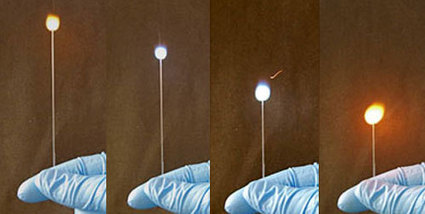
For many of us, the most memorable bits of school chemistry classes were lessons where we ignited metal salts over a Bunsen burner to produce brightly coloured flames, from the lilac of potassium to the distinctive red of lithium. Now a group of chemists from Harvard University have found a way of using these colourful flames to transmit coded information.
Working in the lab of legendary chemist George Whitesides, Samuel Thomas III has developed the ‘infofuse’, a strip of flammable paper patterned with metal salts. As the strip burns, the metals change the colour of the flames, creating coded pulses of light that can be used to send messages. It’s a vibrant, visual equivalent of Morse code and as a test-run, they used their infofuses to transmit the message, “LOOK MOM NO ELECTRICITY”....
|
|
Scooped by
Jacques Urbanska
December 8, 2014 11:21 AM
|
Deep Lab is a impermanent collective of cyberfeminist researchers, organized by STUDIO Fellow Addie Wagenknecht to examine how privacy, security, surveillance, anonymity, and large-scale data aggregation are problematized in the arts and society. The Deep Lab participants, all women, are an international group of new-media artists, information designers, data scientists, software engineers, hackers, writers, journalists and theoreticians, who are engaged in ongoing critical assessments of contemporary digital culture. During the second week of December 2014, these experts will work collaboratively at the STUDIO in an accelerated pressure project, which blends aspects of a booksprint, hackathon, dugnad, charrette, and a micro-conference.
The Frank-Ratchye STUDIO for Creative Inquiry is a flexible laboratory for new modes of arts research, production and presentation. Founded in 1989 within the College of Fine Arts at Carnegie Mellon University (CMU), the STUDIO serves as a locus for hybrid enterprises on the CMU campus, the Pittsburgh region, and internationally. Our current emphasis on new-media arts builds on more than two decades of experience hosting interdisciplinary artists in an environment enriched by world-class science and engineering departments. Through our residencies and outreach programs, the STUDIO provides opportunities for learning, dialogue and research that lead to innovative breakthroughs, new policies, and the redefinition of the role of artists in a quickly changing world.
|