Media Arts Watch Lab - www.arts-numeriques.info - laboratoire de veille Arts Numériques - twitter @arts_numeriques - @processing_org - @DigitalArt_be - by @jacquesurbanska @_Transcultures
“Share This - art on social networks” is a research project by Stedelijk Museum Amsterdam, Het Nieuwe Instituut, The Netherland Institute for Sound and Vision and Upload Cinema. Our aim is to explore ways of collecting and presenting artists, designers and image creators currently active on social media.This Tumblr is our open (yet slightly moderated) research environment and does not represent a curated selection by parties involved.
A research project by Stedelijk Museum Amsterdam, Het Nieuwe Instituut, The Netherlands Institute for Sound and Vision and Upload Cinema.
“Share This - art on social networks” is a research project by Stedelijk Museum Amsterdam, Het Nieuwe Instituut, The Netherland Institute for Sound and Vision and Upload Cinema. Our aim is to explore ways of collecting and presenting artists, designers and image creators currently active on social media.
This Tumblr is our open (yet slightly moderated) research environment and does not represent a curated selection by parties involved.
Docteur Boo Boo est de retour et c’est à Paris qu’il choisit d’offrir une conceptualisation du "GLITCH" : singularité, anomalie, défaillance électrique, électronique qui entraîne des dysfonctionn
A destination des artistes œuvrant dans le domaine de l'art vidéo et des arts numériques.
La DRAC Auvergne, la DAAC du rectorat de Clermont-Ferrand et VIDEOFORMES recherchent un(e) artiste pour une résidence dans un établissement scolaire du secondaire (Académie de Clermont-Ferrand ex-région d'Auvergne).
Les artistes devront adresser leur candidature avant le 25 JUIN 2015, par courrier à : VIDEOFORMES, LA DIODE, 190-194 boulevard Gustave Flaubert, 63000 Clermont-Ferrand.
CANDIDATURE – RÉSIDENCES VIDEO ARTS NUM Document Adobe Acrobat [28.7 KB] Télécharger
This piece questions the role that all of the little gadgets we use from day to day play in our lives. Frequently, they are a form of escapism, used to avoid thinking and interacting by staring into the information space. Often they are being used as a tool to spy on us and gather data about our habits. For once, they are “consciously” staring back at us, moving and following viewers around. . The piece consists of four Android tablets, two counter-balances, seven servos and two Kinects. The Kinects track users as they walk about the space. A piece of OpenFrameworks software then works out what angles each of the servos needs to rotate to based on people's locations, how each of it's parent servos are orientated and the structure of the mobile. This is then sent over ethernet to a Chipkit board (80Mhz Arduino compatible board) that controls the servos. The tablets are all running a Processing app.
Living design, living architecture, living urbanisme, living éducation... Au-delà de l’art, tous les champs de l’activité humaine se voient aujourd’hui investis de mécanismes animés par l’intelligence artificielle. Florent Aziosmanoff décrypte ces activités en plein essor qui promettent de révolutionner notre société.
Il montre en particulier que lorsqu’une personne se trouve confrontée à un dispositif ayant un comportement autonome, sa propre attitude est guidée par la relation établie avec ce dispositif. Les enjeux de discours du créateur s’expriment ainsi au travers du comportement du spectateur, qu’il dirige à travers son œuvre. Le living art se trouve être ainsi un art « qui vit » autant qu’il est « à vivre », portant le discours de l’artiste dans l’évidence d’une relation intime et personnelle, vécue au quotidien entre l’œuvre et son spectateur. ...
Since I started free software in the 80s, developers have grown to routinely mistreat users by shackling behaviour and snooping – but we have ways to resist
In 1983, when I started the free software movement, malware was so rare that each case was shocking and scandalous. Now it’s normal.
To be sure, I am not talking about viruses. Malware is the name for a program designed to mistreat its users. Viruses typically are malicious, but software products and software preinstalled in products can also be malicious – and often are, when not free/libre. ...
Les candidats devront remplir le formulaire et uploader leur dossier de présentation sur form.prixcube.com
Chaque candidature doit contenir les informations suivantes :
Un dossier de présentation de l’artiste (date de naissance, biographie, références) et de l’œuvre. Ce dossier décrira de façon détaillée et illustrée les enjeux artistiques de l’œuvre ainsi que son fonctionnement. Toutes ces informations doivent être compilées dans un seul document en format pdf. Une fiche technique détaillée : technologies utilisées, plan d’implantation, matériel nécessaire, modalités de transport (dimensions, poids, conditionnement). Des visuels et une vidéo de présentation de l’œuvre, si possible en situation de diffusion publique. La vidéo doit être disponible sur internet via une url.
Digimag Journal is a new interdisciplinary peer-reviewed online publication, seeking high-standard articles and reviews at the intersection between digital art and contemporary art production, the impact of the last technological and scientific developments on modern society, economy, design, communication and third millennium creativity.
The IATEFL Learning Technologies SIG in association with MEI (Marketing English in Ireland) and the support of ELT Ireland are happy to announce that Digital ELT Ireland 2015 will take place on 31 October – 1 November 2015 in Dublin. This year’s theme is “Technology & Pedagogy in Practice” and call for papers is now open. The focus of the conference is to explore how a growing awareness of the relevance and benefits of using technology for ELT, is working in practice.
The aim is to host practical and theoretical presentations which can help to enhance our classroom experiences and aid our understanding of technology in ELT. How are teachers linking the use of technologies to sound pedagogy? What are the pedagogical considerations involved when training teachers in the use of technology?
by Yizhong Zhang, Chunji Yin, Changxi Zheng and Kun Zhou Technical Paper at ACM SIGGRAPH 2015
Hydrographic printing is a well-known technique in industry for transferring color inks on a thin film to the surface of a manufactured 3D object. It enables high-quality coloring of object surfaces and works with a wide range of materials, but suffers from the inability to accurately register color texture to complex surface geometries. Thus, it is hardly usable by ordinary users with customized shapes and textures.
We present computational hydrographic printing, a new method that inherits the versatility of traditional hydrographic printing, while also enabling precise alignment of surface textures to possibly complex 3D surfaces. In particular, we propose the first computational model for simulating hydrographic printing pro- cess. This simulation enables us to compute a color image to feed into our hydrographic system for precise texture registration. We then build a physical hydrographic system upon off-the-shelf hardware, integrating virtual simulation, object calibration and controlled immersion. To overcome the difficulty of handling complex surfaces, we further extend our method to enable multiple immersions, each with a different object orientation, so the combined colors of individual immersions form a desired texture on the object surface. We validate the accuracy of our computational model through physical experiments, and demonstrate the efficacy and robustness of our system using a variety of objects with complex surface textures.
Les résidences du Studio XX offrent aux artistes la possibilité d’expérimenter et de créer de nouvelles œuvres. Nous répondons à leurs besoins techniques, créatifs et théoriques en les référant à notre réseau communautaire d’expert-e-s (la décision de s’y impliquer revient à l’artiste). Les artistes en résidence ont accès à un espace de travail, à un ordinateur réservé et aux équipements du Studio XX pendant six semaines. Ils-Elles profitent d'un soutien technique ainsi que d'un cachet d’artiste.
Leur travail est présenté dans le cadre de nos activités de diffusion. Trois résidences ouvertes sont offertes annuellement (incluant la possibilité de résidences virtuelles).
Depuis 10 ans maintenant, le festival Les Rencontres d'Arts Numériques d'ISI offre une programmation pluridisciplinaire de qualité, cherchant chaque années à se renouveler pour présenter les nouveautés de la scène musicale électronique actuelle et des arts numériques.
A la fin de l'été, durant les trois dernier jours du mois d'aout, de 16h à 23h, le festival ISI investit une ancienne chapelle en plein cœur du vieux Montpellier et propose une découverte des arts numériques visuels et sonores. Une exposition, des performances et des concerts, permettent aux aficionados et aux novices de venir profiter des derniers beaux jours bercée par la musique électronique.
This exhibition celebrated the community and work created by the Autodesk Artist-in-Residence Program at Pier 9. Featured projects include work created by digital fabricators, fine artists, architects, furniture-makers, chefs, and a host of other creatives who have passed through Pier 9’s residency program over the past year. The exhibition included over 40 artists and more than 70 works, all of which were installed across the Autodesk Pier 9 Workshop, including in the CNC labs, 3D printshop and test kitchen.
Festival des cultures numériques et pratiques électroniques libres
Electropixel#5 est un festival dédié aux arts numériques et électroniques émergents, qui expérimente avec l’espace public. Cette année, le thème se focalise sur la transmutation et la transmission, dans leurs aspects les plus vastes possibles.
Electropixel#5 va cartographier des flux de perturbations, d’interventions et de diversions électroniques à travers des performances, des concerts, des happenings, des expositions, etc., qui confronteront le public à des expériences poétiques, insoupçonnées, subversives, provocatrices composés d’art numérique et électronique, au sein de zones urbaines et au delà du domaine public.
Rozin’s anthropomorphic "PomPom Mirror" features a synchronized array of 928 spherical faux fur puffs. Organized into a three-dimensional grid of beige and black, the sculpture is controlled by hundreds of motors that build silhouettes of viewers using computer-vision. Along its surface, figures appear as fluffy animal-like representations within the picture plane, which is made permeable by a ‘push-pull’ forward and backward motion of meshed ‘pixels’. Ghostly traces fade and emerge, as the motorized composition hums in unified movement, seemingly alive and breathing as a body of its own.
"PomPom Mirror", 2015 928 faux fur pom poms, 464 motors, control electronics, video camera, custom software, microcontroller, wooden armature 48 x 48 x 18 in / 121.9 x 121.9 x 45.7 cm
AESTHETICA refers to the philosopher Max Bense´s publication of the same name from 1965. Simultaneously, he initiated the first exhibition of Georg Nees´s algorithmically generated plotter drawings at TH Stuttgart´s campus gallery. That same year, other exhibitions of Frieder Nake in Stuttgart and Michael A. Noll in New York followed. Fifty years later, the computer as a tool has decisively inspired and expanded 21st century art. Net art, software art and interactive installations are just a few examples of the varying creative directions.
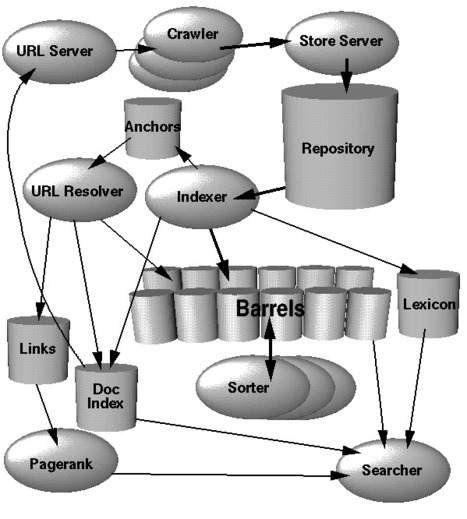
In this paper, we present Google, a prototype of a large-scale search engine which makes heavy use of the structure present in hypertext. Google is designed to crawl and index the Web efficiently and produce much more satisfying search results than existing systems. The prototype with a full text and hyperlink database of at least 24 million pages is available at http://google.stanford.edu/
To engineer a search engine is a challenging task. Search engines index tens to hundreds of millions of web pages involving a comparable number of distinct terms. They answer tens of millions of queries every day. Despite the importance of large-scale search engines on the web, very little academic research has been done on them. Furthermore, due to rapid advance in technology and web proliferation, creating a web search engine today is very different from three years ago. This paper provides an in-depth description of our large-scale web search engine -- the first such detailed public description we know of to date.
Apart from the problems of scaling traditional search techniques to data of this magnitude, there are new technical challenges involved with using the additional information present in hypertext to produce better search results. This paper addresses this question of how to build a practical large-scale system which can exploit the additional information present in hypertext. Also we look at the problem of how to effectively deal with uncontrolled hypertext collections where anyone can publish anything they want.
The Internet is the place where nothing goes to die.
Those embarrassing photos of your high school dance you marked “private” on Facebook? The drunk Instagram posts? The NSFW snapchats? If you use social media, you’ve probably heard a warning akin to “don’t post anything you wouldn’t want your employer (or future employer) to see.”...
Installation performed at La Maison Des Jonglages in La Courneuve (Paris). December 2014.
Boucles sans fin, trajectoires aléatoires, lévitations, etc ; nous nous trouvons face à des actions sur lesquelles nous n'avons pas de prise mais qui, par elles-même, touchent au but. Et l'irréalisable, l'invraisemblable de certaines pièces nous pousse doucement vers la rêverie.
Works from 147 artists contribute in diverse ways to the web-to-print discourse.
Printed Web 3 is currently featured on the front page of Rhizome.org as a browsable Apache directory.
Earlier this year, I announced an open call for the third issue of Printed Web, a semi-annual publication dedicated to web-to-print discourse. I received a stunning array of files from recognized artists like Olia Lialina, Kim Asendorf, and Clement Valla, but the real beauty of the open call was connecting with a new group of people working with material found or created on the web —147 contributors in all. A particularly diverse view of networked culture formed on my desktop through an accumulation of notes, attachments, tweets, and downloads. Gathering this community around Printed Web was immensely satisfying for me, and I wanted to include every submission in the issue — but having received hundreds of PDFs, JPGs, PNGs, and GIFs, the logistical challenges to this have been considerable.
My intention had always been to publish all of the files received in a single print edition, but as submissions poured in, I decided that “scattering” the material across different networked versions would allow the project to occupy multiple positions in a way that suited its multiplicitous content.
Through a U.S. manufacturing partnership with Adafruit and the launch of a new global sister brand called Genuino, Arduino.cc today announces a couple of big moves that address the manufacturing challenges that have emerged for the company over the past few months.
Much of 2015 has seen the open-source board maker defending itself from its former manufacturing partner, which recently claimed ownership of the brand, launched its own Arduino product line and website, and worked to bar distributors from buying Arduino products from other manufacturers.
Pour les adolescents nés avec Internet (souvent désignés de « digital native » ou « génération Y ») l’utilisation massive des terminaux connectés et des réseaux sociaux numériques semble une évidence. Toutefois au-delà des idées reçues, comment l’accès mobile, instantané et illimité au Réseau, façonne-t-il leur perception du monde, leur rapport aux autres, à la connaissance et à la culture ?
Cette rencontre professionnelle réunira les contributions d'artistes, chercheurs, médiateurs et adolescents autour de plusieurs études de cas. L'enjeu est de s’interroger, d’une part sur les pratiques réelles de cette génération, et d’autre part, sur la manière dont les artistes s’en emparent et les mettent en perspective dans leurs créations.
Cette rencontre est proposée par Le Grand Bleu en partenariat avec Pictanovo (avec l’aide de la Région Nord Pas-de-Calais), dans le cadre de l’Eclairage Création Interactive.
Melissa Faithful for Art-Sheep Adam Martinakis is a Polish-Greek artist who combines philosophy and technology in his series of 3D futuristic bodies. Aiming to answer questions regarding the relationship between people and the effect technology has on humans, the digital artist explores the possibilities of these questions, by creating a body -pun intended, of digital, though intimate, work.…
Adam Martinakis is a Polish-Greek artist who combines philosophy and technology in his series of 3D futuristic bodies.
To get content containing either thought or leadership enter:
To get content containing both thought and leadership enter:
To get content containing the expression thought leadership enter:
You can enter several keywords and you can refine them whenever you want. Our suggestion engine uses more signals but entering a few keywords here will rapidly give you great content to curate.


 Your new post is loading...