Media Arts Watch Lab - www.arts-numeriques.info - laboratoire de veille Arts Numériques - twitter @arts_numeriques - @processing_org - @DigitalArt_be - by @jacquesurbanska @_Transcultures
John Maeda, former President of the Rhode Island School of Design, delivers a funny and charming talk that spans a lifetime of work in art, design and technology, concluding with a picture of creative leadership in the future. Watch for demos of Maeda’s earliest work -- and even a computer made of people.
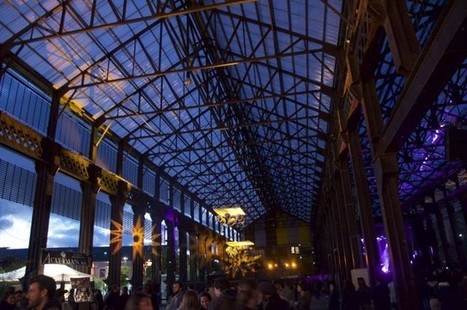
"Je suis parti l'appareil au poing me frotter aux lumières de l'évènement phare de la Digital Week, le festival Scopitone à Nantes."
L’écosystème numérique Nantais est, après celui de Paris, le plus actif et le plus varié de notre bien aimé hexagone. La preuve une fois de plus avec la Digital Week qui s’est tenue du 17 au 27 septembre dernier, sous l’égide de la #NantesTech. Je suis parti l’appareil au poing me frotter aux lumières de l’évènement phare de cette semaine numérique, le festival Scopitone. ...
There is an odd and contingent conjunction of strands dominating the contemporary world. In the first instance, there is the fundamental ungrounding that pervades the world today — that is to say, the collapse of neoliberalism and its attendant hegemony over the social imagination. It is difficult to overestimate how significant this shift is, even if its full consequences have yet to be felt. This leads to the second important strand in our contemporary world: the abyssal void at the heart of alternative political thinking. While neoliberalism has seen its foundations collapse under the weight of its own contradictions, the ground below it remains uninhabited. Movements like Occupy have arisen, but have promoted inadequate localist and horizontalist solutions to global problems. Political science professor Jodi Dean pithily critiqued, ‘Goldman Sachs doesn’t care if you raise chickens’. Meanwhile, mainstream alternatives have remained wedded to obsolete visions of a capitalist golden age, advocating a return to the classical Keynesian economics of the 1960s. This of course ignores the changes in social composition, the changes in technological infrastructure, and the changes in the global balance of power.
Lets explore together “Virtual Reality”, the astonishing and new possibilities offered by the renewing of the medium with the advance of the screens and microcontroller technology and the open source/hardware movement. It gave birth to the Oculus Headset or more recently the OSVR devkit, with open and free tools. For artists, developers or scientists of any field, students : the 6 November : presentation and hands-on workshops. For a more broad public : the 7 November, presentation of artistic and scientific projects using these media.
By examining our minds at a quantum level, we change them, and by changing them, we change the reality that shapes them.
The irrationality of how we think has long plagued psychology. When someone asks us how we are, we usually respond with "fine" or "good." But if someone followed up about a specific event — "How did you feel about the big meeting with your boss today?" — suddenly, we refine our "good" or "fine" responses on a spectrum from awful to excellent.
European Digital Art and Science Network reprises its open call for A Residency at the ESO and Ars Electronica
(Linz, October 16, 2015) For the second consecutive year, Ars Electronica and the European Southern Observatory (ESO) are offering an artist the extraordinary opportunity to spend a residency at the ESO in Chile and then at the Ars Electronica Futurelab in Linz. Prospective participants can submit an application to www.aec.at/artandscience/en/ in the form of a video elaborating on the concrete ideas and projects they aim to develop and the inspiration they hope to derive. The deadline is November 29, 2015. An international jury made up of representatives of all European Digital Art and Science Network member institutions will select the residency recipient. The resulting work of art will be showcased at the next Ars Electronica Festival September 8-12, 2016 in Linz.
In the continuation of their collaborative program on Cultural Heritage in the Digital Age, which started beginning of 2015,iMAL and Packedorganise the first international symposium in Brussels on the issues of preservation of born-digital art and culture and their public access.
In the last decade, digital technologies have invaded on a global scale all realms of our daily life, both private and professional. A large part of today’s cultural and artistic creations are produced with digital technologies, using them as their native medium of expression as well as their medium of distribution on which the users’ experience strongly relies. Born-digital culture is expanding as fast as the progress and availability of digital technologies and infrastructures, and most probably will soon represent the vast majority of all contemporary cultural production...
Crée en 2011 le Kikk Festival de Namur (5e édition du 5-7 novembre 2015) est en passe de devenir l’un des événements les plus en vogue dans le milieu des arts numériques. Et si autrefois, le festival pouvait assumer son étiquette de petit poucet, la donne est aujourd’hui différente. A tel point que la riche et singulière programmation du Kikk, offre une alternative intéressante aux gros événements nationaux comme les Transnumériques ou le Via festival. Une exception dans le paysage numérique.
In 1996, New Radio and Performing Arts, Inc. (NRPA) extended its mandate from experimental radio art to net art and launched its pioneering web site http://turbulence.org/ Turbulence works creatively explore the Internet as a site of production and transmission. This includes work by emerging and established individual artists and collectives. Turbulence has commissioned over 200 works and hosted more than twenty multilocation streaming performance events. As networking technologies have developed wireless capabilities and become mobile, Turbulence has remained at the forefront of the field by commissioning, exhibiting, and archiving the new hybrid networked art forms that have emerged.
Turbulence works have been included in the Whitney Museum of American Art's Biennial ('00, '02, '04), and its Bit Streams and Data Dynamics exhibitions; Total Museum of Contemporary Art, Korea; Ars Electronica, Austria; International Festival of New Cinema and New Media, Montreal; European Media Arts Festival, Germany; and the Sundance Film Festival, among many others. Several have been awarded Prix Ars Electronica.
Turbulence also hosts and exhibits work through its Spotlight, Artists' Studios, and Guest Curator sections, and provides free information about developments in new media through its world-renowned blogs...
This exhibition at ZKM | Center for Art and Media in Karlsruhe, from 03 October 2015 to 01 May 2016, is based on the collaboration with a network of scientists, journalists, activists, and artists in some twenty countries around the world, and in cooperation with expert organizations such as the German PEN Center, the Chaos Computer Club, Reporters Without Borders, and such platforms as netzpolitik. org, digitalcourage.de, WikiLeaks, and others.
The exhibition’s aim is to expand public debate about the ever-present surveillance and censorship methods, which is an urgent priority not only due to constant new reports in the media, but especially because of the extensive obstruction of the investigation of these practices...
Les valorisations des startups dites "technologiques" explosent. Mais ces entreprises - qui pour la plupart ne créent pas de valeur - sont peu rentables et précarisent le travail - devraient bientôt connaître un retour de bâton.
Les politiques monétaires très expansionnistes mises en œuvre depuis la crise financière de 2007-2008 ont un défaut majeur : elles peuvent fausser les prix des actifs. Elles risquent ainsi d'entraîner une mauvaise allocation des ressources disponibles, et d'abord des capitaux. Confrontés à des placements qui ne rapportent plus rien à cause de taux d'intérêt proches de zéro, les capitaux sont lancés dans une course au rendement, coûte que coûte.
C'est vrai des actions cotées, bien sûr, l'évolution des cours ces dernières années ayant été largement soutenue par les flux financiers vers les marchés actions. Mais le coté a ses limites, et même baignés par l'euphorie, les marchés finissent en général par se raisonner sur la base des résultats des entreprises. C'est en revanche beaucoup moins vrai pour tout ce qui touche à l'investissement dans le non-coté. Par construction, on n'analyse pas une start-up comme une entreprise mature, et on ne lui demande pas d'avoir la même rentabilité. Dès lors, le champ des possibles en matière de valorisation est beaucoup plus large... et la porte grande ouverte pour un phénomène de bulle spéculative....
In 2013 MUTEK Montréal launched MUTEK_IMG, a spin-off festival to augment its focus on electronic music by developing a platform that would serve as a dedicated “forum on currrent practiecs in digital creation.” Back with a second edition focused on virtual reality and immersive media, MUTEK_IMG 2015 will consider VR’s possible role as “the next platform in experiential technology” and bring together researchers, technologists, media artists, and related production and distribution companies for a critical consideration of the emerging medium. With a number of VR headsets already available and the long-awaited release of the Oculus Rift due in early 2016, it is an ideal moment to survey the immersive media landscape and consider opportunities for both creation and commercialization.
Taking place on October 1st–3rd at Montréal’s PHI Centre, MUTEK_IMG’s program is broken into three major components: a daylong VR Salon, a VR exhibition, and a symposium foregrounding current topics in projection mapping, hacking, and interactive art in urban space.
Qu’il manipule du code, de la matière sonore, ou de l’impression 3D, l’artiste numérique semble toujours suspect de ne pas « faire » d’art. Cécile Babiole, qui officie depuis les années 1980 sur le front des « nouveaux médias », en sait quelque chose. L’artiste flirte avec les expérimentations sonores comme avec la fabrication numérique tout en ne cessant d’interroger notre rapport aux machines. Nous avons demandé à Sarah Brown, qui l’accompagne pour un projet au long cours intitulé « Machines obsolètes », de livrer un journal de bord de cette création.
Pour Johan Huizinga, historien néerlandais auteur de “Homo ludens”, le jeu est l’essence de toute culture, seul l’élément ludique rend possible l’existence d’une authentique civilisation.
Aujourd’hui le phénomène global de ludification de nos sociétés agit sur l’apprentissage, sur la consommation et sur nos modes de vie. Cette ludification portée par l’avènement des technologies numériques a rendu les frontières de plus en plus poreuses entre les jeux vidéo, leurs mécanismes et “nos vies” au travers de domaines aussi variés que la publicité, l’architecture, la mode, la médecine et l’art.
Comment le transfert des mécanismes du jeu influence-t-il notre bon vouloir ? Le jeu serait-il un objet de pouvoir caché, aliénant notre libre arbitre ? L’industrie des jeux vidéo a contribué avec son développement à l’émergence et la diffusion de nouvelles interfaces technologiques permettant de faire évoluer les claviers et souris vers une relation où le corps humain et ses mouvements sont l’interface. Les différents systèmes de commandes (Wii mote, Kinect, Leap motion, oculus…) utilisent des technologies de pointes, qui étaient jusque-là réservées à l’usage scientifique et à la recherche et qui sont devenues des biens de consommation.
Ces nouvelles interfaces, accessibles à tous, ont inspiré des nouvelles générations d’artistes impliqués dans des réseaux travaillant de façon ludique et spontanée avec ces technologies de masse participant ainsi à la création d’une nouvelle espèce humaine le “Digital homo ludens” qui transforme ces produits en outils de création.
Comment ces interfaces originales orientent-elles les relations homme/machine?
Propulsée par différents complexes militaro-industriels, l’industrie des jeux vidéo nous propose souvent une vision du monde orientée, produisant du divertissement à bas coût. On peut dès lors, émettre l’hypothèse que le jeu vidéo est aujourd’hui devenu ce que Guy Debord dénonçait à propos du “spectacle” “un des “'appareil de propagande de l'emprise du capital sur nos vies”.
Ces espaces virtuels et technologiques sont devenus des territoires à conquérir et à investir artistiquement afin de défendre une certaine “souveraineté technologique” comme définie par Alex Haché. La technologie issue des jeux vidéo offre une “manne providentielle” d’outils et de modes de création pour les artistes. Cette trousse à outils est en évolution permanente, elle rend accessible et utilisable un certain nombre de moyens hardware et software à des fins artistiques. Les artistes qui s’en emparent, transforment alors ce média de masse en l’utilisant à la création d’un nouveau langage. En effet, la “souveraineté technologique” est ici synonyme d’une forme d’indépendance technologique que les artistes mettent en œuvre dans leur pratique. A l’instar de la plupart des média artistiques, le détournement de ces technologies représente une possibilité d’apprendre et de construire son propre monde. Ce désir de compréhension accompagne une volonté artistique de réappropriation du devenir technologique de nos sociétés.
Ces artistes mettent en évidence et critiquent l'influence que peuvent avoir ces mécanismes sur nos vies, à l’inverse du techno-positivisme dominant, valorisant ses différentes propriétés curatives, éducatives, sportives… .
Welcome to the second edition of THE WRONG. A global event hosting + 60 online pavilions, + 40 IRL embassies around the world, featuring the dedication of +90 curators and the work by +1000 artists.
Happening both online and offline, THE WRONG is the largest and most comprehensive art biennale worldwide today, and opens November 1st. 2015 at http://thewrong.org and in IRL embassies around the world.
The 2015 call for entries is closed since Octobre 26. A permanent call for entries replaces it, and enables any individual or organization to enter new submissions to the next programme.
Any individual or organization can submit one or several proposals. The call for entries is open to film, video and multimedia submission, without any restriction for length or genre. Submission is free, regardless of geographical origin. Works proposed to Les Rencontres Internationales must not have been previously publicly shown in Paris.
Please take a few minutes in order to read the FAQ page, it contains important information regarding the call for entries, click here.
In the prophetic 1997 film “Face/Off,” John Travolta figures that the only way to avoid going back to prison was to surgically replace his face with that of Nicolas Cage’s. Although medical science has not really gotten to the point where that isn’t still completely laughable, a new technology out of Stanford University is getting us closer.
Researchers have figured out how to make one person’s face mimic the facial expressions of another, in real-time video. The method, announced in a paper (pdf) that will appear in a special edition of the scientific journal ACM Transactions on Graphics later this year, uses a regular computer, special cameras, and some seemingly magical new software.
An art-historical perspective on interactive media art that provides theoretical and methodological tools for understanding and analyzing digital art.
Since the 1960s, artworks that involve the participation of the spectator have received extensive scholarly attention. Yet interactive artworks using digital media still present a challenge for academic art history. In this book, Katja Kwastek argues that the particular aesthetic experience enabled by these new media works can open up new perspectives for our understanding of art and media alike. Kwastek, herself an art historian, offers a set of theoretical and methodological tools that are suitable for understanding and analyzing not only new media art but also other contemporary art forms. Addressing both the theoretician and the practitioner, Kwastek provides an introduction to the history and the terminology of interactive art, a theory of the aesthetics of interaction, and exemplary case studies of interactive media art.
In an era of fast-paced technological progress and with the impact of humans on the environment increasing, the concept of “nature” itself seems called into question. Bio Art explores the work of “bio artists,” those who work with living organisms and life processes to address the possibilities and dangers posed by biotechnological advancement.
A contextual introduction traces the roots of bio artistic practice, followed by four thematic chapters: Altering Nature, Experimental Identity and Mediums, Visualizing Scale and Scope, and Redefining Life. The chapters cover the key areas in which biotechnology has had an impact on today’s world, including ecology, biomedicine, designer genomes, and changing approaches to evolutionary theory, and include profiles of the work of sixty artists, collectives, and organizations from around the world. Interviews with eight leading bio artists and technologists provide deeper insight into the ideas and methods of this new breed of creative practitioners.
William Myers
William Myers is a writer, teacher, and curator based in Amsterdam. He has worked for the Museum of Modern Art, the Smithsonian Cooper-Hewitt National Design Museum, the Guggenheim, and Genspace, the first community biotech lab in the United States. His writing has appeared in Metropolis magazine, The Architect’s Newspaper, and New York Magazine.
L'humain du futur sera-t-il bardé de puces électroniques ? Pour éviter un scénario catastrophe, une poignée de bidouilleurs augmente déjà l'être humain d'une autre façon.
On l'a tous rêvé (ou cauchemardé), ils l'ont fait. Un être humain peut a présent vivre avec une puce électronique implantée dans le corps, pour toutes sortes de raisons. On imagine d'ici les géants du web (Google, Facebook...) s'intéresser au principe pour aller encore plus loin dans la conniassance et la quantification de ses internautes, mais certain ne le voient pas de cette oreille. Et se battent avec les armes de leurs ennemis.
In 'Continuization Loop', a single 35mm film loop is pulled up and down over more than 150 guiding wheels, creating a wall of film. The frames of this piece of film are only black or transparent. When the loop travels through the mechanism, the image of video static appears.
While film as a medium normally makes images appear through projection in combination with the transport of celluloid through a projector, Continuization Loop omits the projection and makes the image appear by means of the transport only.
The installation combines and imitates visual elements from three generations of visual media: the material aspect of film, the empty signal of video and the binary logic of digital. But at the same time the most important attributes of these media are absent: there is no construction of an illusory filmspace, there is no real video image and there are no computers involved.
SIMULTAN is an annual festival dedicated to media art and artistic experiment, creating a bond between different media...
What would Voyager 3 contain if it would be re-launched today, after 38 years? In 1977, an information package was launched into space, a symbolical selection for the human civilization, launched with the intention to be intercepted or discovered by an alien civilization. A sort of “hello” from the humans, a way of saying “we are here”.
Today, maybe, such a package would contain microchips, texts with smiley faces at a correct decoding. We would probably brag about the invention of a virtual communication system, about our intelligent control systems? Our self-control or the controlling of others. We might also include some e-books about the human nature, on micro-sd cards, because we also advanced our knowledge in the field of psychoanalysis. Why wouldn’t we send a picture of Osama or of other terrorists that we cannot find, maybe they would help us with that. Maybe we could simply send a cry for help, in the hope that in the thousand years that would take them to discover it, there would still be a chance for a few of us to be saved. Or Voyager 3 could be a new Noah’s ark, a capsule of DNA for a possible reconstruction.
In the end, the important thing to know is that we are not alone. And also, it is important to understand how did we end up here. But does it worth the effort? Or wouldn’t it be wiser to enjoy our mere existence and to co-exist peacefully without exploiting each other for the sake of profit, without exercising our power and dominance over each other.
Is this exploitation of others human nature? Is it the engine of progress? Is this evolution? Or is it evolution the creation of virtual realities where we can feed our brains with “01”? Till then, we have other serious problems. Soon the Earth will become overcrowded and under the human influence, the fight for territory drives the species to the verge of extinction. For now, we are preparing a colony to Mars…
But meanwhile art must go on, contemplating and acting, re-acting with our creative means, being aware of the power of now. Hope exists as long as we believe in hope, as long as we believe in our creative power in order to save ourselves and hope for a broader echo.
The BOZAR Electronic Arts Festival (BEAF) offers an opportunity to explore the very best of digital culture. Now a must for fans of the digital arts, the festival includes electronic music, installations, artistic performances, screenings, workshops, and talks. Its beats will resound throughout the Centre for Fine Arts over three whole days. The Centre's main auditorium, the Henry Le Boeuf Hall, usually used to stage classical concerts, will host leading lights of electro, including Apparat from Berlin. An exhibition of works of "Digital Art" will be on display in a number of the Centre's spaces. The Festival's "showpiece" can be seen in the Horta Hall, where the Swiss artist Zimoun presents a monumental work entitled 64 ventilators, 98m² polyethylene foil 0.08mm. The BEAF's multidisciplinary programme, which brings together popular artists and cutting-edge projects, attracts more visitors – keen to discover new sensations – every year. Attendance doubled over three years, to almost 6,000 visitors for the festival as a whole.
To get content containing either thought or leadership enter:
To get content containing both thought and leadership enter:
To get content containing the expression thought leadership enter:
You can enter several keywords and you can refine them whenever you want. Our suggestion engine uses more signals but entering a few keywords here will rapidly give you great content to curate.


 Your new post is loading...