Media Arts Watch Lab - www.arts-numeriques.info - laboratoire de veille Arts Numériques - twitter @arts_numeriques - @processing_org - @DigitalArt_be - by @jacquesurbanska @_Transcultures
Adam Ferriss is a photographer and digital media artist based in Los Angeles, CA. In addition to his artistic practice, Adam runs the photography labs at Otis College of Art and Design. His most recent projects involve creating tri-chromatic color separation photographs and algorithmically restructuring pixel array data.
RIXC is the center for new media culture and artist collective, that initiates projects in intersection of art, science and emerging technologies. RIXC's activities include: production of artworks and innovative art, science and technology projects, organising of Art+Communication festival, exhibitions, publishing of Acoustic Space journal series. RIXC uses events and publications to introduce novelty themes, most recent – renewable energy (2009), techno-ecologies (2011), art of resilience (2012), and fields – contextual seedbeds for social changes (2014). In 2014 RIXC launched first activities for upcoming Riga Innovation Lab – for art and science research and public education projects. RIXC also is a key founder of Liepaja University's Art Research Lab & New Media Art education program. RIXC has extensive experience in network building locally and internationally, and currently is developing Renewable Network – for Baltic-Nordic and Europan cooperation.
History
RIXC was established on May 2000 on the basis of E-LAB (Centre for electronic arts and media, since 1996). The basic activity of RIXC is to initiate the most novel and current topics in digital art by performing innovative experimental projects in art, science and technology in Latvia and internationally. RIXC fosters cultural exchange as well as promotes new forms of cultural and artistic expression. RIXC approaches new media not only as a new field of artistic and cultural practice, but also as an infrastructure to support other forms of art and culture.
Since 2013 RIXC office is located in Spikeri creative quarter for culture and creative industries. RIXC office is the place where RIXC production team works managing projects and administrating RIXC activities.
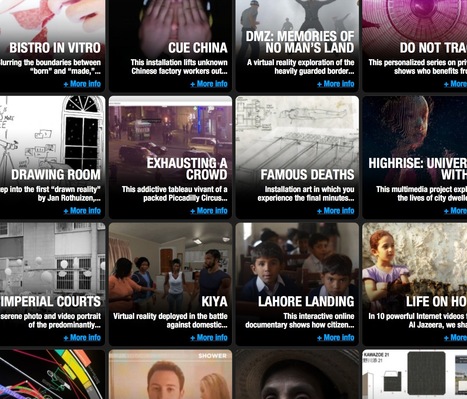
IDFA DocLab is a festival program for new media within the International Documentary Film Festival Amsterdam(IDFA). The mission of IDFA DocLab is to showcase interactive documentaries and other new digital artforms that succesfully push the boundaries of documentary storytelling in the age of the interface. Projects are curated and presented online, as well as during live cinema events, exhibitions, workshops and industry panels.
RealTime's Media Art Archive provides access to reviews, articles and commentaries on an innovative and challenging field of practice from 1994 to the present.
Explore this unique resource covering the work of Australian and international artists via our search facility or a range of non-exclusive categories.
The Pirate Book, A compilation of stories about sharing, distributing, and experiencing cultural content outside the boundaries of local economies, politics, or laws. By Nicolas Maigret and Maria Roszkowska.
Despite being the nation that ostensibly spearheads the war on piracy, the United States was at its inception a “pirate nation” given its refusal to observe the rights of foreign authors. In the absence of international copyright treaties, the first American governments actively encouraged the piracy of the classics of British literature in order to promote literacy. The grievances of authors such as Charles Dickens fell upon deaf ears, that is until American literature itself came into its own and authors such as Mark Twain convinced the government to reinforce copyright legislation....
In a world of drone wedding videos, personalized retargeting ads, YouTube celebritydom and Edward Snowden, the digital is undeniably ubiquitous. Our mental peripheries and dreams, once the dumping ground of real-life daily stresses, are now littered with the memories of ill-advised Snapchats, externalized Instagram personalities and rejected Facebook friendship requests. Art has held a stake in the digital realm for some time—even before the 1980s when Andy Warhol made computer art on his Commodore Amiga home PC. But the last few years have seen a shift in the modalities of contemporary artwork and the establishment of artist communities based solely in the production of art interested in analyzing and critiquing our digital world. A new generation of artists has grown up at a time when media piracy and appropriation are commonplace, and they struggle to gain attention within an intensely saturated global information matrix. While digital art attempts to marry its democratic origins with a desire for legitimacy, a new art biennial has been quietly making waves within the scene, and putting forth challenges to a still-hesitant art establishment.
2015 Prix Net Art Awardee Constant Dullaart discusses "DullTech," "Jennifer in Paridise," and his DVD performances. Video by New Rules (www.newrules.tv).
Ce wiki est la base de connaissance du master en arts numériques organisé à arts². Il est alimenté aussi bien par les professeurs et les intervenants que par les élèves. Et, bien entendu, il est ouvert à toute personne désireuse de collaborer à la création de cette base de connaissance artistico/technique.
Ce wiki est la concrétisation d'une idée: il est crucial de réfléchir aux nouvelles pratiques artistiques induites par leur médium et au rapport à la technologique.
Vous retrouverez donc ici aussi bien du code, des descriptions de dispositifs, des énoncés d'exercices, des résultats de workshops, que des reférences théoriques.
Salon de rencontre entre arts et sciences qui accueille des professionnels autour de propositions au croisement des nouvelles technologies et de la création artistique. L’objectif est de permettre au public de venir tester ces dispositifs d’interface homme machine, résultats de travaux de collaborations entre artistes et scientifiques (dont certains développés à travers l’Atelier Arts-Sciences) ou projets directement issus des laboratoires et instituts de recherche (CEA, INRIA, Centre Multimédia Erasme, Universités). Les maquettes présentées ont ainsi des stades d’évolution différents, du démonstrateur technologique à l’œuvre d’art, en passant par des extraits de spectacles. L’intérêt est surtout de donner aux porteurs de projet l’occasion de présenter eux-mêmes leurs travaux par une illustration directe et partagée autour des installations. Les technologies utilisées se retrouvent autour de deux grands domaines : lumière et énergie, et informatique et numérique. Entre découverte pour le grand public et moments privilégiés de rencontre entre professionnels, cet événement est l’occasion de rassembler créateurs d’arts et créateurs de technologies à Grenoble. Guidés par l’équipe de l’Atelier Arts-Sciences et les étudiants du Master 2 de Communication Scientifique et Technique, les visiteurs sont invités à s’immerger dans la toile lumineuse d’une scénographie évolutive, et – à l’image d’un arbre à souhaits – laisser un CV, un projet, une carte de visite, une trace de leur passage…
Ever since its inception, people have used the technology of the Internet to represent themselves to the world. Sometimes this representation is a construction based on who they are outside the network, such as with a personal webpage or blog. Other times people use the built-in anonymity of the Internet to explore and engage alternative identities. This identity tourism (Nakamura, 2002) takes place within game spaces (e.g. MUDs, MMORPGs), chat rooms, or forums, as well as within those spaces already mentioned such as webpages and blogs. In each case, the underlying technology that facilitates this network society of digital representations is software. How this software is designed by its creators determines the ways that users can (and cannot) craft their online representation.
.
The most popular network space for personal representation is Facebook, the world’s largest online social network. The site has more than 500 million active users and has become the most visited website in the United States, beating out Google for the first time in 2010 (Cashmore, 2010). Facebook functions as a prime example of what Henry Jenkins (2006) calls “participatory culture,” a locus of media convergence where consumers of media no longer only consume it, but also act as its producers. Corporations, musicians, religious organizations, and clubs create Facebook Pages, while individuals sign up and fill out their personal profiles. The information that organizations and people choose to share on Facebook shapes their online identity. How those Pages and profiles look and the information they contain is determined by the design of the software system that supports them. How that software functions is the result of decisions made by programmers and leaders within the company behind the website. ... click to read more
.
Glimpsedome is a digital thought pavilion aimed at displaying written knowledge and contemporary thinking. Understanding digital culture as an on-going construction of a transdisciplinary process, we have brought together different voices coming from the fields of art, philosophy, engineering, design, social sciences, fiction, poetry, activism, critical thought and journalism, to collectively reflect on the trends and trajectories of creativity and culture in the ever-shifting internet paradigm. The pavilion will also act as real-time device to reflect on the events happening at The Wrong Biennale.
Curated by the digital culture researcher Andreu Belsunces, Glimpsedome will gradually feature texts from Ben Grosser, Daphne Dragona, Ramón Sangüesa, Jara Rocha and Femke Snelting, Pau Waelder, Joana Moll, Elena Garnelo, Roxana Fabius, Quelic Berga, Verbatim Veirs, Andrés Colmenares and Lucy Rojas, among others. Nevertheless, Glimpsedome is an open adventure so new texts and ideas are welcomed.
Glimpsedome will extend its activites away from the keyboard through talks, workshops and sessions at Hangar, a centre dedicated to art and research in Barcelona. This will be done through sessions organized by e-rregular, a transdisciplinary research project at the intersection between art, technology and society.
Swimming Pool by Leandro Erlich is an art installation with a permanent home at the 21st Century Museum of Art of Kanzawa, Japan. It has also had temporary installations at MoMAPS1 and the Venice Biennale.
Conceived in 1999, Swimming Pool allows visitors to look down into a seemingly full pool of water with fully clothed visitors walking around the bottom of the pool. From below, the blurry vision of looking up when underwater is recreated using a thin piece of glass with water running over top of it.
Complete with a climbing ladder, swimming pool is a fun and interactive installation that creates the illusion of being underwater whilst remaining completely dry.
Sense data est né de la volonté de créer un blog sur l’art contemporain et les formes expérimentales issues des arts sonores et visuels populaires (musique, cinéma, radio, web). Il souhaite proposer un parcours subjectif dans l’actualité artistique sous la forme d’un carnet de notes, constitué au fil des expositions, des performances et des lectures, avec ce que cela comporte d’arbitraire et de lacune. Il ne prétend à aucune exhaustivité et ne revendique pas un point de vue de spécialiste. Il a pour unique ambition de partager ses enthousiasmes et ses découvertes.
Chaque fois que nous le pourrons, il sera accordé une place primordiale aux arts sonores et en particulier aux installations sonores. Au-delà, ce blog sur l’art contemporain essaie d’être particulièrement attentif aux thématiques suivantes :
_ Les médias entrés récemment dans le champs des pratiques artistiques (vidéo, film, photo, son, numérique, etc.)
_ Les enjeux liés à l’utilisation des images et des archives dans les arts
_ Les rencontres entre les arts populaires et l’art contemporain
Bien que sensibles à la question des technologies, nous ne concevons pas l’art comme une pratique close sur elle-même. Nous souhaitons faire partager une vision de l’art qui ne se restreint pas aux questions formelles mais qui est ouverte sur ce que les oeuvres nous apprennent sur nous-même et sur le monde.
In an era of fast-paced technological progress and with the impact of humans on the environment increasing, the concept of “nature” itself seems called into question. Bio Art explores the work of “bio artists,” those who work with living organisms and life processes to address the possibilities and dangers posed by biotechnological advancement.
A contextual introduction traces the roots of bio artistic practice, followed by four thematic chapters: Altering Nature, Experimental Identity and Mediums, Visualizing Scale and Scope, and Redefining Life. The chapters cover the key areas in which biotechnology has had an impact on today’s world, including ecology, biomedicine, designer genomes, and changing approaches to evolutionary theory, and include profiles of the work of sixty artists, collectives, and organizations from around the world. Interviews with eight leading bio artists and technologists provide deeper insight into the ideas and methods of this new breed of creative practitioners. - Thames & Hudson
World Wide Tours brings you the best website-seeing experience of The Wrong (again) in a nicely curated, exclusive and weekly 5 minute automatic virtual tour. Every Monday a new selection of the finest pavilions, embassies, curators and artists links will be introduced. The tour takes all users to the selected site, where they have the ability to navigate through, looking at the artworks, admiring the scenery, but only for a limited time before continuing to the next.
Powered by arebyte / curated by Nimrod Vardi, Tine Scharffenberg and David Quiles Guillo
Dans ce paradigme numérique, l’usage de termes métaphorique tel que « fenêtre » (window), « ami » (friend) ou encore « corbeille » (recyclebin) sont déjà familiers à la plupart d’entre nous. Mais qu’advient-il lorsque l’on décontextualise des concepts tels que la notion d’ « hyperlien » (hyperlink), unfriend (« retirer de la liste d’amis »), « hashtag » (« ou mot-dièse ou mot-clic ») ou autre déviations linguistiques natives de l’ère numérique pour les restituer à l’univers tangible de la matière ?
En le destituant de sa complexité technologique, une telle stratégie de déplacement permet-elle de questionner ce nouveau médium et son influence sur nos normes quotidiennes ?
From Bits to Paper, Cardboard and ABS propose dans un premier temps une résidence artistique regroupant une sélection de 6 artistes nommés à l’issue d’un appel à projet international.
Directeur de projet et commissaire d’exposition: Filipe Pais En collaboration avec Géraldine Farage
Avec son « Histoire de la modernité sonore », l’américain Jonathan Sterne a lancé un nouveau courant de recherches : les sound studies.
Depuis des années déjà, ce qu’on appelle les visual studies se sont développées dans les sciences humaines et sociales, associant des chercheurs de nombreuses disciplines qui tous ont placé l’image, les images au centre de leurs travaux. L’image, sacralisée dans nos sociétés médiatiques globalisées capables de fabriquer des icônes à une vitesse…supersonique. L’image, donc, a littéralement doublé le son, injustement oublié, notamment par les sciences humaines et sociales. Mais les choses changent et depuis quelques années des bruits se font entendre de ce côté-là, annonçant l’avènement des sound studies, avec notamment la publication d’un livre pionnier, « Une Histoire de la modernité sonore », publié en 2003 et enfin traduit en français, son auteur, Jonathan Sterne est cette semaine l’invité de La Suite dans les Idées.
MECHANICAL TECHNO DEMONSTRATION Made at Lime Wharf Machines Room as part of Rhythm & Drone // Research & Development residency, September 2015. https://rhythmanddrone.wordpress.com/
Microexpressions reveal your deepest emotions, even when you are trying to hide them. Now a machine vision algorithm has learned to spot them, with wide-ranging applications from law enforcement to psychological analysis.
Most people are good at recognizing the ordinary emotions on other people’s faces. But there are another set of facial expression that most people are almost entirely unaware of. In the late 1960s, psychologists discovered that when humans try to hide their emotions, they often display their real feelings in “microexpressions” that appear and disappear in the blink of an eye...
Tor saw the attack coming, but failed to stop it. Law enforcement has been complaining for years about the Web “going dark,” saying that encryption and privacy tools are frustrating their ability to track criminals online. But massive FBI operations over the last year that have busted ‘hidden sites’ used for the sale of drugs, hacking tools, and child pornography suggest the digital criminal world has gotten lighter, with law enforcement bragging that criminals can’t “hide in the shadows of the Dark Web anymore.” While mysterious about its tactics, law enforcement indicated that it had found a way to circumvent the tool on which these sites relied, a software called Tor. But criminals are not the only ones who rely on it.
Michal Brzezinski's main fascination is the way how the world stays in persistent communication process on each of levels of the so-called life. His art is discussing with life definition trying to expand it out of carbon based organisms and his art is kind of visualisation of this idea with the biosemiotics and informatics as background. Affect takes the main place in his direct-theory art process. You can find here embodied cognition and affective interactions, as well as direct cinema, material film and structural video.
Overtoon is a platform for research, production and distribution of sound art and sound-based installation art or experimental media art, directed by Aernoudt Jacobsand Christoph De Boeck. In its Brussels-based studios artists can make use of a workspace in the centre of Brussels, tools which facilitate the production process related to audio and media art, technical expertise, artistic feedback, production and financial support and a broad international network.
Overtoon offers two types of residencies: production residencies and research residencies. While production residents are invited to work in our studios up to a year in order to deliver a work of art that Overtoon will present in its network, research residents can find a spot in our studios for a shorter amount of time in order to investigate an aspect of their work that is related to sound.
Overtoon is supported by the government of Flanders and the Flemish Community Commission in Brussels.
The 9th edition of the Bains numeriques biennial takes part in the 350th anniversary of the Academy of Science and proposes a crossing in the nearby worlds of art and sciences.
During the biennial, Enghien-les-Bains becomes a city where various artistic and scientific visions and imaginations merge. Once more, the biennial attempts to offer to its visitors a path of installations, exhibitions, live performances and concerts all through the city: lake, streets, squares and station. From places of the daily life revisited, the public will be transported in new living areas and venues.
Increased reality, imaginary mappings, immersive spaces, the works presented during these 5 days proposes us new perceptive paradigms. Our representation is modified, that of our body at first, then of the city and the world. By moving the physical marks, immersing in a mental space and experimenting new sensory strategies, the proposed artistic performances will be in connection with the scientific imagination, in particular that of the cognitive sciences..
Moritz Simon Geist is a classical musician and a robotics engineer who builds his own musical instruments and seems to genuinely and tirelessly have fun in the process. The most famous of his creations is the MR-808, an oversized replica of the TR-808 produced by Roland to reproduce drum sounds. This 1980s electronic drum machine imitated the drum so inadequately that it actually created its own sound. The distinctive ‘thump thump’ became an integral part of hip hop music, gained iconic status with Marvin Gaye’s Sexual Healing and reached such a cult position within the music industry that even Kayne West paid tribute to the machine in his hit album 808s and Heartbreak.
Geist’s TR-808 opens up MR-808’s guts and allows us to see how the sounds are mechanically produced. The installation recreates 11 sounds of the TR-808 using mechanical actuators and physical tone generators and displays them inside an oversized wooden replica of the original instrument. ...
"White Rain" is an interactive lighting installation which establishes an emotional atmosphere. Ever-changing rain and physical participation of humans create exquisite scenery. In the space, LEDs and acrylic bars hang randomly in organic forms from the ceiling. The innumerable projected bits of light on the acrylic bars create an image of light with water texture. When participants join in the work, the lights of rain surrounding them become intensive. The lights visually attract participants and become the light source that beautifully illuminates the body. Rain-like lights trickle as the participant extends his/her hand. The light of rain changes its form as time goes by.
TRANSFER is pleased to present the first installation of DiMoDA – ‘The Digital Museum of Digital Art’ in conjunction with The Wrong New Media Biennale.
DiMoDA is a preeminent virtual institution and a virtual reality exhibition platform dedicated to the distribution and promotion of New Media Art. For it’s debut, DiMoDA will be presenting works by Claudia Hart (NY/CHICAGO), Tim Berresheim (DE) Jacolby Satterwhite (NY) and a project by Aquanet 2001 (Salvador Loza and Gibran Morgado) from Mexico City.
The atrium of the museum is architected and modeled in 3D by Alfredo Salazar-Caro. Viewers wear an Oculus Rift to enter DiMoDA, immediately approaching a number of ‘portals’ which can be used to access the ‘wings’ of the museum. Exhibiting artists have complete control to shape the virtual environment in which their works are installed inside the museum. ...
To get content containing either thought or leadership enter:
To get content containing both thought and leadership enter:
To get content containing the expression thought leadership enter:
You can enter several keywords and you can refine them whenever you want. Our suggestion engine uses more signals but entering a few keywords here will rapidly give you great content to curate.


 Your new post is loading...