Media Arts Watch Lab - www.arts-numeriques.info - laboratoire de veille Arts Numériques - twitter @arts_numeriques - @processing_org - @DigitalArt_be - by @jacquesurbanska @_Transcultures
The Art|Sci Center is dedicated to pursuing and promoting the evolving “Third Culture” by facilitating the infinite potential of collaborations between (media) arts and (bio/nano) sciences. The center’s affiliation with the California NanoSystems Institute (CNSI) offers access to cutting edge researchers and their laboratories and a dedicated gallery for exhibitions.
Here too the center hosts the Sci|Art NanoLab Summer Institute for high school students by introducing them to the vast possibilities in the quantum field of art|science for the present and future generations. In cooperation with CNSI, the UCLA School of the Arts and the Department of Design | Media Arts, the Art|Sci Center supports visiting research scholars and artists in residency from around the world.
The center presents lectures, mixers, and symposia to bring artists and scientists together in order to mesh these cultures and inspire individuals to think about art and science as already interrelated and relevant to our society.
The center presents lectures, mixers, and symposia to bring artists and scientists together in order to mesh these cultures and inspire individuals to think about art and science as already interrelated and relevant to our society.
Simply turn it on to transform any space into a free and open communications and file sharing network.
Share (and chat!) Freely Inspired by pirate radio and the free culture movements, PirateBox utilizes Free, Libre and Open Source software (FLOSS) to create mobile wireless communications and file sharing networks where users can anonymously chat and share images, video, audio, documents, and other digital content.
Private and Secure PirateBox is designed to be private and secure. No logins are required and no user data is logged. Users remain completely anonymous - the system is purposely not connected to the Internet in order to subvert tracking and preserve user privacy.
Easy to Use Using the PirateBox is easy. Simply turn it on and transform any space into a free communication and file sharing network. Users within range of the device can join the PirateBox open wireless network from any wifi-enabled device and begin chatting and sharing files immediately.
In case you don't know VVVV already: it's a great piece of software for developing multi media applications using a visual programming language. Click through the VVVV website to get the details.
While the original VVVV runs as desktop application on Windows, VVVV.js tries to introduce all the great VVVV paradigms to the world of web browsers. In plain language this means:
VVVV.js is a Javascript port of VVVV's "runtime parts", which enables your web browser to run VVVV files (or VVVV XML Code) on the client side.
While this sounds just too good to be true, here comes the bummer: besides porting parts of VVVV's internals, all the nodes you want to use have to be ported to Javascript as well. Having in mind, that there are hundreds of nodes for the original VVVV, this is just absurd ... right? But let's just give it a try anyway.
Why?
Because once you're into patching VVVV, textual programming just makes you feel fat and sluggish. There should be a way to develope client side web applications the VVVV way.Because HTML5 with Canvas and WebGL, combined with powerful Javascript interpreters make it possible.Because of a tiny flavour of cross-platform compatibility: VVVV patches on mobile devices, anyone?
Marbling is an interactive mixed reality marbling track and musical composition machine.
Part of the contraption is a display placed in a slightly slanting position. A computer displays marbles on this screen, and they are rolling down. The marbles leave a trace on the screen, and this trace is slowly blurring, creating colorful patterns. These patterns show some resemblance to the images created by the graphical technique called marbling.
Spectators can place two kinds of real, physical objects on the screen: marble sources, and other objects. The virtual marbles bounce against the objects, and new marbles come into existence near the sources.
Whenever a new ball comes out of a source, it is assigned a piano key, and this key is hit on a virtual piano. If a marble bounces, the same piano key is hit. While the configuration is changed by a spectator, the whole installation freezes, and a soft, thin and a bit eerie sound can be heard. If the configuration is changed, and the spectator withdraws his hand, the marbles start rolling again.
Just like my other work, the installation is not a game. No points, no right or wrong, no winners and losers. But you can play and experiment with it, for hours and hours. At least, I can...
In 2012, the Liedts-Meesen Foundation organizes Update_4 in the framework of the project Zebrastraat and following the first three update biennials.
In Update_4, we retained the philosophy of previous editions while putting some new accents. In the past, the exhibitions were associated with the New Technological Art Award Liedts-Meesen that could count on an increasing interest from the artists and the public. Our focus is now on the presentation of participants of the contest NTAA and comprises:
-a larger contribution of new technologies in the arts -an increase in the number of nominees from 10 to 20 -a presentation on three sites instead of only one: the Zebra Street in Ghent, and La Cambre and and iMAL, both in Brussels.
The second part of the event consists of an exhibition by re-known artists in the field of technological art. On each of these sites, two or three well-known works of art will enhance the works of the nominees.
These two activities are substantively broadened with a symposium that will take place on November 15th till 17th. During three days, artists and theoreticians are invited to reflect on the contemporary art in relation to new media and technology, both with private and public moments. The traditional catalog accompanying the Update Award and exhibitions, will be enriched with texts and the proceedings of the discussions in this colloquium. The ceremonies of the jury award and the public award will be held on November 18th. The winners will be announced at the end of Update_4.
Update_4/NTAA Exhibition from September 22nd till November 18th, 2012 - Open from Wednesday to Sunday, 2 till 6 p.m.
"I make images, programming languages, and interactive pieces exploring our inherently broken patterns of thought. I'm interested in how computers expose our inability to think logically, while reinforcing our compulsive and categorical habits -- an aping of logic. This translation back and forth helps me explore the boundaries that make us human while isolating us and distancing us from the world. For more on this, check out this interview on Rhizome (http://rhizome.org/editorial/2012/jun/13/artist-profile-daniel-temkin/) where I talk more about my work."
Science Gallery is a world first. A new type of venue where today's white-hot scientific issues are thrashed out and you can have your say. A place where ideas meet and opinions collide.
Our exhibitions change on a regular basis, and we have loads of new events every week. Visit our events listings to find out what's coming up over the coming weeks. Opening hours change with each exhibition, so go to make sure to check the website to find out the current hours. We're always closed on Mondays.
Unlike most galleries, we don't have a permanent collection. This means that there is always something new to see, but it also means that between exhibitions (which can be a gap of up to three weeks), only our shop and café remain open. So if you are planning to visit an exhibition, to avoid disappointment, make sure to check on our website and check exhibition dates before travelling to Science Gallery.
Throughout each exhibition, we've got events, talks, debates and workshops, giving you a chance to get involved. Exhibitions are free and so are some events.
We all need our own space to think, unwind or to clear or heads; some of us create den’s or man caves to label a spot within our homes to call our very own. What if we were able to go beyond the escapism of a computer, a mouse and an external experience and instead become the interface?
Combining our need for time alone with the advancement of technological features that span farther than our imaginations, would you be intrigued?
The immersive human cocoon is a digital experience that was conceived by a man formally of the MIT Media Lab, John Underkoffer, and its 360 degree prototype was developed by NAU out of Zurich, Switzerland; a dome that is fully equipped with motion sensing software giving you a true 3D experience.
plateforme réunissant une sélection de ceux qui ont retenus mon attention des événements plus que nombreux et bons qui se produisent à Bruxelles (et un peu plus loin)...
The net.art generator automatically produces net.art on demand.
This version of the net.art generator creates images. The resulting image emerges as a collage of a number of images which have been collected on the WWW in relation to the 'title' you have chosen. The original material is processed in 12-14 randomly chosen and combined steps.
The net.art generator was programmed by Panos Galanis from IAP GmbH, Hamburg, and was a commission by the Volksfürsorge art collection.
Pleae visit net.art-generator.com for more informations regarding net.art.generators.
INTACT is an experimental research project in the field of cyberculture, dedicated to the development of teleshared actions by telepresence and the construction of a network of cooperation for telematics shared creation.
The purpose of a teleshared action is to produce a collaborative artwork among two or more users. Sharing through Internet all kind of archives and audiovisual information o sensory through software and hardware, which take and place in common areas diverse artistic manifestations in real time. The result of teleshared action is a creation in co-responsibility (coauthor) among users connected, where each one is -at the same time- client/server (nodes).
The conformation of networks has as a main purpose to promote the discussion and critical thinking around remote creation, and also to enforce the possibilities of new procedures associated to it, and the troubles of actual communication coming from telematics.
Our working domain is the Internet network, through which all the creative proposals related with long distance come together. However, our activities do not only feed from the internet but also, from the different spaces associated to the actions promoted by INTACT. Among these are museums, universities, foundations and art galleries.
Our main collaborators are in Barcelona, Asturias, Toledo y Paris. Furthermore, artists from other cities around the world have worked with us giving their particular vision of understanding the action, they come from Lund, Valencia and Uruguay.
MoTA is a multidisciplinary platform dedicated to the research, production and presentation of Transitory, Experimental and Live Art forms.
As its name indicates, MoTA examines the ideas of museum - what is the role of the museum today and in the future, transitoriness- in either space or time- and art- what is art in relation to life.
MoTA is a museum without physical space. Its programs are realised in different locations and contexts, both in physical and virtual space.
MoTA organizes support actions for transitory art in the form of continuous events, exhibitions and educational programs both locally and internationally.
MoTA's program is happening throughout the year in cities across Europe and beyond.
It is conceived through an open and collaborative approach of international curators and artists and is enriched with in depth research of its yearly theme.
MoTA's approach to artistic production is collaboration. With its methodology MoTA aims at over-coming social differences and exclusive modes of working. MoTA is an artistic-curatorial initiative dealing with themes of contemporary system errors and their consequences (such as virtuality, alienation, loss of identity, hyper-mobility, sexual freedom, media and social violence of all kinds) and strategies to produce ideas, actions and reactions to these errors.
MoTA measures contact with public outside of artistic circles and discussion outside auto-refelective philosophies of artworks.
MoTA is in constant search for the new, the uncertain and the undefined.
Research and recent innovations have led to an amazing increase of types and uses of visual displays and screens; indeed, in our predominantly visual culture, they are everywhere. A typical person carries at least one device with a screen, is presented with them in public places, uses them at work and in many leisure activities. They are so ingrained in our everyday acts and habits that we don’t even notice them anymore.
L.S.D invites its users to engage in a new perception of their daily environment.
L.S.D feeds on light via two LDR (light depending resistor) mounted on a suction cup, allowing the sensors to be mounted on any screen surface. An analogue synthesizer converts the light input to sound waves. This device can be used in many different configurations and feeds from any light sources. Even if L.S.D can be controlled by any light source, its design is aimed at screen reading/listening.
MESO is working on the border line between technology and design — offering an integrated view on digital media system design.
MESO are specialists for innovative and surprising media solutions, with a strong focus on realtime and collaborative systems. In virtual spaces as well as in real space.
MESO is a design team for digital media and media systems. MESO was founded in 1997 by four designers and a computer scientist which shared a strong passion for projects transcending their own discipline. Today MESO looks back on over ten years of design of digital media and media systems. There are to many projects to catch them into one sentence, from complex web applications, multi sensory environments, on air design, interactive stage sets and many more.
The word MESO stems from the Greek word μέσος, which means middle or in-between. So μέσος is the border line between design and technology, the human and the machine.
Performance Saturday, Nov 10th, 20h and Sunday, Nov 11th, 20h Versum is a realtime virtual 3D world that invites both the audience and the composer to look at the music and listen to the visuals.
The virtual world is seen and heard from the viewpoint of a virtual camera with virtual microphones attached, that moves through a 3d space, like in a first person shooter game. Within this space, we can see objects that can also be heard, and like in reality, the nearer they are, the louder we hear them. So when the camera (controlled in realtime) moves past several visual objects, we simultaneously hear several sounds fading in and out. Consequently, the exact path that the composer chooses, determines how melodies and rhythms will be seen and heard. ...
Formation pro : PURE DATA > Temps réel pour les arts de la scène
→ Formation animée par Olivier Heinry du 26 au 30 novembre 2012
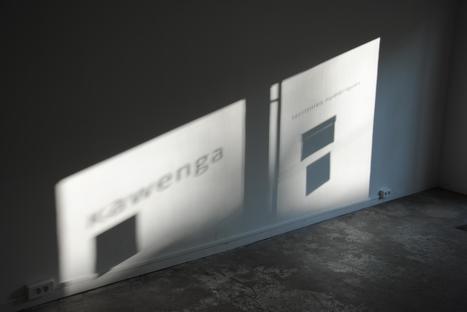
Soucieux de répondre aux besoins liés aux dernières évolutions d'usages notamment professionnels, Kawenga met en place à partir de cette année une offre de formations professionnelles aux technologies numériques pour les métiers de la danse, du théâtre, de la musique contemporaine et des arts visuels.
Formation pro : Interactivité Temps Réel / Initiation à Processing
→ Formation animée par Zandrine Chiri du 3 au 7 décembre 2012
Soucieux de répondre aux besoins liés aux dernières évolutions d'usages notamment professionnels, Kawenga met en place à partir de cette année une offre de formations professionnelles aux technologies numériques pour les métiers de la danse, du théâtre, de la musique contemporaine et des arts visuels.
Formation pro : Processing dans les arts de la scène
→ Formation animée par Thomas Bernardi du 17 au 21 décembre 2012
Soucieux de répondre aux besoins liés aux dernières évolutions d'usages notamment professionnels, Kawenga met en place à partir de cette année une offre de formations professionnelles aux technologies numériques pour les métiers de la danse, du théâtre, de la musique contemporaine et des arts visuels.
Comprendre les arts numériques // Faire des propositions nouvelles à ses publics
→ Une formation animée par Pascal Desfarges à Kawenga les 15&16 mars 2012
A la frontière entre recherche scientifique et artistique, les arts numériques incarnent un mode d’expression en perpétuel mouvement.
l'Institut Supérieur des Beaux Arts de Besançon Franche-Comté en partenariat avec la Rodia scène de musiques actuelles, le Crous de Franche-comté, l'Université de Franche-comté ainsi que le DU art danse et performance, organise les quatrièmes rencontres internationales étudiantes de la performance, les 9,10 et 11 avril 2013.
Comme chaque année, cet événement, premier en Europe dédié à la pratique d'étudiants des écoles d'Art de France et d'Europe, réunira environ 35 artistes sur trois sites. En parallèle de la programmation, des tables rondes et rencontres seront proposés aux artistes avec différents acteurs européens. Mêlant jeunes artsites, jeunes diplômés, étudiants et artistes confirmés, ces "rencontres" ne se développent pas autour d'une thématique mais questionne l'ensemble de la pratique performative.
prise en charge du transport aller-retour et de l'hébergement sur place.
Vous trouverez des archives des éditions précedentes sur le site :
Pour toute candidature : envoi de dossier artistique ou de projet en pdf, et renseignements contacter :
Julien Cadoret (Chargé d'action culturel à l'Institut Supérieur des Beaux Arts de Besançon / Franche-Comté, Commissaire) mail : julien.cadoret08@gmail.com tel : 06.82.39.34.52. Date limite de candidature : 25/01/2013.
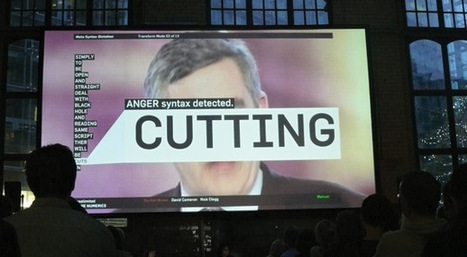
2010 was the first year that the UK Parliamentary elections included American style television debates between the party leaders. The organizers of the FutureEverything festival in Manchester, England had seen footage of our US Debate remix, ReConstitution, and invited us to do something similar for a live audience over there. We have now fully integrated the LIWC text analysis libraries to track things like emotion and self-reference in our software. The show was streamed live, a first for us, on April 29th.
Two Degrees 2011 aimed to reflect world events since the first festival in 2009: failed climate treaty negotiations, financial disasters and government cuts. Protest and activism have hit the headlines, from revolutionary movements in the Middle East to London’s biggest protests for nearly ten years. And away from the mainstream media eye there is a growth of alternative and inspiring solutions to our impending climate crisis.
Sitting between art and activism, performance and protest, 2011's festival was a chance to be part of artist led actions; tell your own revolutionary story, help eradicate an invasive species, go on a mass bingo bike ride, ask an expert about the future or exchange your own personal and political views for a free haircut.
Cityscape 2095 is the result of a collaboration between Yannick Jacquet (AntiVJ) and Swiss illustrator Marc Ferrario aka Mandril. Though using different techniques of expression their work is heavily influenced by architecture.
The core idea of this project was to create a sense of the passing of a day in an imaginary city, in fast-forward.
The spectator would be at the top of a tower, facing a huge “world city”. A mix of various architectural influences were used to create a dystopian city which would feel strangely familiar but also impossible to locate. Thomas Vaquié's sound design helped reinforcing the « disturbing strangeness » element of the city.
This project has been presented for the first time at the Mapping Festival of Geneva 19-29 May 2011.
Artiste multidisciplinaire, Diane Landry réalise ce qu’elle nomme des « œuvres mouvelles », des installations, des sculptures et des performances où s’agite un monde hétéroclite d’objets issus de notre univers quotidien et culturel. Objets qu’elle falsifie et transforme sous l’effet du mouvement, du son, des jeux d’ombres et de lumière.
The European Network of Living Labs (ENoLL) is the international federation of benchmarked Living Labs in Europe and worldwide. Founded in November 2006 under the auspices of the Finnish European Presidency, the network has grown in ‘waves’ up to this day. To this date, 6 Waves have been launched, resulting in over 300 accepted Living Labs. The ENoLL international non-profit association, as the legal representative entity of the network, is headquartered in Brussels, at the heart of Europe.
What is a Living Lab?
A Living Lab is a real-life test and experimentation environment where users and producers co-create innovations. Living Labs have been characterised by the European Commission as Public-Private-People Partnerships (PPPP) for user-driven open innovation.
A Living Lab employs four main activities:
Co-Creation: co-design by users and producers
Exploration: discovering emerging usages, behaviours and market opportunities
Experimentation: implementing live scenarios within communities of users
Evaluation: assessment of concepts, products and services according to socio-ergonomic, socio-cognitive and socio-economic criteria.
ArtistTalk.eu started as a collaborative initiative by three contemporary art and new media centers from Eastern and central Europe (MoTA Ljubljana, CIANT Prague and WRO Wroclaw) to establish a platform for networking, education and exchange between new media and experimental art organisations on a European level. With focus on the importance of education in new media and contemporary art practices,
The ArtistTalk.eu platform gives artists and cultural workers the opportunity to disseminate their knowledge and ideas, increase their visibility and enhance understanding of contemporary and new media art.
To get content containing either thought or leadership enter:
To get content containing both thought and leadership enter:
To get content containing the expression thought leadership enter:
You can enter several keywords and you can refine them whenever you want. Our suggestion engine uses more signals but entering a few keywords here will rapidly give you great content to curate.


 Your new post is loading...