Your new post is loading...

|
Scooped by
Jacques Urbanska
November 12, 2012 10:59 AM
|
OKFestival combined annual events OGDCamp and OKCon to form the first festival of its kind, and was entirely sold out this year. Its 2012 theme was Open Knowledge in Action, looking at the value that can be generated by opening up knowledge, the ecosystems of organisations that can benefit from such sharing, and the impacts transparency can have in our societies. With a bold and experimental programme focused on participation, organised through collaborations amongst over 100 guest planners from around the world leading 13 key Topic Streams from Government Transparency to Open Hardware, we aimed to highlight the true diversity of today’s open knowledge and data initiatives. View the online videostreams today to see how hundreds of change-makers and experts from private, public and community sectors and helped build an international open knowledge ecosystem with us in Helsinki.
|
|
Scooped by
Jacques Urbanska
November 12, 2012 10:48 AM
|
This conference concerns the way the artistic creation and the technological research are now so entangled that any innovation within the one interests and bends the development of the other one.
A virtual actor, a crossmedia circus, intelligent agents and interactive images ... This conference concerns the way the artistic creation and the technological research - areas that were historicaly separated - are now so entangled that any innovation within the one interests and bends the development of the other one. In the new laboratories of art and computer creation (Ircam, Hexagram, Lip6, CNAM, Orange Labs), hybrid works make irreversible the division of the ancient borders setting art and science.
Jean-Paul Fourmentraux is a sociologist, lecturer (HDR) at the University of Lille 3 and researcher at the Ecole des Hautes Etudes en Sciences Sociales (EHESS Paris) at the Raymond Aron Center for Sociological and Political Studies (CNRS)
|
|
Scooped by
Jacques Urbanska
November 12, 2012 10:39 AM
|
A tool for producing electronic music, based on the interaction of the Rubik's Cube, B.A.
http://www.visense.de
|
|
Scooped by
Jacques Urbanska
November 11, 2012 10:14 AM
|
The LINK Center for the Arts of the Information Age is a multi-functional center promoting artistic research with new technologies and critical reflections on the core issues of the information age: it organizes workshops, seminars, conferences and shows, forges partnerships with private and institutional partners, publishes books and networks with similar organizations worldwide. Founded in 2011, the LINK Center acts locally but thinks European. Nomad without physical premises, the LINK Center is a work in progress. It sets out to introduce the “Media Art Center” model into Italy, but with a new vision based on an innovative organizational strategy and cultural outlook. The LINK Center aims to spark artistic reflections on the new technologies and their social and cultural consequences. With the awareness that this is a constantly evolving, developing field, the LINK Center does not set any boundaries in terms of technology or media. It also abandons the traditional sector-based approach of cultural institutions, looking to a more multifaceted interpretation of the term art: visual arts, but also architecture, design (in all its aspects), literature and music. Scientific research and technological innovation are among the key conceptual nodes that guide the work of the center.
|
|
Scooped by
Jacques Urbanska
November 11, 2012 10:00 AM
|
The Machinima Expo is now in its fifth year of celebrating the best of world machinima online. Each November we screen over 50 films, provide panel discussions, interviews and opportunities to meet and learn from filmmakers all over the world. The 2012 Machinima Expo will take place on this website and Second Life simultaneously on November 16-18.
|
|
Scooped by
Jacques Urbanska
November 11, 2012 9:51 AM
|
TouchDesigner is a visual development platform that equips you with the tools you need to create stunning realtime projects and rich user experiences. Whether you're creating interactive media systems, architectural projections, live music visuals, or simply rapid-prototyping your latest creative impulse, TouchDesigner is the platform that can do it all.
|
|
Scooped by
Jacques Urbanska
November 11, 2012 9:31 AM
|
If you've read some of my other articles on this blog you probably know I'm a fan of HTML5. With HTML5 we get all this interesting functionality, directly in the browser, in a way that, eventually, is standard across browsers. One of the new HTML5 APIs that is slowly moving through the standardization process is the Web Audio API. With this API, currently only supported in Chrome, we get access to all kinds of interesting audio components you can use to create, modify and visualize sounds (such as the following spectrogram). So why do I start with visualizations? It looks nice, that's one reason, but not the important one. This API provides a number of more complex components, whose behavior is much easier to explain when you can see what happens. With a filter you can instantly see whether some frequencies are filtered, instead of trying to listen to the resulting audio for thse changes....
|
|
Scooped by
Jacques Urbanska
November 11, 2012 9:24 AM
|
Lorsqu'on parle de réalité virtuelle, la notion d'espace apparaît souvent comme un véritable fer de lance de certaines constructions théoriques utilisées pour appréhender le nouvel objet d'analyse, principalement lorsqu'on fait appel aux notions d'architecture et de structure du cyberespace (1). C'est, pour ma part, en analyste du fait visuel et spatial - tant artistique qu'architectural - que je désire aborder ce problème. En effet, dans la triade disciplinaire histoire de l'art, esthétique, sémiologie visuelle, l'étude spatiale de l'image, de l'objet ou de l'édifice occupe un place prédominante. Des outils conceptuels ont ainsi été développés afin de permettre une meilleure appréhension de la richesse de la réalité «spatialisante» par laquelle s'exprime cette dimension signifiante de la condition humaine.
|
|
Scooped by
Jacques Urbanska
November 11, 2012 9:10 AM
|
Murmur Study is an installation that examines the rise of micro-messaging technologies such as Twitter and Facebook’s status update. One might describe these messages as a kind of digital small talk. But unlike water-cooler conversations, these fleeting thoughts are accumulated, archived and digitally-indexed by corporations. While the future of these archives remains to be seen, the sheer volume of publicly accessible personal — often emotional — expression should give us pause. This installation consists of 30 thermal printers that continuously monitor Twitter for new messages containing variations on common emotional utterances. Messages containing hundreds of variations on words such as argh, meh, grrrr, oooo, ewww, and hmph, are printed as an endless waterfall of text accumulating in tangled piles below.
|
|
Scooped by
Jacques Urbanska
November 10, 2012 11:45 AM
|
The European Media Art Network and its partners provide residencies between April and September 2013 in Mexico, England, Germany, France and the Netherlands with support of the European Commission's Culture 2007-2013 Programme, the Fondo Nacional para la Cultura y las Artes Mexico, the Goethe Institute Mexico, the Centro Cultural Alemán de San Luis Potosí, the City of Utrecht, the Arts Council of England and the regional municipalities of Centre in France.
Mexican based Media Artists in the fields of digital media including internet and computer based art, filmmakers, sound and video artists are invited to apply for a two months artist residency at IMPAKT, Utrecht, Netherlands; Bandits Mages, Bourges, France; FACT, Liverpool, United Kingdom or at Werkleitz Centre for Media Arts in Halle, Germany.
European Artists can apply for a two months residency at Centro Multimedia in Mexico City and Centro de Arte y Nuevas Technologias (CANTE) in San Luis Potosi.
|
|
Rescooped by
Jacques Urbanska
from Artilect Fab Lab Toulouse
November 10, 2012 11:39 AM
|
Rapport de stage (master-recherche)... Les FabLabs ou la RepRap sont-ils vraiment accessibles au grand public ?Que se passerait-il si on appliquait au monde des objets le principe des logicielsopen-source ?On ne pourrait transposer tel quel ces logiques, on peut s’aendre à ce qu’il yest un certain nombre de diérences entre la praque classique et une praqued’open-design.Qu’elles conséquences et changements peut-on observer dans la praque dudesign ? Vers quelles nouvelles praques ?Quels modèles économiques sont viables ?Quel rôle pour le designer si tout le monde a accès aux ouls de producons etpeut fabriquer soi-même ses objets ?Comment s’adapter à la montée en puissance des ulisateurs qui deviennent deplus en plus acteurs ? Comment gérer le transfert de contrôle des designers auxparcipants ?
Via Artilect FabLab Toulouse
|
|
Scooped by
Jacques Urbanska
November 10, 2012 11:18 AM
|
Since January 1990, ArtFutura, the festival of Digital Culture and Creativity, has explored the most interesting projects and ideas that have come up on the international panorama of new media, interactive design, videogames and digital animation. Its activities include exhibitions, conferences, workshops, interactive installations and live performances. Among the festival’s participants in previous editions: William Gibson, Theo Jansen, Toshio Iwai, Laurie Anderson, Hiroshi Ishii, Paul Friedlander, Moebius, David Byrne, Masaya Matsuura, Howard Rheingold, Timothy Leary, Tomato, Tetsuya Mizuguchi, Rebecca Allen, Ryota Kuwakubo, Mariscal, Orlan, Stelarc, Yoichiro Kawaguchi, Brian Eno, Karl Sims, Marcel.lí Antúnez, Arthur Kroker, Xeni Jardin and many others. Also, organizations and companies such as Ars Electronica, Industrial Light & Magic, Weta Digital, Pixar, Sony Pictures Imageworks, Digital Domain, SAT Montreal, Blast Theory, UVA, Amorphic Robot Works or the MIT Media Lab. What is more, the GaleríaFutura division promotes the more exhibitable aspects of new digital creativity. Among its projects there's the large-scale exhibition "SoulsandMachines" at the Museo Nacional Reina Sofía in 2008. Throughout these years, ArtFutura has shown how, at the beginning of this new millennium, art and science are following parallel paths more than ever. It is now impossible to understand art separated from new media, Internet and digital technology.
|
|
Scooped by
Jacques Urbanska
November 10, 2012 11:07 AM
|
Grégory Chatonsky is a prolific French artist using a large array of electronic media, including the Internet, since the early nineties. Among different strategies, he dissects and redirects flows of information, more often than not placing the user in an uncharted territory. In « Ten Words + One Text » he addresses the book form as a sequential medium, conventionally maintaining this specific characteristic, but transforming it simultaneously in something which can’t be followed as a continuous stream anymore.
The original artwork consists of ten close headphones. The first one is broadcasting the first word of a book; the second headphone is broadcasting the second word and so on. Each of them leaves silence between the spoken word, so the whole text is formally properly read but it’s unlistenable in its entirety.
In its web adaptation the author makes all the ten different digital audio files available, which are listenable only one by one. The dissection of the text into words in different channels deals with an established artistic mechanism: dismantling a process while building another one with the same whole content and its basic mechanism, but whose output is irrecoverably unusable.
|
|
|
Scooped by
Jacques Urbanska
November 12, 2012 10:56 AM
|
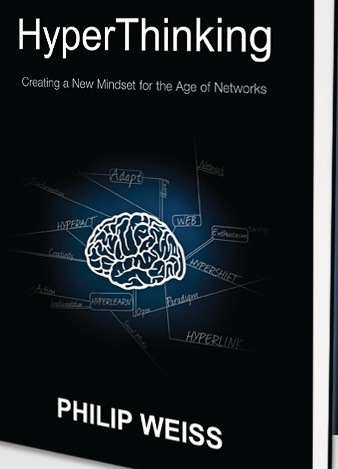
Over the last 14 years of advising leading global companies, author Philip Weiss developed a unique approach designed for the modern executive to adapt and thrive in this age of vast networks, digital communications and perpetual change. The Hyperthinking model is predicated on the assumption that the most important skill required to help you and your organisation grow is the mind-set of individuals. Whilst studying Philosophy, Politics and Economics at Oxford, Philip Weiss launched two college magazines, started the first student radio station on a full FM licence in the UK, and received the Young Achievers Award from HM the Queen. In Brussels he set up ZN, a leading eCommunications agency working with companies, political institutions – like the European Commission and Parliament – and other organisations on how to use the Internet to integrate and transform communication. He works with such household names as Toyota, Microsoft, Sony, Sanofi Pasteur, UCB and various industry associations. His Hyperthinking model was developed to enable the ZN team and their clients manage rapid change and innovation, and to adapt their strategies and structures to the age of networks. In 2010, Philip co-founded TEDxBrussels. He is now Chairman of IABC Europe (International Association of Business Communicators).
|
|
Scooped by
Jacques Urbanska
November 12, 2012 10:42 AM
|
Paul Marique
'Beauty versus Sense' conspiracist.
Art Director currently employed by LBi Belgium.
Visual Artist engaged in Untitled Structure and noussommesquatrevingt collective.
Passionately engaged in Design, Photography and AudioVisual performances
|
|
Scooped by
Jacques Urbanska
November 12, 2012 10:37 AM
|
Le Transdigital cookbook #3 est le nouvel opus d'une publication annuelle dont les thématiques tournent autour du rapport entre Art et Technologie. La thématique de cette édition porte sur les rapports entre Art et Science quatre des nombreux artistes interviewés dans ce numéro : Eduardo Kac, créateur d’un célèbre lapin transgénique vert fluo mais aussi de l’Edunia, un pétunia auquel il a mêlé son ADN et Revital Cohen qui, depuis des années explore le corps post humain, représenteront ici le bioart alors que Kitsou Dubois nous parlera de sa collaboration chorégraphique sur les corps en apesanteur avec la NASA et l’Agence Spatiale Européenne et enfin, le belge Lawrence Malstaf qui travaille sur les notions d’imprévisibilité et de contrôle dans l’intimité et le hasard.
|
|
Scooped by
Jacques Urbanska
November 11, 2012 10:09 AM
|
With the digital medium, Benjamin’s theory about the work of art in the age of mechanical reproduction seems to have reached its dead end. When there is no difference between copy and original, the aura fades and rarity can only be artificially simulated. Yet, is it always true? Playing with Benjamin and Groys, this article shows how, like the mythological Phoenix, aura can resurface in the most replicable digital artifact: the website. COPY AND ORIGINAL On July 8, 1999, the New York Times published a story reporting on a mysterious European activist group, whose practice consisted in copying art websites and publishing them on the address 0100101110101101.org (Mirapaul). The article described this practice as an “attack on the commercialization of Web Art,” yet it was more than that. With their thefts, 0100101110101101.org wanted to state clearly, on the one side, that the Web was- and should always be- the place of free access to knowledge; and, on the other side, that the digital medium finally turned the word “original” into nonsense...
|
|
Scooped by
Jacques Urbanska
November 11, 2012 9:56 AM
|
Alerting Infrastructure! is a physical hit counter that translates hits to the web site of an organization into interior damage of the physical building that web site or organization represents. The focus of the piece is to amplify the concern that physical spaces are slowly losing ground to their virtual counterparts. The amount of structural damage to the building directly correlates to the amount of exposure and attention the web site gets, thus exposing the physical structure’s temporal existence. The project has been active in 9 countries (Ireland, Peru, Brazil, USA, Spain, Canada, Belgium, Germany, The Netherlands) to date.
|
|
Scooped by
Jacques Urbanska
November 11, 2012 9:46 AM
|
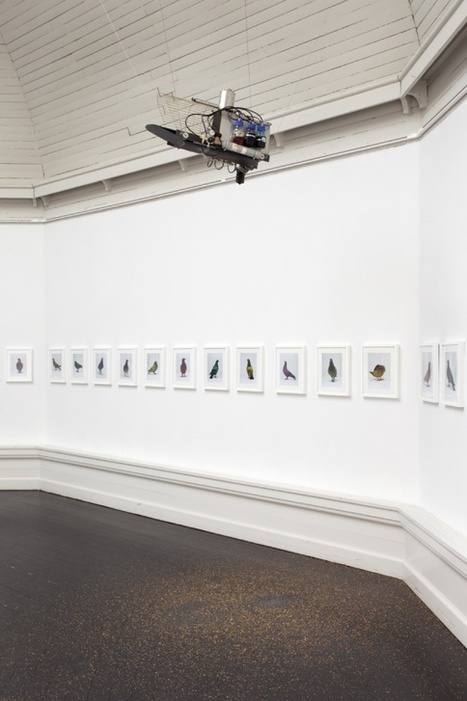
Julien Charriere and photographer Julius von Bismark are authors of this project called "some pigeons are more equal than others", consisting about dying 35 pigeon in the city of Copenhagen. A «pigeon apparatus» was build with this purpose. The machine works as a bird trap with a conveyor belt mechanism, ones inside the machine the pigeon get automatically airbrushed in different colors. The machine was installed for a week on a roof in Copenhagen. Then you could see these pigeons flying around the city. It has also been done in Venice.
|
|
Scooped by
Jacques Urbanska
November 11, 2012 9:27 AM
|
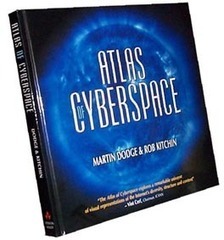
The Atlas of Cyberspace, by Martin Dodge and Rob Kitchin, is the first comprehensive book to explore the spatial and visual nature of cyberspace and its infrastructure. It uses a user-friendly, approachable style to examine why cyberspace is being mapped and what new cartographic and visualisation techniques have been employed. Richly illustrated with over 300 full colour images, it comprehensively catalogues 30 years worth of maps that reveal the rich and varied landscapes of cyberspace. The book includes chapters detailing:
- mapping Internet infrastructure and traffic flows
- mapping the Web
- mapping online conversation and community
- imagining cyberspace in art, literature, and film
|
|
Scooped by
Jacques Urbanska
November 11, 2012 9:17 AM
|
This seminar will introduce the basics of realtime sound synthesis and will introduce participants to the SuperCollider language and architecture along the way. Attendees will learn about sound generators and processors as well as become acquainted with the implementation of synthesis techniques, mainly substractive and granular synthesis.
|
|
Scooped by
Jacques Urbanska
November 11, 2012 4:14 AM
|
With : Mitch Altman, Alexander Asseily, Bart Becks, Yvonne Cagle, Xavier Damman, Alexander D'Hooghe, Dr. Stuart Firestein, Greg Gage, Eri Gentry, Alan Greene, Connie Hedegaard, Tito Jankowski, Peter Jansen, Andrew Keen, Zoe Laughlin, Rudi Pauwels, Irene van Peer, Ben Kestner, Jeroen Raes, Aaron Rowe, Scala, Yasaman Sheri, Dale Stephens, Monte Stettin, Steve Wozniak, Bruno Zamborlin... In the spirit of ideas worth spreading, TEDx is a program of local, self- organized events that bring people together to share a TED-like experience. At a TEDx event, TEDTalks video and live speakers combine to spark deep discussion and connection in a small group. These local, self-organized events are branded TEDx, where x=independently organized TED event. The TED Conference provides general guidance for the TEDx program, but individual TEDx events are self-organized. This year our theme is Bits, Atoms, Neurons, Genes -aka BANG BANG-.
|
|
Scooped by
Jacques Urbanska
November 10, 2012 11:41 AM
|
Open Call for all those creative minds who either wish to change their environment for a couple of weeks and find inspiration in a new surrounding or simple need undisturbed time and/or a space to develop their work. Fundacion Gruber-Jez offers support to all people and institutions involved in contemporary art since 2001 and welcome you to one of the most international creative residency programs in the Mexican area. FundAP offers artists-in-residence the opportunity to live and work in a rural village close to the colonial city of Merida, Yucatan for a period of 1 to 3 months. We offer a residency based program with opportunities for specific projects in sculpture, installations and alternative media. FundAP residency is a unique and inspiring place to explore and expand your creative practice and thinking, produce original works with other creative artists
|
|
Scooped by
Jacques Urbanska
November 10, 2012 11:33 AM
|
Laboratoire de recherche sur les arts numériques et multimédias - Digital Arts WatchLab
Retrouver toutes les news sur Facebook... Find all news on Facebook... with hundreds of FB specific pages liked : structures, festivals, calls, artists...
|
|
Scooped by
Jacques Urbanska
November 10, 2012 11:12 AM
|
Fantastic Futures is a collaborative team of students, artists, doctors, and future leaders from Iraq and the United States. For their recently completed Rhizome Commission, Fantastic Futures created a free and open online sound archive that examines concepts of time through the recording, collaging, and sharing of sounds between these two countries. For these young people, faced with huge questions about their future, the website serves as a platform to subvert unjust structures of power used to divide them by instead supporting each other and offering a means through which their stories might be heard. Their goal is nothing short of social justice and the means of achieving that are slow, steady, and subversively poetic. For this event, which takes place in the New Museum Theater, Fantastic Futures will create a participatory performance of the website, enacted by humans wearing sounds. To further explore shared experiences of time, memory, and trauma between countries in conflict, audience members will be blindfolded for a portion of the event to enhance a synesthetic experience—listening to light. By slowing down, and possibly stopping time altogether, Fantastic Futures’s performance creates a space for careful listening and contemplation. Fantastic Futures is led by Huong Ngo (Hong Kong/United States), Or Zubalsky (Israel/United States), Andrew Persoff (United States), and Ali Salim Abood (Iraq). fantasticfutures.fm
|