


Que ReFaire ? Exploiter l'aura numérique des objets
InternetActu.net
Un objet industriel commence sa vie sous la forme d'un modèle et de schémas de fabrication. Sa fabrication est pilotée et tracée sous forme numérique.
Via frederique

 Your new post is loading...
 Scoop.it! Que ReFaire ? Exploiter l'aura numérique des objets Via frederique 
No comment yet.
Sign up to comment
Scoop.it!

The idea described in the final project was something, about control emmited signals and receibe the echo to proces it an convert in an haptic sensation, mainly in form of vibration.
see also the scoop.it : http://www.scoop.it/t/sbei-instrumento-electro-acustico-de-ultrasonidos-para-percibir-el-entorno
Scoop.it!

« Les langues sacrées ont laissé lire leur vocabulaire perdu ; jusque sur les granits de Mezraïm, Champollion a déchiffré ces hiéroglyphes qui semblait être un sceau mis sur les lèvres du désert, et qui répondait de leur éternelle discrétion ». Cette phrase de Chateaubriand tirée des Mémoires d’Outre-Tombe rappelle comment la mémoire d’une civilisation peut rester inaccessible. L’histoire de l’Egypte antique est ainsi restée murée dans les hiéroglyphes pendant 14 siècles. Avec le numérique, sorte d’espéranto mondial apporté par l’informatique, un tel phénomène semble devenu définitivement impossible. En réalité, la situation de l’archivage des quantités astronomiques de données produites par la société d’aujourd’hui pose d’autres problèmes tout aussi ou parfois encore plus épineux que celui auquel s’est confronté Champollion. Avec le risque suprême de la disparition de la pierre de Rosette salvatrice. ...
Scoop.it!
Silence is gone from today's urban spaces. Noise pollution is produced, 24 hours a day, 7 days a week. We can close our eyes, but our ears are always open. Unnatural sound disrupts the activity and balance of human or animal life. Noise in a range of low frequencies is imperceptible by our ears, but is sensed by the whole body. This unheard sound becomes part of our everyday life.
Scoop.it!
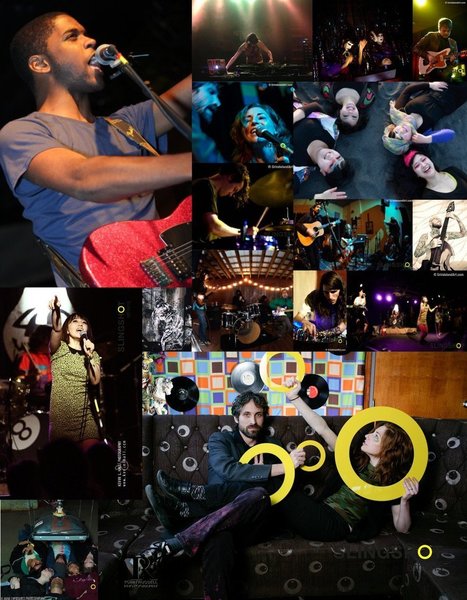
The new Festival of Music, Electronic Arts and Tech in Athens, GA, Takes over downtown March 21-22, 2014. Spread over 4 city blocks, SLINGSHOT spotlights international, national and local acts on stage, boundary pushing artwork throughout the urban environment, and a tech conference with leading tech innovators.
The first SLINGSHOT happened in March 2013 and featured 70+ bands and artists from 20 countries around the world.
Come experience Athens' biggest, smartest party!
Scoop.it!

Nearly three years ago we published a story about Kenji: the ‘third generation humanoid robot.’ Kenji was an alarmingly unique robot – he was capable of the robot equivalent of love. The article further stated that Kenji developed intense feelings for a young female intern at the lab, and had to be deactivated. Other web news outlets picked up on this story – Gizmodo, IGN, The Next Web all published articles on Kenji’s adventures. ... Nearly three years ago we published a story about Kenji: the ‘third generation humanoid robot.’ Kenji was an alarmingly unique robot – he was capable of the robot equivalent of love. The article further stated that Kenji developed intense feelings for a young female intern at the lab, and had to be deactivated. Other web news outlets picked up on this story – Gizmodo, IGN, The Next Web all published articles on Kenji’s adventures.Read more at http://realitypod.com/2013/08/an-update-on-kenji-the-robot-programmed-to-fall-in-love/#HfxY9s5gFzhcqUJ6.99Nearly three years ago we published a story about Kenji: the ‘third generation humanoid robot.’ Kenji was an alarmingly unique robot – he was capable of the robot equivalent of love. The article further stated that Kenji developed intense feelings for a young female intern at the lab, and had to be deactivated. Other web news outlets picked up on this story – Gizmodo, IGN, The Next Web all published articles on Kenji’s adventures. Read more at http://realitypod.com/2013/08/an-update-on-kenji-the-robot-programmed-to-fall-in-love/#HfxY9s5gFzhcqUJ6.99Nearly three years ago we published a story about Kenji: the ‘third generation humanoid robot.’ Kenji was an alarmingly unique robot – he was capable of the robot equivalent of love. The article further stated that Kenji developed intense feelings for a young female intern at the lab, and had to be deactivated. Other web news outlets picked up on this story – Gizmodo, IGN, The Next Web all published articles on Kenji’s adventures. Read more at http://realitypod.com/2013/08/an-update-on-kenji-the-robot-programmed-to-fall-in-love/#HfxY9s5gFzhcqUJ6.99
Scoop.it!

Le robot humanoïde iCub sur lequel travaille depuis de nombreuses annéesl’équipe dirigée par Peter Ford Dominey, directeur de recherche CNRS dansl’unité Inserm 846 « Institut pour les cellules souches et cerveau de Lyon »(Inserm, CNRS, Université Claude Bernard Lyon 1) est dorénavant capable decomprendre ce qu’on lui dit et d’anticiper la fin d’une phrase. Cette prouessetechnologique a été rendue possible par la mise au point d’un « cerveauartificiel simplifié » qui reproduit certains types de connexions dites« récurrentes» observées dans le cerveau humain. ...
Scoop.it!

Even though Red Burns was one of the most influential figures in the tech industry over the past 30 years — most famous for co-founding the groundbreaking Interactive Telecommunications Program (ITP) at NYU, and in a sense, the beginnings of interaction design — it’s not uncommon for technophiles to have never heard her name. Two weeks ago, she passed away. But much more needs to be said about one of the smartest, gutsiest women I ever knew, and about what she thought about education, technology, design … and life. Red wasn’t particularly interested in IPOs or the latest tech fetish, even though she was always exceptionally proud of her students and their accomplishments. She knew that technology was a means to an end — and that the end was people. ...
Scoop.it!
Process and Processing – Nicholas presents recent work and explains how he has come to rely on Processing in his projects.
Nicholas Felton is an infographic designer. He is the author of several Personal Annual Reports that weave numerous measurements into a tapestry of graphs, maps and statistics to reflect the year’s activities. He is the co-founder of Daytum.com, and is a member of the product design team at Facebook. His work has been profiled in publications including the New York Times, Wall Street Journal, Wired and Good Magazine and has been recognized as one of the 50 most influential designers in America by Fast Company. He is credited for influencing the design of Facebook's timeline.
Scoop.it!

Le collectif néerlandais Metahaven, qui conçoit le design graphique comme un outil politique, questionne la transparence sur Internet.
Metahaven, collectif de designers basé à Amsterdam, opère sur le fil entre politique et esthétique. Fasciné par les recoins obscurs du réseau, ce studio singulier fondé par Vinca Kruk et Daniel Van der Velden, qui répond à nos questions, utilise le design graphique pour questionner le pouvoir de l’image à l’ère d’Internet.
Pour le festival du graphisme de Chaumont, ils ont réalisé une nouvelle œuvre, Nomadic Chess : Geography (photo, à gauche), jeu d’échecs grandeur nature pavant le sol de la Chapelle des jésuites. L’échiquier est constitué de carreaux en skaï sérigraphié, dont les motifs s’inspirent de l’iconographie pop du Web, créant un intrigant dialogue visuel avec les ornementations baroques de l’église. Il met en scène les protagonistes d’Internet et les luttes de pouvoir qui s’y trament : Amazon, Facebook, Google versus Anonymous, WikiLeaks, communisme versus hyperindividualisme, anonymat versus popularité, censure versus liberté d’expression. A la fois jeu et sculpture, les carreaux amovibles peuvent être portés comme un habit et se propager dans le monde physique. ...
Scoop.it!

On September 6th, a Nomadic Happening will leave the East Coast for the West by train. A changing cast of artists, musicians and creative pioneers will collaborate in site-specific events at station stops and onboard. You can be a part of it right here. Meet the participants. See our inspirations. Contribute art.
Scoop.it!

FB Resistance is a research initiative and hands-on workshop series to rethink and change the frame that Facebook is setting for us.
Facebook is defining our identity and social interactions in digital space. The code is the law (A quote by Lawrence Lessig). What would you do if you could change it? This workshop shows you how. Let's inspire each other and work on concepts to alter Facebook.com!!
Scoop.it!

Peintures murales, vidéos, performances, installations in situ… Les oeuvres du musicien et plasticien Jérôme Poret ont pour caractéristique commune de matérialiser les ondes sonores.
Alexandre Castant. Comment décrirais-tu le «mobile» esthétique de ton travail, qui se situe à la croisée du rock alternatif, du post-punk et des musiques industrielles et électroacoustiques?
|
Scoop.it!

a python script waits for tweets containing selected hashtags. when a tweet is detected, an OSC message containing the number of characters is sent.
twitter monitoring is done through tweepy , while OSC messages are sent using liblo. Source code is available here. Sadly, twitter autentication methods are quite complicated, and this application needs a code in order to run. I can not share this code with no one. Until I find a way to store this key in an unreadable way, this code is just proof of concept. If you really want to use it, you need to register your own application. ...
Scoop.it!
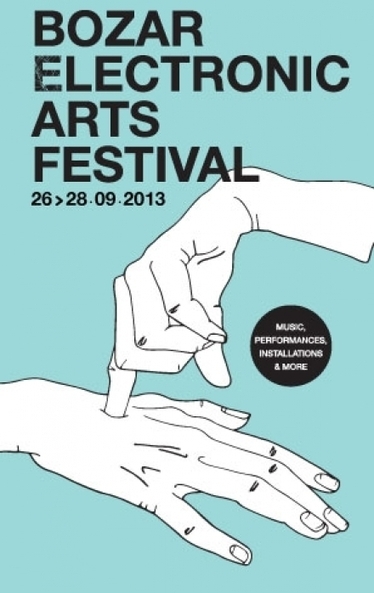
Le BOZAR ELECTRONIC ARTS FESTIVAL (BEAF), événement annuel unique en Belgique, propose pour sa deuxième édition trois jours et nuits consacrés aux cultures électroniques. Qu'il s'agisse de musique, d'installations audiovisuelles, de performances ou de workshops, le festival entend faire découvrir les artistes qui font vivre ces disciplines aujourd'hui.
L'édition 2013 du festival proposera une programmation musicale portée par Modeselektor, Jon Hopkins, Juan Atkins & Moritz Von Oswald, Regis, Vatican Shadow et Silent Servant, un focus sur le label berlinois PAN et bien d'autres, une collaboration musicale axée sur le dub avec l'Ancienne Belgique, et aussi de nombreuses installations et créations "arts numériques" notamment en collaboration avec le festival québécois ELEKTRA, invité de ce BEAF 2013. Les différents espaces du Palais des Beaux-Arts s'ouvrent à nouveau pour une immersion totale dans les cultures digitales.
Scoop.it!
Birth and death are only a rewind button away. This is a world where meaning is found in a videotape. That videotape can be both rewound and fast forwarded, endlessly replaying the best events again and again. Will the physical world eventually be subject to the same rules?
This sculpture is made possible via a system of armatures similar to those one might find within the prehistoric animal exhibits in a natural history museum. They will differ in that they will be mechanically driven and allow for varying positions of the broken marble pieces. A system of electronic drives, stepper motors, ballscrews, linear shafts and computer software similar to what one might find in a high-tech assembly plant provides the movement.
Both the irony and beauty of this sculpture will ultimately lie in the question, “Has this sculpture successfully cheated death, entropy and time?” We have become accustomed to the ability to pause the video, finding a frame just before the moment of death or just as we please. In a similar fashion, I wish to make a sculpture that cheats death and time. ...
Scoop.it!

Online works from or-bits.com are translated to print form in a project that conceptualizes the book as interface.
One of the most intriguing things about On the Upgrade, a series of publications resulting from the activities on online exhibition platform or-bits.com, is the way it considers shifts in formats. At first look, the book series seems like a kind of flexible archive. The web-based projects of or-bits.com are reflected in printed form in the books: artists who contribute to the publication are those who participated in the various online projects of or-bits.com. And the book is used as a way to disseminate, document, or expand the work within a different scheme.
But the transition from online to print is not always seamless. In the introduction to WYSIWYG, the latest On the Upgrade publication which came out in May, the book is described as "a new configuration of the works." While some of the online pieces are more amenable to the book format (Julia Tcharfas’s research, presented in typewriter typeface, looks natural in print in a way that would always look precious online), others are distant cousins of their online iterations (a transcription of a live online radio piece by Sara Nunes Fernandes). ...
Scoop.it!
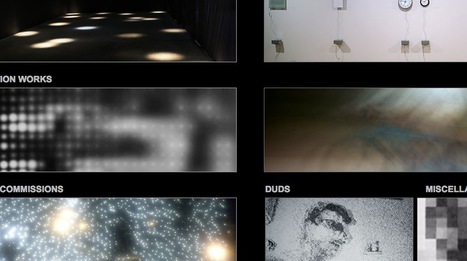
Jim Campbell est né en 1956 à Chicago, en Illinois. En 1978, il obtient des diplômes en génie électrique et en mathématiques du Massachusetts Institute of Technology à Cambridge. Il vit et travaille maintenant à San Francisco, en Californie. À titre d'ingénieur, Campbell détient plus d'une douzaine de brevets d'invention dans le domaine du traitement de l'image et il travaille présentement à des produits reliés à la télévision haute définition dans un laboratoire en Californie.
À l'origine cinéaste, Campbell s'est tourné vers la science après plusieurs années de travail sur un film personnellement éprouvant à propos de la maladie mentale. Il a finalement combiné sa formation en art et en science et, en 1988, il commence à créer des installations interactives en utilisant ce qu'il nomme des « dispositifs électroniques fabriqués sur mesure » conçus spécifiquement par l'artiste pour chaque installation. Ses œuvres d'art électroniques ont été présentées dans des musées aux États-Unis et en Europe, notamment au San Francisco Museum of Modern Art, et au Arizona State University Art Museum. ...
Scoop.it!

Les données, comprises comme un ensemble de signes traduits sur un support à accès non-linéaire, sont une nouvelle catégorie de phénomènes dans notre quotidienneté. Modifiant profondément notre accès et notre conception du monde, notre façon même d’agir dessus, nous cherchons des moyens de les représenter. Nous sommes entourés de données mais elles restent la plupart du temps illisibles même si nous les manipulons et les utilisons dans l’ensemble de nos activités de travail et de loisirs.
Si nous ne sommes qu’au balbutiement de ce nouveau mode de représentation, il faut en remarquer l’originalité. Qu’est-ce donc que ces images? Sont-elles abstraction ou figuration? Comment entendre la différence qui pourrait séparer la visualisation de la représentation dans son sens classique? La visualisation des données a pour objectif de rendre sensible, en un clin d’oeil, un grand stock de données et donc de transformer ces unités discrètes en une perception qui tend vers la plus grande continuité possible. Le flux turbulent des données binaires est traduit en aplats, formes, lignes et flèches afin de rendre compte, non pas de chaque unité mais des mouvements de différence entre elles. La visualisation des données est donc différentielle. À cette fin, la visualisation des données ajoute des données aux données, car elle en est elle-même constituée. ...
Scoop.it!

APREM est une plate-forme qui offre des expertises et donc des points de vue différents aux intervenants et publics présents. Son principe fondateur étant de connecter et mettre en commun les connaissances à partir des « spécialités » de chacun. Adoptant une perspective artistique à la fois interdisciplinaire et du lien social comme cadre d'analyse d'une époque de bouleversements, l'enjeu d'APREM est de faire se rencontrer des artistes d’un nouveau genre (et en devenir) capables d’explorer les chemins croisés de la théorie critique, de l’art, de la technologie et de l’activisme (hacktivisme).
Scoop.it!
L'entrepreneur Elon Musk est un homme avec de nombreux projets. Le fondateur de PayPal, Tesla Motors et SpaceX discute avec Chris Anderson, administrateur de TED, et partage les détails de ses projets visionnaires qui incluent une voiture électrique grand-public, une compagnie de location de panneaux solaires et des fusées totalement réutilisables.
Elon Musk is the CEO and product architect of Tesla Motors and the CEO/CTO of Space Exploration Technologies (SpaceX). Full bio »
Scoop.it!

The list of tips contains in brackets indices designating combinations of media and functions.
Scoop.it!
Grégoire Chamayou vous présente son ouvrage "Théorie du drone" aux éditions la Fabrique.
Scoop.it!
Fragmented Memory is a triptych of large woven tapestries completed in May 2013 in Tilburg, NL at the Audax Textielmuseum’s Textiellab. The project uses digital practices and processes to blur the lines between photography, data visualization, textile design, and computer science. The result are works of visual art that serve not only to render visible the invisible processes mediating everyday experience, but also to operate as distinctly tactile and lo-fi digital storage media—the process becomes a means to capture, record, and transmit data.
A snapshot of my computer’s physical memory was extracted in a core dump (using OSXPmem). Three selections of the binary data were converted to images using custom software written with the help of Jeroen Holthuis in Processing which grouped 6 bits into RGB pixel color values (2 bits per channel). The resulting 64 hues in the images were then mapped to a custom woven color palette created by mixing 8 colors of yarn using variations on a satin weave. The resulting patterns were then woven on a computerized industrial Jacquard loom. Because of the direct mappings from binary data, to image, and from image to woven pattern, it’s actually possible to decode the original binary data sourced from my computer’s physical memory. In fact, a key to the binding patterns is provided on the back of each piece. Textiles have long been used as a medium for imagery but are also closely connected to the development of automation and computer technology. Fragmented Memory collapses these two histories, functioning as a visual and physical medium for the storage and transmission of digital information.
More: http://phillipstearns.wordpress.com/fragmented-memory/ http://glitchtextiles.com
Scoop.it!

Le site web GridFlow (2011-12, reynalddrouhin.net/works/gridflow/) agrège sous forme d’une mosaïque les images d’articles dont les flux RSS sont enregistrés. Quiconque peut ajouter le (ou les) flux de son choix afin d’alimenter la grille. Le projet donne ainsi à voir une tranche de temps sans début ni fin, tel un rhizome, et révèle l’humeur du temps («Zeitgeist») par l’accumulation ou la répétition d’éléments marquants dans l’actualité du net.
La fresque subit les assauts des vagues de mises à jour du flux, créant le remous et la perpétuelle recomposition de la grille. Celle-ci, mouvante, semble prendre vie ; elle dessine un ruban infini d’images qui se déroule tout au long du mur. La mosaïque telle qu’elle est à présent n’est déjà plus : « carpe diem » permanent, elle est par essence éphémère, par la rapidité d’affichage des images et leur disparition.
A tout moment, il est possible de générer une archive grand format, Capture d’un instantané de la grille, et de figer ainsi la mosaïque comme un ensemble, la verrouiller entre deux instants.
|






