Media Arts Watch Lab - www.arts-numeriques.info - laboratoire de veille Arts Numériques - twitter @arts_numeriques - @processing_org - @DigitalArt_be - by @jacquesurbanska @_Transcultures
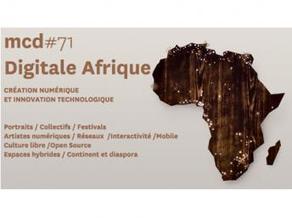
C’est le fruit de dix ans de travail. Chef de projet et auteur multimédia, basée depuis dix ans à Dakar, Karen Dermineur a dressé un état des lieux des différentes pratiques de la création numérique en Afrique. En tant que rédactrice en chef invitée d’une édition spéciale de mcd, elle a établi la première cartographie de l’Afrique digitale affichant toutes les tendances artistiques dans ce domaine : installations, art vidéo, photographie numérique, NetArt, art sonore jusqu’aux festivals, plateformes, blogs, FabLabs… Entretien. ...
In 1989, two Melbourne teenage hackers known as Electron and Phoenix stole a restricted computer security list and used it to break into some of the world's most classified and supposedly secure computer systems. So fast and widespread was the attack, no-one could work out how it had happened - until one of the hackers called The New York Times to brag.
Ten years after their arrest, this dramatised documentary uncovers not only how they did it but why. It takes us headlong into the clandestine, risky but intoxicating world of the computer underground.
Transnomades is a series of interdisciplinary, prospective and friendly events, initiated by Transcultures, Centre of digital and sound cultures and the culture service of Saint-Gilles since 2011 that promotes creative meeting between artists from different cultures that explore innovative digital practices.
This festival edition proposes in four locations of Saint-Gilles (Maison du Peuple ; Cutlural Centre Jacques Franck, Maison des Cultures, Atelier du Web), a focus on the connected arts in their diversity and the launch of the Mobile Awards (performance, installation, emerging talents, public awards...) on the occasion of la quinzaine numérique of the Federation Wallonia-Brussels.
Launched by transcultures on the occasion of la Quinzaine Numérique, mobile awards intend to stimulate digital creativity by giving it visibility. Further to a call for proposals, different mobile prizes - performance, installation, emergence, audience - rewarding arts network projects, from Belgium and abroad will be presented as part of those Transnomades 2013.
Transcultures launches the spamm.be platform (in partnership with spamm.fr - Super Art Modern Museum), a web space dedicated for new art forms that use the network as a creative material, accompanied by a critical corpus. A first selection of introductory works (co-curation: systaime, digital artist, founder of spamm.fr)
Kill Your Darlings shows the transformation of our teenagers as beautiful little darlings into cruel little devils.
This transformation shows how digital culture has changed how we think about privacy, bullying and the use of real-time media.
Internet has given everybody his or her own channel to talk to the whole world. Whose actually listening is not always important of even known. More importantly Twitter has made thoughts, opinions and in a bigger context, social relationships, freely available for everyone to enjoy.
Kill Your Darlings shows us the ‘private’ social circles of young teenage girls. Here we can see everything, look past their perfect, pretty and cute profile photo’s and see their not so perfect and often shocking tweets that they use to publicly insult, offend and abuse. Kill Your Darlings uses small LCD-keychains shaped in the form of a little heart to show this content. Each individual heart shows a picture of a young teenage girl only to be followed up by one of her most hateful tweets that completely shatters her own ‘perfect’ image. ...
Soundscape generated naturally by the passage of air through the strings and by its set in motion light filaments, that touch , in a stochastic way, the instruments. What you can hear is a universe unique and uncontrollable and at the same time uniform and harmonious: stillness in motion.
Blowjob born by the natural development of two themes: the first is based on building self generative soundscapes and sculpture, the second is based on archetypal sounds, those sound marks that could be deeply recognized in a trans-cultural way by human beings. Among these there is surely the wind and its ability to animate what it skims: "... the answer my friend is blowing in the wind ..."
In February 2012, the Department of Homeland Security was forced to release a document previously requested - and denied - via the Freedom of Information Act containing a list of hundreds of keywords regularly queried for the purpose of monitoring suspicious activity on social networking sites. Subsequent news headlines about this disclosure warned that the list contained "hundreds of words you shouldn't use online if you don't want to end up on an FBI watch list".
In response to this call for "sensible", precautionary self-/censorship, I am proposing to build my own Department of Homeland Security website that monitors and archives the use of these targeted 374 keywords on popular social networking sites. The information collected will be made available to the public through homelandsecurityhearts.us as both a 24 hour live stream (phase 1) and in archival form (phase 2). The latter option will include print-on-demand services, allowing users to compile data into periodic volumes for any combination of keywords they wish to access.
My goal is to build a system that is scalable, using a combination of public and private channels (i.e. using both public API keys and data brokers) for gathering information. I will focus on developing the programming infrastructure to handle mining one of these networks at a time. At a later stage, I hope to expand processing capabilities to both increase the volume of information mined and to include a wider cross-section of relevant social media sites (phase 3). I am currently working on phases 1 and 2, which will focus exclusively on Twitter.
Introduction au live painting avec processing et le leap motion. dessiner le tracé de votre doigt en toute simplicité. Le leap motion est un nouvel outil pour tous les geeks et fans d’interactivité. Il permet de capter avec une grande précision la position et les mouvements de vos mains et doigts. Pour plus d’information, je vous invite à visiter le site officiel : www.leapmotion.com ou visionner simplement la vidéo officielle d’introduction...
“Beyond New Media Art” is the revised, updated version of a book first published in Italian with the title “Media, New Media, Postmedia” (Postmedia Books, Milan 2010). Through the circulation of excerpts, reviews and interviews, the book produced some debate outside of Italy, which persuaded the author to release, three years later, this English translation.
“Beyond New Media Art” is an attempt to analyze the current positioning of so-called New Media Art in the wider field of contemporary arts, and to explore the historical, sociological and conceptual reasons for its marginal position and under-recognition in recent art history. On the other hand, this book is also an attempt to suggest new critical and curatorial strategies to turn this marginalization into a thing of the past, and to stress the topicality of art addressing the media and the issues of the information age.
From the book’s preface: “So what is New Media Art? What does this term really describe? And what has occasioned the schism between this term and the art scene it is supposed to describe? And lastly, what accounts for the limited presence in critical debate of an artistic practice that appears to have all the credentials for representing an era in which digital media are powerfully reshaping the political, economic, social and cultural organization of the world we live in?”
Domenico Quaranta is an art critic and curator. His work focuses on the impact of the current techno-social developments on the arts. He regularly writes for Flash Art and Artpulse. In 2006 he edited (with M. Bittanti) the book “GameScenes. Art in the Age of Videogames”; in 2010, he published the book “Media, New Media, Postmedia”. As a curator, he organized various shows, including “Holy Fire. Art of the Digital Age” (Bruxelles 2008, with Y. Bernard), “Playlist” (Gijon 2009 and Bruxelles 2010) and “Collect the WWWorld. The Artist as Archivist in the Internet Age” (Brescia 2011; Basel and New York, 2012).
Studio NAND explores interactions between society, science and technology using design as a methodology to craft engaging experiences, stories and visualisations.
They consult and work with private and public sector organisations with the aim to identify new ways of using design and upcoming technologies. Their clients include major corporations, cultural organisations and research institutes, such as the German Telekom, Cultural Olympiad, and Disney Research Pittsburgh. Their work has been recognised internationally at the Siggraph Emerging Technologies Exhibition, the MoMA New York, the Venice Biennale, ARS Electronica and the Beijing Design Week, amongst others.
Une analyse intéressante de Nicolas Bole (Le Blog documentaire) sur les différentes typologies de narration. Où l'on réalise qu'il reste encore certainement des pistes à explorer.
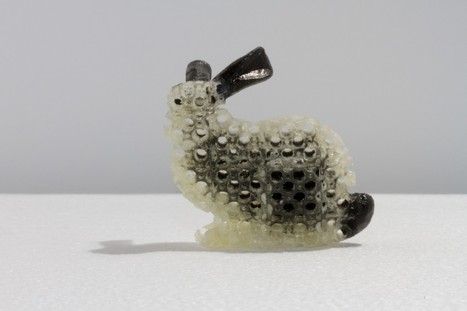
Although 3D printing technology has progressed in leaps and bounds in recent years, most printers are still only capable of printing a solid object out of a single material. That's fine if you want to produce a plastic object with the same density throughout, but what if you want to use multiple materials in the one object or alter its internal architecture to vary its density and therefore its flexibility? A team at MIT's Computer Science and Artificial Intelligence Lab (CSAIL) has developed a new software pipeline that makes both these things possible.
Bizarre ? Des humains qui jouent avec des robots, des machines qui voudraient devenir humaines, l’humanité du 21eme siècle consomme et possède des outils qui désirent maintenant apprendre, la réalité et le virtuel n’ont jamais été aussi proches. Dieu ne serait t il qu’une équation ? L’homme augmenté sera t il la future norme ?
Le festival GAMERZ revient pour sa 9e édition à Aix-en-Provence du 10 au 20 octobre 2013. Cette année, plus de 50 artistes internationaux présentent des installations multimédia dans 4 lieux culturels de la ville.
Artistes, professionnels de la création issus de différents réseaux européens se joignent au festival pour proposer au public un circuit d’expositions entièrement gratuit qui, au-delà des aspects récréatifs et culturels, éveillent des réflexions sur les métamorphoses de notre société.
Interventions époustouflantes, concerts improbables, conférences participatives et rencontres professionnelles alimenteront une programmation riche et novatrice à la frontière des arts et des technologies en téléportant le public au cœur de ces nouvelles formes d’expression.
Held annually since 2007, CYBERFEST is the first and biggest festival for technologically based art in Russia. This year, it will be held in Berlin from 12 to 17 November. Cyberfest13: “Time & Place” will unite top innovators from around the world with the exhibit “Paradigm Shift”. The festival is curated and managed by The WYE run by Leah Stuhltrager, an international art and technology hub spanning 2000 m2 of the historic Post building in the heart of Kreuzberg, Berlin. An incubator for local and international innovators, the space serves as a platform to elevate professionalism and exchange between the Art and Tech industries in Berlin.
La reconnaissance artistique internationale de France Cadet s’est appuyée sur les présentations de ses robots chiens. Les petits animaux de compagnie produits par Silverlit Toys Manufactory à Hong-Kong ont été démontés, reconstruits, reprogrammés. Ce travail particulier a été régulièrement exposé dans des festivals internationaux autour des nouveaux médias tels qu’Ars Electronica, Exit, Sonar, Emoção Artificial... et aussi dans des instituions plus traditionnelles, galeries ou des musées d’art contemporain (CAAC à Séville, la galerie Quadrum à Lisbonne, la galerie Pascal Vanhoecke, le Palais de Tokyo à Paris) ou encore dans des foires (ARCO à Madrid, ART PARIS et SLICK à Paris). L’exposition personnelle qui se tient à Marseille à l’Espace Ugot, jusqu’au 27 septembre, se prolongera par une autre à la Galerie Susini à Aix-en-Provence, du 10 au 20 octobre (festival des arts multimédia : Gamerz #9). ...
TodaysArt has been presenting programs focused on adventurous contemporary visual and performing arts, architecture and digital culture annually since 2005. The ninth edition unfolds in the former ministry of interior and kingdom relations (Binnenlandse Zaken) building – part of a municipal complex of over 124 000 square metres – on September 27th and 28th.
The festival brings international acts and artists to the city of The Hague, treating visitors to outstanding performances and works in a program that includes a large number of world and European premieres and exclusive shows. Next to the former ministry building the festival takes place in the City Hall and the surrounding public spaces.
The Analog Particle Screen attempts to imitate the visual appearance of computer animated particle systems. Computer animated particle systems use physical simulation to produce natural movements of particles. They imitate physic laws and their effects on particles. In his work, Robert Mathy wants to reverse this workflow. He uses real physic laws and particles to simulate the visual appearance of computer animations.
The work exists of a table with a screen on the tabletop. Small grains are located in between of two acrylic plates. An algorithmic driven matrix of van der graff generators placed under the screen causes the plates to get charged with electrostatic energy. This causes the particles to move, build swarms, attract and repeal from each other. The audience can interact with the particles by disturbing the electrostatic field when they touch the screen.
Pour sa 8e édition, SHOW OFF confirme sa place de 1ère foire des arts numériques. La foire revient dans les lieux de ses premières éditions : l’espace Pierre Cardin. Fidèle à son engagement en faveur de l’émergence et de la jeune création, SHOW OFF se concentre sur les arts numériques et les nouvelles pratiques artistiques qui en découlent. A la fois panorama de la création numérique actuelle et vitrine pour les jeunes artistes, cet événement sera aussi l’occasion de soulever les problématiques liées à cette pratique artistique lors d’un cycle de conférences.
Rendez-vous du 21 au 23 octobre 2013
Après-midi réservé aux professionnels le 21 octobre de 16h à 18hVernissage public le 21 octobre de 18h à 22hOuverture au public les 22 et 23 octobre de 12h à 21h
Espace Pierre Cardin : 1-3 avenue Gabriel 75008 Paris
Whereas it's true that the avant-garde artists and writers of the 20th century served a variety of artistic, social and political purposes, The Artist 2.0 is historically canonized in the Museum of Glitch Aesthetics as a collaborative and pseudonymous creative force whose collective body of works, though limited in number, have been able to employ networked and mobile media communication strategies unavailable to his radical predecessors. According to online curator and performance artist Margot Kittler, the main aesthetic strategy of The Artist 2.0 is to create “an alternative dream world of inclusion where a utopian collective, comprised of networks of like-minded artists and intellectuals, use all available new media technologies to intervene in and/or disrupt global capitalist flows.” The fictional personae who drive the energetic activity that powers these networks often turn to what Kittler refers to as “glitch aesthetics” as a way to undermine “the predictable protocols of exclusion” found in the upmarket commodity culture generally associated with the art market. According to Kittler, “artists like 2.0 are on an aesthetic mission to disrupt mainstream perceptions of how these art market venues stage faux objective standards in determining the aesthetic value of a work of art.” ...
Il manque au monde numérique des intellectuels critiques. Tel est le constat qu’un professeur de théorie politique américain, Henry Farrell (@henryfarrel), dresse dans le dernier numéro de la revue Democracy.
Pourquoi est-ce important ? Parce dès que vous vous intéressez au numérique, vous découvrez une petite constellation d’intellectuels, américains ou travaillant aux E-U, qui tiennent le haut du pavé. Ils s’appellent Nicholas Carr, Clay Shirky, Ethan Zuckerman ou encore Jeff Jarvis. Ils tiennent des blogs très lus, écrivent des livres à succès, participent à toutes les conférences importantes, et la moindre de leur analyse fait le tour des réseaux du monde entier. Alors quand quelqu’un avance que ces intellectuels ne sont pas critiques, ça nous intéresse jusqu’ici, dans notre vieux pays.
Qu’est-ce que Farrell reproche à tous ces gens ? Eh bien tout simplement de fournir un emballage vaguement intellectuel aux idées qui servent les grandes entreprises du numérique. L’attaque est rude, mais Farrell l’étaye.
Daniel Palacios creates machines that can scan and visualize the flow of visitors, objects that communicate with their viewers by means of artificial intelligence, or images that represent what happened in an specific moment and space. Viewed in terms of form alone, they are interactive artworks consisting of complexly functioning machinery with scarcely comprehensible software components.
Beyond such technical aspects, however, the artist’s works are stirring inasmuch as they are concerned with extremely human, philosophical questions, about perception, memory, time and space. The fascination of Palacios’ works derives from such intuitively comprehensible spatial images and experiences, as well as the discrepancy between technical precision and a subjective reproduction and perception of reality.
His installation “Waves” is open in the framework of the City Sonic sound itinerary at the Salle Saint-Georges from 7 to 21 September 2013.
Graphical notation and composition by Candas Sisman Barabás Lőrinc: Trumpet Ölveti Mátyás: Cello Candas Sisman: Electronics and Objects
Budapest Art Factory (BAF) is pleased to present to you SYN-Phon; sound performance based on graphical notation by Candaş Şişman featuring Barabás Lőrinc & Ölveti Mátyás. Candaş Şişman resided at BAF for the month of June as part of its cross-cultural fertilization residency program. SYN-Phon will be exhibited to act, as a visual linguistic delivery through a cogitation segment followed by the sound performance on June 29th.
LaLibrairie du Jeu de Paume & Leonardo/Olats ont le plaisir de vous inviter à rencontrerKaren O'Rourke, artiste et maître deconférences à l’Université Paris 1 - à l'occasion de la parution de son livre Walking and Mapping: Artists as Cartographers avec la participation du duo d'artistes Esther Polak et Ivar van Bekkum.
Contemporary artists beginning with Guy Debord and Richard Long have returned again and again to the walking motif. Debord and his friends tracked the urban flows of Paris; Long trampled a path in the grass and snapped a picture of the result (A Line Made by Walking). Mapping is a way for us to locate ourselves in the world physically, culturally, or psychologically; Debord produced maps like collages that traced the “psychogeography” of Paris. Today, the convergence of global networks, online databases, and new tools for location-based mapping coincides with a resurgence of interest in walking as an art form. In Walking and Mapping, Karen O’Rourke explores a series of walking/mapping projects by contemporary artists. Some chart “emotional GPS”; some use GPS for creating “datascapes” while others use their legs to do “speculative mapping.” Many work with scientists, designers, and engineers.
This semester I’m working as a research assistant to Alex Ruthmann at NYU. The job includes helping him with a new joint music education and music technology class, Designing Technologies & Experiences for Music Making, Learning and Engagement. Here’s the bibliography. The central class project is to create a music education technology experience — a lesson plan or classroom activity, a piece of software or hardware, or something outside those categories.
Everyone in the class has to maintain a blog documenting their design process. (Wouldn’t it be cool if every teacher of everything had their students blog about their class work?) My music education experience design is going to be my thesis, which I’m already blogging about. So instead I’ll use these posts for some public-facing note taking.
Most existing technology for music teaching is, shall we say, not good. Software designed for the pros is too difficult for novices. Even Garageband is too complex. The stuff for beginners is too often boring drills with a thin layer of game on top, exercises lacking musical context and any intrinsic motivation for playing. It’s rare for music ed tech to be tested in the classroom. The complexity of the classroom environment does make it hard to do conclusive tests that control for all the confounding factors, but anecdotal and qualitative observations are better than nothing.
All teachers are really experience designers — the experience is whatever takes place in the classroom. And experience designers are de facto teachers, whether they realize it or not. Interface metaphors, presets and defaults are all lessons that need to be learned. ....
Neural is a printed magazine established in 1993 dealing with new media art, electronic music and hacktivism. It was founded by Alessandro Ludovico and Minus Habens Records label owner Ivan Iusco in Bari (Italy). In its first issue (distributed in November 1993) there was the only translation in Italian of the William Gibson’s Agrippa (a book of the dead) book.
You can also subscribe to the magazine Digital Edition accessing all issues since #29. Or you can buy the magazine from the closest of the almost 200 stores stocking it. A back issues pack is available.
To get content containing either thought or leadership enter:
To get content containing both thought and leadership enter:
To get content containing the expression thought leadership enter:
You can enter several keywords and you can refine them whenever you want. Our suggestion engine uses more signals but entering a few keywords here will rapidly give you great content to curate.


 Your new post is loading...