Media Arts Watch Lab - www.arts-numeriques.info - laboratoire de veille Arts Numériques - twitter @arts_numeriques - @processing_org - @DigitalArt_be - by @jacquesurbanska @_Transcultures
Year Zero One is a media arts collective committed to the production, development and distribution of electronic media art through net based projects and site-specific public art exhibitions.
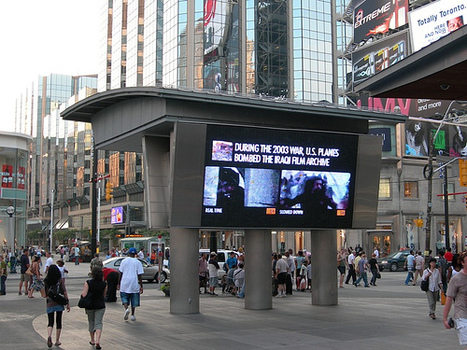
[YZO] is a non-profit media arts organisation committed to the production, development and presentation of electronic media art through networked exhibitions and site-responsive projects in public space. Founded in 1996 by Toronto based media artists Michael Alstad + Camille Turner, YZO established a Canadian node in a network of international sites that fostered the emergence of net based art practice in the 90’s. Throughout this time YZO has produced dozens of large-scale projects including the first exhibition of electronic art at Pearson International Airport, and early creative explorations of public urban screens and geographic information systems. YZO continues to produce and support new and hybrid forms of artistic practice – particularly art that intersects new technologies with architectural and public space and cultural applications for mobile devices.
Le temps est désormais révolu où l’on considérait Internet comme un « gadget », un « phénomène de mode » ou un épiphénomène qui ne concernait qu’« une petite élite de jeunes hommes occidentaux plus quelques informaticiens venus d’ailleurs ». À l’instar de la presse écrite, du cinéma, de la radio ou de la télévision, il paraît légitime de se demander comment cette technologie – qui reste toujours « nouvelle » – interagit dans la communication entre les hommes et les formes d’organisation de la société. ...
Processing est un langage de programmation simple pour la création multimédia : création visuelle, modélisation 3D, design d’interaction, art génératif, développement…
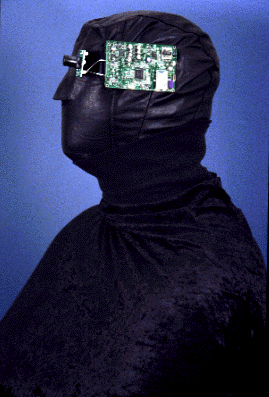
- (according to definitions found in literature) Represents an assemblage of human-machine with partial artificial intelligence, with prostheses and artificial organs which, if they become damaged, can be replaced through the organ bank.
- (from the encyclopedia) a CYBernetic ORGanism, a combination of human and machine the result of the advance of technology in the 20th century, especially in cybernetic science.
- (film) New human whose body functions and some motor functions have been enhanced. Great specter of possibilities for the replacement of organ functions (i.e. implantation of biochips, reinforced sensors, prosthetic additions).
The cyborg is, deep at the heart of the subject, a universal question that has interested humankind throughout all of history. It is one of the visions for immortal and improved life. Some people say that even if they were to give up all their body parts and just keep their mind inside a machine they would accept it for eternity. This project won't go so far, but perhaps the visitors might.
collaborative knowledge space for media art, culture and media technology and an infrastructure for media art production...
netzspannung.org is a platform for interactive art and media art education. Netzspannung.org has been online since 2001, and defines itself as a tool for researching, reflecting upon, and imparting electronic culture. The platform for the › theory and practice of media art offers over 2,500 work descriptions, texts, images and videos for the purpose of interdisciplinary education in › art, › designand › informatics. Every month, between 100,000 and 150,000 international visitors take advantage of the cost-free access to over 200 hours of › lectures and › experimental teaching and learning modulesfor schools and universities.
The .GIFYS are the first ever awards honoring the animated GIF as a medium, social commentary and art form. GIFs in categories ranging from celebrity cats to news and politics were selected by our expert nominating panelists, and then we invited the internet to vote on the most GIFtastic in each category. Winners are immortalized on our website, finally giving GIFs their rightful glory.
Cette introduction dans sa version pré-éditable (préprint) met en perspective les travaux de recherche du tandem E. A. Amato / E. Perény et les apports originaux de chacun des auteurs ayant contribué à l'ouvrage collectif paru chez l'éditeur scientifique Hermès Publishing-Lavoisier France
Le sommaire est repris à la fin de ce qui constitue l'équivalent d'un article, afin de permettre au lecteur de resituer la présentation des différents chapitres.
Qu’elles se muent en galerie éphémère, donnent lieu à des expos, films ou performances, ces forteresses dédiées au stockage de données numériques inspirent les artistes.
A 18 heures, au 58, boulevard Lefebvre, dans le XVe arrondissement de Paris, vendredi 10 janvier. Une petite foule, qui prendra une proportion critique au cours de la soirée, est agglutinée devant le bâtiment de briques rouges en travaux, attendant l’ouverture des portes. «Merci de ne pas faire pipi contre les murs, il n’y a pas de toilettes en bas, il faut remonter au -1», plaisante une responsable du lieu où se déroule l’exposition : un abri antiatomique situé à 26 mètres sous terre.
Construit en 1949 dans un vide de carrière sous le laboratoire central des Ponts et Chaussées et classé secret-défense jusqu’en 1982, il est abandonné l’année suivante. Deux longs escaliers de béton à double révolution plongent dans le sous-sol, éclairés à l’aide d’un puissant groupe électrogène. Les murs recouverts de tags rappellent que si elle est peu connue du grand public, l’adresse fut pendant longtemps un terrain de jeu pour les cataphiles et explorateurs urbains. Telle la vidéaste Raphaëlle Uriewicz, initiatrice de l’exposition avec Alexandre Réty, qui se déploie dans les 1 500 m2 du terrier, transformé en galerie d’art numérique éphémère. Les artistes et musiciens ont investi les vingt-six alcôves alignées le long d’un couloir étroit, illuminé par les projections et installations. ....
Experimenta is Australia’s preeminent media arts organisation, dedicated to commissioning, exhibiting and touring the best Australian and international contemporary media art.
We operate on a biennial model: launch in Melbourne every two years and then tour that exhibition across Australia during the next two years. We also partner with some of Australia’s leading cultural organisations to present additional exhibitions, projects and events.
Since 1986, Experimenta has transformed public spaces, exhibition venues and corporate environments into captivating, interactive, and thought provoking destinations. From large-scale outdoor installations to intimate and extraordinary indoor exhibitions, the artworks shown worldwide by Experimenta are always evocative, intriguing and uniquely multi-sensory.
Each biennial exhibition brings with it new opportunities for commissioned artists to realise significant and ambitious art works. These opportunities include financial, professional development and industry support from Experimenta. Experimenta’s past commissioned artists have exhibited internationally, been acquired by major public and private collections, attracted lucrative public commissions and received significant commercial success.
Experimenta’s commissioned artists also contribute to the Australian component of the biennial exhibition. These exhibitions continue to be at the forefront of contemporary new media art, delighting audiences of up to 50,000 during a four week season. Exerimenta exhibitions confirm Australia’s place at the forefront of technical and artistic innovation.
In addition to Experimenta’s core exhibition program is a responsive suite of pop-up, festival, public and commercial projects. Consulting for some of the worlds most cutting edge organisations Experimenta presents a unique media art experience within public spaces, residential developments and commercial enterprises.
De la matière au code, du bit à l'atome / Les arts plastiques à la lumière du numérique
Adrien Lucca, artiste et enseignant à l’ENSAV-La Cambre
Dans quelle mesure une pratique artistique contemporaine peut-elle à la fois s’inscrire dans le champ traditionnel des arts visuels (dessin, peinture, sculpture, installation…) et dans celui des arts dits « numériques » (interactivité, capteurs, programmation informatique, modélisation…) ?
• Lundi 14h-16h • Janvier 20, 27 / février 3, 10 • Soirée de présentation mercredi 15 janvier 18h30-20h • Séance 8 € / 6 € - cycle : 30 € / 20 €
We wanted to create a device that makes content accessible anywhere in big, to share real life moments. Freeing content from its container, its small screen or plastic box will open a whole new world of possibilities, of experiences and enable people to dream and let their imagination go wild. KEECKER is all about being creative and open: users will love the simplicity and we hope developers will create genius applications for it.
Eduardo Kac was born in 1962 in Rio de Janeiro (Brazil). In the early eighties, he cultivated a career in performance art, presenting a series of weekly public performances. One such event took place in 1982 on Ipanema Beach during the 60th anniversary of Brazil's Week of Modern Art of 1922.
In 1989, Kac headed to Chicago, Illinois (USA), to study at the School of the Art Institute of Chicago where he earned a master of fine arts degree the following year. Kac is now a Ph.D. research fellow at the Centre for Advanced Inquiry in Interactive Arts (CAiiA) at the University of Wales in Newport, Wales, and an assistant professor of art and technology at the School of the Art Institute of Chicago. He has exhibited extensively all over Europe and North and South America and received many prizes and awards, including the Leonardo Award for Excellence,ISAST in 1998 and the Inter Communication Center (Tokyo) Biennial Award in 1999.
Kac began his artistic career as a traditional performance artist but eventually moved on to investigate technology artistically through an exploration of poetry. After becoming dissatisfied with the unidimensionality of the printed word, Kac turned to holography. In 1983, he coined the term "holopoetry" to describe his three-dimensional floating texts and thus began an intense relationship between artistic practice and the possibilities of technology. Works created during this time include Holo/Olho (Holo/Eye) (1983) and Chaos (1986). From there, he moved on to telecommunications art and in 1986 produced his first telepresence work with remote-controlled robotics. ...
La Bibliothèque nationale du pays projette de mettre à disposition des internautes l'ensemble des écrits norvégiens depuis la fin du XVIIe siècle. Un programme permis par la signature d'accords très progressistes avec les auteurs et les éditeurs.
What kind of robots does an animator / jazz musician / roboticist make? Playful, reactive, curious ones. Guy Hoffman shows demo film of his family of unusual robots -- including two musical bots that like to jam with humans. (Filmed at TEDxJaffa.)
project inspired by the acoustic mirrors, a military defence system for listening to the sky created between the two world wars. The project is constructing two new sound mirrors – one in England and one in France. The new mirrors will face each other across the English Channel, and will enable the French and the English to speak across the sea. (ongoing since 1998)
Standing silent and abandoned, a series of isolated and mysterious concrete structures line the south east coast of England. Known locally as “listening ears”, these structures are vestiges from great inter-war acoustic experiments that took place in both England and France - early acoustic warning systems against the possibility of an airborne invasion across the English Channel.
The acoustic mirrors tilted their faces to the sky and collected sound in giant concrete dishes. They were operated by trained listeners who endured cold nights at their listening posts, entombed in concrete bunkers, or high on listening platforms in front of the mirrors, to pick up distant noises from the sky. The acoustic mirrors were never used in wartime - the invention of radar and the increasing speed of aeroplanes rendered them obsolete within ten years of their erection.
Almost seventy years later, these now forgotten experiments have become the focus and the inspiration for an an attempt to re-invent this redundant technology for the 21st Century.
Artport is the Whitney Museum’s portal to Internet art and an online gallery space for commissions of net art and new media art. Originally launched in 2002, Artport provides access to original art works commissioned specifically for artport by the Whitney; documentation of net art and new media art exhibitions at the Whitney; and new media art in the Museum’s collection.
Theometrica is a sound sculpture that explores the relation of ethnologic geometric visual graphics and synthesis sound generation.
Inspired by acupuncture, a traditional chinese medicine technique based on the insertion and manipulation of needles, this sculptural instrument is designed to control sound elements in real time by fixing specific pins into a spinning disk. Furthermore, its interface design represents an active space where geometrical constellations are being decoded into sound events.
Three main factors has been taken in consideration for the object detection. In one side a regulated motor turns the disk in relation to a performing required speed, contributing in the definition of the temporal distribution of the sound events in the course. In the other hand, by stablishing a target line which detects the position of the needles and its sequenciation using a rangefinder sensor, proximity is translated into data which is recieved from a computer using serial communication and running a visual-programming software patch (Max/MSP or PureData). By stablishing a communication in between visual space relationships and performatic abilities, data flows are sonified following specific aesthetical and usability criterias.
The development of this prototype starts a research process which aims to explore the correlation between sacred geometry, probability and synthesis sound generation, with a focus in performance.
Cet espace présente toutes les informations à destination des artistes et des écrivains qui souhaiteraient entamer une collaboration avec l'Observatoire de l'Espace du CNES.
L'Observatoire de l'Espace accompagne, à travers son programme Création et Imaginaire Spatial, des artistes et des écrivains qui manifestent un intérêt pour le monde de l'espace dans leur travail de création.
Silo 468 is a permanent light art piece that will transform an abandoned oil silo in Helsinki into a light display and civic center. For this project, Tecné Collective joined Lighting Design Collective (» ldcol.com) to create a custom software that controls the installation’s light show.
Th silo is 35 meter width and 16 meter hight, located in a highly visible spot in the southern part of Kruunuvuorenranta, eastern of Kruunuvuorenselkä, just 2 km across the Helsinki’s city center. The silo is covered in a lights grid that can be viewed up to 5km away. The project is part of the World Design Capital Helsinki 2012 event.
The software creates a particle system that combines motion behaviors from birds, insects, an fishes to create organic and non repetitive animations for the lighting system, in a 128 x 10 LED grid. This animations are being generated using current data from the local weather, specially wind speed and direction, to create a vast and unpredictable array of light movements that give the viewer a visual representation of the weather sensations in the city.
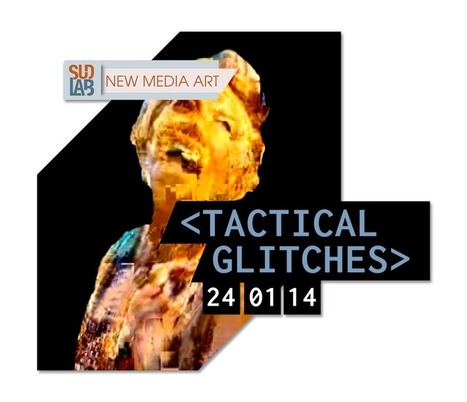
SUDLAB as part of the program SUDLAB | NEW MEDIA ART presents the group exhibition 'Tactical Glitches' curated by Rosa Menkman (NL) and Nick Briz (USA)
"Technologies come with expectations, but these expectations aren’t always met. An mp3 might skip and crackle. A computer monitor might—for a moment—show shards instead of windows. A website might hickup on load and scramble its contents. When this happens, we call this unexpected occurrence a glitch. While these moments are rarely anticipated and usually unwelcome, they are at times intentionally provoked. The result of this intentional and creative instigation is what we often call GLITCH ART." (Rosa Menkman, Nick Briz)
Artists
- glitchr (LT) - Theo Darst (USA) - Pox Party (USA) - Glti.ch Karaoke (UK - ROK) - UCNV (JP) - Ana Hui Zhang (CN) - Sherpa (GT) - Benjamin Gaulon (FR) - Tatjana Marusic (CH / DE / HR) - Nancy Mauro-Flude (AUS)
Onion Skin is a new immersive installation by Olivier Ratsi, an artist on the ANTIVJ visual label.
The first stage in the Echolyse project, which will give birth to several variations around the same concept, Onion Skin is made up of a physical dimension – a module of two walls, positioned at right angles – augmented by a projection and a 5.1 sound broadcast. Onion Skin is a graphical work about the re-composition of time and space through a game of perspectives, both of the exhibition space itself and that of the projection canvas. Built around a progressive structure, made up of 4 parts lasting 14 minutes in total, the piece plays on the principle of repetition and scale to create a physical and hypnotic experience that opens doors onto the hidden and untouchable.
The whole experience of the installation is based on a very specific point of view. A precise position from which a new dimension is revealed to the audience by anamorphosis. The simple geometric elements (“peelings”) that seemed to be flat at first suddenly start delimiting a new space. The illusion of a new dimension within the installation slowly appears as the onion skins seem to be leaving their physical surface behind. ...
Centre national des arts plastiques, CNAP, Soutien à la création contemporaine, collections en ligne, calendrier et guide-annuaire de l’art contemporain, ressources artistiques
L’aide à la recherche artistique permet à l’artiste de s’affranchir un temps des contingences économiques. Elle favorise l’expérimentation sans contrainte — hormis celles que l’artiste se donne — d’un nouveau champ du réel à explorer. Cette publication revient sur plus de dix ans du dispositif « soutien pour le développement d’une recherche artistique » et de projets soutenus. Les propos recueillis, ainsi que les extraits de rapports de recherche, reflètent l’engagement de chaque bénéficiaire et esquissent ce que pourrait être aujourd’hui la recherche artistique. Ils témoignent de la nécessité pour les artistes d’explorer sans cesse de nouvelles pistes impliquant parfois des déplacements à l’étranger, ou de trouver un soutien à la mise en oeuvre de technologies ou de savoir-faire spécifiques souvent coûteux. Sont également données à lire les impressions de membres des commissions impliqués dans ce dispositif.
To get content containing either thought or leadership enter:
To get content containing both thought and leadership enter:
To get content containing the expression thought leadership enter:
You can enter several keywords and you can refine them whenever you want. Our suggestion engine uses more signals but entering a few keywords here will rapidly give you great content to curate.


 Your new post is loading...