


dropingNews is a machine which can give the user the ability to have a taste of the Internet by using a molecular kitchen technic. more info: http://www.timhorntrich.de

Digital #MediaArt(s) Numérique(s)
208.5K views |
+0 today
Media Arts Watch Lab - www.arts-numeriques.info - laboratoire de veille Arts Numériques - twitter @arts_numeriques - @processing_org - @DigitalArt_be - by @jacquesurbanska @_Transcultures
Curated by
Jacques Urbanska
 Your new post is loading...
 Scoop.it! 
The desire to change the world has often led artists to align themselves with wider social movements and to break with established institutions of art. This reader gathers together an international selection of artists’ proposals, manifestos, theoretical texts and public declarations that focus on the question of political engagement and the possibility of social change. ... 
Scoop.it!

Call for Apps Are you making an open data based app? Apps for Europe is running an online competition to find the best app developers across the continent.
Scoop.it!
It’s a chastity belt for breasts! The “true love tester” bra is the world’s first scientifically engineered undergarment for women that actually reads your body’s signals. Ravijour, the company behind this peculiar product, touts the garment as “a revolutionary bra that knows how women truly feel.” It seems the bra cannot be unhooked without “true love” and will literally pop off of the wearer upon finding that special someone.
Here’s how the technology works: The bra has built-in sensors that measures the wearer’s heart-rate. The data collected by the sensors is sent to a special app on your phone. ...
Scoop.it!
Deuxième volet de la série Nocturnes, Tumbleweed propose au spectateur une installation-spectacle tissant lumière, son et brume. Dépourvu de présence humaine, le plateau s’anime telle une sculpture en mouvement, des formes évanescentes se déformant et se reformant sans cesse. Au fil d’un temps étiré, ce théâtre des éléments nous plonge dans un univers onirique où l’instant fugace côtoie les mémoires des temps à venir… virevoltants tissés dans l’accalmie des vents.
> ENGLISH VERSION Second part of the Nocturnes serial, Tumbleweed presents to the audience a sensory artwork mixing light, sound and mist. Devoid of human presence, the stage comes to life like a moving sculpture: evanescent shapes deforming and reforming over and over again. In a stretched time, the performing elements take us into a dreamlike world where the transient moment mixes with forward memory…
Scoop.it!
En dialogue avec le film Last Room de Pierre Carniaux
À partir du même tournage au Japon, le réalisateur Pierre Carniaux et l’artiste plasticien Thierry Fournier créent le film Last Room et la pièce interactive sur iPad Dépli : un dialogue entre cinéma et arts plastiques qui propose une expérience inédite.
Tourné au Japon par Pierre Carniaux, le film Last Room est une fiction et un documentaire. Les occupants de love hotels et d’hôtels capsules se racontent à travers des histoires à la fois intimes et rêveuses, entremêlées de voyages à travers les paysages de l’archipel… Bientôt, ces récits personnels résonnent avec une histoire collective : celle de Gunkanjima, île fantôme à l’abandon au large de Nagasaki, puis avec celle du Japon tout entier.
Créée sur iPad par Thierry Fournier, la pièceinteractive Dépli propose une nouvelle forme d’expérience du cinéma: une navigation à travers le film Last Room. Un cinéma « jouable » et sensuel, où le spectateur peut recréer une infinité de parcours dans le film en choisissant et en mélangeant les plans, leur sens, leur vitesse… Jouée sur iPad seul, avec une TV, dans une salle de cinéma ou dans le cadre d’une exposition, Dépli propose l’expérience inédite de réécrire un film par le toucher.
Scoop.it!
Selected Works from Musashino Art University Degree Show 2011
Scoop.it!

Il faut se faire une raison : il n'existe pas d'anonymat numérique. Chaque recherche sur internet, e-mail envoyé, "J'aime", livre acheté laisse des traces qui permettent de remonter jusqu'à vous.
Scoop.it!

association création, créativité humaine et contemporaine solidaire à Narbonne en Languedoc Roussillon, espace de diffusion pour la création contemporaine.
Cultures numériques et solidarité numérique contre la fracture numérique sur le web à Narbonne et dans le Grand Narbonne dans le département de l'Aude en Languedoc Roussillon. Alter médias Cité est une plateforme culturelle de l'association EDCC qui vous invite à vous joindre à notre petite équipe pour développer les cultures numériques et la pratique des arts numériques à Narbonne. 1/ association artistique : la création numérique contemporaine 2/ association culturelle : EDCC alter médias cité Narbonne 3/ association d'économie solidaire : solidarité numérique / Partage des savoirs et des connaissances...
Scoop.it!

Initiative née d’une collaboration créative entre l’École des Arts, le Centre culturel de Braine-l’Alleud, l’Académie de Musique de Braine-l’Alleud, Clair Obscur (programme de sensibilisation à l’art contemporain porté par les centres culturels de Genappe, Rixensart, Braine-l’Alleud et Brabant wallon), UCL Culture et Transcultures (également initiateur du Festival City Sonic à Mons), Résonances explore différentes dimensions de la création sonore dans les arts contemporains.
Du 5 février au 3 mai 2014, cette « manifesta-son » fédératrice propose une découverte poétique et sensorielle des nouvelles pratiques audio à travers des œuvres plastiques, numériques… hybrides en Brabant wallon.
Autour d’une exposition à l’École des Arts de Braine-l’Alleud, des évènements exceptionnels, concerts, performances, créations participatives, ateliers, conférences et rencontres dans les lieux partenaires sont proposés pour permettre à un large public de s’immerger dans ces univers singuliers.
Scoop.it!

In the mid nineties, Joan Heemskerk and Dirk Paesmans were among the first artists to realise the internet's creative potential, and there they realised their first works and projects. The internet has since rapidly changed – we no longer have a connection for telephone and internet, social media emerged, and almost everyone has a smartphone or tablet – and new generations of artists have discovered its potential. Since MAMA's exhibition program has included many artists from this new generation – Aids-3d (Daniel Keller and Nik Kosmas), Ryan Trecartin and Lizzie Fitch, Dennis de Bel, Brad Troemel, Constant Dullaart, Rafaël Rozendaal, etc. – we thought it was time to pay homage to JODI in the form of a solo exhibition, two curated pages on MAMA's website, and an artistic research project for young artists.
Scoop.it!

In February of 1997 the Galerie der Gegenwart (Gallery of Contemporary Art) of the Hamburger Kunsthalle (Hamburg Art Museum) was the first museum in the world to announce a net art competition. The event was supported by Philips, the German news magazine, SPIEGEL, and their website, SPIEGEL ONLINE. The name of this competition was EXTENSION, and was meant to be an extension of the museum into virtual space. The competition posed the question of how traditional tasks of the museum, collecting, preserving, mediating, and researching, could be applied to art on the internet.
Scoop.it!

LA Game Space is a nonprofit center for exploring the potential and expanding the possibilities of video games through exhibitions, talks and workshops, artist residencies, and research labs.
|
Scoop.it!

When, in November, the publisher Stewart Brand was asked about who carries the flag of counterculture today, he pointed to the maker movement. The maker era might not be upon us yet, but the maker movement has arrived.
In January of 1903, the small Boston magazine Handicraft ran an essay by the Harvard professor Denman W. Ross, who argued that the American Arts and Crafts movement was in deep crisis. The movement was concerned with promoting good taste and self-fulfillment through the creation and the appreciation of beautiful objects; its more radical wing also sought to advance worker autonomy. The problem was that no one in America seemed to need its products. The solution, according to Ross, was to provide technical education to the critics and the consumers of art alike. This would stimulate demand for high-quality objects and encourage more workers to take up craftsmanship. The cause of the Arts and Crafts movement would be achieved, he maintained, only “when the philosopher goes to work and the working man becomes a philosopher.” ... Via Aurelie Ghalim
Scoop.it!
Atelier d'introduction au logiciel Processing (pour débutants).
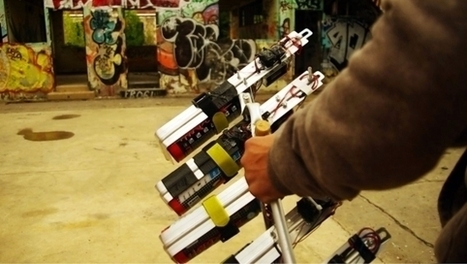
Le G.R.L Fr vous accueille et explore avec vous le monde du graffiti numérique : décryptez les nouvelles technologies, testez, expérimentez et créez vos propres outils de réappropriation de l'espace urbain.
Scoop.it!

Les journalistes de Radio Nova, les codeurs de l’école Simplon.co et les membres d’ICI Montreuil veulent concevoir ensemble un androïde qui officiera sur les ondes. Une campagne de crowdfunding vient de se terminer pour le financer.
Scoop.it!

When we shared this image from the @buffer Twitter account recently, it got me thinking. The Tweet resulted in over 1,000 retweets, which somehow was an indication that a lot of people seemed to agree with this statement.
Scoop.it!

Basically, it will log into your Facebook account and click on "every" possible like link on your home news stream. Yes, that means the 'like' under every comments also. (It is not 100% accurate. Experience has shown that it might miss some. But it does the trick.) Since most of my fb_friends feel flattered, empowered, loved,... when they receive a 'like' for their actions on facebook, I thought I might automate some love giving and distribute 'likes' to my friends in a more efficient way. Or have I just created the first like-spamming application? This project has started a couple years ago and was first done in Python using Selenium Webdriver with the intention of working as a standalone server application. But for some reason, it never reached that stage because having a chromeless firefox behaving like a desktop one with selenium on top of it, was something I could not achieve. So earlier 2013, the project was rewritten in javascript using phantomjs and casperjs and this somehow was much more easier.
Scoop.it!
Expunction is a project by mobile Internet communicator Igor Štromajer. Between 11 May and 16 June 2011, Štromajer, a pioneer of net art both in Slovenia and worldwide, ritually deleted a number of his classical net art works produced between 1996 and 2007. He expunged one net art project per day, permanently deleting it from his online server, so that the projects are no longer available at the Intima Virtual Base. He deleted 37 net art works altogether, amounting to 3,288 files or 101.72 MB.
Those of Štromajer’s projects that were not on the Intima Virtual Base online server at the time of expunction but are permanently loaded on the servers of the galleries and museums that have acquired them through purchases or donations (Centre Pompidou in Paris, Ars Electronica Lab in Linz, Computer Fine Arts Gallery in New York, MNCA Reina Sofía in Madrid, etc.) were (and still are) inaccessible to the artist for deletion.
The Expunction project broaches the questions of temporality, duration, archiving, and accessibility of (net) art works that automatically change over time as the hardware and software change (browsers, players, applications etc.), slowly but inexorably losing their functionality and consequently also their content. The artist’s basic premise in this project was that whoever creates, programs, and composes art is also entitled to deprogram, deconstruct, and delete it. This is not an act of violence or destruction, but rather the observation of the natural rhythm of birth, life, and death, cyclically repeated and oscillating in natural amplitudes. In a way, Štromajer has erased history, including his own personal history, since he believes our memory serves to deceive us, to misrepresent rather than paint and describe the past. A deceptive memory can be erased without qualms, since it does not portray a real picture of the past it speaks of, but always only a deceptive, distorted image. For this reason the deleted works or their remaining fragments, undeletable once they have been made publicly accessible since the World Wide Web is so widely spread and fragmentary, tell us much more about the originals (original works) than the originals themselves. With its empty slot and precise documentation, a nonexistent work, or rather its absence, points out the ephemerality of a net art work, telling at the same time much more about the deleted work than the so-called actual original could.
Scoop.it!

Vjspain.com is a portal dedicated to the world of visual, have a place where everything related to the world of Audiovisual:
artists / visual creators / site / interactive / live cinema / mapping / live AV / vjing / generation real / mash up time
The project has been active since 2004, with the help of Oscar Teston, creator and webmaster. This uptime is the Official Portal vjspain.con regarding Spanish-speaking world of visual and visual creation in real time.
The web vjspain.com is designed and intended for and videojockeys. The new version has a powerful news manager and project generation database updated videojockeys where self-managed spaces provides for all its users.
Scoop.it!

An interdisciplinary project that combines photomontage, painting and audiovisual.
The project, conceived as a video installation, intended to address the space reinterpreting its essence, as it tries different interpretations of cities and their intrinsic characteristics: life and architecture of cities and maintaining its identity over time. It is the city, imposing large space structures, which reinvents plastically to revive the consciousness of the viewer about their environment
Scoop.it!

In our research project trees, we are working on the acoustic recording, analysis and representation of ecophysiological and climatic processes and studying the acoustic and aesthetic requirements for making them perceptible. Measurements of acoustic emissions in plants must be analysed and understood in relation to other measurement data such as that relating to the microclimate, sap flow, changes in trunk radius and water potential in the plants’ organs – all measurement data that is not auditory per se. Therefore, in our research project trees, we deal with the sonification of ecophysiological data as well as analysing the actual acoustic emissions: How can processes that are beyond our normal perception be made directly perceptible, creating new experiences and opening a new sight on processes in nature? To what extent is our sense of hearing of use? ...
Scoop.it!
Rafaël Rozendaal browsing JODI January 2014. Made on the occasion of the exhibition "Jodi Go Home" at Showroom Mama in Rotterdam. http://www.showroommama.nl/...
Scoop.it!

On January 24, 1984, Macintosh put the creative power of technology in everyone’s hands. Explore the 30 years of innovation that have followed.
Scoop.it!

Between shiny high-tech, e-waste dumps, big data businesses and mass surveillance schemes: under the title afterglow, the 27th edition of transmediale, for the third time with artistic director Kristoffer Gansing, will explore our present post-digital moment as one in which former treasures of our mediatised life are turning into trash.
The moment of afterglow describes both the positive and negative mental after effects of drug use as well as the moment of deep twilight when the dust that has risen from the earth into the atmosphere is temporarily lit up.
transmediale 2014 afterglow adopts this psychedelic twilight moment as a symbol of today’s ambivalent condition of digital culture – leaving behind the digital revolution and looking towards a future in which media technologies have become part of daily life, turning into physical and immaterial waste. International thinkers and cultural producers use the post-digital condition between trash and treasure as a starting point to deal with some of the burning issues of today and to invent new speculative practices through exhibitions, performances, screenings and panels....
|




