Media Arts Watch Lab - www.arts-numeriques.info - laboratoire de veille Arts Numériques - twitter @arts_numeriques - @processing_org - @DigitalArt_be - by @jacquesurbanska @_Transcultures
Deadline for submissions: 4 April 2014, 5pm Production residency: 5 May – 15 June 2014 Public presentation: 19 – 22 June 2014
Eastern Bloc’ media lab is a space for experimenting, learning, theorizing and creating – a place to further develop systems-based, networked, generative and hybrid practices through an artist-led discourse. The lab is a site of convergence for artists (both emerging and established), professionals, students, technicians, theorists and curators – encouraged to work side by side, supporting one another conceptually as well as technically.
Eastern Bloc’s residency program, with its three residencies per year (Fall, Winter, Spring), is a chance for artists and audiences to critically engage in the artistic process, with a focus on DIY and open source culture as well as and the political discourse surrounding contemporary digital culture, and a special consideration for pedagogy and technological democratization.
For the upcoming Spring residency, artists (or artist collectives) are asked to submit a project in one or more of the following disciplines: Net art, interactive installation/performance, bio art, audio/video installation, audio/video performance, sound performance, public intervention...
Imagine if you could take living cells, load them into a printer, and squirt out a 3D tissue that could develop into a kidney or a heart. Scientists are one step closer to that reality, now that they have developed the first printer for embryonic human stem cells.
In a new study, researchers from the University of Edinburgh have created a cell printer that spits out living embryonic stem cells. The printer was capable of printing uniform-size droplets of cells gently enough to keep the cells alive and maintain their ability to develop into different cell types. The new printing method could be used to make 3D human tissues for testing new drugs, grow organs, or ultimately print cells directly inside the body.
L’évolution conjointe du numérique et de la scène est naturelle : le producteur de spectacles est plus que jamais au coeur de la mise en valeur et du développement de la carrière d’un artiste.
L’irruption d’Internet, l’essor des réseaux sociaux, et plus récemment la généralisation des terminaux mobiles ont profondément transformé la consommation de la musique, stimulant ainsi la filière musicale et artistique, l’ouvrant notamment pour le spectacle vivant, à de nouveaux acteurs. ...
ITEMS a été chargé par le PRODISS, syndicat national des producteurs, diffuseurs et salles de spectacles de musiques actuelles et de variété, d’étudier de manière prospective les leviers de croissance actuels et potentiels que l’écosystème numérique permet de générer.
A l'occasion de la rétrospective que consacrera le Grand Palais à l'artiste américain, «Libération» vous propose de découvrir en exclusivité un extrait d’une de ses dernières productions.
Un grand souffle va balayer le Grand Palais. Le 5 mars s’ouvre, pour quatre mois et demi, la première rétrospective en France dédiée à la figure de l’art vidéo, l’Américain Bill Viola, âgé de 63 ans. Partenaire, Libération qui accompagnera cet événement a le privilège de diffuser en exclusivité un extrait d’une de ses dernières productions, The Dreamers (les Rêveurs).
Urban Media Aesthetics is an ongoing curatorial research project that investigates subject matters relevant to artistic and curatorial practices with digital art forms in urban environments.
The notion of urban media aesthetics as a curatorial subject relates to the presentation and integration of artistic, visual digital content in urban contexts. This materializes in various contemporary examples, such as digital art installations, media facades, pervasive and mobile displays, big screens, projections of moving images, architectural mapping and animation, responsive architecture, and other types of “exhibition forms,” which take the urban environment as their exhibition space while integrating digital content, infrastructure and digitally-inspired forms into the urban ecology.
While urban media aesthetics as a research area might reflect a history of technologies, with relations between developments in screen and projection technology and developments in artistic expression and presentation, this initiative is not looking for a historical narrative or line of progress or development. There is no ‘one’ history of this discourse and no archive laying the ground for it either. There is no established framework for grasping, approaching and critiquing the emerging artistic and curatorial practices with media aesthetics in urban public contexts. Perhaps we can look towards principles of nomadicism, interdisciplinarity and emphasis on cultural and social situations, which we find in an archeological approach, to avoid relying on historicity that would tell us about technological “progress” without questioning what progress even means.
It’s taken five years to get the Booooooom Facebook page to the size it is now and after all that it appears, due to Facebook’s greed, it’s a complete waste of time to continue using it. The other day I made a post, and of the 155,000 people following our page, only 400 people saw it. That’s not even 1% of our followers! That’s kinda insane if you think about it. There was a time when 60,000 people would see a post, and we had less followers then!
If you run your own Facebook page you’ve already experienced this problem of reaching your own fans. These people who opted in and want to receive your updates won’t ever see them now unless you pay money.
Découvrez une expérience multimédia qui vous emmènera du Sud au Nord de la Cisjordanie, grâce à des témoignages de Palestiniens et d’Israeliens. Vingt ans après les accords d’Oslo, qu’en est-il de la situation en territoire palestinien occupé ?
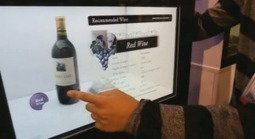
Fascinant ! C'est clairement le mot qui nous vient à l'esprit lorsque l'on est devant un écran tactile transparent. Dans la sélection de vidéos que nous
Adaptive fa[CA]de’ explores the computational possibilities and performative aspects of Cellular Automata. Using an artificial Neural Network it constitutes a ‘living skin’ that responds to the light levels of its environment. Building upon the unique patterns of Cellular Automata, ‘Adaptive fa[CA]de’ provides optimal light intensity to the interior, whilst resulting to an emergent, kinetic behaviour.
Adpative fa[CA]de was exhibited from the 8th of September till the 2nd of October 2009 at Digital Hinterlands Exhibition at Arup’s Phase 2 Gallery on 8, Fitzroy st, as part of London Digital Week. The project was also included in the book 'Passages Through Hinterlands' co-authored by Ruairi Glynn and Sarah Saifei which included featured projects from young architects and recent graduates.
Pictanovo accompagne les entreprises qui veulent expérimenter des concepts et des genres bousculant les idées reçues dans le monde de l'image et des industries culturelles. Avec le soutien de ses financeurs, le fonds Expériences Interactives investira plus d'un million d'Euros en 2014 dans des projets créatifs et innovants sur trois thématiques : Transmédia, Jeu vidéo et Médiation culturelle. La principale nouveauté est l'élargissement du serious game vers l'ensemble des jeux vidéo.
Pictanovo poursuit ses partenariats avec la Communauté Urbaine de Dunkerque pour le lancement duLearning Center Ville Durable et le Pôle Numérique Culturel en complément de l'appel "Start up Numérique Culturel" et renforce son partenariat avec Wallimage.
Venez le 11 mars 9h15 à L'imaginarium découvrir le règlement, le dossier et les conditions 2014 du fonds « expériences interactives » et poser toutes vos questions
Brèves en focus Chroniques en mouvement Sasha Waltz au ZKM à Karlsruhe. La danse, médium multiple, vous pétrifie !, Geneviève Charras « New Zen 4 Tv », la vidéo musique, Étienne Brunet Une Pythie mondialisée. Tunnels around the world, Jean-Jacques Gay Voir Viola dire Action à Hollywood, Jean-Paul Fargier Portrait d’artiste : Sigrid Coggins Entretien avec Sigrid Coggins, Gabriel Soucheyre Captiver le public par captation, Franz Narbah Serial Portraits, une oblique dans le rapport artiste/spectateur, Antoine Choplin Sigrid Coggins, le bonheur comme médium ?, Alain Livache Quelques Serial Portraits Quelques commentaires sur Serial Portraits (…) SIGRID COGGINS : PORTRAIT VIDÉO Sur le fond Les gris hyperboréens, Alain Bourges Les étranges communautés : "Euréka" ou le plus beau film du monde, Jean-Paul Gavard-Perret Les œuvres en scène Juste une icône, récit d'une passion clandestine, Gilbert Pons Regards de la fée, Chantal Detcherry Petite sirène, Marc Petit Feuilles mortes, en guise d'introduction aux images de Véronique Orobanche, Gilbert Pons
Zeugen is an interactive and immersive new media creative electronics artwork that uses 32 human cast robotic faces and a face tracking system to explore the concepts of seeing and being seen.
Après le succès des deux premières éditions en 2012 et 2013, qui ont rassemblé plus de 5000 personnes sur l’ensemble du territoire japonais, l’Institut français du Japon prolonge l’expérience numérique et organise en février 2014 la troisième édition de Digital Choc, festival destiné à mettre en lumière la créativité française dans les domaines des cultures numériques et des nouvelles images.
Après avoir exploré les territoires traversés par l’art numérique en 2013, la prochaine édition s’articulera autour des machines intelligentes, de leur capacité à nous faire rêver, et de leur place grandissante dans la création.
L’avènement des machines au XXème siècle a provoqué autant de fantasmes et de fascinations que de craintes. En effet, si les machines ont longtemps été au service des humains, telles leurs esclaves, elles ont développé de plus en plus d’autonomie, au point que dans certains cas leur pouvoir échappe à leurs maîtres. L’usage de la technologie, de l’électronique et de l’ordinateur dans l’art a donné aux machines un rôle de plus en plus important dans le processus de création : elles chantent, elles dansent, peignent, écrivent selon des programmes qui leur laissent de plus en plus d’indépendance.
Avec Frédéric Penelle, en artiste invité. Frédéric est un jeune et talentueux graveur belge que j'ai eu la chance de rencontrer il y a quelques années. Il avait d'ailleurs réalisé une installation dans nos locaux, à l'occasion des 5 ans de la boite.
A collection of text graphics and related works, stretching back thousands of years. Textiles, BBS-graphics, poetry, mosaic, typography, and much more. Collected by Raquel Meyers and Goto80.
Modéliser le cerveau humain, un des organes les plus énigmatiques, tel est l’objectif titanesque du projet phare qui vient d’être lancé par l’Union européenne pour un coût total estimé à 1,19 milliard d’euros. Ce cerveau virtuel fonctionnera à l’aide de supercalculateurs et incorporera les résultats les plus récents des recherches en neurosciences. Comment mettre en équation ce réseau au câblage incroyablement complexe constitué de 100 000 milliards de connexions nerveuses qui n’ont pas été entièrement caractérisées ? Une des solutions envisagées pourrait être d'implémenter les règles du développement embryonnaire du cerveau in vivo et de les laisser reconstruire un cerveau in silico. Il resterait ensuite une étape décisive : le connecter à un corps virtuel et le faire évoluer dans un environnement hypothétique afin de vérifier s’il est « réellement » intelligent ? Ces travaux sont aussi une source d’inspiration remarquable pour concevoir des ordinateurs bioinspirés du fonctionnement des neurones. En effet, avec une vingtaine de watts à peine, le cerveau assure d’innombrables fonctions, dont certaines ne peuvent être réalisées simplement par les machines, de quoi faire rêver… Les memristors, composants électroniques passifs, sont ainsi capables de simuler le comportement synaptique à l’échelle nanométrique grâce à de nouveaux concepts de mémoire numérique basée sur des mécanismes de commutation ferromagnétique et ferroélectrique.
ANAT [Australian Network for Art and Technology] supports artists and creative practitioners engaging with science and technology, within Australia and beyond.
For the past 25 years, the Australian Network for Art & Technology (ANAT) has been a catalyst for experimentation and innovation across art, science and technology. ANAT champions artistic excellence by supporting professional artists and fostering a culture of creative risk-taking, secures the necessary resources to enable artists to pursue creative research and realise groundbreaking artworks, and communicates the importance of creative experimentation and expression within the arts and – increasingly – in broader
We want to shine a light on a new breed of artist that has adopted design and code to express themselves.
Algorithms are the building blocks of our digital society, helping us calculate, search, order and process the information around us. Today however we are seeing the creative potential of code emerging; a new hybrid of artist and coder has been born.
Artists & Algorists is a independent blog that aims to showcase this joining of art and computer science. Through this website we want to support those ‘artists and algorists’ who are pushing digital tools to a new level, creating different kinds of algorithms that allow the viewer to interact and play a part in the creation of the art itself.
We are a small passionate team made up of an increasing number of contributors. Directed by Damian and Nalden and led by Editor-in-chief Gemma. With your help we hope to build a community of artists, coders and interested people to support and expand this exciting multidisciplinary movement.
Si vous êtes désireux de compléter votre formation par un cursus de création unique en son genre, pendant deux années au contact des grands artistes d’aujourd’hui avec accès à des équipements professionnels, un budget de production et dans une large multidisciplinarité, Le Fresnoy vous attend.
If you would like to complete your training with a unique two- year course in contact with some of today’s greatest artists, with access to professional equipments, a production budget and a wide multidisciplinarity, Le Fresnoy is waiting for you.
Deadline - Date limite de dépôt du dossier artistique / administratif : Lundi 5 mai 2014 minuit Rencontre d’information et visite : Mercredi 19 mars 2014 - 14h30
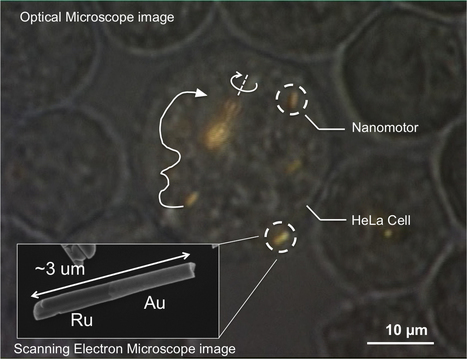
Penn State University chemists and engineers have, for the first time, placed tiny synthetic motors inside live human cells in a lab, propelled them with ultrasonic waves, and steered them magnetically.
The Penn State nanomotors are the closest so far to a “Fantastic Voyage” concept (without the miniature people).
The nanomotors, which are rocket-shaped gold rods ~300 nanometers in diameter and ~3 microns long, move around inside the cells, spinning and battering against the cell membrane.
The nanomotors are activated by resonant ultrasound operating at ~4 MHz, and show axial propulsion as well as spinning.
BEARINGS GLOCKEN is a musical instrument that automatically performs a glockenspiel using steel ball for bearings, said to be the world's most perfect sphere on earth. The steel ball is finished into a nearly perfect sphere, and has the property of uninformly bouncing back, over and over. BEARINGS GLOCKEN uses this property in a musical instrument. It is possible to rent it to various entertainments. You will be able to see the shocking-charming phenomenon in front of this work. We are looking forward to sharing the moment with you. BEARINGS GLOCKEN was selected as jury recommened work at 2009 Japan Media Arts Festival.
Christa Sommerer et Laurent Mignonneau sont artistes et chercheurs à ATR, Laboratoire de Recherche dans l’Intégration des Médias et des Communications à Kyoto (Japon).
Leurs travaux font appel à l’utilisation " d’interfaces naturelles " et ils utilisent comme langage la vie artificielle et les processus d’images en évolution.
New Media and Performance Arts gallery examining the relationship between technology and the human body
We arebyte; A cross desciplinary gallery space in East London working mainly in Performance and New-Media arts. We work with local and international artists on-site and on-line, promoting new and innovative means of engaging the public and facilitating participation. arebyte (formerly known as ARtCH), is a non-for-profit organization, founded in November 2010. arebyte is dedicated to making art more accessible, communicative and tangible to new audiences through the production of high quality cultural events and activities.
Systaime, c’est l’anti-système de l’art (et rien à voir avec certaine quenelle faisandée). Systaime, aka Michaël Borras, est un pur rejeton du Net, un artiste virtuose du datamoshing, du cut et du remix. Du quoi ? Vous ne vivez pas dans les rets du Web, émoticônes et autres favicons ne font pas partie de votre vocabulaire ? Systaime, lui, détrône les icônes de la webculture comme d’autres déboulonnaient les statues de Lénine, Staline ou Moubarak. Sans hiérarchie ni respect, il copie-colle à tout va, use et abuse du foklore informatique, cette culture visuelle qui n’a pas fini de sortir des écrans pour gagner les rues, les modes, les gens.
L’inventeur de la French Trash Touch (entendez un savant mélange de pop culture, net culture, basse et haute culture) est une incarnation vivante et durable du flux. Le flux ? Cet amas continu et quasi infini de datas, ces données en zéro et un de l’univers numérique qui sont la base de toutes les images, vidéos, sons qui circulent sur nos écrans, du téléphone à l’ordinateur. Lolcats et boobs, même combat ! Systaime les passe à la moulinette de ses ciseaux digitaux, concaténant les signaux, signets et symboles de notre culture infiltrée par les réseaux informatiques.
To get content containing either thought or leadership enter:
To get content containing both thought and leadership enter:
To get content containing the expression thought leadership enter:
You can enter several keywords and you can refine them whenever you want. Our suggestion engine uses more signals but entering a few keywords here will rapidly give you great content to curate.


 Your new post is loading...