



Pour blinder la Toile, des chercheurs proposent de créer des services en ligne où les données ne sont déchiffrées que dans les navigateurs, jamais côté serveur. Subtil, mais faisable.

 Your new post is loading...
 Scoop.it! Pour blinder la Toile, des chercheurs proposent de créer des services en ligne où les données ne sont déchiffrées que dans les navigateurs, jamais côté serveur. Subtil, mais faisable. 
No comment yet.
Sign up to comment
Scoop.it!

Mapping Festival celebrates this year its 10th edition from May 22d to June 1st , 2014. After its success in 2013, we repeat the formula discerning professional workshops from events intended for the public. Articulated around various themes and technological explorations, conducted by international instructors who are specialists in their respective fields, the six workshops will be spread over the two weeks of the festival. Send an e-mail to moc.lavitsefgnippam@spohskrow - in the message object, name the workshop you’d like to attend, - join CV, references, videos, photos, everything that defines you and could be useful for us to know you better. Registration deadline: Monday, April 7th, 2014 You will receive an answer within 7 days after the deadline.
Scoop.it!

All in all, the Padcaster is a versatile, lightweight accessory for anyone using an iPad to create podcasts or even shoot short films, music videos, and other content.
Scoop.it!

From
k0a1a

PRISM reveals information about wireless devices present in its vicinity. By intercepting network protocol messages, data such as username, hostname and IP address are publicly displayed. Observers can gaze into the rotating prism and read disclosed personal information about the people around them.
Scoop.it!

Jardin numérique est un événement rennais ouvert, gratuit et participatif qui défend la créativité au quotidien, l’accès aux technologies et le partage des savoirs. Depuis 2012, Jardin Numérique est ouvert, gratuit et participatif. A travers cet événement, notre volonté partagée avec tous les acteurs qui le souhaitent est de défendre et de promouvoir la créativité au quotidien, en facilitant la circulation des savoirs et la réappropriation des technologies par chacun. Pour cette 3ème édition, nous proposons à nouveau ateliers, initiations, rencontres et concerts, dans un esprit fidèle à celui du Jardin Moderne : débroussaillons les chemins de traverse, inventons-les si besoin, augmentons et réaffectons les fonctions de nos vieux outils, expérimentons pour créer !
Scoop.it!

It’s easy to praise robots and automation when it isn’t your ass on the line. I’ve done it lots. But I may have to eat my own Cheerios soon enough. Software is writing news stories with increasing frequency. In a recent example, an LA Times writer-bot wrote and posted a snippet about an earthquake three minutes after the event. The LA Times claims they were first to publish anything on the quake, and outside the USGS, they probably were.
Scoop.it!

Processing for wordpress allows you to easily manage and include processing sketches into a post or page with shortcodes. Processing for wordpress is a plugin that allows you to easily manage and include processing sketches into a wordpress post or page. It automatically adds the right librairies for you and will offer different features and templates to presente your creation in a minimalist and elegant way.
Scoop.it!
From
vimeo
"Chorus" is a contribution to This is NOW, an exhibition that took place in Oslo, showcasing international talents in poster art and motion graphics. This project started as a poster but quickly evolved into a disturbing video with this mouthlike-character producing weird noises and fusing with the buzz of the exhibitiion visitors.
Scoop.it!
This interactive kinetic installation combines a vacuum cleaner powered pneumatic tube transport with a small sized ball pit.
Scoop.it!

One idea is dominating this year's Game Developers Conference: virtual reality. From Treadmills to bodysuits, from guns to games, the emerging VR ecosystem is vast--and growing. At this year's Game Developers Conference, currently underway in San Francisco, one idea has dominated the field: virtual reality. Could the tech's time truly, finally, be here? On Tuesday night, at a Sony session on the "future of innovation at Sony Computer Entertainment," Sony researcher Richard Marks and Sony Computer Entertainment president of Worldwide Studios Shuhei Yoshida revealed the existence of a new prototype VR headset for the PlayStation 4, called Project Morpheus. Using the existing PlayStation Eye camera for positional tracking and the PlayStation Move for 3-D motion controls, the current Morpheus prototype has specs on par with other VR headsets: 1080p screen, 90 degree field of view, and head-tracking at 1000hz. The price and release date of the new model were not yet released.
Scoop.it!

Berlin has a rich and long-standing tradition of women engaged in the fields of media arts, media activism and digital culture. Today over half of Berlin’s independent project spaces and initiatives revolving around the themes of tech, media and digital culture are run by women. A broad range of female curators and activists continue to shape net politics – initiating independent programmes, hosting events and leading research at Berlin’s universities. Despite this large female contingent, and in a city where the workforce is generally evenly distributed, it is at odds that the theoretical discourse on media art and net activism, executive roles and directorships, as well panelists and participants at events and festivals, are still male-dominated. In a forward-thinking city like Berlin, this ongoing gap should be addressed so that the wider fields of media arts and activism are fully inclusive of the multitude of female skills and viewpoints on offer. ...
Scoop.it!

Une rencontre avec
Scoop.it!

Le collectif #LeClairObscur de Frédéric Deslias s’attache à explorer les problématiques liées à la question des rapports Homme-Machine et réfléchit plus particulièrement à la façon dont l’homme, sa pensée, son organisation sociale, ses modes d’interaction sont modifiés par l’informatique et Internet.
|
Scoop.it!

HAPPY TRUCS We Love The Net invites you to the exhibition Happy Trucs* This exhibition presents a series of “connected” objects : Little Umbrella, 7ième Ciel, le CatchBarge, TweetPlace, Pegman Vaudou...
Scoop.it!
The Winter 2013 Donoho Colloquium presented by The Neukom Institute, and Studio Art, Film & Media Studies and Digital Music Departments
Scoop.it!

Ever since Google launched its Google Glass project, the reality of wearable eyewear seems to be inevitable. Since then, developers from around the world have been trying to take on Google Glass by creating their own wearable display glasses. Instead of just being able take a photo or video, smart ... Continue reading » Via Audrey Bardon

Lionel Reichardt / le Pharmageek's curator insight,
March 26, 2014 5:19 PM
Pharmageek partenaire de Interaction Healthcare à l'occasion de la conférence : "Du serious game au Google glass, comment la simulation numérique peut changer la pratique du médecin et la vie du patient ?" qui aura lieu le 3 avril prochain à PARIS LA VERSION CANADIENNE DE LA CONFÉRENCE Pharmageek partenaire de Interaction Healthcare à l'occasion de la conférence : "Du serious game au Google glass, comment la simulation numérique peut changer la pratique du médecin et la vie du patient ?" qui aura lieu le 10 avril prochain à MONTREAL -CANADA
Scoop.it!

The earliest known reference to synthetic generation of curves using Fourier series is:
This paper served as inspiration for the creation of Fourier art, since it shows several examples of synthetically generated curves from simple Fourier descriptors representations, many exhibiting axial and rotational symmetries. These shapes are shown in the figure on the right.
Scoop.it!

Quand la photographie électrique, en séries, sera introduite sur la scène, [...] la projection pourra se dire toute-puissante et peu de choses lui seront refusées. Adolphe Appia. Effets d’absence ou scène augmentée ? L’analyse la plus courante, lorsqu’on se penche sur l’intégration de l’image vidéo dans la mise en scène contemporaine, repose sur le postulat que la palette expressive du théâtre s’en trouverait à chaque fois élargie : écrans et moniteurs permettraient d’accroître l’efficacité de la représentation théâtrale, faisant même naître selon certains chercheurs une forme de « scène augmentée »[2], au sens où l’on parle d’une « réalité augmentée » pour désigner l’hybridation du réel et du virtuel. La complexification des modes de présence de l’interprète, le croisement des espaces-temps fictionnels ou le développement de niveaux narratifs autonomes, tels qu’ils résultent de l’introduction de ces images sur la scène, viendraient simplement enrichir des moyens scénographiques et dramaturgiques déjà éprouvés, sans remettre en cause leurs modes de fonctionnement ordinaires. ...

Centre de ressources Le Mouffetard-TAM's curator insight,
June 19, 2014 10:19 AM
"vidéo", "réel", "virtuel", "corps", "théâtre"
Scoop.it!
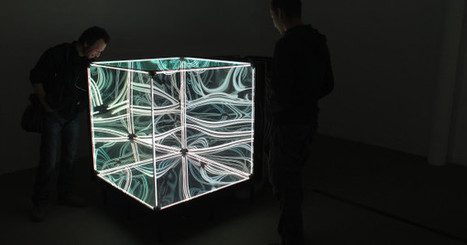
The results are nothing short of awe-inspiring! This is one of those art projects that I could probably stare at for hours, losing myself inside it. The design collective Numen for Use created a 3D box of one-way mirrors, which also expands and contracts when inflated. The results are nothing short of awe-inspiring!
Scoop.it!

Why are we obsessed with broken worlds? Inasmuch as they represent the fallen ideals of their given societies, ruins become a tactile presence in videogames by reconfiguring the remnants of an intangible past for unconventional mechanical use. Blown-out apartments become snipers’ nests in Fallout 3. A toppled skyscraper creates a new path to avoid the dangerous streets below in The Last of Us. Dangerous sections of subway stations that seemed so alien and odd now become the safest places in Metro 2033. A crumbling temple turns provides cover and opportunity for vertical traversal in an Uncharted firefight. Yet there is another layer still to uncover regarding a game’s relationship to the ruins the player explores. In “Ozymandias” Shelley contemplates not only history but also the role of art in its preservation by juxtaposing the time-worn nature of the statue itself to his own poem, wondering if his own verse will remain poignant as language continues to change and evolve. H. G. Wells asks similar questions in his dystopian novels. The ruins of the distant future in The Time Machine confirm the death of any literary tradition, further reified in the vacant sensibilities of the life forms of a post-literate earth.
Scoop.it!

Brain implants today are where laser eye surgery was several decades ago, fraught with risk, applicable only to a narrowly defined set of patients – but a sign of things to come. NYU Professor of Psychology Gary Marcus discusses on Lunch Break. Photo: Getty. What would you give for a retinal chip that let you see in the dark or for a next-generation cochlear implant that let you hear any conversation in a noisy restaurant, no matter how loud? Or for a memory chip, wired directly into your brain's hippocampus, that gave you perfect recall of everything you read? Or for an implanted interface with the Internet that automatically translated a clearly articulated silent thought ("the French sun king") into an online search that digested the relevant Wikipedia page and projected a summary directly into your brain? ...

Jacky Degueldre's curator insight,
March 26, 2014 10:53 AM
Or for a permanent information flows regulator driven by personal hashtags?
Scoop.it!

The Prix Cube rewards the best digital artwork created by an artist under the age of 36. The purpose of this award is to highlight and support work by an emerging artist in the international digital art scene. The Prix Cube will be awarded to a digital artwork less than 2 years old in the following areas: interactivity, generativity, network, internet and mobility. The artworks must be innovative installations or systems which explore the characteristics of digital technology in art (excluding live shows, video art and photography). Five artworks will be shortlisted and exhibited to the public during an exhibition at the Espace Saint-Sauveur in Issy-les-Moulineaux (Grand Paris Seine Ouest, France) from 26 to 30 November 2014. The winner of the Prix Cube will receive €10,000.
Scoop.it!

The information age is powered by thin fiber-optic cables buried in the sea bed, spreading between continents to connect the most remote corners of the planet. These great arteries account for practically all of our international web traffic, and each one has been logged by Washington research firm Telegeography in its interactive Submarine Cable Map 2014. The company's research director Alan Mauldin told CNN about the world's underwater networks. ...
Scoop.it!

Facebook is acquiring Oculus VR for $2 billion, including $400 million in cash and 23.1 million shares of stock valued at a total of $1.6 billion, Facebook announced today. According to a press release from Facebook, the company plans to expand the Oculus Rift headset's applications beyond gaming to broader fields such as media, entertainment, communications and education. At the same time, Facebook wants to "accelerate" the company's growth in the gaming space. The deal is expected to close during the second quarter of 2014. ...
Lionel Reichardt / le Pharmageek's curator insight,
March 26, 2014 2:05 AM
Pharmageek partenaire de Interaction Healthcare à l'occasion de la conférence : "Du serious game au Google glass, comment la simulation numérique peut changer la pratique du médecin et la vie du patient ?" qui aura lieu le 3 avril prochain à PARIS LA VERSION CANADIENNE DE LA CONFÉRENCE Pharmageek partenaire de Interaction Healthcare à l'occasion de la conférence : "Du serious game au Google glass, comment la simulation numérique peut changer la pratique du médecin et la vie du patient ?" qui aura lieu le 10 avril prochain à MONTREAL -CANADA
Scoop.it!
|





