Media Arts Watch Lab - www.arts-numeriques.info - laboratoire de veille Arts Numériques - twitter @arts_numeriques - @processing_org - @DigitalArt_be - by @jacquesurbanska @_Transcultures
Lotus Dome by Daan Roosegaarde and his studio is a living dome made out of hundreds of ultra-light aluminium flowers that fold open in response to human behavior. When approached, the big silver dome lights up and opens its flowers. Its behavior moves from soft breathing to a more dynamic mood when more people interact. The light slowly follows people, creating an interactive play of light and shadow.
The graphic representations of the lotus flower on the walls, and the deep bass sound, transforms the Renaissance environment into a 'Techno-Church'.
Abundant, bright sunshine was once the critical component for commercial viability of the solar energy puzzle – until now.
Researchers at the National Physical Laboratory have announced they've created solar panels which are actually more efficient when the sun is less intense.
According to the NPL scientists, this latest solar energy production technology works better on cloudy days than it does in full sunshine. In fact, these new solar panels are up to 3% more effective on cloudy days they are on sunny days.
Dr. Fernando Araujo de Castro, a principal research scientist at the National Physical Laboratory in the UK, leads research on solar photovoltaic and organic electronics, and his work focuses on materials and product development. ...
Qu’ils se nomment hackerspaces, fablabs, makerspaces ou lieux de fabrique, des ateliers ouverts se créent un peu partout en France comme ailleurs dans le monde, réunissant des créateurs, ingénieurs, designers, bricoleurs, amateurs ou professionnels, autour de projets communs. Ils témoignent de la vitalité d’un mouvement qui a fait ses preuves dans le monde virtuel, au sein de la communauté du Libre, avant d’investir le domaine de la fabrication. Expérimentant de nouvelles façons de concevoir, de coopérer, de fabriquer ainsi que de nouvelles formes de régulation collective, ces expériences posent des questions essentielles pour le devenir de nos sociétés, tout en bousculant quelques-unes de nos catégories de pensée. L’intérêt que les acteurs politiques commencent à leur manifester ouvre des possibilités de financement mais comporte aussi un risque de mise en concurrence et de standardisation. Les deux journées que nous organisons ont pour but de réunir des acteurs de ce mouvement et des chercheurs qui s’y intéressent, afin de réfléchir ensemble aux différents enjeux propres au développement effervescent de ces ateliers ouverts, en suivant quatre angles d’interrogation. ...
Paris, France - Conservatoire national des arts et métiers, 292 rue Saint-Martin, 75003 Paris
Présentation des deux journéesQu’ils se nomment hackerspaces, fablabs, makerspaces ou lieux de fabrique, des ateliers ouverts se créent un peu partout en France comme ailleurs dans le monde, réunissant des créateurs, ingénieurs, designers, bricoleurs, amateurs ou professionnels, autour de projets communs. Ils témoignent de la vitalité d’un mouvement qui a fait ses preuves dans le monde virtuel, au sein de la communauté du Libre, avant d’investir le domaine de la fabrication. Expérimentant de nouvelles façons de concevoir, de coopérer, de fabriquer ainsi que de nouvelles formes de régulation collective, ces expériences posent des questions essentielles pour le devenir de nos sociétés, tout en bousculant quelques-unes de nos catégories de pensée. L’intérêt que les acteurs politiques commencent à leur manifester ouvre des possibilités de financement mais comporte aussi un risque de mise en concurrence et de standardisation. Les deux journées que nous organisons ont pour but de réunir des acteurs de ce mouvement et des chercheurs qui s’y intéressent, afin de réfléchir ensemble aux différents enjeux propres au développement effervescent de ces ateliers ouverts, en suivant quatre angles d’interrogation.
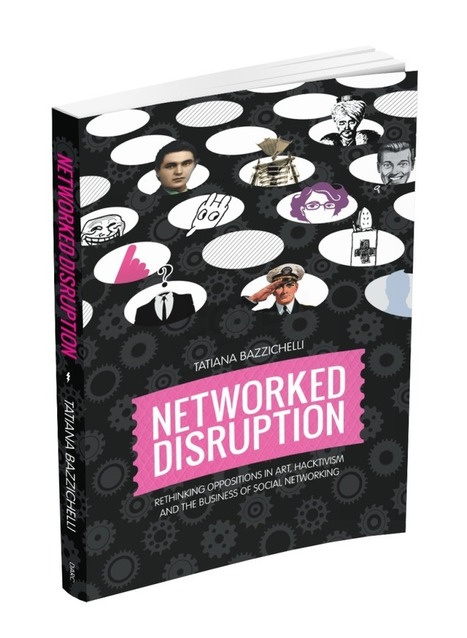
The current techno-economic paradigm of Web 2.0 has challenged notions of art and hacktivism within digital culture. The book “Networked Disruption” takes up this challenge and discusses a new perspective on political and social criticism. It simultaneously asks what are the conditions for hacker and artistic practices under Web 2.0 and how can social networking be seen to build on and incorporate artistic practices from the earlier decades of digital and network culture.
Through its theoretical discussion of contemporary art and hacktivism, the book maps out a new contradictory space for art and criticism: Networked disruption.
A pen and a pad specifically designed for sketching in the augmented environment. Free from any screen or computer, Gravity allows you to focus on what really matters, developing your ideas in an intuitive way.
As you start to draw, objects will take shape in front of you. Through the landing pad controls, you can adjust the plane in which you sketch, giving volume to your creation. With augmented reality glasses, Gravity reinvents how you and your collaborators visualize and contribute to each other’s ideas.
The project started with a strong belief: the tools that are commonly used for drawing, designing and making things in 3D limit people’s ability to bring their ideas to reality. Through numerous prototypes, tests and iterations, we created Gravity as a simple and engaging tool that will shape a new wave of 3D creation.
The Internet has turned everybody into an artist. Anyone can now release online a video, a song or a movie for the entire world to see. This phenomenon has deeply affected the cultural industries, apparently still struggling to adjust to this new model. Grégory Chatonsky explores the limits of this model with I’ll Be Your Mirror, his new exhibition opening next month at the Centre des Arts of Enghien-les-Bains, near Paris. The entire show is based around a single project, Capture, a set of generative machines producing autonomously the songs of a fictitious rock band, as well as its music videos, books and merchandising. The programs respond to each other and continuously create to the point that no human being can consume its entire production. Our desire for consumption is aroused but we soon realize that this quest for endless consumption has no point. Complex and sensible, Grégory Chatonsky’s exhibition will change your perception of the world we live in. ...
Ultimaker 2 open source design files and documentation, including the Bill of Materials, the 3D files and documentation for each part.
At March 28th, Ultimaker released the Ultimaker 2 source files to the world, as promised when the 3D printer was introduced 6 months earlier. From day one, we have been recognized for our open source culture and we feel that open source brings the field of 3D printing to a higher level. It is our firm belief that sharing knowledge does not mean losing knowledge. On the contrary, we learn from each other, inspire each other and use each other’s knowledge to create even better products and develop impressive innovations world-wide.
We are excited to see what kind of ideas, innovations, improvements and products this will lead to. We will continue to share our knowledge and experience and look forward to achieving many remarkable 3D printing goals together. Or in the words of Martijn Elserman, co-founder of Ultimaker: “Since its introduction, the Ultimaker 2 received a very positive response and its demand has been beyond expectation. This strengthens our confidence in our philosophy to innovate and improve together with the worldwide community of 3D printer enthousiasts.”
Literature written in the style of computer code, electro-acoustic compositions with newly created sounds, but also subcultures with clearly identifiable manifestations, from Internet porn to neo-Nazis and anti-copyright activists: high-, low- and subculture have long been impossible to distinguish, including in the degree of their self-reference. Art and media criticism focuses mainly on the concepts, not on the objects themselves.
In Anti-Media Florian Cramer shows, through a close reading of cultural expressions and analysis of media and art criticism, how these constantly refer to their tradition, language and medium while trying to subvert them.
Robot Fest is an annual event for anyone interested in the creative use of technology. We welcome all roboticists, hackers, artists, hobbyists and makers of any age who have the unquenchable urge to develop and create new, previously unseen forms from lifeless electronics, fabrics and mechanical parts. Join the fun and excitement with hands-on exhibits, and workshops!
L’Institut Genre, sexualité et féminisme (IGSF) de l’Université McGill est heureux d’inviter à la candidature de propositions de présentations pour un colloque d’un jour intitulé « ZÉR0 FUTUR ». L’événement est associé au festival féministe d’arts médiatiques + de culture numérique Les HTMlles 11 « ZÉR0 FUTUR », produit par le Studio XX et se tenant du 7 au 15 novembre à Montréal, Canada. Les HTMlles est une plateforme internationale dédiée à la présentation d’œuvres d’arts médiatiques indépendantes créées par des artistes s’auto-identifiant comme femmes, trans ou dissidents et dissidentes du genre, dans un environnement transdisciplinaire, axé sur l’anti-oppression.
Le vendredi 7 novembre 2014 Un colloque d’un jour associé à
Les HTMlles 11 | ZÉR0 FUTUR Festival féministe d’arts médiatiques + de culture numérique
Conjointement organisé par l’Institut Genre, sexualité et féminisme (IGSF) à l’Université McGill, Media@McGill, Les HTMlles 11 et le Studio XX.
The McGill Institute for Gender, Sexuality, and Feminist Studies (IGSF) is pleased to invite presentation proposals for a one-day conference entitled “ZER0 FUTURE”. The conference is associated with The HTMlles 11 “ZER0 FUTURE” feminist festival of media arts + digital culture, produced by Studio XX held November 7-15 in Montreal, Canada. The HTMlles is an international platform dedicated to the presentation of women’s, trans and gender non-conforming artists’ independent media artworks in a transdisciplinary environment that strives for anti-oppression.
Friday, November 7, 2014 A day-long conference associated with
The HTMlles 11 | ZER0 FUTURE Feminist festival of media arts + digital culture
Affone est un projet d’affiches sonores interactives. Elles sont des objets tangibles (objets physiques, permettant de manipuler du numérique), réalisées à l’aide d’encres conductrices sur du papier cyclus 80g. Le principe est de sortir le numérique de l’écran ; de garder l’aspect premier d’une affiche sérigraphiée avec ses qualités de grammage, de relief, de « toucher », mais en utilisant, pour certaines, des interactions numériques programmées. Affone est une série de huit affiches expérimentant le son : haut parleur, microphone, texte lu, lignes jouées… Elles mettent en scène des actions/réactions avec le spectateur et interrogent le support du numérique, la proximité…
Call for Papers Histories, Theories and Practices of Sound Art May 15 – 16 – 17, 2014 Venues: Goldsmiths, May 15 and 16, 2014; The Courtauld Institute of Art May 17, 2014.
Traditionally, the curator has been affiliated to the modern museum as the persona who manages an archive, and arranges and communicates knowledge to an audience, according to fields of expertise (art, archaeology, cultural or natural history etc.). However, in the later part of the 20th century the role of the curator changes – first on the art-scene and later in other more traditional institutions – into a more free-floating, organizational and ’constructive’ activity that allows the curator to create and design new wider relations, interpretations of knowledge modalities of communication and systems of dissemination to the wider public. ...
Graphical notation and composition by Candas Sisman Barabás Lőrinc: Trumpet Ölveti Mátyás: Cello Candas Sisman: Electronics and Objects
Budapest Art Factory (BAF) is pleased to present to you SYN-Phon; sound performance based on graphical notation by Candaş Şişman featuring Barabás Lőrinc & Ölveti Mátyás. Candaş Şişman resided at BAF for the month of June as part of its cross-cultural fertilization residency program. SYN-Phon will be exhibited to act, as a visual linguistic delivery through a cogitation segment followed by the sound performance on June 29th.
Les programmes de résidences de l’Institut français permettent à des créateurs français et étrangers – artistes, cinéastes, commissaires d’expositions, auteurs, etc. – de séjourner quelques semaines ou quelques mois dans un autre pays que le leur pour développer un projet de création, à l’aide d’une bourse ou de la mise à disposition d’un logement.
70 organisations unissent leur talent pour créer un printemps montréalais qui met de l’avant l’effervescence de la créativité numérique.
Le Printemps numérique résulte d’un partenariat initié par la Conférence régionale des élus (CRÉ) de Montréal avec une soixantaine d’organisations issues des milieux créatifs ou intéressées par les arts numériques. La première édition se déroule de la mi-mars à la mi-juin 2014. En connectant science, industrie et art, elle met de l’avant l’effervescence et le rayonnement de la créativité numérique montréalaise.
A panel of the National New Media Art Award 2012 shortlisted artists talk about their works on display and discuss contemporary new media art. Chaired by Peter McKay, Curator, Contemporary Australian Art & Amanda Slack-Smith, Assistant Curator, Australian Cinémathèque.
The National New Media Art Award is the most significant new media award in the country. The biennial award program comprises the $75 000 New Media Art Award and exhibition of shortlisted artists. The Award and exhibition showcase the work of leading Australian new media artists.
QAGOMA congratulates George Poonkhin Khut winner of the 2012 National New Media Art Award.
Five years ago, a team of researchers from Google announced a remarkable achievement in one of the world’s top scientific journals, Nature. Without needing the results of a single medical check-up, they were nevertheless able to track the spread of influenza across the US. What’s more, they could do it more quickly than the Centers for Disease Control and Prevention (CDC). Google’s tracking had only a day’s delay, compared with the week or more it took for the CDC to assemble a picture based on reports from doctors’ surgeries. Google was faster because it was tracking the outbreak by finding a correlation between what people searched for online and whether they had flu symptoms.
Processing est un langage de programmation simple pour la création multimédia : création visuelle, modélisation 3D, design d’interaction, art génératif, développement…
Patatap is a portable animation and sound kit. With the touch of a finger create melodies charged with moving shapes. While easy to pick up there is a wide range of possibilities. Switch between multiple color palettes and matching soundscapes on the fly. Whether its on your laptop, desktop, mobile phone, or tablet Patatap invites creators of all ages to engage the mind and senses in a different type of creation process. ...
To get content containing either thought or leadership enter:
To get content containing both thought and leadership enter:
To get content containing the expression thought leadership enter:
You can enter several keywords and you can refine them whenever you want. Our suggestion engine uses more signals but entering a few keywords here will rapidly give you great content to curate.


 Your new post is loading...