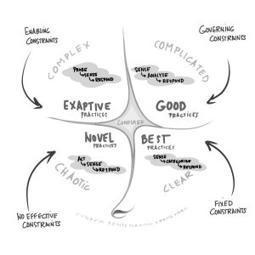
El Modelo Cynefin te ayuda a reconocer qué tipo de problema estás enfrentando en tu proyecto y cuál es la mejor forma de actuar: simple, complicado, complejo, caótico o desorden.
Il filamto parla del framework Cynefin (si pronuncia più o meno “Kunevin”), un modello concettuale sviluppato da Dave Snowden all’inizio degli anni 2000 per aiutare manager e leader a prendere decisioni in contesti complessi.
In sintesi:
Il problema di partenza: nel management spesso si cercano “ricette universali” (best practice) che dovrebbero funzionare sempre, ma in realtà falliscono perché ignorano la variabile fondamentale: il contesto.
La proposta del framework: invece di domandarci “qual è l’approccio giusto in assoluto?”, dobbiamo domandarci “in che tipo di contesto mi trovo?” e scegliere il metodo di gestione più adatto alla situazione.
I cinque domini del Cynefin:
Semplice (obvious) – cause ed effetti sono chiari e prevedibili, si applicano best practice (es. procedure standard in banca).
Complicato – le relazioni causa-effetto ci sono, ma non sono evidenti; servono esperti e analisi (es. diagnosi di un meccanico).
Complesso – cause ed effetti emergono solo retrospettivamente; servono esperimenti, apprendimento iterativo e adattamento (es. mercati finanziari, dinamiche sociali).
Caotico – nessuna relazione chiara, prevale l’imprevedibilità; occorre agire subito per contenere i danni e ristabilire un minimo d’ordine (es. gestione emergenze come l’11 settembre).
Disordine – il centro della mappa, quando non è chiaro in quale dominio ci si trova.
Un punto cruciale: il pericolo maggiore sta nel dominio semplice, perché quando si diventa compiacenti e si smette di monitorare il contesto, si rischia di precipitare all’improvviso nel caos.
👉 In pratica, il testo racconta che il Cynefin framework è una bussola per muoversi tra sistemi ordinati e non ordinati, riconoscendo che ogni contesto richiede un approccio decisionale diverso.
Neste vídeo, que é parte de uma aula do curso ITIL4® Practitioner: Incident, mostro o uso do modelo Cynefin (KNF) como ferramenta poderosa para compreender a complexidade dos incidentes e adotar a abordagem mais adequada em cada situação.
Introdução ao modelo Cynefin (KNF) e sua aplicação no ITIL4® - 00:00 Utilidade do modelo na categorização de incidentes - 01:39 Diferença entre situações claras, complicadas e complexas - 03:09 Quando aplicar a técnica de Swarming - 04:47
🗓️ 5 min Training: "Not Everything Benefits from a Best Practice Solution"
Attn: busy nonprofit CEOs who want to free up the time and brain space to focus on what matters most at your nonprofit!
Let's talk about Frameworks: Cynefin!
Not all challenges can—or should—be solved the same way. In this 5-minute training, I’ll introduce the Cynefin framework, which helps you sort problems into categories so you can stop overthinking the simple stuff and stop oversimplifying the complex stuff.
Join me for tactical, easy-to-implement practices that you can quickly implement at your nonprofit. I take topics from the field - real topics that real nonprofit CEOs we work with bring to us at PivotGround - and we discuss them so that you can get bite-sized nuggets to take into optimizing your work and getting a greater return on your mission impact.
Il vous est déjà arrivé qu’on vous demande de la visibilité alors que la seule chose que vous savez est que vous n’en avez aucune ? Ou au contraire on vous demande de faire roadmap, estimation, projection et comité de pilotage pour un projet sur lequel aucune erreur n’est possible ?
Nous vous invitons à venir découvrir Cynefin. Un outil modélisant plusieurs typologies de relation à une problématique et nous invitant à adapter nos comportements en fonction.
Utile pour améliorer l’alignement dans les équipes, augmenter les chances que les décisions que nous prenons fonctionnent ou tout simplement faire le grand saut de réduire la confusion. C’est une petite partie du potentiel de Cynefin que nous vous invitons à découvrir à travers ce talk.
The Cynefin Framework provides a structured way to understand and navigate the complexity of the world by categorizing situations into five domains: Simple, Complicated, Complex, Chaotic, and Disorder. Each domain suggests distinct decision-making approaches: • Simple (Obvious): Clear cause-and-effect relationships exist, and solutions rely on established best practices or standard procedures. Examples include routine tasks like changing a flat tire or following a recipe. The focus here is on adhering to straightforward rules. • Complicated: Cause-and-effect relationships are clear but require analysis or expertise to identify. These situations, such as diagnosing a mechanical issue or planning a surgical procedure, often benefit from expert input. The emphasis is on applying appropriate analysis and technical knowledge. • Complex: Multiple interconnected factors make cause and effect uncertain or emergent. Examples include developing a new vaccine or managing innovation in a dynamic market. Experimentation, iteration, and learning are critical to finding effective solutions. • Chaotic: High unpredictability and rapidly changing conditions dominate, as seen in natural disaster responses or market crashes. The priority is immediate action to stabilize the situation and impose order before addressing longer-term solutions. • Disorder: This domain represents uncertainty or confusion, where it’s unclear which of the other domains applies. Identifying the true nature of the situation is the first step toward resolution.
Sources: - Snowden, D. J., & Stanbridge, P. (2020). Cynefin: Weaving Sense-Making into the Fabric of Our World. [Detailed insights into the framework.] - Kahneman, D. (2011). Thinking, Fast and Slow.
Leadership challenges in today's world are increasing in intensity, complexity and frequency. Leaders need to upgrade their thinking skills with tools that enable them to wrestle with such adversities. In this webinar we explain what systems are and how systems thinking enable leaders to make a better sense of the world. We introduce Cynefin Framework as a world-class framework of contextualization and Causal Loop Diagrams who help us understand dynamics of interactions in systems.
The Cynefin Framework and Estuarine Mapping (Estuarine Framework); Frequently mentioned, but what are they and how are they related?Most people who will come across this blog will probably be familiar to some extent with the Cynefin Framework, and increasingly more people are becoming familiar with...
Douglas Squirrel, author of Agile Conversations, joins Bill Raymond on the Agile in Action podcast. Douglas discusses the misconceptions around agility in tech teams and the importance of experimentation in complex environments.
Bill and Douglas discuss the benefits of rapid experimentation, handling complexity and chaos, and avoiding common pitfalls in software development.
In this podcast, you will learn the following:
✅ The Cynefin framework for managing complexity
✅ The importance of experimentation in software teams
00:00 Introducing Douglas Squirrel 00:27 Defining Agility in Software Teams 01:35 Introduction to the Cynefin Framework 03:15 Exploring the Simple and Complicated Quadrants 04:51 Understanding the Complex and Chaotic Quadrants 11:19 Dealing with Burnout in Complex Environments 13:37 Delivering Value Through Experimentation 17:16 The Value of Negative Results 17:50 Challenging the Concept of Best Practices 18:26 Explaining Failures to Clients 18:53 Embracing Complexity in Innovation 21:07 Signs You're Not in the Complex Domain 23:13 The Danger of Not Testing Innovations 25:04 Encouraging Frequent Customer Feedback 26:39 Designing Effective Experiments 30:13 Real-World Examples of Experimentation 33:02 Conclusion and Contact Information
Digitalisation in an inherently complex activity, with unknowns being very high and experimentation required on an ongoing basis - there is no 'once and done'. The changes in leadership framing, decision making and ways of working required are hugely under estimated in discussions and planning of 'transformation' and failure to engage with that could risk your success.
Dave, Sjoukje & Rob talk with Dave Snowden, Director and Founder of the Cynefin Centre about his work on making sense of complexity, they discuss Dave's seminal work, the Cynefin Framework, how he has subsequently built on that thinking and how you apply that it in the digitalisation process of your organisation. His insights are not to be missed.
Finally, in this weeks Trend, we set out some perceived wisdom of what is required in digital leadership and see what stacks up.
TLDR: 00:43 Intros 01:21 Cloud conversation with Dave Snowden 24:53 Six Tips For CEOs for Leading Digital Transformations 40:31 Wainwright walks!
THE CYNEFIN FRAMEWORK https://thecynefin.co/about-us/about-cynefin-framework/ Cynefin, pronounced kuh-nev-in, is a Welsh word that signifies the multiple, intertwined factors in our environment and our experience that influence us (how we think, interpret and act) in ways we can never fully...
In this video, I introduce the Cynefin Framework, a powerful tool for understanding decision-making in different contexts. To bring the framework to life, I draw on two very different examples: • The Israelites’ journey from Egypt to the Promised Land, highlighting how their challenges map across different kinds of problems • Everyday air travel experiences — including what happens when a snowstorm hits a Houston airport
We’ll see how the framework helps leaders distinguish between problems that require clear rules, expert judgment, patient trust, or urgent action.
I close by exploring how artificial intelligence fits into the Cynefin framework — where AI performs well, where it struggles, and what this means for the future of work. Most importantly, we’ll discuss how to future-proof our jobs in an AI-driven world by developing skills that remain uniquely human.
Whether you’re a student of leadership, a professional navigating uncertainty, or just curious about how faith, travel, and technology can all illuminate decision-making, this talk offers practical insights and encouragement.
Keywords: Cynefin Framework, Leadership Lecture, Decision Making, AI and Jobs, Biblical Examples, Airport Travel Analogies
This episode introduces learners to the importance of complexity thinking in agile environments, where uncertainty, emergence, and unpredictability often challenge linear planning. It begins by framing the concept of complex adaptive systems (CAS), which describe how interactions among agents create outcomes greater than the sum of parts. The Stacey Matrix is then explained as a tool for classifying scenarios based on the level of certainty around requirements and technology. These models help practitioners decide when agile approaches are appropriate and when traditional methods may suffice.
The discussion then explores the Cynefin framework, which offers a more dynamic and nuanced classification of contexts. By distinguishing between clear, complicated, complex, chaotic, and aporetic domains, Cynefin helps teams tailor decision-making strategies to their environment. Candidates learn how PMI often frames exam questions using scenarios that implicitly map to these models, requiring recognition of complexity signals. This grounding ensures learners can apply classification frameworks to interpret uncertainty and choose the right practices. Produced by BareMetalCyber.com.
Though many innovators claim to embrace risk, in practice, the vast majority treat it as a toxic spill, trying to avoid it. This series of articles explores the hidden forces of innovation: chaos, risk, and uncertainty, and how to leverage, not mitigate, them.
Have you ever had a problem that, in trying to solve it, you have made it worse?
When trying to solve problems we make mistakes when we don’t properly understand the problem in the first place. Therefore, one critical step in decision-making is classifying the type of problem that you are trying to solve.
This is where the Cynefin framework can help us. It is a critical thinking, decision-making and problem-solving model championed by the Harvard Business Review and used by countless decision-makers, such as the US and UK governments.
Mondo 2000 - Chaos & Complexity Pdf Library. .:ESRA On-Line. Psychonautics. LSD.Mutant Yippies, LSD, and Cyberpunks: The Story of the Space Age Newspaper 'High...
In what's become a bit of a tradition here at the Lounge, we're delighted to welcome back Dave Snowden for our December meetup.
Dave will discuss how we need to deliberately change the conversation from talking about desirable behaviors to changing the environment so that desirable behaviors emerge. Other topics include discussing Emergence, updates on Estuarine Mapping, and the various schools of Complexity, and whatever else is on Dave's mind. It's always a pleasure to spend time with Dave and hear about where he thinks this thing we call complexity is going.
*Dave Snowden* Dave is the founder and Chief Scientific Officer of The Cynefin Company (formerly known as Cognitive Edge) and the founder and Director of the Centre for Applied Complexity at the University of Wales. His work has been focused on looking at complex issues relating to strategy and organizational decision-making. He has pioneered a science-based approach to complex organizational issues - drawing on anthropology, neuroscience, and complex adaptive systems theory.
*Timestamps* 00:00:00 Intro 00:00:54 *Opening Remarks* 00:03:28 Emergence 00:14:44 Estuarine Mapping 00:19:43 Individuals (Mental Models, Mindsets), Interactions, Environment (substrates) 00:28:40 Changing the Context, Energy Gradients 00:31:05 Schools of Complexity (Computational, Psychodynamic, Anthro) 00:35:49 *Group Discussion* 00:37:10 Novelty Processing 00:42:34 Working with Leaders (Crews) / C-level 00:49:14 Mindsets, revisited 00:53:38 Emergence, revisited 00:56:06 Mental Models, revisited 01:04:40 Pitfalls of Binary Thinking 01:07:55 From Workshops towards Distributed Decision-making 01:12:33 Neuro-diversity & Cognitive Styles 01:22:24 Identities & Roles 01:26:16 Granularity and Abstraction 01:28:40 AI (mandatory AI discussion) 01:32:43 Stability / Instability 01:38:12 Strategic Management / Leadership 01:44:58 Language revisited 01:46:32 Workshops (and Facilitation), revisited 01:52:40 Summary and big shoutout to our 2024 Speakers & Members!!!
We are delighted to welcome Dave Snowden to the Complexity Lounge. Dave joins us to discuss his latest thoughts on the applications of constructor theory in complex systems, as well as the latest iterations of the Cynefin framework and whatever else is on his mind. Please join us as Dave helps us bring the first year of our virtual meetup to a close.
*Dave Snowden* Dave is the founder and Chief Scientific Officer of The Cynefin Company (formerly known as Cognitive Edge) and the founder and Director of the Centre for Applied Complexity at the University of Wales. His work has been focused on looking at complex issues relating to strategy, and organizational decision making. He has pioneered a science-based approach to complex organizational issues - drawing on anthropology, neuroscience, and complex adaptive systems theory.
The Cynefin Framework, created by Dave Snowden and Mary Boone in 1999, categorizes problems into five domains: Simple, Complicated, Complex, Chaotic, and Disorder. This helps decision-makers determine the nature of issues and choose appropriate responses. Simple issues need straightforward solutions, Complicated problems require expert analysis, Complex situations use a probe-sense-respond strategy, Chaotic conditions need immediate action, and Disorder indicates confusion about which domain applies. This framework assists in avoiding oversimplification of complex issues or overcomplication of simple ones. Effective use involves continual reassessment, open dialogue, and agile response strategies.
Understanding the Simple, Complicated, Complex, and Chaotic Quadrants
Simple, represented by a common car, where everything is easily understood; Complicated, like a Formula One car, which requires expert knowledge and the following of rules; Complex, akin to a test pilot flying a new airplane, which involves unknowns and requires exploration; and Chaotic, similar to an aircraft in a tailspin, where quick and random actions are necessary to regain control.
The Cynefin Framework sets out different lenses through which circumstances can be made sense of, from 'clear' through to 'chaos'! As we have covered on previous episodes of the show (CR020 & CR003), it is very useful for helping frame and understand the shift to “digital”.
This week, Dave, Sjoukje, and Rob talk to Rob England and Cherry Vu, who are Teal Unicorn and explore new ways of management, about the relevance of the Cynefin Framework in their work with organisations, the builds Rob and Cherry have made on it (with Dave Snowden!), and what results they have seen. We also talk about ways to drive additional value from the Cloud.
TLDR: 01:00 Anti-Compentative UK probe into Cloud Service Providers 04:40 Cloud conversation with Rob England and Cherry Vu 44:13 Three actions to unlock greater Cloud Value 51:50 Celebrating Robs 21st birthday and a Corporate Rebels write up!
Mastering Project Uncertainty – A Systems Thinking Approach by Paul Cuypers offers a theoretical framework and practical models, tools, techniques, and guidelines to systematically minimize uncertainty, thereby increasing the chances of project success.
To get content containing either thought or leadership enter:
To get content containing both thought and leadership enter:
To get content containing the expression thought leadership enter:
You can enter several keywords and you can refine them whenever you want. Our suggestion engine uses more signals but entering a few keywords here will rapidly give you great content to curate.


 Your new post is loading...


 Scoop.it!