


Nadine Zangarini - installation, Kamil Iwaszczyszyn - mural,
exhibition Batiment 4, Esch-sur-Alzette, Luxembourg, 12/11-06/12/2020
https://www.kaiwa.studio/about

 Your new post is loading...
 Scoop.it! Nadine Zangarini - installation, Kamil Iwaszczyszyn - mural, exhibition Batiment 4, Esch-sur-Alzette, Luxembourg, 12/11-06/12/2020
https://www.kaiwa.studio/about

No comment yet.
Sign up to comment
Scoop.it!

Miikka Heinonen, exhibition Batiment 4, Esch-sur-Alzette, Luxembourg, 12/11-06/12/2020
Scoop.it!

Gérard Claude, exhibition Batiment 4, Esch-sur-Alzette, Luxembourg, 12/11-06/12/2020
Scoop.it!

Marc Soisson, exhibition Batiment 4, Esch-sur-Alzette, Luxembourg, 12/11-06/12/2020
https://marcsoisson.tumblr.com/
Scoop.it!

Jeff Keiser, exhibition Batiment 4, Esch-sur-Alzette, Luxembourg, 12/11-06/12/2020
Scoop.it!

Chiharu Shiota: Butterfly Dream, Museum of Kyoto, 2018
https://www.chiharu-shiota.com/butterfly-dream
Scoop.it!

Chiharu shiota “Navigating the Unknown”, König Galerie, London, UK, 2020
https://www.chiharu-shiota.com/
Scoop.it!

Akihito OKUNAKA, installation, Biwako Biennale, Omihachiman, Shiga, Japan, 2020
Scoop.it!

Artist: Strijdom van der Merwe: installation: WAVE. Constructed from reeds. Ephemeral, Neuchatel, Switzerland, 2020.
Scoop.it!

Jerzy Kalina: Poisoned source, 2019, National Museum, Warsaw - response to the famous work by Maurizio Cattelan.
Scoop.it!

Jonathan Prince, Shatter Series, cor-ten and polished steel, in situ at Christie’s Sculpture Garden 2019, New York
Scoop.it!

Agostino Fasolato 1714-1787.
Scoop.it!

Ariel Moscovici, "Between Two Points X" (1998). Bronze. 11,5 x 45 x 11,5 cm
http://acasculpture.blogspot.com/2011/05/sculptures-cote-jardin-ariel-moscovici.html
|
Scoop.it!

Elmar Hubert, exhibition Batiment 4, Esch-sur-Alzette, Luxembourg, 12/11-06/12/2020
http://elmar-hubert-skulptur-plastik.de/
Scoop.it!

Patricia Lippert, Pascale Behrens, exhibition Batiment 4, Esch-sur-Alzette, Luxembourg, 12/11-06/12/2020
Scoop.it!

Claus G. Beeskow Camarda, exhibition Batiment 4, Esch-sur-Alzette, Luxembourg, 12/11-06/12/2020
Scoop.it!

Marc Soisson, exhibition Batiment 4, Esch-sur-Alzette, Luxembourg, 12/11-06/12/2020 https://marcsoisson.tumblr.com/
Scoop.it!

Théid Johanns, exhibition Batiment 4, Esch-sur-Alzette, Luxembourg, 12/11-06/12/2020
https://lb.wikipedia.org/wiki/The%27d_Johanns
Scoop.it!

Chiharu Shiota: “May to Day”, The Gwangju Biennale, 2020
As part of a special exhibition, the installation “The Language of God” is presented at the Former Armed Forces’ Gwangju Hospital . The work was inspired by the Japanese relation to Christianity. As the bible and Christianity were forbidden, this did not stop people from spreading the contents verbally. The Bible itself was not as important for the people as the act of adapting its meaning in order to make it their own personal guide book. Pages flow in the air like lost words ending up in each individual’s mind.
https://www.chiharu-shiota.com/
Scoop.it!

Akihito OKUNAKA, installation, Biwako Biennale, Omihachiman, Shiga, Japan, 2020
Scoop.it!

Maurizio Cattelan: La Nona Ora, 1999, Red carpet, glass, wax, painted lifesize figure, Venice Biennale
Scoop.it!

Marina Abramovic, Rhythm 0, performance, 1974To test the limits of the relationship between performer and audience, Abramović developed one of her most challenging (and best-known) performances. She assigned a passive role to herself, with the public being the force that would act on her. Abramović placed on a table 72 objects that people were allowed to use in any way that they chose; a sign informed them that they held no responsibility for any of their actions. Some of the objects could give pleasure, while others could be wielded to inflict pain, or to harm her. Among them were a rose, a feather, honey, a whip, olive oil, scissors, a scalpel, a gun and a single bullet. For six hours the artist allowed audience members to manipulate her body and actions without consequences. This tested how vulnerable and aggressive human subjects could be when actions have no social consequences. At first the audience did not do much and was extremely passive. However, as the realization began to set in that there was no limit to their actions, the piece became brutal. By the end of the performance, her body was stripped, attacked, and devalued into an image that Abramović described as the "Madonna, mother, and whore. Additionally, markings of aggression were written on the artist's body. There were cuts on her neck made by audience members, and her clothes were cut off her body. With an initial determination to find out how the public acts with no consequences tied to their actions, she realized by the end that the public might very well have killed her for their own personal enjoyment. In her works, Abramović affirms her identity through the perspective of others, however, more importantly by changing the roles of each player, the identity and nature of humanity at large is unraveled and showcased. By doing so, the individual experience morphs into a collective one and creates a powerful message. Abramović's art also represents the objectification of the female body, as she remains motionless and allows spectators to do as they please with her body; the audience pushes the limits of what one would consider acceptable. By presenting her body as an object, she explores the elements of danger and physical exhaustion. Initially, members of the audience reacted with caution and modesty, but as time passed (and the artist remained passive) people began to act more aggressively. As Abramović described it later: "What I learned was that ... if you leave it up to the audience, they can kill you. ... I felt really violated: they cut up my clothes, stuck rose thorns in my stomach, one person aimed the gun at my head, and another took it away. It created an aggressive atmosphere. After exactly 6 hours, as planned, I stood up and started walking toward the audience. Everyone ran away, to escape an actual confrontation."
https://en.wikipedia.org/wiki/Marina_Abramovi%C4%87
*** En 1974, Marina Abramovic a réalisé une performance où elle disait aux visiteurs qu'elle ne bougerait pas pendant six heures, quoi qu'ils lui fassent. Elle a mis 72 objets à disposition sur une table de son côté qui pourraient être utilisés pour plaire ou détruire, y compris des fleurs à un couteau et une arme chargée. Elle a invité les visiteurs à utiliser les objets dessus comme ils le souhaitent. Au départ, a déclaré Abramović, les visiteurs étaient pacifiques et timides, mais ils sont rapidement devenus violents : ′′ L ' expérience que j'ai appris était que... si vous laissez la décision au public, vous pouvez vous faire tuer... Je me suis senti très violée. Ils ont coupé mes vêtements, mis des épines de roses dans mon ventre, quelqu'un m'a pointé l'arme sur la tempe, et une autre a retiré son arme de près. Cela a créé une atmosphère agressive. Après exactement 6 heures, comme prévu, je me suis levé et commencé à marcher vers le public. Tout le monde s'est enfui en courant, échappant à une vraie confrontation." Cette performance a révélé quelque chose de terrible sur l'humanité, semblable à ce que l'expérience de l'arrestation de Stanford, Philip Zimbardo et l'expérience d'obéissance de Stanley Milgram ont également montré la rapidité avec laquelle les gens s'agressent selon les circonstances. Cette performance a montré à quel point il est facile d'inhumaniser une personne qui ne peut pas se défendre, et est particulièrement puissante parce qu'elle défie ce que nous pensons savoir de nous-mêmes.
Scoop.it!
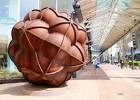
J.K. Virkkunen: "CORPUS MINOR #1", public artwork on "Art Avenue", a street that goes from Kanazawa Station to downtown Kōrinbō, Japan
Scoop.it!

Ariel Moscovici: The Space Between II, sculpture, stainless steel, 440 x 900 x 900cm
https://vietnamnews.worldtimes.news/french-sculptor-realises-dream-in-viet-nam/
http://arielmoscovici.free.fr/
|





