


Marian Bijlenga : untitled (with detail),2000; dyed horsehair, coton; 57 by 57 inches. Courtesy of gallerymateria, Scottsdale, Ariz

 Your new post is loading...
 Scoop.it! Marian Bijlenga : untitled (with detail),2000; dyed horsehair, coton; 57 by 57 inches. Courtesy of gallerymateria, Scottsdale, Ariz

No comment yet.
Sign up to comment
Scoop.it!

Dani Karavan: "Kikar Levana", (White Square, Detail), 1977–88. Edith Wolfson Park, Tel Aviv, Israel.
Scoop.it!

Jannis Kounellis, Chaumont-sur-Loire, Château de Chaumont-sur-Loire, 2011
Realization of the order for the Château de Chaumont-sur-Loire which, featuring organic and industrial elements, questions the relationship between nature and culture
Scoop.it!

Henrique Oliveira, 2010, Smithsonian, Washington DC
These whirling columns seem to arise both from the ground and dive from the ceiling, creating a fusion between stalagmites and stalactites that turns the place into living cave.
Scoop.it!

Jorge Mayet is a Cuban artist who exhibits mainly in Spain. His job is to make sculptures of trees plants or natural objects, in very small size, a few centimeters.
Scoop.it!

Tomasz Domański: "Industrial Grotto", 1998, Sculpture Space, Utica, USA, wax, metal, gas burners, h = 250 cm 250 x 250 cm
In the industrial area called the cave there are two types of forms. Some are "mechanical", these are stalactites, the second - stalagmites have organic shapes, created by the cascade of accumulating the drops of wax, dripping with stalactites hanging from the ceiling.
Scoop.it!

Cai Guo-Qiang: “Head On”, National Art Museum of China, Beijing, China, 2008 A pack of 99 wolves (constructed from an iron armature and sheepskins) crashed into a glass. Great determination in this confrontation inevitable, all the wolves following it religiously. Fatalism quite upsetting.
Scoop.it!

Constellation humaine, 1998
Chen Zhen est un artiste-plasticien chinois né en 1955 à Shanghai et décédé le 13 décembre 2000
Scoop.it!

Chiharu Shiota: "During Sleep", 2005, Museum Moderner Kunst Karnten, Klagenfurt, Austria
Scoop.it!

Chiharu Shiota: "Dialogue from DNA", Manggha Centre of Japanese Art and Technology, Krakow, Poland, 2004
Scoop.it!

Wela (Elisabeth Wierzbicka), an enviromental installation: "Crown of Thorns", 2011, Paris International Golf Club, Baillet-en-France Crown of thorns, borrowed from Christianity, Wela symbolizes both the vivacity of nature, considering it as a creation much more complex than can be that of an artist, and the image of a nature suffering, what we need to defend and protect.

Merlin alejandra Diaz Guisao's curator insight,
September 20, 2022 1:03 PM
analogías profundas, ejemplificando el sufrimiento que un día se vivió y ahora, comparando con la naturaleza que sufre y debemos cuidar.
|
Scoop.it!

Dani Karavan: "Way to the Hidden Garden", 1992–99. Sapporo Open Air Sculpture Park, Sapporo, Japan.
Scoop.it!

Wela (Elisabeth Wierzbicka): « Suspended Passage » Installation, 2006, The Street Arts Festival, Sotteville-lès-Rouen
Scoop.it!

Wela (Elisabeth Wierzbicka): « Suspended Passage », artist is preparing the installation, 2006, The Street Arts Festival, Sotteville-lès-Rouen
Scoop.it!
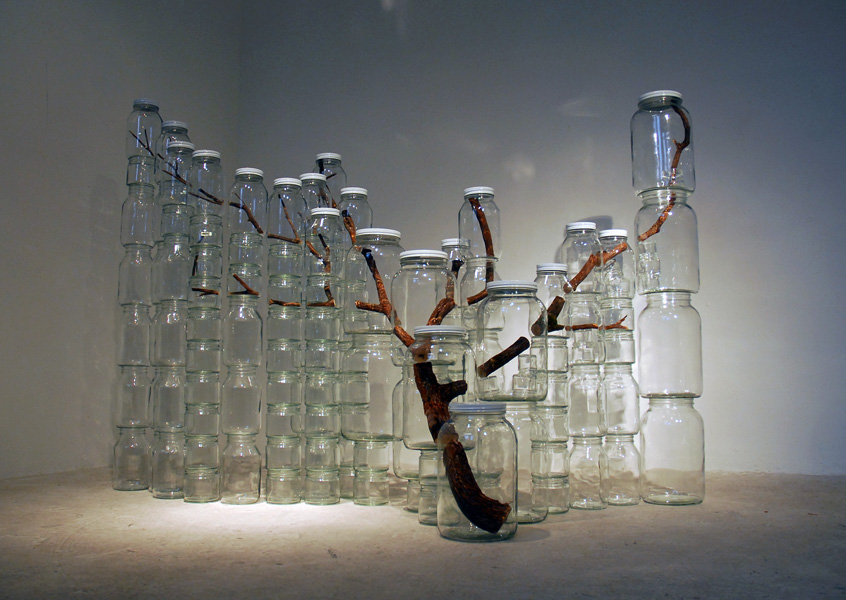
Naoko Ito: "Urnban nature: Ubiquitous”, 2009, Jar, tree, 50h x 70w x 35d in
Scoop.it!

Jorge Mayet, at Horrach Moya Gallery, Palma de Mallorca
Jorge Mayet is a Cuban artist who exhibits mainly in Spain. His job is to make sculptures of trees plants or natural objects, in very small size, a few centimeters. Objects made of fabric, acrylic, and paper copies are not consistent with reality. Jorge likes to think of dispossessing them of trees or ground. The report is particularly elegant.
Scoop.it!

Chen Zhen: Emerging fountain , 1999-2008, Paris
Scoop.it!

Xavier Veilhan: "The Coach", 2009, Chateau de Versailles, welded sheet steel, acrylic paint
Scoop.it!

Louise Bourgeois: sculpture of a spider, Centre Pompidou, Paris, 2008
Scoop.it!

View of a sculpture by Berlin-based Japanese artist Chiharu Shiota in Berlin. The artist stuck hundreds of shoes to the facade of a building in the city's Mitte district as part of the "Torstrasse, 166 -- House of Imagination" exhibition. 2008.
Scoop.it!

Simon Starling, "Autoxylopyrocycloboros", 2006, film
A somewhat unwieldy name for such an elegant and conceptually resolved work. The film meticulously shot on super 16mm, which seems to be the contemporary art moving image medium of choice at the moment, features two men in a boat navigating a picturesque mist-shrouded Scottish Loch. I assume that one of the men is the artist. The boat is an old wooden one powered by a fuel burning stove, the two men are hard at work sawing pieces of the boat away which in turn are used to fuel the engine that propels its passage. And so it goes until the boat finally starts taking on water and rather undramatically sinks.
|






