


"Teaser of the Festival of Lights to be held in Lyon from December 8 to 11, 2011."

Art Installations, Sculpture, Contemporary Art
703.9K views |
+21 today
The diversity of approaches. You can see more at: https://fr.pinterest.com/alternatiview/installation-art-sculpture-contemporary-art/ or at: https://www.pinterest.fr/alternatiview/
Curated by
Anne Bak
 Your new post is loading...
 Scoop.it! 
Sean Mc Ginnis : "A lotus for Noreen", installation in String, 2m x 1m x 1m - 6,56' x 3,28' x 3,28', MAC, Paris 2009
mcginnis.fr/ 
Scoop.it!

Gabriel Orozco, Mexican artist Orozco’s exploration of the use of installations in addition to his photographs and sculptures, allows the audience’s imagination to explore the creative associations between often-ignored objects in today’s world. His work permits a rarely allowed interaction between the artwork and the audience.
Scoop.it!
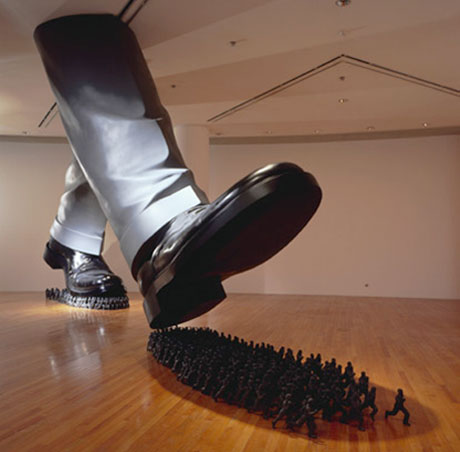
Do-Ho Suh:"Karma", 2003, installation at the Artsonje Center, Seoul
A Korean artist, Do Ho Auh’s sculptures are architectural environments, beautifully and meticulously crafted. whether addressing the dynamic of personal space versus public space, or exploring the fine line between strength in numbers and homogeneity, he constructs site-specific installations that question the boundaries of identity. His work explores the relation between individuality, collectivity, and anonymity.
The Theory of karma and its manifestation on the three dimensional plane, artistically, as a visual art , is articulated as memory coming to consciousness as a recall, and repeat of what occurred in the past now imposed on a imposed in the actual. Artistically, a representation of an opportunity to resolve incompatible memories. …
Scoop.it!

Bruce Shapiro: "Pipedream III", Ontario Science Centre, Toronto, 2006
Bruce Shapiro is one of the world's pioneers in DIY computer controlled kinetics. For over a decade, the California-based tinkerer has been designing software to automate a range of machines—from a stratograph, which makes highly-detailed sand art (pictured), to a series called "Sisyphus" that creates intricate mandalas in sand using a ball bearing and a tilt table. Check it out after the jump, along with an image from Shapiro's "Pipedream III," a hi-res bubble raster or embolograph that's capable of reproducing faces.
Scoop.it!

Shawn Lani: "Icy Bodies" swirls art and science in this mesmerising installation. Shards of frozen dry ice sublimate as they are released into a satisfyingly large and dark basin. The gas then propels them, leaving little wakes at they snake about. It's like watching from a plane lots of crewless boats with their engines left on randomly exploring the moonlit night ocean.
shawnlani.com/
Scoop.it!

Maria Lopes: "Consciousness Field", 2009, The Brain Unravelled, Slade Research Centre, London
Scoop.it!

Bright Ugochukwu Eke (NIG): Acid Rain, 2009, RETHINK - Contemporary Art & Climate Change, Copenhagen
Scoop.it!

Monika Sosnowska’s architectural installation "Stairway" at K21 in Dusseldorf, 2010
Scoop.it!

Designed by an Austrian artist, Manfred Kielnhofer, the Time Guards (Wachter der Zeit) installation is based on the constant struggle with concepts of space, sculptures and installations as well as the engagement of mysticism and primal religions. Art Sculpture at Festival of Lights Berlin, 2011
Scoop.it!

Sound installation from Arno Fabre - 2009. LES SOULIERS (THE SHOES) is an ensemble of thirty pairs of shoes mechanically queued by tramplers and computer-controls.
|
Scoop.it!

Sean McGinnis, American artist living in Paris His works are made of floating rope / suspended in space, held in place by the tension of the son and attached to the elements of the place. These facilities take between one and three weeks to be completed and they are often ephemeral. As they are created on site, they are intimately related to their respective sites, they can not be displaced and are being dismantled at the end of the exhibition. The work of the plant is considered as an important part of the work
mcginnis.fr/
Scoop.it!

Do-Ho Suh: “Paratrooper I”, 2004, installation at the Gallery Lehmann Maupin, New York
Scoop.it!
http://technorama.ch/Videos.138.0.html...
Bruce Shapiro is one of the world's pioneers in DIY computer controlled kinetics. For over a decade, the California-based tinkerer has been designing software to automate a range of machines—from a stratograph, which makes highly-detailed sand art (pictured), to a series called "Sisyphus" that creates intricate mandalas in sand using a ball bearing and a tilt table. Check it out after the jump, along with an image from Shapiro's "Pipedream III," a hi-res bubble raster or embolograph that's capable of reproducing faces.
Scoop.it!

"Wind-Arrows", outdoor works exhibition at Fort Mason. A sculpture stretching 35 feet in height, it is intended to show just how different the wind can be at varying heights. The wind goes in different directions at different altitudes.
The Outdoor Exploratorium at Fort Mason was created by the Exploratorium in partnership with the Golden Gate National Recreation Area and Fort Mason Center. These interactive exhibits were designed to help visitors notice and investigate the subtle phenomena of the everyday world and explore the complex systems at play in outdoor environments. Fort Mason offers a unique location for observing the movement of wind and waves, the interplay of light, shadow, and temperature, and the interaction between natural and built environments.
The Exploritorium, San Francisco, opened in 1969, was America's first hands-on science museum. It was founded by physicist and educator Frank Oppenheimer, brother of atomic bomb developer, J. Robert Oppenheimer. The "museum of science, art and human perception" features over 650 exhibits based on interactive participation. Housed in a giant half-moon-shaped structure behind the Palace of Fine Arts these exhibits feature engaging examinations of physics, electricity, life sciences, thermodynamics, weather, light, psychology, linguistics and sense perception.
http://www.exploratorium.edu/outdoor/#/vrlocation/you-are-here/
Scoop.it!
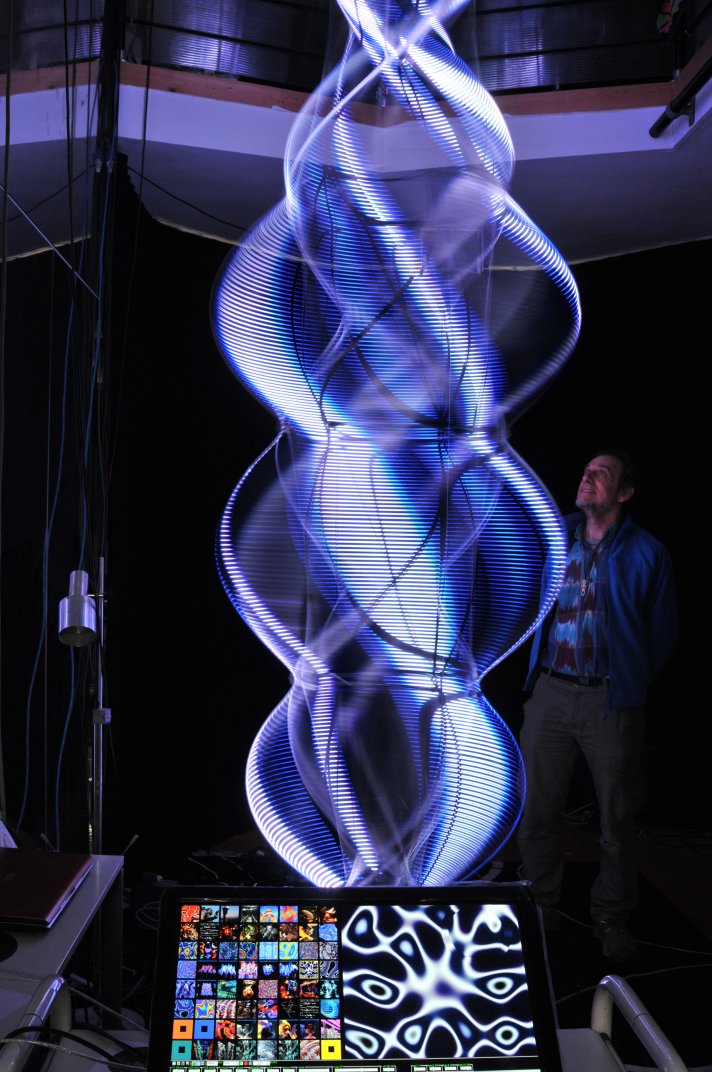
Paul Friedlander: "Art Futura XXI", Bilbao, Spain, 2011- Alhondiga Bilbao Interactive light sculpture: visitors select images of earlier Friedlander's artworks using a touch screen. The images are digitally processed in real time using custom software to create a pallete of colours in the new light sculpture. Below the light sculpture is the touch screen used for interactive control. The sculpture is an example of the use of artist's invention chromastrobic light, light that changes colour faster than the eye can see. The sculpture is in fact lit by only one colour at each instant but appears to be multi-coloured. These photos faithfully show how it looks to the human eye.
Scoop.it!
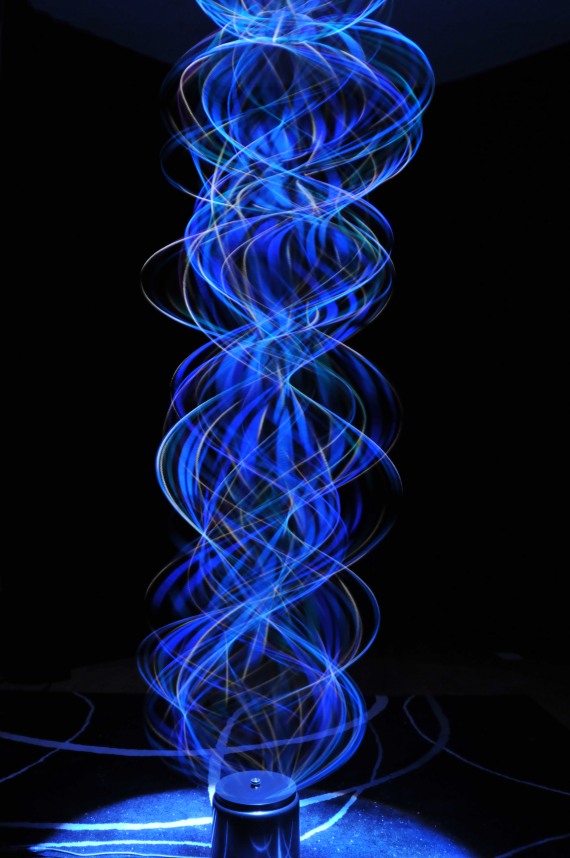
Paul Friedlander: "Outside Time", "The Brain Unravelled" (An exhibition in three discplines, art, anthropology and neurology.), Slade Research Centre, London, 2009 The installation is a development of the long standing wave series. It is light sculpture to be lit entirely by LEDs.
Scoop.it!
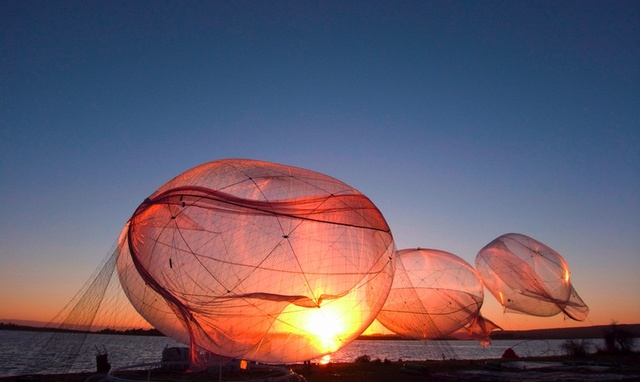
Tomas Saraceno: Space Elevator II, 2009, RETHINK - Contemporary Art and Climate Change, Copenhagen
Scoop.it!

Ryan Gander: "Really Shiny Things That Don’t Mean Anything" (Warsaw, 2011-2012)- is the first installation in the series of artistic interferences in the urban space to be exhibited under the collective title “New place (Tribune)” (the project is a joint initiative of the Warsaw City Hall and the Museum of Modern Art). British artist, Ryan Gander created a sculptural installation composed of a nearly 3m dia sphere, which imitates a magnet attracting shiny metal-like objects.
Scoop.it!

Climate change campaign at Berlin by Brazilian artist Nele Azevedo was extremely creative and dark. It was an installation art consisting of 1000 tiny ice sculptures of men sitting on the steps of Berlin concert hall. This artistic installation on the occasion of release of the report entitled Impact of Global Climate Change was sponsored by WWF. 2009
neleazevedo.com.br/
Scoop.it!

Steven Siegel: "Freight and Barrel", 2004, Three Rivers Arts Festival, Pittsburgh, this work is made of crushed plastic packaging
|






