This Instructable explains how to use a gas sensor with your Arduino.
This lets your Arduino smell (and hence you program responses to) overall gas levels for a variety of nasties, including ethanol, methane, formaldehyde, and a bunch of other volatile organic compounds.
My cost to make this actual device was under $100, including the full Arduino kit.
Like the idea of making coffee on the fly? from your bed? While you're on the bus coming home? Then the Tweet-a-pot is for you!
Tweet-a-pot is the next in fancy twitter enabled devices. This coffee pot enables its owner to make a pot of coffee from anywhere they have cell phone reception, using twitter and an arduino board.
The tweet-a-pot is the easy implementation for remote device control! with a bit of code and some hardware, you can have your very own twitter enabled coffee pot.
Getting stuck out in the rain without keys was the motivation for this project. It lets you trigger a garage door opener through a website hosted by an Arduino. With the Arduino connected to a wireless network, you can use your smart phone to connect to the webserver, enter a password, activate the garage door and get inside before getting drenched in the downpour. A MegunoLink Pro interface panel is used to configure the program: setting up to 10 passwords, which are stored in the device’s EEPROM.
Hello guys! In this instructable I'll teach you how to make a very simple proximity sensor using infrared LEDs and Arduino. After several times trying to optimize it, I finally came up with something that is quite simple e precise. Just like my first instructable, this project is perfect for beginners in the arduino's world, with a few components anyone can make it. I hope you all enjoy it.
At the Codemotion in Milano, I had a chat with Federico Vanzati from Officine Arduino, and he gave me the fantastic idea to try to use a supercheap USB Audio card with Arduino Yún to give to it full audio capabilities with zero effort.
Optical mouse uses a small camera that records surface to calculate movements of the mouse. In this tutorial I will show you how to display video signal of this camera in your browser.
The mouse I took apart was an old Logitech RX 250 which contains ADNS-5020 optical sensor. This sensor records 15x15 pixel images in grayscale. It also calculates X-Y movements of the mouse.
Adafruit is excited to add another product to the growing Adafruit Bluefruit line, this time it's the Bluefruit EZ-Link: the best Bluetooth Serial link & programmer ever made. "Like you, we have purchased all sorts of Bluetooth devices with high expectations - we just wanted something that worked! But nothing ever did exactly what we wanted: there was always some configuration modes to wade through, and trying to reprogram an Arduino is impossible. So we did what we always do, we went in and engineered something better. Something that works!"
What if making an Arduino, or wiring up an Arduino was as easy as printing one out? In this tutorial we printed our own Arduino Pro Mini board using a pen plotter and the Electroninks Circuit Scribe (a rollerball pen with highly conductive ink). Within 15 minutes we printed the board, placed components down with glue or tape, and uploaded a sketch.
Recently we saw a neat project by the people from Evil Mad Scientist – their “Peek-O-Book“, a neat take on a book with a shy monster inside, based on hardware from their Snap-O-Lantern kit. Not wanting to fork out for the postage to Australia we decided to make our own version, of which you can follow along.
This is a fun project that doesn’t require too much effort and has a lot of scope for customisation. There’s no right or wrong when making your own (or this one!) so just have fun with it.
NavSpark is a small, powerful, breadboard-friendly, 32bit development board that is Arduino compatible, with a world class GPS receiver as on-board peripheral, and under $15.
There is also NavSpark-BD, a variant model having world-class GPS/Beidou receiver as on-board peripheral, that enables you to adopt new GPS/Beidou satellite navigation technology when Broadcom Qualcomm just recently came out with solution supporting Beidou to their tier-1 smartphone customers like Apple and Samsung.
I’ve completed the first pass of what seems to be a popular electronics self-education project: a home thermostat. I’ve already written about some of the software, and now I’d like to share some of the hardware details.
Chlonos is an electronic gadget with a brain, a display, some sensors and a voice.
It's something interesting to put on your wall. It can measure temperature and light, it keeps track of the time and will tell you about it all.
The processor is based on the Arduino Uno platform, the display is a LoL Shield and the speech engine is the SpeakJet chip. Various analog sensors and audio circuits have been cobbled together. The firmware has been developed in C using the AVR gcc compiler.
All hardware schematics and source code have been released as Open Source under the GNU GPL v3 licence.
This guide shows you how to quickly and easily build an Arduino-based robot. Robotics is an exciting and fun hobby that has become very affordable in recent years. What would have required a lot of money and experience to do a few decades ago is now affordable, easy, and most of all, FUN!
The Odhner Arithmometer was a very popular pinwheel calculator invented in Russia in 19th century by a Swedish immigrant called W. T. Odhner. Like most of pinwheel calculators, it worked with an engine formed by a set of linked wheels which could perform the four basic mathematical operations within a machine of reduced size.
My awesome rubber band turret, controlled by an Arduino Uno, interfaced through a thumbstick. I have control over the X/Y movements of the turret, at various speeds depending the tilt, as well as firing and laser switching on/off all from the little thumbstick. Its powered by a 9V external wall adapter, and an additional 5V for the laser (I don't have a V. reg.)
The SPEED-VEST is a bicycle safety device and advocacy tool which displays the wearer’s current speed on their back in easy-to-read lighted numerals. It improves rider conspicuity while legitimizing bicycle speeds on the roadway. Originally conceived by Brady Clark and engineered by Mykle Hansen, it just won the Hub Bike Shop’sBike Gadget Contest in Minneapolis, MN.
The system consists of a wheel speed sensor, a wearable numeric display and a small computer that does the thinking. The computer is an Arduino: an open-source embedded computing platform powered by an Amtel microcontroller. It runs for 6 hours on a 9 volt battery.
Recently I've been making a device that unlocks my front door when a specific rhythm is knocked. It uses a piezo sensor and a solenoid motor - similar to what's used in car locks. I've programmed it to learn a new rhythm code at the push of a button and to recognise the rhythm regardless of the knock tempo. During the day a solar panel outside the door charges the batteries. I've still got a few technical things to fix up and I'll hopefully make it a lot smaller once it's finalised but for now it's so good not having to put 500 bags of groceries down to open the door.
If you’re a guitarist, or know a guitarist, you probably know just how many guitar effects there are out there — but what if you could design your own effects?
[J Rodriguez] has just released his opensource Arduino guitar pedal shield, dubbed the pedalSHIELD. He designed it as a platform to learn about digital signal processing, effects, and synthesizers — without needing an in-depth knowledge of electronics or programming. It allows you to design your own effects in C/C++, or download from his own library online. Some of the downloadable presets include an octave pedal, reverb pedals, delay pedals, and even distortion pedals!
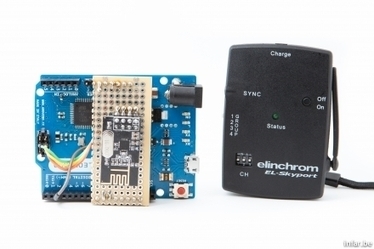
After figuring out how the Elinchrom EL-Skyport Transmitter works, I wanted to do a proof of concept implementation with an Arduino. This would allow me verifying my assumptions I made in my previous investigation. The hardware is based on an Arduino Leonardo equipped with a cheap (< 4 USD) nRF24L01+ module. After powering up the Arduino, it sends out a trigger pulse to the EL-Skyport Receiver every 500 ms.
Our company here in Bangladesh owns a quite old concrete batch plant, which had full manual control requiring an operator to control 14+ switched and observe 3 mechanical scales (dial gauges). I was successful to upgrade this plant to an automated unit requiring minimal operator input using custom made Arduino Uno compatible board and LIFA. Wiring is still very messy and remains unfinished, which I shall take care in the near future after all testing is done.
To get content containing either thought or leadership enter:
To get content containing both thought and leadership enter:
To get content containing the expression thought leadership enter:
You can enter several keywords and you can refine them whenever you want. Our suggestion engine uses more signals but entering a few keywords here will rapidly give you great content to curate.


 Your new post is loading...