Your new post is loading...

|
Scooped by
David Connolly
October 17, 2012 12:20 PM
|
An hour long talk on getting ahead once you leave University and before! Comedy, Laughs and serious help provided in equal measure.
REcorded at Edinburgh University Arc Soc. this tells you the way forward. acoording to BAJR
|
|
Scooped by
David Connolly
October 17, 2012 5:18 AM
|
Headlines Bronze Age discoveries at Cheeseman’s Green, England
Crete, 3500-year-old Minoan building found
Oldest dental filling found in a Stone Age tooth
Stonehenge scan reveals hidden rock art
Danish textile history gets re-writtend
Bronze Age pathway found along London’s railway
Europe’s ‘oldest urban settlement’ found in Bulgaria
Neolithic Houses are to be built at Stonehenge
New insight into ancient Mesopotamian trade routes
The nomadic horse worshippers of Kazakhstan
|
|
Scooped by
David Connolly
October 17, 2012 2:38 AM
|
ROWS OF OPEN shelves hold pottery vessels of every shape and size close to the entrance of the crypt.Built-in presses along one wall store bulky items from cooking cauldrons to millstones, while aisles of floor-to-ceiling brass-handled drawers conceal smaller objects from prehistoric flint tools to medieval “ear scoops”. Stowed away IN the bowels of the National Museum on Kildare Street in Dublin, are hundreds of thousands of archaeological artefacts, most of which have never been seen by the public. The 1,000-cubic-metre crypt is home to an estimated 300,000 objects, but until recently, even the longest-serving members of the museum’s staff were unsure what lay behind some of those doors and drawers. The majority of items in the crypt has remained untouched for half a century or longer, and, in many instances, the old identification labels are long lost, making it extremely difficult to know where the object came from or what exactly it is.
|
|
Scooped by
David Connolly
October 17, 2012 2:07 AM
|
An intriguing glimpse into how the ruling elite lived through the centuries in the heart of one of Yorkshire’s most historic cities has been revealed. Archaeologists have disclosed some of the finds they have unearthed during excavations centred on the medieval Guildhall in York, including a fragment of a comb from Viking times and a wig curler from the 1700s. The dig was carried out over the summer months to delve into the foundations of York’s home of democracy and its civic origins in the hope of revealing artefacts from the past. Few excavations had been carried out in this area and they had not been thoroughly documented so York Council’s senior officers decided the work was a good opportunity to learn more about the seat of local democracy.
|
|
Scooped by
David Connolly
October 16, 2012 9:12 AM
|
A landmark mosque in Aleppo was burned, scarred by bullets and trashed — the latest casualty of Syria's civil war — and President Bashar Assad on Monday ordered immediate repairs to try to stem Muslim outrage at the desecration of the 12th century site. The Umayyad Mosque suffered extensive damage, as has the nearby medieval covered market, or souk, which was gutted by a fire that was sparked by fighting two weeks ago. The market and the mosque are centerpieces of Aleppo's walled Old City, which is listed as a UNESCO World Heritage site.
|
|
Scooped by
David Connolly
October 16, 2012 4:38 AM
|
Making a mirror the old-fashioned way...
Continuing from the recent Çatalhöyük news story of the Obsidian Mirror Among the intriguing finds at the Neolithic site of Çatalhöyük in central Anatolia are a few polished obsidian artifacts believed to have been used as mirrors. In a letter in response to an article, "The World's First City" (March/April 1998), which mentions the obsidian mirrors, P.H.M. Hawley wrote, "to make such a mirror requires considerable technology in a sense. To grind a flat surface and then achieve a true polish is not easy" (May/June 1998, p. 11). In an accompanying comment, Orrin Shane (an author of the original article and a curator at the Minnesota Museum of Science) said of the Çatalhöyük mirrors, "Their exceptional planar surfaces are highly polished and reflect a sharp image." I was curious just how difficult it would be and how long it would take to make an obsidian mirror.
|
|
Scooped by
David Connolly
October 15, 2012 9:06 AM
|
The Canadian government’s enthusiasm for the conflict has puzzled and angered many in the country, where shows of patriotism are more subdued than they are south of the border.
Although it produced “The Star-Spangled Banner,” the War of 1812 does not get much attention in the United States. In Canada, however, the federal government is devoting surprising attention to the bicentennial of the conflict, which it describes bluntly in a new television commercial as an act of American aggression against Canada.
Much about the war is fiercely debated by historians but one thing is clear: Canada was not yet a country at the time of the war, which pitted the United States against the British.
|
|
Scooped by
David Connolly
October 15, 2012 3:26 AM
|
These modern versions of prehistoric stone & flint tools were created by Tel-Aviv based designers Ami Drach & Dov Ganchrow.
Just how cool!
|
|
Rescooped by
David Connolly
from Anthropology and Archaeology
October 15, 2012 2:51 AM
|
Within the hidden inland and interior regions of South-Central California, millions of years of wind scouring and water erosion have sculpted distinctive yellow-and-tan sandstone outcrops into bizarre and beguiling forms worthy of a Daliesque timescape. The endless forces of weather and climate have created a menagerie of rocky pinnacles, honeycombed sandstone cavities, and sinuous rockshelters. In desert scrub and patchy oak woodlands, misshapen cave mouths appear to grin awkwardly in shifting shadow and light as the sun wheels overhead, season after season.
Via Kyle Kunkel O'Connor
|
|
Scooped by
David Connolly
October 15, 2012 2:07 AM
|
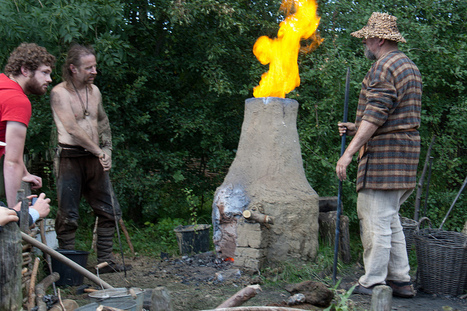
to get iron from ore... you gotta make some fire!
|
|
Scooped by
David Connolly
October 14, 2012 5:30 PM
|
A re-enactment of the Battle of Hastings on what is believed to be the original battlefield has been cancelled because of torrential rain. English Heritage said for safety reasons the event could not go ahead because of unacceptable levels of mud on the battlefield and public areas. Sunday's re-enactment marked the 946th anniversary of the battle when William the Conqueror defeated King Harold. Hastings Borough Council said the cancellation was a disappointment.
|
|
Scooped by
David Connolly
October 14, 2012 2:37 PM
|
Last Tuesday one of the world's leading experts on Neanderthals, Jean-Jacques Hublin, spoke at the Houston Museum of Natural Science.
|
|
Scooped by
David Connolly
October 14, 2012 3:27 AM
|
David Petts, a Lecturer at Durham University writes the following in a post
Couple of things caught my eye recently- most recently was the (UK) government announcing plans to revive a series of road building schemes that had been shelved, seemingly funded somehow by a combination of local authorities and commercial capital (because that kind of thing has worked SO well in the past) and
The trouble is, and very few archaeologists I think admit this, is that whatever the pros and cons of road construction (both in environmental terms and as an act of Keynesian economic stimulus), archaeology is just another subcontractor of the construction industry.
Read on for the full debate.
|
|
|
Scooped by
David Connolly
October 17, 2012 5:23 AM
|
A team of volunteers have helped to uncover Roman artefacts at Arbeia Roman Fort in South Shields.
|
|
Scooped by
David Connolly
October 17, 2012 2:41 AM
|
Archaeologists in southern Sweden have unearthed what is presumed to be a 5,000-year-old dolmen, or a portal tomb, near the megalithic monument Ale's Stones, sometimes referred to as "Sweden's Stonehenge".
”The findings confirm what we have believed; that this has been a special place for a very long time,” said archaeologist Bengt Söderberg to news agency TT. On Saturday, the first day of the dig, the scientists already had a hunch that they would find something on the site, expecting a Stone Age grave and a Bronze Age monument.
|
|
Scooped by
David Connolly
October 17, 2012 2:32 AM
|
Monks have lived for at least 17 centuries at Saint Catherine’s Monastery — where monks have lived for at least 17 centuries.It sits on a mountaintop – in the southern part of a triangular peninsula that sits between the Mediterranean and the Red Sea. Through the centuries this peninsula has served as a land bridge between the continents of Asia and Africa.
With both Images and a sound file description.
|
|
Scooped by
David Connolly
October 16, 2012 10:23 AM
|
Excavation of the 2,000-year-old settlement in Dibba Al Hisn has stopped due to the blockage of modern buildings surrounding the site.
Excavation of the site has been restricted to an area of 20 metres by 20 metres, where a settlement believed to be more than 2,000 years old had been found in the Sharjah enclave. But work was halted midway through last year as Sharjah officials tried to buy the properties.
|
|
Scooped by
David Connolly
October 16, 2012 9:09 AM
|
Middle East Environment news for the Middle East.
The Archaeological Museum of Rabat was first built in 1932 and is badly in need of a renovation, so Archi5 submitted plans for a new solar-powered facility that would rise in harmony with its surrounding. Comprised of a series of boxy ribbons filled in with glazing, the conceptual museum is a fluid space that provides “visual environmental comfort,” according to the design brief, as well as a protective shell for the museum’s numerous archaeological and earth science treasures.
|
|
Scooped by
David Connolly
October 16, 2012 2:22 AM
|
Thirty years ago – on 11 October 1982 – the Tudor warship Mary Rose was dramatically raised to the surface, more than four centuries after she sank accidentally during an engagement with the French fleet in 1545. But after three decades of research into the ship and its contents there is still much that can be learned, especially by the application of new technology - and this is exactly what is happening at the University of Huddersfield in collaboration with The Mary Rose Trust.
|
|
Scooped by
David Connolly
October 15, 2012 5:55 AM
|
A conference in Cambridge, southeast England, will mark the 60th anniversary of the decipherment by Michael Ventris of Linear B, a script used for an early form of ancient Greek. His stunning achievement pushed back the frontiers of knowledge about the ancient world. When during the early 20th century archaeologists excavated some of the most famous sites of Ancient Greece – notably Knossos on the island of Crete and Mycenae and Pylos on the mainland – they found large numbers of clay tablets inscribed with a type of script that baffled them.
|
|
Rescooped by
David Connolly
from Anthropology and Archaeology
October 15, 2012 3:04 AM
|
These are Frank Hurley's famous early colour photographs of Sir Ernest Shackleton's ill-fated 'Endurance' voyage, as part of the British Imperial Trans-Antartica Expedition
Via Kyle Kunkel O'Connor
|
|
Scooped by
David Connolly
October 15, 2012 2:26 AM
|
Crocodile Skin Suit of Armour ‘In ancient Egypt the crocodile was seen as sacred and divine, and worshipped as a god, so this suit might have been worn by priests of the crocodile sect . from 3rd century AD
|
|
Scooped by
David Connolly
October 15, 2012 1:47 AM
|
Yapı Kredi Culture Center displays a photography documenting a century of archaeological excavations in the Hattuşa, situated in the northern province of Çorum. The exhibition features photographs drawn from German Archaeological Institute The unpublished photographs that form the backbone of the show were gathered with the aim of painting a historical, ethnographical and sociological panorama of the whole excavations process from 1906 to 2012.
|
|
Scooped by
David Connolly
October 14, 2012 4:27 PM
|
Archaeologists are reserving judgment but Greek and Bulgarian media have reported that a tomb found in the town of Amphipolis in northern Greece could be that of Alexander the Great’s widow and his son, Roxana of Bactria and Alexander IV...
Archaeologists are reserving judgment but Greek and Bulgarian media have reported that a tomb found in the town of Amphipolis in northern Greece could be that of Alexander the Great’s widow and his son, Roxana of Bactria and Alexander IV Aegus. Amphipolis is near Serres, a Greek town that Bulgarian media did not fail to point out is just 30km from the Bulgarian border.
|
|
Scooped by
David Connolly
October 14, 2012 4:17 AM
|
The story of the last 14,000 years in Mobile will be on display at the new Archaeology Museum opening on the University of South Alabama campus.Culled from a university archaeological collection comprised of tens of thousands of artifacts, the museum highlights a past richer than most residents understand. The rarest items in the museum date back more than 10,000 years, a collection of stone spear points used by the region’s earliest residents. Artifacts from that era are hard to come by because the area the Gulf’s first native peoples inhabited is now underwater.
|


 Scoop.it!