esting of Giovanni de’ Medici’s bones has shown that the mercenary soldier died of gangrene, and not an improperly amputated leg, as had been rumored. Known as Giovanni of the Black Bands for the black bands of mourning he wore after the death of Pope Leo X, he was hit be a cannon ball during a battle when he was 28 years old. “The leg was already partially amputated by the cannon ball, so the surgeon simply completed the amputation by cleaning the wound and smoothing the stump,” said Gino Fornaciari of the University of Pisa.
They were humble farmers who grew corn and dwelt in subterranean pit houses. But the people who lived 1200 years ago in a Utah village known as Site 13, near Canyonlands National Park in Utah, seem to have had at least one indulgence: chocolate.
Researchers report that half a dozen bowls excavated from the area contain traces of chocolate, the earliest known in North America. The finding implies that by the end of the 8th century C.E., cacao beans, which grow only in the tropics, were being imported to Utah from orchards thousands of kilometers away.
In the Permian High School class Bible History and Literature, public school students are taught that the Bible's miracle stories – in this specific case, Moses crossing the Red Sea – have been proven through archaeology. This course is among a host of examples of academically problematic lessons taught to secondary students in 57 public school districts and three charter school districts in Texas.
The Chinese annals not only give information on and the interpretation of the name of that mysterious country but also add details about its geography, administration, economy – including agriculture, domesticated animals and products –, trade and...
Through a careful examination of the accounts of Daqin ( 大秦 ) – presumably the Roman Empire – and Fulin ( 拂菻 ) – Byzantinum –, we can depict a picture of how the Chinese imagined another ancient empire far away in the West. The Chinese annals not only give information on and the interpretation of the name of that mysterious country but also add details about its geography, administration, economy – including agriculture, domesticated animals and products –, trade and the envoys sent by Daqin ( 大秦 ) people.
Important medieval frescoes of St. Premte Chapel in the remote village of Valsh in central Albania, have suffered irreparable damage at the hands of thieves who tried to prize them from the walls.
A shocking tale of destruction of rare frescoes in Albania - do please spread the news about this and perhaps contact the Albanian Ministry to ask what is happening. Pressure helps!
amazing how archeologist can come up with conclusions from artifacts. the hieroglyphic inscriptions on these statues shed light on the wars that took place between mayan cities.
Archaeologists working at the Smithsonian Tropical Research Institute in Panama have discovered a cluster of 12 unusual stones in the back of a small, prehistoric rock-shelter near the town of Boquete. The cache represents the earliest material evidence of shamanistic practice in lower Central America.
Understanding trends of violence in the past is important for interpretations of the character of past cultures, origins of warfare and relationships between (or within) groups. By looking at the total deceased population of a site during the same time period we can see patterns of violence associated with specific age, sex or social groups. Only recently have studies begun to reexamine evidence from the Neolithic for violence- since it was previously thought it was a relatively peaceful period. It is posited that the changes in the Neolithic, introduction of farming, decreased mobility and rise of animal husbandry, may have lead to changes in interpersonal behavior. However, evidence for violence is low and often can be interpreted in multiple ways.
A recently uncovered rare archaeological artifact was stolen this week from the Tel Shiloh archaeological site in Israel.
Tazpit News Agency reported last week on the discovery of the artifact, a broken clay pitcher lying in a layer of reddish ashes that helped to complete the story of the devastation of Shiloh, the ancient capital of Israel during the First Israelite commonwealth. The ashes found attest to a devastating fire the occurred on the site. The dating of the clay pitcher, 1050 BCE, correlates with the dating of the limited portrayal of events surrounding Shiloh’s destruction depicted in Book of Samuel.
Dr. Linda Rudy of Chicago’s Old Town neighborhood wondered if urban archaeologists ever looked at construction sites to see if anything interesting was down there. A great question, but it gets more intriguing when you consider Linda’s backstory.
“They’re digging up Wells Street to put in new water mains and there are really big trenches right in the street,” she said. “I saw railroad ties being hauled out. I wonder what railroad ties were doing under Wells Street.”
THE EXCAVATION work on the Projecto Villajoyosa Romana, which has been ongoing for the past few weeks, has uncovered the remains of two houses built in the 16th and 18th centuries.
The foundations of the two structures cover a 100-square metre area to the north of the tower.
Under the direction of Diego Ruiz of the Villajoyosa museum and archaeologists Lorenzo Abad and Sonia Gutiérrez of Alicante University, excavation of the area around the Sant Josep tower has uncovered more evidence of how the site was used.
The DNA of a battle that helped turn the tide of a war going horribly wrong for America lay buried just 6 inches below a Maryland cornfield.
For nearly two centuries, musket balls, canister shot and other artifacts from intense fighting at Caulk's Field waited to tell the story of a sweltering August night in 1814, when militiamen sprang a trap on a British raiding party bent on destruction.
How did the citizen-soldiers best their battle-tested foes?
State archaeologist Julie Schablitsky hopes to figure that out. With the help of cadaver-sniffing dogs and history buffs armed with metal detectors, she is retracing the footsteps of Sir Peter Parker, a British marine captain who led 170 troops, and a like number of militiamen commanded by Col. Philip Reed.
The Celts were long considered a barbaric and violent society. But new findings from a 2,600-year-old grave in Germany suggest the ancient people were much more sophisticated than previously thought.
The little Bettelbühl stream on the Danube River was completely unknown, except to local residents. But that changed in the summer of 2010 when a spectacular discovery was made just next to the creek.
Not far from the Heuneburg, the site of an early Celtic settlement, researchers stumbled upon the elaborate grave of a Celtic princess. In addition to gold and amber, they found a subterranean burial chamber fitted with massive oak beams. It was an archeological sensation that, after 2,600 years, the chamber was completely intact.
Over a few exceptionally warm days last July, Greenland’s frozen surface turned into a colossal puddle.
Even the coldest parts of the world’s largest island saw ice thaw and rain fall, fuelling concerns over the future of glaciers that hold enough water to raise global sea levels by around 7 metres.
A record of the past written in an ancient ice core now reveals that Greenland’s ice sheet is not melted as easily as some fear. But the message is not entirely reassuring: it also implies that Antarctica has much greater potential to raise sea levels than previously thought.
In a necropolis in Spain, archaeologists have found the remains of a Roman woman who died in her 30s with a calcified tumor in her pelvis, a bone and four deformed teeth embedded within it.
Two of the teeth are still attached to the wall of the tumor researchers say.
The woman, who died some 1,600 years ago, had a condition known today as an ovarian teratoma which, as its name indicates, occurs in the ovaries .
Scripted series are at such a premium at the moment that many networks who've built their brand on nonfiction programming are preparing to launch dramas, among them History.
Excavations at the Olympic Park site by Museum of London Archaeology Service (MoLAS, now MoLA) and Pre-Construct Archaeology working as a joint venture (MoLAS-PCA), and RPS Planning and Development and AOC Archaeology Group produced a number of waterlogged finds of wood and leather, some of which underwent archaeological conservation at the Wiltshire & Swindon History Centre as part of the post-excavation programme undertaken by Wessex Archaeology.
A nearby short duration gamma-ray burst may be the cause of an intense blast of high-energy radiation that hit the Earth in the 8th century, according to new research led by astronomers Valeri Hambaryan and Ralph Neuhӓuser.
ARCHAEOLOGISTS have proved for the first time that people started living in the Didcot area as early as 9,000 years ago.
Oxford Archaeology has been excavating land at Great Western Park, where more than 3,300 homes are being built, to detail the site’s history.
The two-and-a-half-year dig has uncovered the remains of a Roman villa, and early Bronze Age arrowheads which will now go on display.
Rob Masefield – director of archaeology at RPS Planning, which is managing the investigation – said one of the most important discoveries was hundreds of flints dating back over 9,000 years to the Mesolithic period.
To experience another culture is to grasp the truth of a metaphor. To seek something out is to dig, and so I did. I crossed pathways with LSU archaeologist, Dr. Heather Mckillop, when I learned of her research on the Classic Maya civilization. Through this process, I realized that there is a certain subjective nature to the scientific study of archaeology. However, it was her personal stories from journeys abroad, and the stories from other Mesoamerican archaeologists, which captured my enthusiasm for this project. I collected footage online, and remixed it into an archival exploration of Maya culture, from both past and present times.
I sense that the future holds something beautiful in the balance of art and science collaborations. I believe that even though Dr. Heather and I possess different ideas, we will always share the same ideal. We both desire to protect and preserve ancient cultures and their withstanding mysteries that continue to baffle researchers. The society we currently live in today is not the result of a natural process, but is the result of outside invasions and the aftermaths of those efforts. It is time for horizon lines separating us from each other to diminish, and for each society to treat each culture with the respect and equality all deserve. This is essential in order for the planet to evolve in consciousness, as it continues to revolve in space, as it has done for the many cycles that have come before.
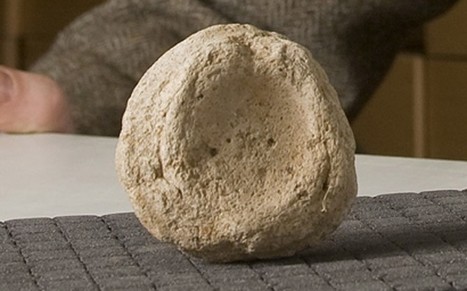
A museum which kept ancient artefacts on display believing they were early gaming pieces has discovered they were actually used as a primitive form of toilet paper.
To get content containing either thought or leadership enter:
To get content containing both thought and leadership enter:
To get content containing the expression thought leadership enter:
You can enter several keywords and you can refine them whenever you want. Our suggestion engine uses more signals but entering a few keywords here will rapidly give you great content to curate.


 Your new post is loading...









That is a sign of the times he lived in. but it does surprise me, that he did not get better treatment.