


Archaeologists have unearthed a trove of skulls in Mexico that may have once belonged to human sacrifice victims. The skulls, which date between A.D. 600 and 850, may also shatter existing notions about the ancient culture of the area.

 Your new post is loading...
 Scoop.it! Archaeologists have unearthed a trove of skulls in Mexico that may have once belonged to human sacrifice victims. The skulls, which date between A.D. 600 and 850, may also shatter existing notions about the ancient culture of the area. 
No comment yet.
Sign up to comment
Scoop.it!

Archaeologists say they have found five large cannon believed to have come from a British ship sunk in the Battle of Cape Passaro against Spain in 1718.
Scoop.it!
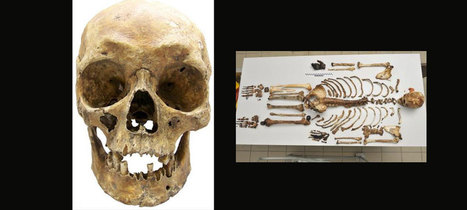
A new method of establishing hair and eye colour from modern forensic samples can also be used to identify details from ancient human remains, finds a new study published in BioMed Central’s open access journal Investigative Genetics.
Scoop.it!

Twenty-six thousand years ago in the Czech Republic, one of our ice-age ancestors selected a hunk of mammoth ivory and carved this enigmatic portrait of a woman - the oldest ever found. By looking at artefacts like this as works of art, rather than archaeological finds, a new exhibition at the British Museum in London hopes to help us see them and their creators with new eyes.
David Connolly's insight:
lovely to see this beautiful face from our part. What story can it tell?
Scoop.it!

Loom weights dating back 2,500 years that were found in the ancient Assoss show the textile industry has existed in the region since ancient times
Scoop.it!

When archaeologists announced the discovery of the tomb of Marcus Nonius Macrinus in Rome in 2008, the find was heralded as the most important in decades. Built in the shape of a temple, with tall fluted columns and an intricately carved sarcophagus, it was the final resting place for the Roman general who served as inspiration for Russell Crowe‘s character in the movie Gladiator, unearthed a the site of a planned housing project some 1,800 years after its construction.
David Connolly's insight:
Italy is running out of money to preserve the remains of the Roman Empire
Scoop.it!

I am a self-confessed history geek, so it is not surprising that many of my travels feature ancient sites quite heavily. I have a bit of a vivid imagination, so it doesn’t take much for a place steeped in history to come alive to me, particularly if it is a half-forgotten place, overshadowed by far more famous neighbours. So come with me to the highlands of Peru, the deserts of Argentina, the South of France - and my hometown. Are you ready to travel through time?
David Connolly's insight:
Get travelling!
Scoop.it!

Research by a University of Southampton historian has found that the practice of ransom was widespread among all soldiers during the Hundred Years War (1337 – 1453) and not, as generally thought, just the preserve of kings, knights and higher orders. Dr Rémy Ambühl has found that ransom in war provided a valuable source of income for all classes in the Late Middle Ages, including those in the lower orders. He says: “There is widespread evidence to suggest that during the 15th century the practice of ransom is increasingly extended to commoners, not just Kings or chivalrous Knights.”
David Connolly's insight:
Very interesting look at the free market being taken over by the govt! Better to be worth something alive than dead!
Scoop.it!

Archeologists often have to be great detectives. A professor at San Diego State has used his detective skills to find hidden historic murals on the university’s campus.
Seth Mallios spends a lot of time in Hardy Tower, searching for clues.
He’s looking for murals that used to cover the walls and ceilings throughout the building, which used to be home to the university library and art department. Many of the murals date back to the 1930s and 40s. Over the years, they’ve been painted over or lost to new construction.
Mallios, an archeologist and head of the anthropology department at SDSU, says he's been all over the campus. "I’ve crawled into every ceiling, under every building, I have found a couple of other murals. I’ve found sketches of murals."
David Connolly's insight:
Amazing
Scoop.it!
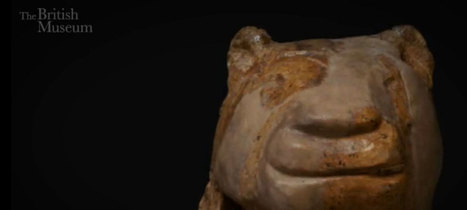
It’s smaller than your thumb: a little piece of mammoth ivory delicately carved into the shape of a woman’s head. But this miniature sculpture, with one wonky eye and rather elongated, slightly Modigliani-esque proportions, is the oldest known portrait in the world, and is about to go on show to the public for the first time in Britain in a new exhibition at the British Museum, Ice Age Art: Arrival of the Modern Mind.
Scoop.it!

Information about the British Museum exhibition Ice Age art arrival of the modern mind
Discover masterpieces from the last Ice Age drawn from across Europe in this groundbreaking show. Created between 40,000 and 10,000 years ago by artists with modern minds like our own, this is a unique opportunity to see the world's oldest known sculptures, drawings and portraits.
David Connolly's insight:
Stunning
Scoop.it!

Enigmatic petroglyphs, once hidden deep within the Paraguayan jungle are a testament to the people of the Amambay hills. However, as the jungle is increasingly torn down and the trees set alight by slash and burn farmers, the rock-art is disappearing at an alarming rate.
David Connolly's insight:
And you can help finance this project.
Scoop.it!
Archeologists in Bulgaria have unearthed a treasure dating back to the third century BC. Gold rings, figurines, bracelets and buttons have been dug up after ...
|
Scoop.it!

PBS will show the story of the Texas State School Board's assault on facts
Some of the most important decisions that influence the public's knowledge aren't made by scientific societies and they don't take place in Washington DC. For the most part, they're made in the capitals of each state, as each has its own standards for what students leaving its public schools should know. Those standards set lesson plans and help decide which textbooks are acceptable.
David Connolly's insight:
lets hope sense prevails
Scoop.it!

Bulgarian Deputy Prime Minister and Finance Minister, Simeon Djankov, has pledged the significant amount of BGN 3 M for restoration and conservation of the historical Roman Baths in the Black Sea city of Varna. The sum came as a pleasant surprise to archaeologists who have asked for BGN 200 000.
Djankov made the pledge during a discussion organized by the Bulgarian Standard daily in Varna in the frame of the newspaper's campaign "The Miracles of Bulgaria."
David Connolly's insight:
money spent now, is worth it in the long run!
Scoop.it!

Naturally circulating lentiviruses are abundant in African primate species today, yet their origins and history of transmitting between hosts remain obscure. perhaps not any more!
Scoop.it!

CT scans of the mummy of a young woman in McGill University’s Redpath Museum have allowed researchers to recreate a hairstyle that was popular in Roman-ruled Egypt, nearly 2,000 years ago. “The mummy's hair is readily appreciable,” wrote the team in a recently published paper, “with longer strands at the middle of the scalp drawn back into twists or plaits that were then wound into a tutulus, or chignon at the vertex (crown) of the head.” The researchers also studied two other Egyptian mummies from the museum, one of an older woman who lived at the same time as the well-coiffed mummy, and the other of a young man who lived a few centuries earlier. Both had severe dental problems.
Scoop.it!
Italian researchers have unearthed a marble benchmark which was once used to measure the shape of Earth in the 19th century.
Called Benchmark B, the marker was found near the town of Frattocchie along one of the earliest Roman roads which links the Eternal City to the southern city of Brindisi.
Placed there by Father Angelo Secchi (1818-1878), a pioneer of astrophysics, the marker consisted of a small travertine slab with a metallic plate in the middle. The plate featured a hole at its center.
“The hole was the terminal point of the geodetic baseline which run in the ancient Appian Way near Rome, between the tomb of Cecilia Metella, a daughter of a Roman consul, and a tower near Frattocchie,” Tullio Aebischer, a cartographical consultant at the department of mathematics and physics of Roma Tre University, told Discovery News.
David Connolly's insight:
19th century scientists once measured Earth based on triangulated measurements and now archaeologists have uncovered one of their key markers the fabulously named. Marker B
Scoop.it!

The discipline of archaeology has traditionally viewed the islands and fjords of the Central Coast as a corridor to somewhere else, imagining it as the route out of Asia to the Americas, speeding travelers on their way to what would become California, Texas, and southern Chile—a faceless service area on the turnpike heading south.
McLaren belongs to a group of scientists with a different perspective. Their question is not the familiar "Where did people come from and where did they go?" Rather, it's, "How did the people live here so well?"
David Connolly's insight:
Brilliant longer article that looks at an often overlooked archaeology
Scoop.it!

Experts at Ludwig-Maximilians-Universität München (LMU) are in the process of analysing Indian Buddhist texts that are over 2000-year-old which have recently come to light. The precious manuscripts have already yielded some surprising results.
Scoop.it!

Archaeologists say an ancient Chinese arrowhead unearthed in Okayama City in Western Japan is the first of its kind discovered in the country.
David Connolly's insight:
The question is what it was used for in Japan/
Scoop.it!

A sapphire ring found in North Yorkshire sparks a meeting of experts to determine exactly when it was made.
David Connolly's insight:
Natalie McCaul, from the museum, said the meeting may "shed new light on the ring" and "reveal some of its secrets".
Scoop.it!

When archaeologists announced the discovery of the tomb of Marcus Nonius Macrinus in Rome in 2008, the find was heralded as the most important in decades. Built in the shape of a temple, with tall fluted columns and an intricately carved sarcophagus, it was the final resting place for the Roman general who served as inspiration for Russell Crowe‘s character in the movie Gladiator, unearthed a the site of a planned housing project some 1,800 years after its construction.
David Connolly's insight:
Italy is running out of money to preserve the remains of the Roman Empire
Scoop.it!

Even though women weren’t legally allowed to fight in the Civil War, it is estimated that somewhere around 400 women disguised themselves as men and went to war, sometimes without anyone ever discovering their true identities. Bonnie Tsui is the author of She Went to the Field: Women Soldiers in the Civil War, which tells the stories of some of these women. I spoke with the San Francisco-based writer about her research into the seldom-acknowledged participation of women in the Civil War.
David Connolly's insight:
Hundreds of women concealed their identities so they could battle alongside their Union and Confederate counterparts
Scoop.it!

After spending the weekend reading blog posts claiming that he was seeking an "extremely adventurous female human" to bear a cloned Neanderthal baby - which was news to him - Harvard geneticist George Church said it may be time for society to give some thought to scientific literacy.
Church became the subject of dozens of posts and tabloid newspaper articles calling him a "mad scientist" after giving an interview to the German magazine Der Spiegel.
In the interview, Church discussed the technical challenges scientists would face if they tried to clone a Neanderthal, though neither he nor the Der Spiegel article, which was presented as a question and answer exchange, said he intended to do so.
"Harvard professor seeks mother for cloned cave baby," read one headline, on the website of London's Daily Mail.
But Church explained on Wednesday that he was simply theorizing.
David Connolly's insight:
That's what happens!
|





