Evening is falling on the ancient Maya kingdom of El Zotz deep in the dense undergrowth of the Guatemalan jungle. A dark tide of bats flows out of a large cave in the nearby mountainside as the last rays of the setting sun illuminate a dramatic series of giant blood-red masks decorating an ancient temple set atop the Diablo Pyramid. Beneath the 40-foot high pyramid lies a burial tomb containing the remains of a Maya king, found with a sacrificial blade lying where his right hand would have been.
Pure Indiana Jones, the scene has attracted widespread international attention as armchair archaeologists the world over follow the latest discoveries at the recently excavated Temple of the Night Sun at El Zotz, headed by Thomas Garrison of the USC Dornsife Department of Anthropology.
The Maya, an advanced Mesoamerican civilization, lived in what is now Guatemala, southern Mexico and Belize, in a series of city-states of varying size and power. While El Zotz was one of the smaller kingdoms, it appears to have more than made up for its size with a keen sense of its own identity and creativity.
These days, Florida welcomes more than 87 million tourists a year, but five centuries ago, when Juan Ponce de Leon landed on what is now known as the east coast of Florida, visits from afar were rare. The Spanish explorer’s voyage, a failed attempt to find gold, brought European settlers to the land inhabited by Native Americans and launched a new era in Florida’s history.
To celebrate the New World discovery in 1513, the Sunshine State is hosting a long list of cultural and heritage events under the campaign “Viva Florida 500.”
Dr John MacGinnis, a specialist in Assyrian civilisation at Cambridge University’s McDonald Institute for Archaeological Research, will fly to the city of Erbil in north east Iraq. En route he will stop off in Turkey where for more than a decade he has been involved in the excavation at the Neo-Assyrian site of Ziyaret Tepe, the ancient garrison town of Tushan.
Uhm, not just shade but ambient colour temperature, differences in colour perception, etc, all have a big effect and are rarely properly handled in an archaeological context. There is actually little point in using Munsell colour standards because conditions cannot be sufficiently well controlled. Same goes for taking colour photos of soils - unless a standard colour chart is included in the frame the recorded colours are pretty meaningless as there is nothing to calibrate them against.
Petroglyph panels cut and chiseled off an eastern Sierra rock art site sacred to Native Americans have been recovered by federal investigators, U.S. Bureau of Land Management officials announced Thursday.
What came first: the bipedal human ancestor or the grassland encroaching on the forest? A new analysis of the past 12 million years’ of vegetation change in the cradle of humanity is challenging long-held beliefs about the world in which our ancestors took shape – and, by extension, the impact it had on them.
New research in the current issue of the journal Geoarchaeology, offers compelling evidence that one of the massive earthen mounds at Poverty Point was constructed in less than 90 days, and perhaps as quickly as 30 days — an incredible accomplishment for what was thought to be a loosely organized society consisting of small, widely scattered bands of foragers.
For centuries, the fate of the original Otomí inhabitants of Xaltocan, the capital of a pre-Aztec Mexican city-state, has remained unknown. Researchers have long wondered whether they assimilated with the Aztecs or abandoned the town altogether.
An article about the Otomi of Xaltocan and the new discoveries that are being made about the population and their affiliation with the Aztec. This article also deals with the genteics of these peoples and how they have altered over time.
Noticia muy interesante que puede causar el surgimiento de nuevas preguntas acerca de la civilización azteca y de lo que pensamos que conocemos. Por medio del estudio del ADN mitocondrial se pretende descubrir si hubo un cruce entre los Xaltocan y los aztecas.
Turkey is an archaeologist's dream. Not only does it offer amazing Mesopotamian, Greek, Roman, Byzantium, and Ottoman ruins, it also offers yet un-explored sites for those interested in archaeology.
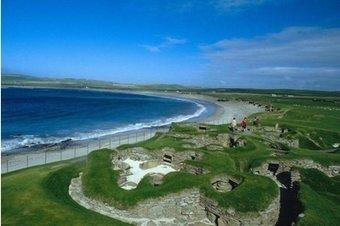
The University of the Highlands and Islands and Orkney's community archaeologist, Julie Gibson, said: "Scotland has the longest coastline in Europe and, as a maritime nation, much of our heritage relates to the sea. Around Orkney, more than one thousand archaeological sites are threatened or are being actively damaged.
A 40-YEAR research project to map York’s historic past is finally nearing completion.
A series of maps showing how the city developed from Roman times to the present day is set to be published, along with essays by leading academics.
Dr Peter Addyman, chairman of York Civic Trust, had the idea of creating the cartographic study of the city’s development when he founded York Archaeological Trust in 1972.
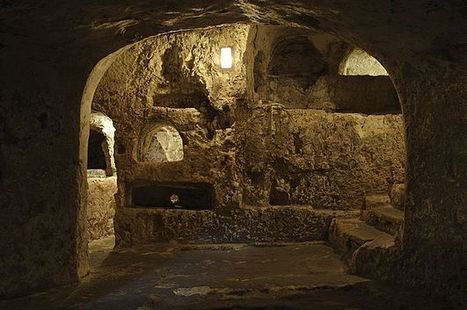
Heritage Malta will be organising a heritage trail including visits to St Paul’s Catacombs and San Pawl Milqi on Sunday, the 10th of February, the feast of St Paul’s Shipwreck. This heritage trail links writings in the Gospels, folklore and archaeological evidence regarding St Paul, who considerably influenced Malta’s culture and heritage.
The tour will commence with a visit to St Paul’s Catacombs in Rabat. This complex of interconnected, underground Roman cemeteries was in use up to the 4th Century AD. It represents the earliest and largest archaeological evidence of Christianity in Malta. The catacombs were purposely built in this location, on the outskirts of the old Roman capital Melite, as Roman law prohibited burials within the city.
Workers at construction site 40 km north of Chennai come across rare, 8th century artefacts; archaeologists say this is the first Pallavan-era finding within city limits in recent times
Little did the villagers in Kattupalli near Minjur, some 40 km north of Chennai, realise that digging a pit to earn Rs. 180 a day would lead to an important archaeological discovery and the unearthing of a 1,200-year-old Pallava period structure — the first such finding within city limits in recent times.
Bulgaria has several little known archaeological sites that potentially hold the answers to key questions about the foundation of western civilisation. Dr Sh...
ARCHAEOLOGISTS have uncovered a slice of Georgian history on the former site of the Royal Infirmary hospital.
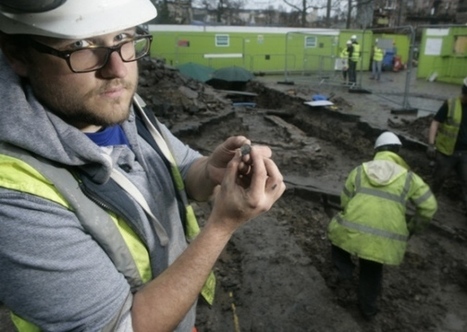
Pottery, bits of bottle, coins and buttons from the 18th century were found by workers at what is now Edinburgh University’s High School Yards.
A dig took place after contractors drafted in to lay utilities uncovered a series of outer walls from the old royal’s Surgical Hospital, which was built on the site in 1738. Among the highlights was a sixpenny piece dating from 1816 and the reign of George IV.
Celebrating 850 years. The bells were melted down after the revolution. Now they are back.. painstaking reconstructions. Can't wait to hear medieval bells.. made in the 21st century
The discovery of a 3,550-year-old child’s sarcophagus near the southern Egyptian city of Luxor could shed light on a little-known period of Ancient Egypt, Jose Manuel Galan, the head of a Spanish team of archaeologists that made the find, told Efe on Wednesday.
Experts who for the past three years have explored the vicinity of the tombs of Djehuty and Hery, two high-ranking dignitaries of the Egyptian court between 1500 and 1450 B.C., discovered the intact funeral receptacle lying unprotected on the ground a few days ago.
A gruesome discovery first came to light in winter 2007 in looters holes at an excavation site in Lake Xaltocan, a drained lake in the northern basin of Mexico where Georgia State University’s Christopher Morehart and his wife were studying ancient agricultural technologies and how people interacted with their environment.
Researchers from Royal Holloway and the Sandia National Laboratories along with 13 other universities across the United States and Europe, challenge the belief that a large impact or airburst comet or asteroid caused a significant and abrupt change to the Earth’s climate and terminated the Clovis culture. They argue that other explanations must be found for the apparent disappearance.
Fifty-six diagnostic sherds, dating to the Crusader period, were found in a pit. Most of them represent local Crusader types, with a few belonging to imported types.
The use of information and communications technology (ICT) has revolutionized archaeological mapping, image recording, and analysis through tools such as GPS, GIS, and digital cameras (Evans and Daly 2006). Gidding et al. (2011) note that archaeologists have been slow to adopt integrated digital recording techniques, relying to an inordinate degree on paper-based recording systems to collect data on archaeological phenomena.
Where archaeologists have utilized digital data, the resultant databases often can answer only very specific research questions (Gidding et al. 2011).
That the challenges of using ICT field collection are becoming less of an issue is evidenced by the recent session at the 2012 Computer Applications and Quantitative Methods in Archaeology conference titled “Using tablet PCs to support field documentation
We've just built a proper integrated recording system for a project in Iraq (http://www.urarchaeology.org/). It does need proper ground-up design and a complete move away from the file-full-of-paper mindset to be properly useful
Timbuktu, the fabled desert city where retreating Muslim extremists destroyed ancient manuscripts, was a center of Islamic learning hundreds of years before Columbus landed in the Americas.
It is not known how many of the priceless documents were destroyed by al Qaida-linked fighters who set ablaze a state-of-the-art library built with South African funding to conserve the brittle, camel-hide bound manuscripts from the harshness of the Sahara Desert climate and preserve them so researchers can study them.
Discover UNESCO World Heritage Sites, which have been attacked during wars. We show the Sites before war, and where possible, what they looked after being attacked & how UNESCO has helped to resto...
To get content containing either thought or leadership enter:
To get content containing both thought and leadership enter:
To get content containing the expression thought leadership enter:
You can enter several keywords and you can refine them whenever you want. Our suggestion engine uses more signals but entering a few keywords here will rapidly give you great content to curate.


 Your new post is loading...