Roman culture is detectable archaeologically throughout Etruria and Campania in the cities and landscapes of the regions. We still see Roman roads in use today! But what can these and other archaeological evidence tell us about the Romans expansion throughout Italy?
Frankly, way too much to cover in one article, so let us look briefly at an area of really interesting archaeology, Etruria and Campania in what is now Modern Italy....
Human sacrifices are the most infamous feature of ancient South American societies, but little was actually known about the victims? New research published in The American Journal of Physical Anthropology explores archaeological evidence from Peru, dating to the Late Horizon era between 1450 and 1532 A.D., to tell us more about the individuals who met their fate.
A hat which belonged to South Korea’s most revered monarch King Sejong has been recovered more than 500 years after it was looted by Japanese invaders, a senior scholar said Wednesday. Apart from its intrinsic value as an historical relic, the discovery has thrilled scholars after documents were found stitched inside the hat carrying explanations of King Sejong’s greatest legacy — the Hangeul alphabet. The monarch known as Sejong the Great ruled from 1418-1450. His reign had a profound impact on Korean history with the introduction of the Hangeul phonetic alphabet that replaced classical Chinese characters. Hangeul vastly increased literacy — previously restricted to the top scholarly class — and remains the official script of both South and North Korea.
Coins are a historical document," said RyAnne Scott, communications coordinator for the American Numismatics Association. Yes, numismatics is a difficult word to pronounce and according to the dictionary it is the collection or study of money, both in coins as well as paper notes. "If there is not a lot of surviving artifacts, coins can tell a great deal about the culture that produced it," Scott said. When this reporter called the American Numismatics Association in Colorado Springs, the intent was to get comment on professor Holt's book. While she had not heard of the book she pointed out, "we have thousands of books for our members and it sounds like the professor's book would be one that we would want to add to our library." The ANA also has a museum with over 250,000.00 coins. And, their goal is to help people understand and appreciate coins. Coins are one way scholars and researchers can learn a lot about ancient cultures throughout the world.
Coins are a historical document," said RyAnne Scott, communications coordinator for the American Numismatics Association. Yes, numismatics is a difficult word to pronounce and according to the dictionary it is the collection or study of money, both in coins as well as paper notes. "If there is not a lot of surviving artifacts, coins can tell a great deal about the culture that produced it," Scott said. When this reporter called the American Numismatics Association in Colorado Springs, the intent was to get comment on professor Holt's book. While she had not heard of the book she pointed out, "we have thousands of books for our members and it sounds like the professor's book would be one that we would want to add to our library." The ANA also has a museum with over 250,000.00 coins. And, their goal is to help people understand and appreciate coins. Coins are one way scholars and researchers can learn a lot about ancient cultures throughout the world. - See more at: http://www.digitaljournal.com/article/344690#sthash.Ss60Y6Ma.dpuf
Coins are a historical document," said RyAnne Scott, communications coordinator for the American Numismatics Association. Yes, numismatics is a difficult word to pronounce and according to the dictionary it is the collection or study of money, both in coins as well as paper notes. "If there is not a lot of surviving artifacts, coins can tell a great deal about the culture that produced it," Scott said. When this reporter called the American Numismatics Association in Colorado Springs, the intent was to get comment on professor Holt's book. While she had not heard of the book she pointed out, "we have thousands of books for our members and it sounds like the professor's book would be one that we would want to add to our library." The ANA also has a museum with over 250,000.00 coins. And, their goal is to help people understand and appreciate coins. Coins are one way scholars and researchers can learn a lot about ancient cultures throughout the world. - See more at: http://www.digitaljournal.com/article/344690#sthash.Ss60Y6Ma.dpuf
For as Scott noted that when we today think of Cleopatra we imagine someone like the actresses who have portrayed her on film. Legends in themselves such as Elizabeth Taylor or Joan Collins, stand out in most people's minds. "But the few coins that survive of her reign perhaps say otherwise. Cleopatra had a large nose and was actually Greek in features not Egyptian." - See more at: http://www.digitaljournal.com/article/344690#sthash.Ss60Y6Ma.dpuf
I've had students design coins, either in clay or with colored pencils and paper for the ancient cultures we study. This article would be a good introduction to the project.
A survey by the Society of Museum Archaeologists (SMA) has exposed a lack of storage space and curatorial expertise in English museums dealing with archaeological archives.
The survey of 134 museums found that 36 could not accept archaeological archives because of lack of space.
It also revealed that museums in 47 local authorities were no longer collecting, while 70% of museums had no specialist archaeology curator.
SMA chairwoman Gail Boyle said: “Many of the museums that responded are local authority museums that have no statutory funding, so they are often targeted [for cuts]. It has become prevalent over time and is getting worse.
“Archaeological field units are having to store their work, as there is nowhere for them to deposit it.
Today New York City is the Big Apple of the Northeast but new research reveals that 500 years ago, at a time when Europeans were just beginning to visit the New World, a settlement on the north shore of Lake Ontario, in Canada, was the biggest, most complex, cosmopolitan place in the region.
Occupied between roughly A.D. 1500 and 1530, the so-called Mantle site was settled by the Wendat (Huron). Excavations at the site, between 2003 and 2005, have uncovered its 98 longhouses, a palisade of three rows (a fence made of heavy wooden stakes and used for defense) and about 200,000 artifacts.
Across northern Syria, rebels, soldiers and civilians are making use of the country's wealth of ancient and medieval remains for protection
THE JEBEL AL-ZAWIYA HILLS, Syria Like countless other Syrians fleeing their country's civil war, Sami was eager to escape the bombs and artillery shells falling on his village. But instead of taking his family to another country, he simply brought them underground.
For the past seven months, the family has lived in a chamber cut into the rock of the Jebel al-Zawiya hills, its walls etched with arabesques and alcoves.
An amazing project to reconstruct an ancient boat, carried out using Bronze Age axeheads and prehistoric techniques in Cornwall, could see the vessel launch this week.
A team of history experts and boatbuilding volunteers will be praying to the prehistoric gods for good weather this week, when a recreation of a 4,000-year-old boat – constructed without nails and sewn together using yew withies – will be launched from Falmouth Harbour in Cornwall.
This stunning flint macehead was found deep within the darkest recesses of the great Neolithic passage tomb at Knowth, Co. Meath. Hidden for millennia, it was discovered in 1982 during an excavation carried out by Dr George Eogan. It is fashioned out a single piece of pale-grey flint, splashed with patches of brown, and is polished and decorated on all six sides.
The principle motifs employed are finely carved spirals and lozenges. On one side these symbols appear to form a human face, with the shaft hole defining a wide, gaping mouth.
This stunning flint macehead was found deep within the darkest recesses of the great Neolithic passage tomb at Knowth, Co. Meath. Hidden for millennia, it was discovered in 1982 during an excavation carried out by Dr George Eogan. It is fashioned out a single piece of pale-grey flint, splashed with patches of brown, and is polished and decorated on all six sides.
The principle motifs employed are finely carved spirals and lozenges. On one side these symbols appear to form a human face, with the shaft hole defining a wide, gaping mouth. This object represents one of the finest artifacts from Neolithic Europe and it displays a high level of both technical and artistic sophistication.
More than 2,000 years ago, at a time when Egypt was ruled by a dynasty of kings of Greek descent, someone, perhaps a group of people, hid away some of the most valuable possessions they had — their shoes.
Seven shoes were deposited in a jar in an Egyptian temple in Luxor, three pairs and a single one. Two pairs were originally worn by children and were only about 7 inches (18 centimeters) long.
Using palm fiber string, the child shoes were tied together within the single shoe (it was larger and meant for an adult) and put in the jar. Another pair of shoes, more than 9 inches (24 cm) long that had been worn by a limping adult, was also inserted in the jar.
Archaeologists and restoration specialists from the National Institute of Anthropology and History (INAH) have added their expertise to the conservation of Theban Tomb 39, in Luxor, Egypt, helping to return fragments of reliefs to their correct location to aid further understanding of a funerary complex that functioned as a place of pilgrimage for over three thousand years.
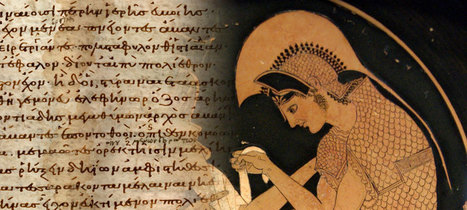
Homer’s Iliad, the ancient retelling of the Trojan wars, is one of the great masterpieces of literature, but historians have long debated exactly how old this great work is. Researchers have applied evolutionary-linguistics in order to analyse the differences in vocabulary between modern and historical texts.
American Indian trails once wove throughout the North American landscape, following the contours of the land to connect communities and provide trade routes across the continent. While remnants of these ancient trails still exist throughout the Southeast, a cultural amnesia of sorts has taken place within today’s culture and landscape, a forgetting of the past because of modern development and life.
However, this historical trail network is being identified throughout the Southeast with a comprehensive mapping project known as the Trails of the Middle, Valley and Out Town Cherokee Settlements. With guidance provided by the Tribal Heritage Preservation Office of the Eastern Band of Cherokee Indians, the nonprofit organization Wild South and its partners have mapped more than 1,000 miles of Cherokee trails that existed prior to the mid-1800s in eastern Tennessee, western North Carolina, South Carolina and Georgia.
Stretching the breadth of northern England, Hadrian's Wall is a majestic reminder of the ambition and might of the Roman Empire's conquest in Britain.
For decades, archaeologists struggled to date the indigenous communities around the wall because the site yielded very few artefacts. The only way of dating these Roman and pre-Roman Iron Age settlements was to excavate what little there was. Since the 1970s, when serious excavation began, experts believed the local population living in the shadow of the wall had actually flourished under the Roman invaders. But the new evidence suggests the Roman legions actually cleared a 10-mile stretch in front of the wall by force.
ONE of the world’s oldest warships dramatically dropped to the harbour floor when water leaked out of its berth in a dock at Dundee’s waterfront, it has been revealed.
Twenty people on board HMS Unicorn were evacuated when the historic vessel began drop to the bottom of the Victoria Dock on Wednesday night following problems with the dock’s sea gate.
The 80 year-old North Carr lightship, which was berthed alongside, also dropped to the bottom of dock when the Camperdown Dock sea gate could not be fully closed and water escaped into the River Tay. Both historic vessels dropped an estimated eight feet onto the muddy floor of the dock and were undamaged.
An international team of researchers has shown that old wives' tales that snails can tell us about the weather should not be dismissed too hastily.
While the story goes that if a snail climbs a plant or post, rain is coming, research led by the University of York goes one better: it shows snails can provide a wealth of information about the prevailing weather conditions thousands of years ago.
The researchers, including scientists from the Scottish Universities Environmental Research Centre (SUERC), analysed the chemistry of snail shells dating back 9,000 to 2,500 years recovered from Mediterranean caves, looking at humidity at different times in the past.
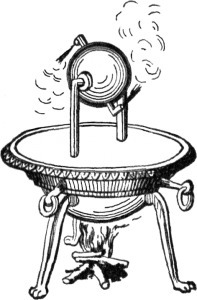
The Romans were undoubtedly master engineers. They were experts at civil engineering, building roads, improving sanitation, inventing Roman concrete, and constructing aqueducts that adhere to tolerances impressive even by today’s standards. Perhaps the best evidence of their aptitude is the fact that many of those structures still stand today, almost 2000 years later. They even began dabbling in technology vastly ahead of their time. Hero of Alexandria drew up plans for a rudimentary steam engine in his Spiritalia seu Pneumatica. He called it the aeolipile.
If you have allergies, then you might want to step away from your computer now. This episode of archaeoLOGIC might be for you. ------------------------------...
About 35,000 years ago, prehistoric artists across Europe suddenly discovered the female form—and the art world has never been the same. The explosion of voluptuous female figurines sculpted out of limestone, ivory, and clay directly inspired Picasso and Matisse.
Researchers have debated the figurines' meaning for decades. Now, two scientists think they have the answer. Presenting their work here last week at the European Palaeolithic Conference, they claimed that the objects started off as celebrations of the female form, then later became symbols that tied together a growing human society.
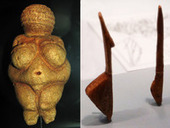
The talk, part of a special exhibition on Ice Age art at London's British Museum, surveyed the more than 20,000 year-history of female figurines, which are found at dozens of archaeological sites from Russia to France. The earliest such objects, which include the famous Venus of Willendorf from Austria (see photo) and a statuette recently found in Germany that some have called the "earliest pornography," date from as early as 35,000 years ago and are generally called the "Willendorf style" of prehistoric art.
The priorities of the Roman civilization were not the same as the Greeks. The Romans were practical people. They were farmers and warriors - not lovers of art as the Greeks were. Their first temples were to Mars, the War God. Music was never a part of education for the young.
They had a desire for colossal effects as we see in the Roman games. Seneca says that in Nero's time the chorus was larger than the spectators. At the games there were also flanks of trumpeters and flutists, much like today's sports games with the band sitting on the bleachers.
“Pitoti” are the figures which are cut into rock rather than painted onto rock. The major single concentration is in the high Alpine valley of Valcamonica, in the Lombardy region of northern Italy. Valcamonica was the first place in Italy to be inscribed on the UNESCO world heritage list, in 1979 – before any of the nation’s more famous and Renaissance masterpieces.
This rock-art exists in abundance: at least 350,000 figures in Valcamonica alone. Above all – and this is why Valcamonica rock-art is genuinely unique – the figures present an autobiographical record.
Dal 2 ottobre al 4 novembre 2012 presso la Triennale di Milano. La mostra utilizza i più moderni ed innovativi strumenti interattivi di comunicazione multime...
To get content containing either thought or leadership enter:
To get content containing both thought and leadership enter:
To get content containing the expression thought leadership enter:
You can enter several keywords and you can refine them whenever you want. Our suggestion engine uses more signals but entering a few keywords here will rapidly give you great content to curate.


 Your new post is loading...