


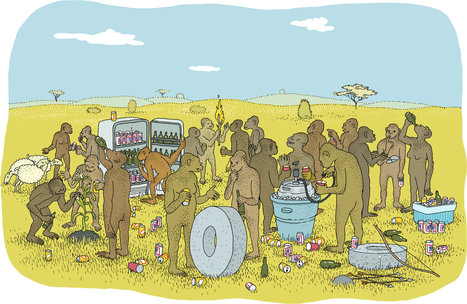
Humans may have found brew before they found bread. It’s a lucky thing.

 Your new post is loading...
 Scoop.it! Humans may have found brew before they found bread. It’s a lucky thing. 
No comment yet.
Sign up to comment
Scoop.it!

An Irish historian planned to spend six weeks organizing Jackie Clarke’s collection of more than 100,000 items documenting Ireland’s struggle to free itself of English rule, but eight years later, she’s still at it.
Scoop.it!

During the 2013 season of the Valley of the Kings Project carried out by University of Basel, Prof. Susanne Bickel’s team have found a number of exciting artefacts including what they suspect to be one of the oldest portable sundials in the area between tombs KV 29 and 61.
Scoop.it!

joint expedition of scientists led by Chapurukha M. Kusimba of The Field Museum and Sloan R. Williams of the University of Illinois at Chicago has unearthed a 600-year-old Chinese coin on the Kenyan island of Manda that shows trade existed between China and east Africa decades before European explorers set sail and changed the map of the world.
Scoop.it!

A study of Neanderthal skulls suggests that they became extinct because they had larger eyes than our species.
David Connolly's insight:
hmmm this calls for a more detailed look at the research... this seems an over simplification
Scoop.it!

By Owen JarusLiveScience A newly deciphered Egyptian text, dating back almost 1,200 years, tells part of the crucifixion story of Jesus with apocryphal plot twists, some of which have never been seen before.
David Connolly's insight:
You have to love this version

Kyle Kunkel O'Connor's curator insight,
March 14, 2013 12:31 PM
new views on religion, interesting topis, religion, alternative history
Scoop.it!

Personal ornaments, often in the form of beads worn as necklaces or bracelets, are considered by archaeologists as a key sign of sophisticated symbolic behavior, communicating either membership in a group or individual identity. Such ornaments are ubiquitous in so-called Upper Paleolithic sites in Europe beginning about 40,000 years ago, where they were made from many different materials—animal and human teeth, bone and ivory, stone, and mollusk shells—and often varied widely among regions and sites.
Scoop.it!

From
en

Baku. Kamala Guliyeva – APA. The new settlement dated back to the Middle Bronze Age in the 3rd millennium BC has been found in Azerbaijan, Chief of Shaki-Gakh-Oghuz Archaeological Expedition of National Academy of Sciences of Azerbaijan (ANAS)...
Kyle Kunkel O'Connor's curator insight,
March 14, 2013 12:46 PM
civilization, history, archyology, anthropology
Scoop.it!

Historian Dan Snow writes that Syria's heritage is under attack - but when the war ends it will be the foundation on which a shredded national identity can be rebuilt.
In August 2012 fire tore through the heart of the Syrian city of Aleppo. One Western journalist said parts of it, including much of the medieval covered market, or souk, were "burned to smithereens".
Old Aleppo is a Unesco World Heritage site, recognised by the world as being internationally significant, a vital piece of humanity's shared past. Central Aleppo was a stunningly preserved medieval settlement, probably the finest example of its kind in the world.
It was as if parts of Stonehenge or the heart of Edinburgh had been wiped out. The fire was caused by the vicious fighting that has swept across Syria since a civil war started in 2011.
More than 50,000 people have been killed, thousands more injured, imprisoned and tortured, and millions made homeless or turned into refugees.
Scoop.it!

Rock art in Fenno-Scandinavia can be divided into northern ‘hunter’s art’ and southern ‘farmer’s art’ styles. The distribution of rock art sites shows that ‘hunter’s art’ is found not only in the area where Sami people live today but also across a much more extensive area settled in earlier times by the ancestors of the Sami (Figure 2). The rock art takes various forms, including polished carvings, pecked engravings and paintings made with red ochre. Very often the rock art is found in sites that are associated with water, for example springs, waterfalls, rivers and close to the sea. The commonest motifs are zoomorphs (often elks and reindeer), boats, and anthropomorphs. In this article I will suggest that many of these rock art motifs are direct or indirect representations of the Mother Earth deity known to the Sami as Máttaráhkká.
David Connolly's insight:
Perfect for Mothers Day!
Scoop.it!

Hidden murals by war artist Evelyn Gibbs are set to be uncovered and restored after electricians discovered them at a church. The paintings, previously thought to have been destroyed during 1972 modernisations, show a Biblical scene set in Nottingham. They were painted at St Martin's Church in Bilborough after Gibbs was evacuated to Nottingham in the World War II. They were discovered behind a false ceiling during repairs in 2009. Work to renovate the church and remove the ceiling is expected to begin in February 2014 and should be completed by the end of the year. Evelyn Gibbs biographer Pauline Lucas said: "It's a very exciting project. "So many murals have been destroyed and painted over and yet here is one that actually survived and is going to be restored."
David Connolly's insight:
Wow!!!
Scoop.it!

The status of women in ancient civilizations was dictated by religion and position, rarely impacting the everyday lives of everyday female interactions.
For the vast majority of women in the Ancient world, daily life revolved around the home as caretakers of children or household managers. Historians that cite examples of powerful women usually rely upon exceptional females, often associated with religious rituals such as the Oracle at Delphi or Rome’s Vestal Virgins. Although the Mediterranean pantheon of goddesses reflects power and cult-following, their example inspired upper class women as well as men, as in the case of the cult of Isis. The lives of everyday women were scarcely affected.
David Connolly's insight:
Religion, Magic, and Ritual Afford Greater Female Status in Ancient Cultures

Cassandra Folkerth's curator insight,
September 28, 2013 5:10 PM
Its interesting to think about how the role of women is based entirely on the religion adopted by that society. If one society has a female god I believe that socitey would have more respect for the female gender. But many societies are quite patriarichal, therefore having more respect for the man than woman. 
Sarah Kerr's curator insight,
October 24, 2013 12:23 AM
This scoop gives some insight on what it was like to be a women in the Ancient Mediterranean World. First of all, women were seen as subservient to males, they were in charge of being caretakers of children and to take care of the home. This scoop goes into depth of the few women in ancient history who had a higher status in women kind by being included in things men were such as poetry, politics and relgious events. 
Karina Moreno's curator insight,
April 28, 2014 11:38 PM
I find it unreal that a lot of history do not mention women nor in many regions they were consider a citizens. Back then they should have realized that women were that made everything happen. A population of people wouldn't have been possible with women giving birth and raising to create who we are today.
Scoop.it!

Excavations at the site of the ancient city of Troy, in the northwestern province of Çanakkale, began over 150 years ago, yet experts believe two or three more centuries of work will be needed to fully discover it.
|
Scoop.it!

Archaeologists working on the UK’s largest infrastructure project – Crossrail – have discovered a lost burial ground in central London which may have been created as a result of the outbreak of plague in the 14th century.
Scoop.it!

As the Syrian crisis enters its third year, an end to the violence in the country is nowhere to be seen. The world has become accustomed to rising death tolls and reports of shelling and destruction. However, another threat looms in Syria, and this time it is targeting its cultural heritage.
Palmyra, one of the oldest cities in the country, has been subjected to intermittent shelling by forces loyal to President Bashar al-Assad. The ruins of the city, which is one of UNESCO’s World Heritage sites, date back thousands of years. “Bombs and rockets come in all directions,” eyewitnesses said.
Assad forces have struck the Roman Temple of Bel – built in 43 A.C. – and damaged its northern wall, eyewitnesses said, adding portions and stones of the wall have been destroyed.
Scoop.it!

Excavations for the Crossrail project in London reveal 13 bodies in a burial ground believed to date from the early days of the Black Death.
Scoop.it!

restored Roman cockerel figurine is the best result from a Cirencester dig in decades, archaeologists have said.
The enamelled object, which dates back as far as AD100, was unearthed during a dig in 2011 at a Roman burial site in the town. It has now returned from conservation work and finders Cotswold Archaeology said it "looks absolutely fantastic".
The 12.5cm bronze figure was discovered inside a child's grave and is thought to have been a message to the gods.
Scoop.it!

It had the potential to be another Afghanistan Buddha disaster, recalling the Taliban’s destruction of two ancient statues that had stood for centuries in this country’s west: A buried Buddhist city lost to time was about to be obliterated by what promised to be one of the largest copper mines in the world.
Now, however, thanks to delays in construction of the massive mine and a hefty influx of cash from the World Bank, the 1.5-square-mile Mes Aynak complex is an archaeological triumph – though bittersweet. Read more here: http://www.miamiherald.com/2013/03/12/3281580/afghanistan-moves-to-salvage-ancient.html#storylink=cpy
Scoop.it!

Researchers performing CT scans of 137 mummies from across four continents showed evidence of atherosclerosis, or hardened arteries, in one third of those examined, including those from ancient people believed to have healthier lifestyles than most of us have today.
Scoop.it!

Seven artefacts dating as far back as 4,000 BCE to the Neolithic period, and thought to belong to the Vinca, a prehistoric culture that traces back to 5,500 BCE in southern Europe, have been returned to Kosovo. They are believed to have been stolen during the 1998-99 Kosovo war, and were discovered by police in Germany in 2005.

Raymond McGee's curator insight,
January 17, 2014 4:43 PM
I found it intresting that these pieces were stolen and found by German police. Alot of important artefacts are placed in Kosovo's Archeological museum.
Scoop.it!

Scientists are questioning the accuracy promised by DNA sampling used to trace generations of ancestors
this week leading scientists challenged the basis of the tests. The Sense About Science campaign group claimed that the practice is as questionable as astrology.
David Connolly's insight:
Go for it!
Scoop.it!

• P • I • T • O • T • I • is a multimedia digital rock art exhibition in the South Lecture Room of Cambridge University’s Museum of Archaeology and Anthropology (MAA), on display until March 23. This is the first time it has been on display in the UK. It brings some of the earliest human figures in European rock art to life with interactive graphics, 3D printing and video games; exploring the potential links between the world of archaeology and the world of film, digital humanities and computer vision.
David Connolly's insight:
Valcamonica - this is on my places to go... and this short film is just so cool!
Scoop.it!

CAIRO: Egyptian antiquities officials have confirmed to Bikyanews.com that a pipe has burst inside the museum holding one of pyramid builder Khufu’s boat.
David Connolly's insight:
i suspect that it is not really threatened by a rising flood of sewage. but... pretty embarrassing
Scoop.it!

A recently-completed cemetery excavation close to Colchester’s Roman circus has revealed that some of Camulodunum’s citizens marked their grave plots with ditches and wooden fences. It had previously been speculated that, during the Roman period, those unable to afford stone monuments might have used wooden markers or mounds of earth to distinguish individual burials. Now a four-month investigation by Colchester Archaeological Trust has unearthed clusters of inhumations dated by grave goods and other finds to the 2nd and 3rd century and surrounded in some cases by lines of small post-holes up to about 20cm in diameter.
David Connolly's insight:
Pretty damn fine!
Scoop.it!

In a remote corner of the world, east of Esperance, in Western Australia, a stone fish trap has been re-discovered by Traditional Owners and an integrated research team operating within the Gabbie Kylie Foundation (National Trust of Australia, W.A.).
David Connolly's insight:
Great article - great project and great fieldschool!
|




