Your new post is loading...

|
Scooped by
David Connolly
May 11, 2013 1:32 AM
|
Dienekes assembles the recent papers that looks at the connection between Bronze Age Scandanavia and the Mycenean state in Greece. a quote to start off the collection states a simple fact that has large implications. It turns out that all examined Swedish subject except one - a slaggbit - comes from mines and ore deposits from sites in Cyprus, Sardinia, the Iberian Peninsula, the Massif Central in the current France, Tyrol and the British Isles. Copper has been transported, and in return it has been shipped back large amounts of amber. What emerges is a picture of a time when international contacts over large water was obvious, and there are already some 2000 years before the Vikings set off on their journeys. http://sverigesradio.se/sida/avsnitt/45788?programid=412
|
|
Scooped by
David Connolly
May 10, 2013 11:32 AM
|
The Carmona necropolis (Spain) is a collection of funeral structures from between the 1st century B.C. and the 2nd century A.D. One of these is known as the Elephant’s Tomb because a statue in the shape of an elephant was found in the interior of the structure.
|
|
Scooped by
David Connolly
May 10, 2013 2:58 AM
|
LOUISBOURG — A team of underwater archeologists is diving to the remains of 18th-century French warships that were sunk during the second siege of Louisbourg in 1758.
|
|
Scooped by
David Connolly
May 9, 2013 1:37 PM
|
This past Tuesday I had the pleasure of attending Anthony Bourdain’s Guts and Glory tour, his first live tour that consists of 75 minutes of fantastic food and travel rants. Throughout his expletive filled diatribe, he emphasized that food is the way to reach other cultures. Food is a primary way that people express their past and present, it is an amalgamation of their historical roots and current living conditions. Through food we create and maintain ties to one another. It is important, in fact it is fundamental to survival. Most importantly to Bourdain, it is a way to learn and connect with other cultures, and through eating he has been able to reach the intimate and cultural side of society throughout the world.
|
|
Scooped by
David Connolly
May 9, 2013 3:25 AM
|
Marine paleoecologist Marco Coolen from the Woods Hole Oceanographic Institution (WHOI) was examining vast amounts of genetic data from the Black Sea sediment record. He was astonished by the variety of past plankton species that left behind their genetic makeup (i.e., the plankton paleome). The semi-isolated Black Sea is highly sensitive to climate driven environmental changes, and the underlying sediments represent high-resolution archives of past continental climate and concurrent hydrologic changes in the basin. The brackish Black Sea is currently receiving salty Mediterranean waters via the narrow Strait of Bosphorus as well as freshwater from rivers and via precipitation.
|
|
Scooped by
David Connolly
May 8, 2013 2:44 PM
|
The so-called Gabriel Stone, said to have been found 13 years ago in Jordan, features an unknown prophetic text from the time of the Second Jewish Temple, which some researchers claim references a messianic resurrection pre-dating Jesus. Scholars say it as a portal into the religious ideas circulating in the Holy Land in the era when was Jesus was born.
Its form is also unique - it is ink written on stone, not carved - and no other such religious text has been found in the region. Curators at the Israel Museum, where the first exhibit dedicated to the stone opened today, say it is the most important document found in the area since the discovery of the Dead Sea Scrolls.
'The Gabriel Stone is in a way a Dead Sea Scroll written on stone,' said James Snyder, director of the Israel Museum.
The writing dates to the same period, and uses the same tidy calligraphic Hebrew script, as some of the Dead Sea Scrolls, a collection of documents that include the earliest known surviving manuscripts of Hebrew Bible texts.
|
|
Scooped by
David Connolly
May 8, 2013 3:57 AM
|
From Ireland to the Balkans, Europeans are basically one big family, closely related to one another for the past thousand years, according to a new study of the DNA of people from across the continent. The study, co-authored by Graham Coop, a professor of evolution and ecology at the University of California, Davis, is published in the journal PLoS Biology. “What’s remarkable about this is how closely everyone is related to each other. On a genealogical level, everyone in Europe traces back to nearly the same set of ancestors only a thousand years ago,” Coop said. “This was predicted in theory over a decade ago, and we now have concrete evidence from DNA data,” Coop said, adding that such close kinship likely exists in other parts of the world as well.
|
|
Scooped by
David Connolly
May 8, 2013 3:50 AM
|
The Cape of Cavalleria on the northern coast of Menorca provides a natural shelter for the port of Sanitja from the northern and northeastern winds. This natural port was first occupied as a military camp during the Roman conquest of the Balearic Islands by General Metelus between 123 and 121 BCE, and the harbour settlement grew over the following centuries. In 1996 the formal study of this area began, revealing one of the most important archaeological sites on the island of Menorca. The initial work between 1996 and 2008, revealed that the military camp had an unexpectedly long occupation of almost 70 years, until it was abandoned around 45 BCE. At this point, the veteran soldiers, merchants and locals started living in a ramshackle settlement that developed slowly into a new city called Sanisera, mentioned first by Pliny the Elder in the 1st century CE.
|
|
Scooped by
David Connolly
May 7, 2013 12:08 PM
|
On a deserted stretch of coastline in the far north-west of Qatar are the ancient ruins of a large fortress.
|
|
Scooped by
David Connolly
May 6, 2013 2:22 AM
|
he Hanging Gardens of Babylon, one of the Seven Wonders of the Ancient World, weren’t in Babylon at all – but were instead located 300 miles to the north in Babylon’s greatest rival Nineveh, according to a leading Oxford-based historian. After more than 20 years of research, Dr. Stephanie Dalley, of Oxford University’s Oriental Institute, has finally pieced together enough evidence to prove beyond reasonable doubt that the famed gardens were built in Nineveh by the great Assyrian ruler Sennacherib - and not, as historians have always thought, by King Nebuchadnezzar of Babylon. Dr. Dalley first publicly proposed her idea that Nineveh, not Babylon, was the site of the gardens back in 1992, when her claim was reported in The Independent – but it’s taken a further two decades to find enough evidence to prove it. Detective work by Dr. Dalley – due to be published as a book by Oxford University Press later this month – has yielded four key pieces of evidence.
|
|
Scooped by
David Connolly
May 5, 2013 5:37 AM
|
A hoard of Roman gold and silver coins, described by an expert as a "lucky" find and likened to the Hoxne treasure, are found in Norfolk. "As this horde finishes with the coins of Tiberius, it could date to either the Roman invasion of Britain in AD 43, or possibly the Boudicca revolt in AD 61, it's difficult to say either way," said Mr Marsden. "It's likely it was buried to have come from a Roman soldier or perhaps settlers trying to hide their hoard from the Iceni invasion. We tend not to see many of this type of Roman silver coins, so to have 59 is really quite unusual. "Coins this size have a spending power of about £30-£40 in today's money - it'd certain buy a solider a few jugs of wine." A medieval gold pendant found in Foxley and a medieval silver seal matrix unearthed in Sustead, near Cromer, were also declared treasure. Erica Darch, from Norfolk Historic Environment Services and the Portable Antiquities Scheme (PAS), said: "It's important to record all archaeological finds, treasure or not, because when studied as an assemblage they add enormously to our understanding of Norfolk's past.
|
|
Scooped by
David Connolly
May 4, 2013 4:16 PM
|
Figs and fig trees are familiar to a wide cross-section of human society, both as a common food and for their spiritual importance. What is less well understood is the global nature of this association between figs and humans, which is maintained across species, continents and societies. This relationship is explored by David Wilson of Ecology and Heritage Partners and Anna Wilson from the University of Melbourne in Australia in a paper published in the Springer journal Human Ecology. Using examples from around the world, the authors show that figs are a vital resource for humans, no matter which species are present in a region.
|
|
Scooped by
David Connolly
May 3, 2013 2:51 PM
|
A nearly 1,000 year-old rune stone has been rediscovered at Bogesunds brygga west of Vaxholm in Sweden. The rune stone was found during an excursion which was part of a course in landscape archaeology at Stockholm University. The stone has previously been known, but had been missing since the 17th century.
|
|
|
Scooped by
David Connolly
May 10, 2013 11:59 AM
|
Once upon a time in the back garden, I started to do some archaeological grain processing experiments. It was the summer of 1995. I'd just finished an archaeology degree. Now I was enrolled on a master's degree course at Manchester University and I was beginning my investigations into how people may have made the ale in prehistory.
In my final year as an undergraduate, I had chosen the British Neolithic and Bronze Age as my specialist subject. We were told that, in Bronze Age Britain- Beakers were for Beer! Warriors buried with wristguards and bows and arrows and fine beaker pots for their ale! It got a laugh from the class, as any mention of beer and brewing seems to do.I'm still not sure why - but that was when I first began to wonder. "OK. So, how did they make it?"
Being married to a craft brewer, I was used to living in a brew house. The sacks of crushed malt. The delicious aroma of the mash. The rituals. The water and wort spilled on the kitchen floor. Steam emanating from the out house door as he mashed the malt and boiled the wort. We lived in a big, old Victorian house and the dining room was where the beer was fermented. We had a cellar to keep it in. He would bring a sack of crushed malt in through the front door and transform it into beer. It was very good beer. It was a fairly simple process.
|
|
Scooped by
David Connolly
May 10, 2013 9:32 AM
|
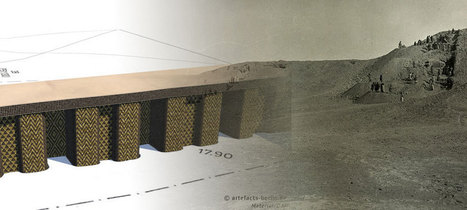
Uruk, in modern-day Iraq, is one of the first cities in the world and was populated almost without interruption for over 5,000 years – from the 4th millennium BC to the 1st millennium AD. The city is famous for the invention of cuneiform writing at the end of the 4th millennium, in the “late Uruk period”. During this creative flourishing the city already covered an area of 2.5 square kilometres and many distinctive architectural features were invented and developed.
|
|
Scooped by
David Connolly
May 10, 2013 1:52 AM
|
More than two years after the January 2011 Revolution, urban and agricultural encroachment continues to threaten Egypt’s archaeological sites. The lack of security that overwhelmed the country during and after the revolution has certainly taken its toll. The sanctity of spiritual and archaeological environments have been desecrated, with plundering and destruction by vandals, thieves and neighbouring residents being carried out virtually unchecked. Well-organised and well-armed gangs of thieves are reportedly plundering archaeological sites, while illegal construction encroaches on and sometimes even covers them. The rich Islamic site of Istabl Antar in Egypt’s first Islamic capital has been isolated, as have Al-Muizz Street in historic Cairo; the ancient Egyptian necropolis of Dahshour; the Giza Plateau; the New Kingdom site of Matariya; the area of Al-Bordan on the Alexandria-Marsa Matrouh highway and the Hagg Kandil site at Amarna in Minya in Upper Egypt, to mention just a few. Some building encroachments were removed safely and without damage, but for others help came too late and some areas of historical importance, where genuine objects and important remains are still hidden in the sand, were ruined or looted.
|
|
Scooped by
David Connolly
May 9, 2013 10:53 AM
|
Australian Geographic
Google Earth fuelling 'armchair archaeology'
Australian Geographic
TRADITIONALLY, ARCHAEOLOGY HAS involved a lot of digging through both archives and dirt, as well as being in the right place at the right time.
|
|
Scooped by
David Connolly
May 9, 2013 2:04 AM
|
Geologists have announced the discovery of what has been dubbed the 'Brazilian Atlantis', some 900 miles from Rio.
|
|
Scooped by
David Connolly
May 8, 2013 7:02 AM
|
A senior druid is calling for fake human remains to be put on display at the new visitor centre at Stonehenge.
|
|
Scooped by
David Connolly
May 8, 2013 3:52 AM
|
Archaeologists with the LAMAR Institute discovered the location of Carr’s Fort, a significant frontier fortification that was attacked on February 10, 1779. The month-long search by a team of six researchers encompassed more than 2,700 wooded acres of the Beaverdam Creek watershed. Battlefield archaeology at Carr’s Fort yielded about a dozen fired musket balls, several musket parts and several hundred iron and brass items from the 18th century.
|
|
Scooped by
David Connolly
May 8, 2013 2:08 AM
|
The chief of a Nanaimo-area First Nation says his community is livid at the discovery that crews hired by BC Hydro damaged an ancient and well-documented petroglyph site while working in the band’s territory last month.
|
|
Rescooped by
David Connolly
from Archaeo
May 6, 2013 9:21 AM
|
If it were any other Saturday morning, Yamir White would probably be playing video games and not giving a thought to digging in the dirt near a school named after 19th century Pennsylvania Gov. George Wolf.
Via Sylvain Rotillon
|
|
Scooped by
David Connolly
May 6, 2013 1:25 AM
|
Rock paintings dating back thousands of years ago have been found in the Aegean province of Aydın’s Çine district.
Similar rock paintings have previously been found in the Beşparmak Mountains, Bafa Lake and its environs, all of which are located in an area divided between Muğla’s Milas district and Aydın’s Koçarlı and Söke districts.
The paintings, which are believed to be 7,500 years old, were discovered as part of work conducted by Tekirdağ Namık Kemal University Archaeology Department Professor Neşe Atik initiated in 2000.
|
|
Scooped by
David Connolly
May 5, 2013 3:18 AM
|
The archaeological excavations started in 2004 to accommodate the Marmaray Metro Project are still uncompleted, while about 40,000 boxes of historical findings are under serious threat as they have been locked in depots.
Though the 8,500-year-old historical artifacts from the Neolithic period drew worldwide interest, the excavations were stopped due to lack of funding.
About 40,000 boxes of artifacts found in the excavations, which were carried out with the sponsorship of the Transportation Ministry State Ports and Airports Authority (DLH), were locked in depots and sealed.
|
|
Scooped by
David Connolly
May 4, 2013 3:05 AM
|
An Air Transport Command plane flies over the pyramids in Egypt.Loaded with urgent war supplies and materials, this plane is one of a fleet flying shipments from the U.S. across the Atlantic and the continent of Africa to strategic battle zones. 1943. Exact Date Shot Unknown. (Army)
|