 Your new post is loading...

|
Scooped by
David Connolly
October 12, 2013 2:53 AM
|
Archaeological excavations have been ongoing for eight years in the village of Oymaağaç of Vezirköprü district in the northern province of Samsun, aiming to unearth the holy Hittite city of Nerik. The head of the excavations, German archaeologist Associate Professor Rainer Czichon said that works in Oymaağaç had started in 2005 and this year’s excavations had now ended.
Czichon said that they had carried out surface survey during the first two years, and then started excavations. “Our goal is to prove that Oymaağaç is the holy city of the Hittite, which is Nerik. “We already know that this region is a Hittite settlement. We have found cuneiform tablets that will prove that this place is Nerik. There are scriptures about Nerik in four cuneiform tablets that we found this year. There is a part named ‘Tahanga’ in two of the tablets. Tahanga is a section in Nerik’s ‘god of air’ temple. This is a strong proof that Oymaağaç is Nerik. We are sure for 95 percent,” Czichon said.
|
|
Scooped by
David Connolly
October 10, 2013 1:28 PM
|
As part of a larger pan-European study investigating the Bronze Age of Europe, an archaeologist from the University of Gothenburg has provided the first evidence of long distance travel by an individual – probably from southern Sweden – into the territory of the Únětice culture of Silesia. The doctoral thesis confirms evidence based on bioarchaeological data.
|
|
Scooped by
David Connolly
October 8, 2013 5:05 PM
|
Archaeologists excavating at the famous Inca site of Machu Picchu in Peru have discovered the remains of an astronomical observatory
|
|
Scooped by
David Connolly
October 7, 2013 4:29 AM
|
The world’s biggest and the most magnificent Corinthian-style temple column head has been unearthed during excavations at the Temple of Hadrian in the western province of Balıkesir.
|
|
Scooped by
David Connolly
October 5, 2013 5:42 PM
|
Excavations are continuing in the western province of Denizli’s ancient city of Hierapolis
|
|
Scooped by
David Connolly
October 3, 2013 5:13 PM
|
Government archaeologists are trying to determine how to clean up some vandalism of First Nation rock art after someone apparently blasted paintball pellets at ancient pictographs near Nelson, B.C.
|
|
Scooped by
David Connolly
October 3, 2013 11:34 AM
|
Fall break is just a couple weeks away, and it may be a great time for a little history lesson here in Green Country. A new and improved ancient village attracts people from all over the world, to learn about the Cherokees and how they lived in the early 18th Century. Just outside the Cherokee Heritage Museum, on four acres, there's a village that almost looks like a movie set, where you'll likely see men playing a stickball game or women finger weaving. It's a way of teaching people about Cherokee history and culture through an authentic experience of what tribal life was like in the early 1700s. The Cherokee Nation has had an ancient village open for visitors since 1967, but it's now been replaced by a new, old village. It's much larger, and more historically accurate.
|
|
Scooped by
David Connolly
October 2, 2013 3:32 AM
|
Archaeologists working with London's Crossrail project have uncovered 20 skulls believed to be from the Roman period. It is likely the bones were washed from a nearby burial site along one of London's "lost" rivers - the Walbrook. Since the Crossrail project began, about 10,000 Roman items have been discovered.
|
|
Scooped by
David Connolly
October 1, 2013 2:04 AM
|
Human hair found in fossilized hyena poop suggests that our ancestors satisfied the hunger of others during prehistoric times. The fossilized dung, part of a “hyena latrine,” will be described in the upcoming October issue of the Journal of Archaeological Science. The latrine was first found a few years ago at Gladysvale cave in the Sterkfontein Valley of South Africa, but it recently went through an additional barrage of testing.
|
|
Scooped by
David Connolly
September 29, 2013 3:41 PM
|
Researchers have confirmed a direct link between bipedal walking and the position of the foramen magnum, a hole in the base of the skull that transmits the spinal cord
|
|
Scooped by
David Connolly
September 28, 2013 4:08 AM
|
Long ago, in the region surrounding Nevsehir and Kayseri, in central Turkey, an ancient people built, or rather dug, over 200 underground cities. The deepest of these, under the present day town of Derinkuyu, delves over 250 feet below the Earth’s surface, and boasts numerous tunnels, halls, meeting rooms, wells and passages.
Because the city was carved from existing caves and underground structures that had first formed naturally, there is no way to discern, with traditional archaeological methods of dating, when exactly Derinkuyu was built. As such, and with ties to the Hittites, Phrygians and Persians, Derinkuyu presents a fascinating riddle for ancient mystery enthusiasts. Long ago, in the region surrounding Nevsehir and Kayseri, in central Turkey, an ancient people built, or rather dug, over 200 underground cities. The deepest of these, under the present day town of Derinkuyu, delves over 250 feet below the Earth’s surface, and boasts numerous tunnels, halls, meeting rooms, wells and passages. Because the city was carved from existing caves and underground structures that had first formed naturally, there is no way to discern, with traditional archaeological methods of dating, when exactly Derinkuyu was built. As such, and with ties to the Hittites, Phrygians and Persians, Derinkuyu presents a fascinating riddle for ancient mystery enthusiasts. Read more at http://www.todayifoundout.com/index.php/2013/09/intriguing-ancient-underground-city-derinkuyu/#QHWQFczIYSheStzG.99Long ago, in the region surrounding Nevsehir and Kayseri, in central Turkey, an ancient people built, or rather dug, over 200 underground cities. The deepest of these, under the present day town of Derinkuyu, delves over 250 feet below the Earth’s surface, and boasts numerous tunnels, halls, meeting rooms, wells and passages. Because the city was carved from existing caves and underground structures that had first formed naturally, there is no way to discern, with traditional archaeological methods of dating, when exactly Derinkuyu was built. As such, and with ties to the Hittites, Phrygians and Persians, Derinkuyu presents a fascinating riddle for ancient mystery enthusiasts. Read more at http://www.todayifoundout.com/index.php/2013/09/intriguing-ancient-underground-city-derinkuyu/#QHWQFczIYSheStzG.99Long ago, in the region surrounding Nevsehir and Kayseri, in central Turkey, an ancient people built, or rather dug, over 200 underground cities. The deepest of these, under the present day town of Derinkuyu, delves over 250 feet below the Earth’s surface, and boasts numerous tunnels, halls, meeting rooms, wells and passages. Because the city was carved from existing caves and underground structures that had first formed naturally, there is no way to discern, with traditional archaeological methods of dating, when exactly Derinkuyu was built. As such, and with ties to the Hittites, Phrygians and Persians, Derinkuyu presents a fascinating riddle for ancient mystery enthusiasts. Read more at http://www.todayifoundout.com/index.php/2013/09/intriguing-ancient-underground-city-derinkuyu/#QHWQFczIYSheStzG.99Long ago, in the region surrounding Nevsehir and Kayseri, in central Turkey, an ancient people built, or rather dug, over 200 underground cities. The deepest of these, under the present day town of Derinkuyu, delves over 250 feet below the Earth’s surface, and boasts numerous tunnels, halls, meeting rooms, wells and passages. Because the city was carved from existing caves and underground structures that had first formed naturally, there is no way to discern, with traditional archaeological methods of dating, when exactly Derinkuyu was built. As such, and with ties to the Hittites, Phrygians and Persians, Derinkuyu presents a fascinating riddle for ancient mystery enthusiasts. Read more at http://www.todayifoundout.com/index.php/2013/09/intriguing-ancient-underground-city-derinkuyu/#QHWQFczIYSheStzG.99
|
|
Scooped by
David Connolly
September 26, 2013 12:58 PM
|
The continuing debate regarding the origins of people inhabiting ancient Mesopotamia during the region’s long history led the authors of a new report published in the Open Access journal PLoS ONE to attempt an isolation and analysis of mtDNA sequences from the area.
|
|
Scooped by
David Connolly
September 24, 2013 8:20 AM
|
When Koen Ergle first saw the rounded end of a nearly black log poking out of the sand in the lake near his home, the 7-year-old thought it was a giant mussel. But it soon became clear it was a near-pristine dugout canoe possibly hundreds of years old.
|
|
|
Scooped by
David Connolly
October 11, 2013 11:56 AM
|
Intriguing new results from a study undertaken by the Institute of Anthropology at Johannes Gutenberg University Mainz (JGU) that has just been published in the journal Science, show indigenous Mesolithic hunter-gatherers and immigrant Neolithic farmers lived side-by-side for more than 2,000 years in Central Europe.
|
|
Scooped by
David Connolly
October 9, 2013 2:36 AM
|
'Ancient humans' used toothpicks nearly 1.8 million years ago, a study of their teeth reveals.
|
|
Scooped by
David Connolly
October 8, 2013 5:05 PM
|
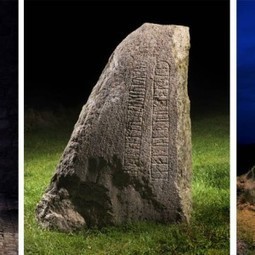
The Danish National Museum Runestone Project sheds light on the numerous rune stones found across the whole country through a series of good quality images and text on Wikipedia. Now, the project is also available in a new smartphone app. from the Cultural Agency of Denmark’s ancient monuments, which can be downloaded free.
|
|
Scooped by
David Connolly
October 6, 2013 12:15 PM
|
he spires of Bagan have survived wars, earthquakes and centuries of tropical sun, but in recent years Myanmar's ancient capital has faced a distinctly modern threat -- scaffolding and cement. The temples, some of which are around 1,000 years old, are one of the country's most treasured religious sites and a top attraction for foreign tourists flocking to the country as it emerges from decades of military rule. While many have largely withstood the ravages of man and nature, haphazard renovation work has also seen new temples built on the foundations of crumbling structures, and experts say they bear little resemblance to the originals.
|
|
Scooped by
David Connolly
October 5, 2013 7:25 AM
|
Archaeologists at Lund University have found what they describe as a moment frozen in time by a brutal massacre, leaving a fort untouched since the 5th century. Excavation of the Iron Age Sandby borg – ringfort on Öland, an island off the southeastern coast of Sweden – has revealed a number of bodies, lying where they fell, in one case, it seems that a couple were cut down from behind as they ran through the house, another body lies in a doorway.
|
|
Scooped by
David Connolly
October 3, 2013 12:45 PM
|
Archaeologists have recently published in the International Journal of Osteoarcheology, a full report on the discovery of early Holocene burials while excavating in the Ille cave, Palawan, Philippines, where the bones of one individual bear the marks of a complex de-fleshing ritual. The island of Palawan, situated between Borneo to the south and the Philippine archipelago to the north and east, is important for its links with the Sundaic region of Southeast Asia. Many cave sites are known from the island, including Tabon Cave, which has the earliest recovered human remains in the Philippines (c. 45,000 years old). Cremation burial as found. Ille cave site in the background. Images: V. Paz & H. Lewis Ille is a solution cave and rockshelter at the base of a c. 75m-high karst tower near the village of New Ibajay, El Nido. The site comprises east and west rock-shelter mouths, opening onto a relatively flat platform of silt loam, in a setting of light woodland. In 1998 the National Museum of the Philippines began a long-term survey and excavation programme in the region, including Ille and other nearby caves and their surroundings.
|
|
Scooped by
David Connolly
October 3, 2013 11:31 AM
|
SHAKEN, scorched and boiled in its own juices, this 4000-year-old human brain has been through a lot. It may look like nothing more than a bit of burnt log, but it is one of the oldest brains ever found. Its discovery, and the story now being pieced together of its owner's last hours, offers the tantalising prospect that archaeological remains could harbour more ancient brain specimens than thought. If that's the case, it potentially opens the way to studying the health of the brain in prehistoric times. Brain tissue is rich in enzymes that cause cells to break down rapidly after death, but this process can be halted if conditions are right. For instance, brain tissue has been found in the perfectly preserved body of an Inca child sacrificed 500 years ago. In this case, death occurred at the top of an Andean mountain where the body swiftly froze, preserving the brain.
|
|
Scooped by
David Connolly
October 1, 2013 2:31 AM
|
A number of UNESCO World Heritage Sites have been deliberately damaged, during conflict, to fuel hatred & block reconciliation.
|
|
Scooped by
David Connolly
September 30, 2013 1:54 PM
|
A mighty warship that sailed nearly 1,000 years ago during the reign of Cnut the Great, will stand at the centre of the British Museum’s Viking exhibition in 2014. The Viking expansion from their Scandinavian homelands during this era created a cultural network with contacts from the Caspian Sea to the North Atlantic and from the Arctic Circle to the Mediterranean. The culture of the Scandinavians can be viewed in a global context which will highlight the multi-faceted influences arising from extensive cultural contacts. The exhibition will capitalise on new research and thousands of recent discoveries by both archaeologists and metal detectorists.
|
|
Scooped by
David Connolly
September 28, 2013 4:20 AM
|
Linguists who reconstruct ancient languages—and who previously did the arduous work solely by hand—now have another tool in their arsenal to speed up their laborious efforts. Computer scientists have proven they can use software to recreate the early languages from which modern tongues have derived. While previously it might have taken a linguist their entire career to reconstruct a major language family, now software running computations on, say, a large experiment that may involve a sixth of the world's languages can be completed in just a few hours. The achievement is not about speed, cautions Dan Klein, associate professor of computer science at the University of California, Berkeley. It's about being able to do things in a large-scale, data-driven manner without losing all the important insights that historical linguists have gained in working on these sorts of problems for decades, he says. Indeed, linguistic researchers compare these techniques to those used for gene sequence evolution.
|
|
Scooped by
David Connolly
September 26, 2013 4:00 PM
|
When Paul Koudounaris first heard of the existence of jewel-studded skeletons hidden in the forests of Germany, he envisioned "something from the Brothers Grimm combined with an Iron Maiden video.” He wasn't far off.
|
|
Scooped by
David Connolly
September 25, 2013 4:35 PM
|
An international team of archaeologists led by experts from the University of York has uncovered evidence of human activity in the high slopes of the French Alps dating back over 8000 years. The 14-year study in the Parc National des Écrins in the southern Alps is one of the most detailed archaeological investigations carried out at high altitudes. It reveals a story of human occupation and activity in one of the world’s most challenging environments from the Mesolithic to the Post-Medieval period.
|















The holy crap that's a large city! Hattusa, the best place on earth... until they had a drought.