Colaborando para una mejor educación en línea para adelantar la evolución de la enseñanza y aprendizaje usando la tecnología y pedagogía como estrategias.
Today, innovation is increasingly conflated with hype, disruption for disruption's sake, and outsourcing laced with a dose of austerity-driven downsizing. If any concept should be seen as an uncomplicated good thing in higher education, it's innovation. Defined by a common-sense notion of "doing things better" and burnished by the sheen of dazzling technological advances, what's not to like about innovation?Yet as 2014 churns on, the glow is wearing off. Today, innovation is increasingly conflated with hype, disruption for disruption's sake, and outsourcing laced with a dose of austerity-driven downsizing. Call it innovation fatigue.How did we get here? And if innovation is still something we are interested in fostering, what are the values that should animate it? What goals and strategies should we be pursuing if we want to reclaim innovation as a positive force as higher education continues to engage with digital and networked technologies?
Despite broadly similar views about the overall place of science in America, there are striking differences between the public and scientists’ views on a host of science-related issues, from whether genetically modified foods are safe to eat to whether the world's growing population will be a major problem.
VideoClass is an educational platform that provides mostly free video lessons for every subject taught in School or University. A smart and convenient way of learning for everyone.
Obstacles schools and districts face when starting a blended learning program can be avoided with the right communication and relationship development.
Using games to teach can increase student engagement and add meaning to learning. Hands-on apps give children the ability to mix tactile play with a digital experience. Thanks to augmented reality, more and more apps in the market blur the line between digital and analog. For example, Bloxels, new from Pixel Press, uses color-coded blocks that can be scanned in with an iPad camera to create a video game level. Osmo is another digital/analog blend. The kit includes a stand and a reflector for an iPad camera, enabling users to play with physical tangram puzzles or word games.
La pregunta es: ¿cómo está la tecnología cambiando la fisonomía de la educación?
Una respuesta es:
"En los últimos años, la educación moderna ha pasado por algunos cambios importantes. Los maestros han adoptado en gran medida tecnologías interactivas y los estudiantes utilizan cada vez más dispositivos inteligentes para acceder a los recursos de aprendizaje. Estas tendencias son provocados principalmente por el desarrollo de tecnologías web y el creciente uso de dispositivos móviles en particular. La posibilidad de acceder a Internet, casi en cualquier momento y lugar es, por supuesto, el principal impulsor de la innovación en el sector de la educación.
Learn three different group work methodologies for the college classroom and identify which are appropriate for your courses, students, and teaching style.
To test browsers, Terrill Thompson used the Native HTML5 Media Player test that ships with Able Player. This test page includes an HTML5 <video> element with two <source> elements to ensure cross-browser support, one targeting an MP4 video file and the other targeting a WebM video file. It also includes four kinds of <track> elements: captions, subtitles, descriptions, and chapters.
Who developed the polio vaccine? Does water boil at different temperatures based on altitude? Which is the hottest of Earth’s three layers? Take our science quiz and see how you compare with Americans overall.
Personalized learning provides a unique, highly focused learning path for each student. Individual attention from instructors isn’t feasible in traditional educational models with large numbers of students, and personalized learning is intended to use IT systems and tools to tailor learning experiences based on student strengths, weaknesses, and pace of learning. Technologies including analytics, adaptive learning, digital courseware, and others underlie personalized learning, which builds a “profile” of each student and makes continual adjustments to learning paths based on student performance. It also provides information to help instructors better target their teaching to individual students.
The 7 Things You Should Know About... series from the EDUCAUSE Learning Initiative (ELI) provides concise information on emerging learning technologies. Each brief focuses on a single technology and describes what it is, where it is going, and why it matters to teaching and learning. Use these briefs for a no-jargon, quick overview of a topic and share them with time-pressed colleagues.
In addition to the 7 Things briefs, you may find other ELI resources useful in addressing teaching, learning, and technology issues at your institution. To learn more, please visit the ELI Resources page.
Flipping the classroom promotes independent learning, personalizes instruction and encourages collaboration. But in order for it to work, students need to actually learn the material at home. Mind maps are one way to help them learn and retain information.
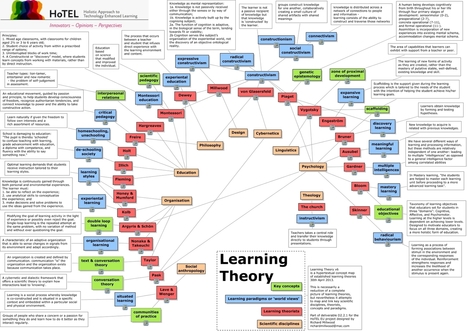
This Concept Map, created with IHMC CmapTools, has information related to: Learning Theory v5, Organisation Kolb, Psychology Vygotsky, Psychology Bloom, Piaget genetic epistemology, Psychology Skinner, Montessori constructivism, Dewey constructivism, radical constructivism Knowledge as mental representation: 1a. Knowledge is not passively received either through the senses or by way of communication; 1b. Knowledge is actively built up by the cognising subject; 2a. The function of cognition is adaptive, in the biological sense of the term, tending towards fit or viability; 2b Cognition serves the subject’s organization of the experiential world, not the discovery of an objective ontological reality., social constructivism connectivism, Taylor Organisation, Holt homeschooling, unschooling, constructivism radical constructivism, Kolb experiental learning, Montessori Montessori education, Social anthropology Lave & Wenger, Vygotsky zone of proximal development, Lave & Wenger situated learning, Education Illich, scientific pedagogy Education based on science that modified and improved the individual., communities of practice Groups of people who share a concern or a passion for something they do and learn how to do it better as they interact regularly.
To get content containing either thought or leadership enter:
To get content containing both thought and leadership enter:
To get content containing the expression thought leadership enter:
You can enter several keywords and you can refine them whenever you want. Our suggestion engine uses more signals but entering a few keywords here will rapidly give you great content to curate.


 Your new post is loading...
 Scoop.it!