Your new post is loading...

|
Scooped by
Alfredo Calderón
December 19, 2015 5:44 AM
|
In Greenlight VR’s last article for Singularity Hub we broke down the virtual reality landscape, including company growth, investment, and geographical trends. In this installment, we’ll look at the consumer...
|
|
Rescooped by
Alfredo Calderón
from SOMO dospuntocero
December 19, 2015 4:49 AM
|
PhotoFilters es una utilidad web, gratuita y sin necesidad de registro, que nos ofrece un puñado de filtros para retocar y mejorar nuestras fotografías.
Via Andoni Gonzalez
|
|
Scooped by
Alfredo Calderón
December 18, 2015 5:56 AM
|
Guía sobre buenas prácticas docentes para el desarrollo en el aula de las competencias básicas del alumnado.
Via Arturo Llaca
|
|
Scooped by
Alfredo Calderón
December 15, 2015 9:58 AM
|
Sea que estemos diseñando un curso, una unidad o lección, una vez que finalmente hemos identificado el objetivo instruccional y determinado que tipo de aprendizaje es; todavía nos hace falta determ…
|
|
Scooped by
Alfredo Calderón
December 15, 2015 8:23 AM
|
Social class is a powerful force in any society and affects every aspect of people’s lives, including education. Even if teachers are not aware of it, social class is operating in their classrooms. It is another form of unconscious bias. Most teachers and administrators are unaware that they hold a preference for or against a particular class. And it’s not so much that you may not like people or students from a particular class. It’s more about markers or indicators of class, like attitudes toward education, ways of speaking and dressing, the neighborhood people live in, the kind of car they drive…you get the picture. These markers are often the way that class manifests itself, the way that class is seen. It is these markers that people respond to during personal interactions, whether these interactions are on the cricket grounds, in the workplace or in the classroom. Social class is a powerful force in any society and affects every aspect of people’s lives, including education.
|
|
Scooped by
Alfredo Calderón
December 13, 2015 11:06 AM
|
|
|
Scooped by
Alfredo Calderón
December 13, 2015 7:25 AM
|
|
|
Scooped by
Alfredo Calderón
December 13, 2015 7:04 AM
|
|
|
Scooped by
Alfredo Calderón
December 13, 2015 6:44 AM
|
|
|
Rescooped by
Alfredo Calderón
from Edumorfosis.it
December 10, 2015 7:00 AM
|
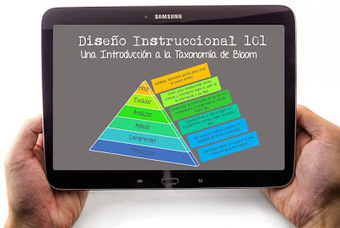
Los objetivos de aprendizaje son la esencia misma del proceso de Diseño Instruccional y con mucha razón: sin ellos, ¿cómo sabríamos qué contenidos y actividades incluir o integrar en nuestros cursos? Desafortunadamente (más de las veces que nos gustaría) los objetivos de aprendizaje no están claramente definidos o alineados a la necesidades de formación por lo que es difícil determinar si se han cumplido al finalizar la experiencia. ¿Qué hacer entonces? ¿Cómo establecer Objetivos de aprendizaje...pertinentes? ¡Con la guía de la Taxonomía de Bloom!
Este sistema de clasificación fue específicamente diseñado para ayudar a los instructores - y a los diseñadores instruccionales - a definir claramente objetivos de aprendizaje y a su vez crear cursos que satisfagan las necesidades de los estudiantes. Echemos un vistazo más de cerca, cómo este principio de diseño instruccional se aplica al diseño de cursos eLearning.
Via Net-Learning, Profa. Ann Rivera #Morreducation, Edumorfosis
|
|
Scooped by
Alfredo Calderón
December 10, 2015 6:44 AM
|
How can we judge the effectiveness of students bringing their own electronic devices to class? Matt Renwick’s checklist looks at whether devices meet all students’ needs, how they are i…
|
|
Rescooped by
Alfredo Calderón
from Informática Educativa y TIC
December 9, 2015 3:43 PM
|
If you have spent any time looking at Twitter, Pinterest, or the Edublog-o-sphere in the last week you've probably seen plenty of references toHour of Code. Over the weekend at the Ed Tech Teacher Google Jamboree Justin Reich and I made references to Logo Writer. For people of a certain age, Logo Writer was our introduction to coding. Today we have many more ways to introduce students to programming and coding. Here are some good resources that you can use to introduce students to programming and coding.
Via Fernando de la Cruz Naranjo Grisales
|
|
|
Rescooped by
Alfredo Calderón
from eLearning Industry
December 19, 2015 4:51 AM
|
|
|
Scooped by
Alfredo Calderón
December 19, 2015 4:49 AM
|
What will happen in big data in 2016? You'd think that would be a cinch to answer, what with all the deep neural net and prescriptive analytic progress bei
|
|
Scooped by
Alfredo Calderón
December 17, 2015 8:07 AM
|
The global increase in and prevalence of social media is stimulating interest in the utilisation of blogs for research purposes. There is, however, a significant lack of information about the manner and scope of blog use in health research. In this scoping review, we aimed to identify how blogs are being used in health research to date and whether blogging has potential as a useful qualitative tool for data collection. Our purpose was to summarize the extent, range, and nature of research activity using blogs. In our scoping review key search terms were developed and applied to selected databases with 44 relevant studies identified. Studies were examined for the inclusion of blog use in their methods and descriptions of the manner in which they were used. While blogs were used in a variety of ways, the majority of identified studies used blogs for data collection, mostly as one method within a set of data collection methods and primarily for gathering information about experiences, perceptions, and feelings. We identified themes related to the blog’s function, the health issue or topic focus, and sampling categories. Our review demonstrated that blogs have potential as a qualitative health research tool for a range of purposes, including data collection. Blogs have particular application for researchers accessing populations beyond their physical reach. Given the global commitment to research for improvements to health and health equity, this review is an essential first step to embark on future qualitative health research using blogs.
|
|
Scooped by
Alfredo Calderón
December 15, 2015 4:38 PM
|
Coming soon to your campus library? Reading desks where you can bike while studying.
|
|
Scooped by
Alfredo Calderón
December 15, 2015 8:38 AM
|
En Barcelona una red de colegios quiso acabar con la inercia y abandonó por completo la educación tradicional. Los resultados preliminares del primer año piloto han sido tan impresionantes, que ni los niños ni los profesores quieren volver atrás.
|
|
Scooped by
Alfredo Calderón
December 15, 2015 8:18 AM
|
In this paper, we explore the benefits of using social media in an online educational setting, with a particular focus on the use of Facebook and Twitter by participants in a Massive Open Online Course (MOOC) developed to enable educators to learn about the Carpe Diem learning design process. We define social media as digital social tools and environments located outside of the provision of a formal university-provided Learning Management System. We use data collected via interviews and surveys with the MOOC participants as well as social media postings made by the participants throughout the MOOC to offer insights into how participants’ usage and perception of social media in their online learning experiences differed and why. We identified that, although some participants benefitted from social media by crediting it, for example, with networking and knowledge-sharing opportunities, others objected or refused to engage with social media, perceiving it as a waste of their time. We make recommendations for the usage of social media for educational purposes within MOOCs and formal digital learning environments.
|
|
Scooped by
Alfredo Calderón
December 13, 2015 8:01 AM
|
Standing in a virtual-reality lab at the University of Maryland here, Ramani Duraiswami passed around a standard pair of headphones. Music played over them — but to the wearer, the source of the sound seemed to move around the room. As the music quieted down, it sounded as if it came from farther away. As it got louder on one side of the headset, it sounded as if it came from that side. “We’re able to perceive the world in all dimensions using our ears,” said Mr. Duraiswami, a computer-science professor and co-founder of the start-up company VisiSonics.
|
|
Scooped by
Alfredo Calderón
December 13, 2015 7:19 AM
|
|
|
Scooped by
Alfredo Calderón
December 13, 2015 6:51 AM
|
|
|
Scooped by
Alfredo Calderón
December 13, 2015 6:33 AM
|
|
|
Scooped by
Alfredo Calderón
December 10, 2015 7:00 AM
|
A día de hoy, casi la mitad del mundo tiene acceso a Internet. Eso son unos 3.200 millones de personas. Miles de millones de personas que se acerc...
|
|
Scooped by
Alfredo Calderón
December 10, 2015 6:27 AM
|
What are the pros and cons of using Periscope For eLearning, and what changes would save this soft's reputation for making it #1 app among educators?
|


 Scoop.it!